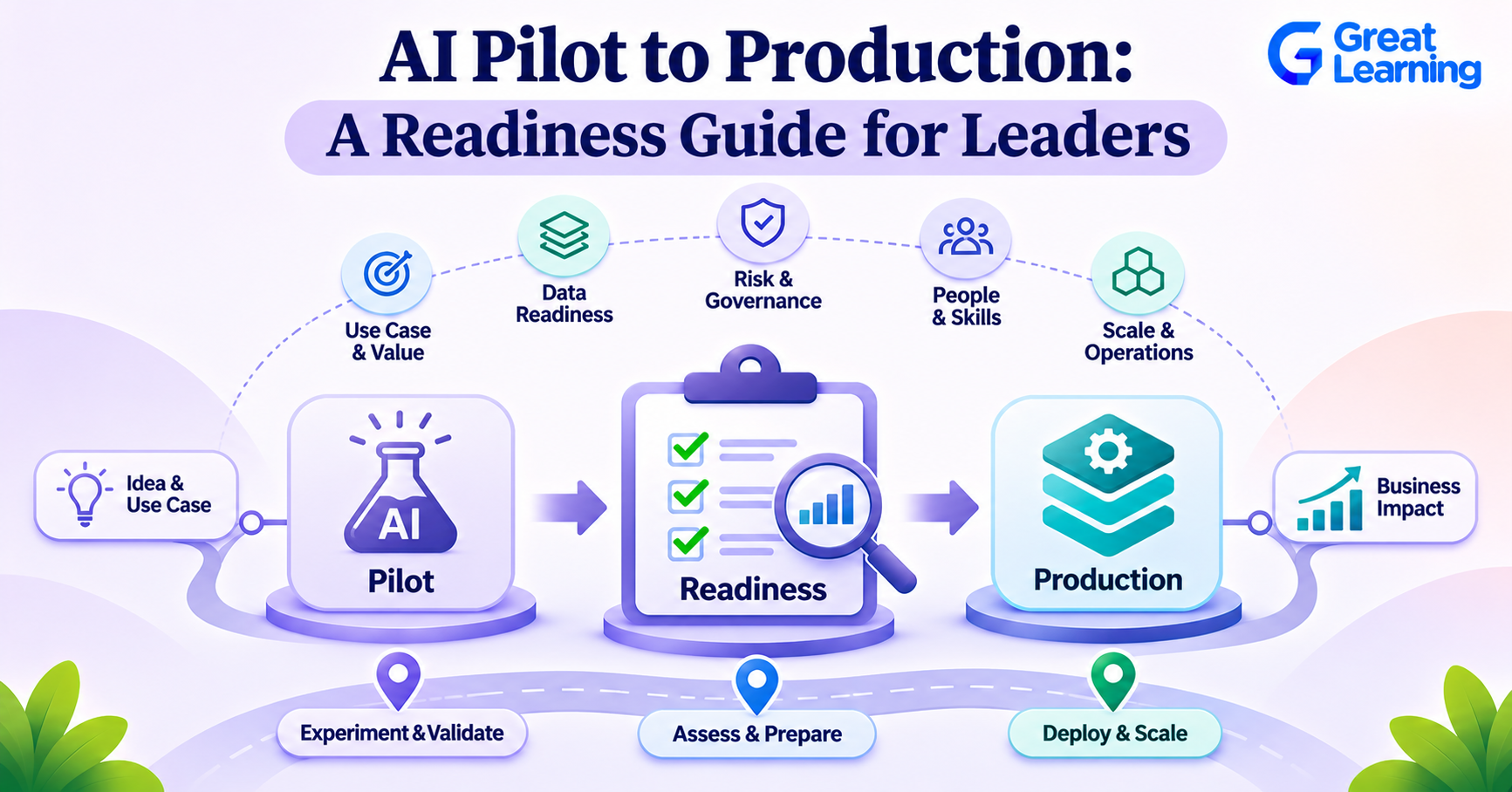
An AI pilot is a limited-scale, real-world test of an artificial intelligence solution within a specific business context. It may perform well in a controlled environment, but production introduces larger workloads, more users, complex workflows, and ongoing costs.
Before scaling, leaders must establish whether the solution can deliver business value and whether the organization can operate it responsibly.
TL;DR
Moving an AI pilot into production requires more than successful testing. Leaders must assess business value, data and technology readiness, governance, team capabilities, workflows, and costs. A phased rollout helps manage risks, monitor performance, and ensure sustainable AI adoption.
Has the AI Pilot Demonstrated Measurable Business Value?
Revisit the problem for which the pilot was designed to solve. Compare its results with baseline performance and the success measures defined at the outset.
For example, a customer support pilot can be assessed through response times and resolution rates, while a document-processing solution can be measured through processing time and error rates.
Leaders should verify that:
- The solution has improved a meaningful business outcome.
- Results are consistent across users and scenarios.
- Employees or customers find it useful.
- Expected benefits justify further investment.
A successful demonstration is not sufficient. Results should show that the solution addresses a business need beyond the limited conditions of the pilot.
Are Your Data, Technology, and Governance Ready for Production?
Production systems must work with real business data, connect with existing applications, and operate under organizational controls. Leaders should confirm three areas:
- Data: Check data quality, completeness, availability, access permissions, and privacy requirements.
- Technology: Assess system integration, infrastructure capacity, scalability, response times, and processes for monitoring performance and managing failures.
- Governance: Define system ownership, human oversight, audit trails, and procedures for addressing bias, security, privacy, and regulatory risks.
For leaders looking to strengthen their understanding of these responsibilities, the Certificate in Leadership with AI from IIT Bombay covers AI strategy, governance, responsible AI, enterprise transformation, and risk, privacy, and compliance through a five-month, faculty-led learning experience.
Certificate in Leadership with AI
Master AI, Generative AI, and Agentic AI to drive business transformation. Learn AI strategy, governance, and enterprise implementation from IIT Bombay faculty.
The organization must be able to manage the system's risks and performance after deployment, not simply demonstrate that it works.
Are Your Teams, Workflows, and Budget Ready to Support AI at Scale?
A pilot may depend on a small specialist team. Production requires clear responsibilities across business, technology, and operational teams. Identify who will maintain the system, monitor its outputs, resolve issues, and support users.
Determine whether employees need training, existing workflows must change, and human review should remain. Without these arrangements, adoption may remain limited even when the technology performs well.
Estimate the total cost of ownership, including infrastructure, model usage, licensing, integration, maintenance, support, monitoring, and training. Compare these costs with expected returns, accounting for increased usage as deployment expands.
How Can Leaders Move an AI Pilot Into Production?
A phased rollout helps organizations test performance in real conditions without committing to an immediate enterprise-wide launch.
- Start with a limited deployment: Introduce the solution to a defined team or workflow and monitor performance against the pilot's success measures.
- Resolve operational gaps: Improve integrations, workflows, monitoring, and user training based on observed issues.
- Expand in stages: Extend access to more teams when performance is reliable and ownership, support, and controls are in place.
At every stage, assign accountable owners and define when deployment should pause or roll back. Review business outcomes and operational performance before approving further expansion.
The McCombs School of Business at the University of Texas at Austin’s Post Graduate Program in AI and Agentic AI for Leaders is designed for leaders developing these capabilities. Its 16-week, no-code curriculum covers AI opportunity evaluation, data readiness, risk, total cost of ownership, build-versus-buy decisions, and POC-to-production readiness. Learners also develop an AI Strategy Blueprint.
Post Graduate Program in Artificial Intelligence for Leaders
Turn insights into action—use AI to make faster decisions, optimize teams, and lead digital transformation.
An AI pilot is ready to scale when its value is demonstrated, its risks and operating requirements are addressed, and the organization can sustain it beyond the initial rollout.