
- Why Did Shubhra Jain Choose to Learn Agentic AI?
- What Do You Learn in an Agentic AI Program?
- How Can Technology Leaders Learn Agentic AI Through Real Business Problems?
- How Can Agentic AI Skills Help With AI Governance?
- What Should Enterprise Leaders Know Before Learning Agentic AI?
- What Can Enterprise Leaders Take From Her Agentic AI Journey?
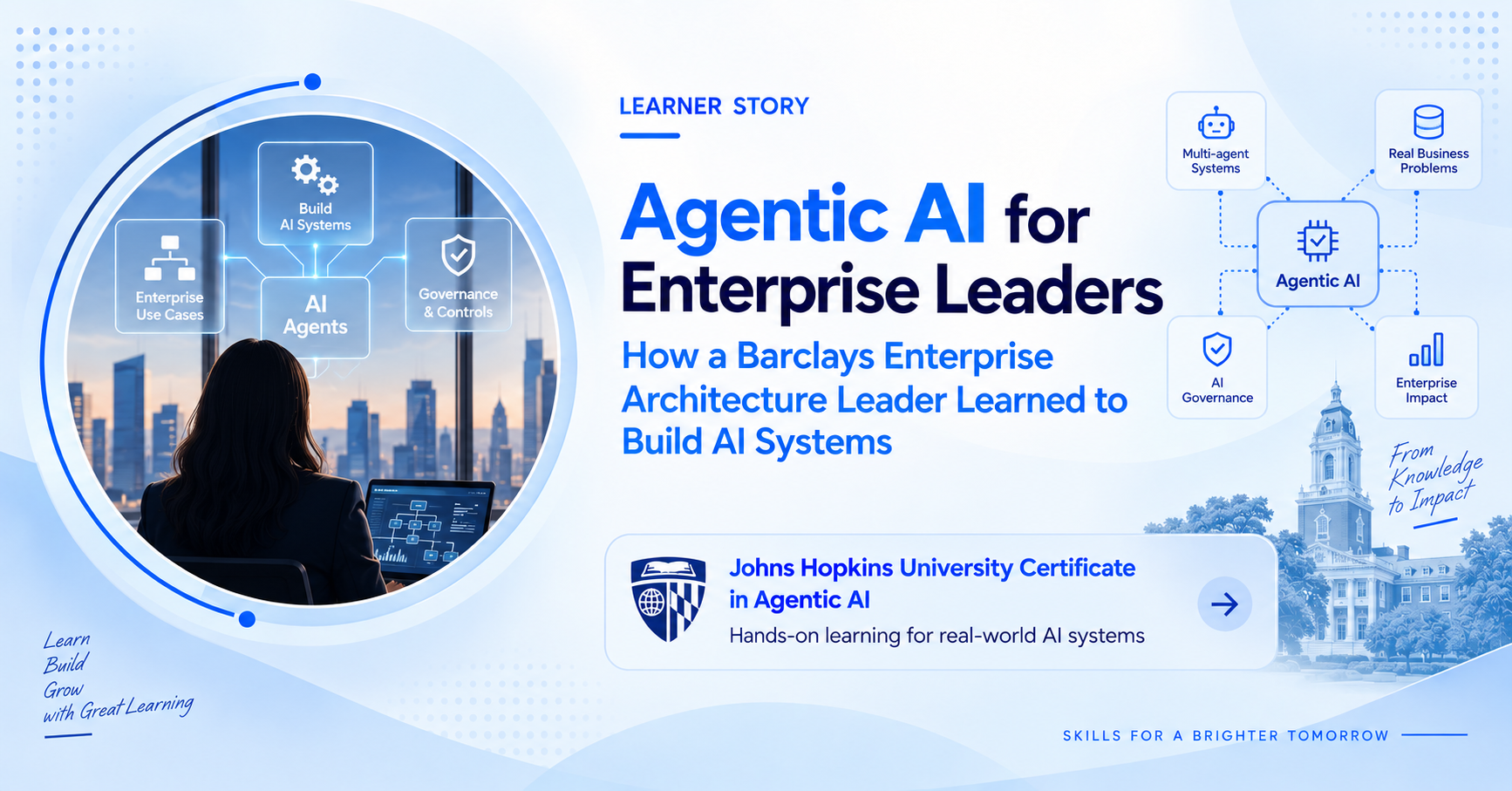
Shubhra Jain, an Enterprise Architecture leader at Barclays with 18 years of experience in technology, enrolled in the Certificate Program in Agentic AI by Johns Hopkins University to understand how AI systems are built, applied, and governed in practice. Her learning journey moved beyond AI concepts toward hands-on experimentation, enterprise use cases, and AI governance.
Certificate Program in Agentic AI
Learn the architecture of intelligent agentic systems. Build agents that perceive, plan, learn, and act using Python-based projects and cutting-edge agentic architectures.
Artificial intelligence is moving from experimentation toward broader enterprise adoption. McKinsey’s 2026 State of AI survey found that 44% of respondents said AI was scaling across their organizations, up from 38% a year earlier. Among organizations with more than $1 billion in annual revenue, 40% reported scaling AI agents in at least one function.
For technology leaders, this shift creates a new challenge: understanding AI is no longer only about knowing what the technology can do. Leaders increasingly need to understand how AI systems are built, where they can be applied, and what controls are needed when they operate within business processes.
Why Did Shubhra Jain Choose to Learn Agentic AI?
Shubhra Jain chose to learn Agentic AI to understand how these systems work in practice and how they can be governed responsibly at enterprise scale. With 18 years of experience spanning software engineering, architecture, and technology strategy, she was already involved in AI governance across Risk, Compliance, Legal, HR, and Sustainability.
For her, understanding Agentic AI from vendor presentations or theoretical material was not enough. She wanted to understand what happens when organizations actually build and deploy these systems.
“You cannot set credible policy for agentic systems from a vendor deck. You need to know where these systems actually break, what autonomy really costs, and which controls are meaningful versus decorative.”
This motivation also reflected a broader shift in her role: she wanted to be able to move from setting policy around AI systems to understanding how those systems are constructed and tested.
What Do You Learn in an Agentic AI Program?
An Agentic AI program can teach professionals how AI systems use autonomy, multiple agents, tools, and human oversight to address complex business problems. For Shubhra, the hands-on component of the Johns Hopkins program was particularly valuable because it allowed her to explore these concepts by building systems.
She worked on an Autonomous Financial Analyst and a multi-agent Mortgage Underwriting System. These projects brought technical concepts into enterprise scenarios where questions around control and accountability become important.
Building the multi-agent underwriting system, for example, required her to think about:
- Where should an AI system have autonomy?
- How can AI decisions be traced?
- How should an AI workflow be audited?
- Where should a human remain involved?
- How should governance controls operate within the system?
Shubhra describes the multi-agent underwriting system as “a governance artifact” because building it helped her understand autonomy boundaries, decision traceability, auditability, and human-in-the-loop design.
Rather than learning these ideas independently, she could see how they interact when an AI system is designed for an actual business process.
How Can Technology Leaders Learn Agentic AI Through Real Business Problems?
Technology leaders can make Agentic AI learning more relevant by applying concepts to problems they already encounter in their organizations. Shubhra adopted this approach during the program by bringing questions from her own professional environment into her assignments.
She explains:
“I stopped treating this as coursework and started bringing real problems from my own estate into the assignments.”
This changed the role of the assignments from academic exercises into opportunities to explore practical technology questions. It also helped her connect what she was learning with the decisions she already faced as an enterprise architecture and AI governance leader.
Her advice to other professionals follows the same principle:
“Don't just learn AI — build with it. Bring your own problems in.”
For experienced technology professionals, this approach can connect existing domain expertise with new AI capabilities rather than treating Agentic AI as a completely separate skill set.
How Can Agentic AI Skills Help With AI Governance?
Hands-on Agentic AI experience can help technology leaders understand AI governance questions more concretely, including autonomy, auditability, traceability, and human oversight. Shubhra's experience with the program changed how she approached these questions in her professional work.
Building the multi-agent systems made governance considerations tangible. Instead of considering controls only as policies or documentation, she began thinking about how controls could operate directly within technology workflows.
This experience contributed to her move toward policy-as-code, where controls can execute within a pipeline rather than remain only as guidance in a document.
For an enterprise architecture leader, this distinction matters because AI governance is closely connected to how systems are designed. Understanding the technology behind agentic systems can therefore inform questions about how much autonomy they should have, how their decisions can be reviewed, and where human intervention is required.
What Should Enterprise Leaders Know Before Learning Agentic AI?
Enterprise leaders should approach Agentic AI as a hands-on capability rather than learning only its concepts and terminology. Shubhra recommends experimenting with AI, challenging what you learn, and applying it to problems from your own professional environment.
Her experience also highlights the value of combining domain knowledge with technical understanding. She notes that professionals already have an advantage through their knowledge of their industry or function; learning Agentic AI can make that expertise more actionable.
For technology leaders, this can mean learning not only what an AI agent can do, but also what is required to build, evaluate, govern, and integrate one into an enterprise environment.
What Can Enterprise Leaders Take From Her Agentic AI Journey?
Shubhra's experience offers a practical perspective on learning Agentic AI as a senior technology professional.
Her approach can be summarized in three ideas:
- Build, don't only study: Hands-on projects can reveal how AI systems behave beyond their theoretical capabilities.
- Connect learning to business problems: Applying concepts to real organizational questions can make technical learning more relevant.
- Understand governance through practice: Building agentic systems can expose practical questions around autonomy, traceability, auditability, and human involvement.
Her experience also reinforces the importance of continuous learning for technology leaders working in a rapidly changing AI landscape. As enterprise AI adoption expands, the ability to understand both what AI can do and how it should be designed and governed is becoming an increasingly important part of technology leadership.
For Shubhra, the value of learning Agentic AI ultimately came from moving from evaluating the technology from the outside to building with it and using that experience to inform how it should be governed inside an enterprise.