
- Why Is AI Deployment Becoming a Priority for Health Care Systems?
- Curriculum and Learning Outcomes
- Which AI Applications and Health Care Use Cases Does the Program Explore?
- What Is the Capstone Project?
- How Is the Program Delivered?
- Who Is the Program Designed For?
- What Certificate Do Participants Earn?
- FAQs
- About Harvard T.H. Chan School of Public Health
- About Great Learning
- The 12-week online program focuses on deploying, scaling, and governing AI solutions across health care systems.
- Participants will learn through recorded lectures, live masterclasses by Harvard Chan faculty, weekly live mentorship sessions, and real-world case studies.
- The curriculum covers predictive AI, Generative AI, medical imaging, Agentic AI, clinical workflow integration, AI scaling, and governance.
- Successful participants will receive a Certificate of Completion from Harvard T.H. Chan School of Public Health.
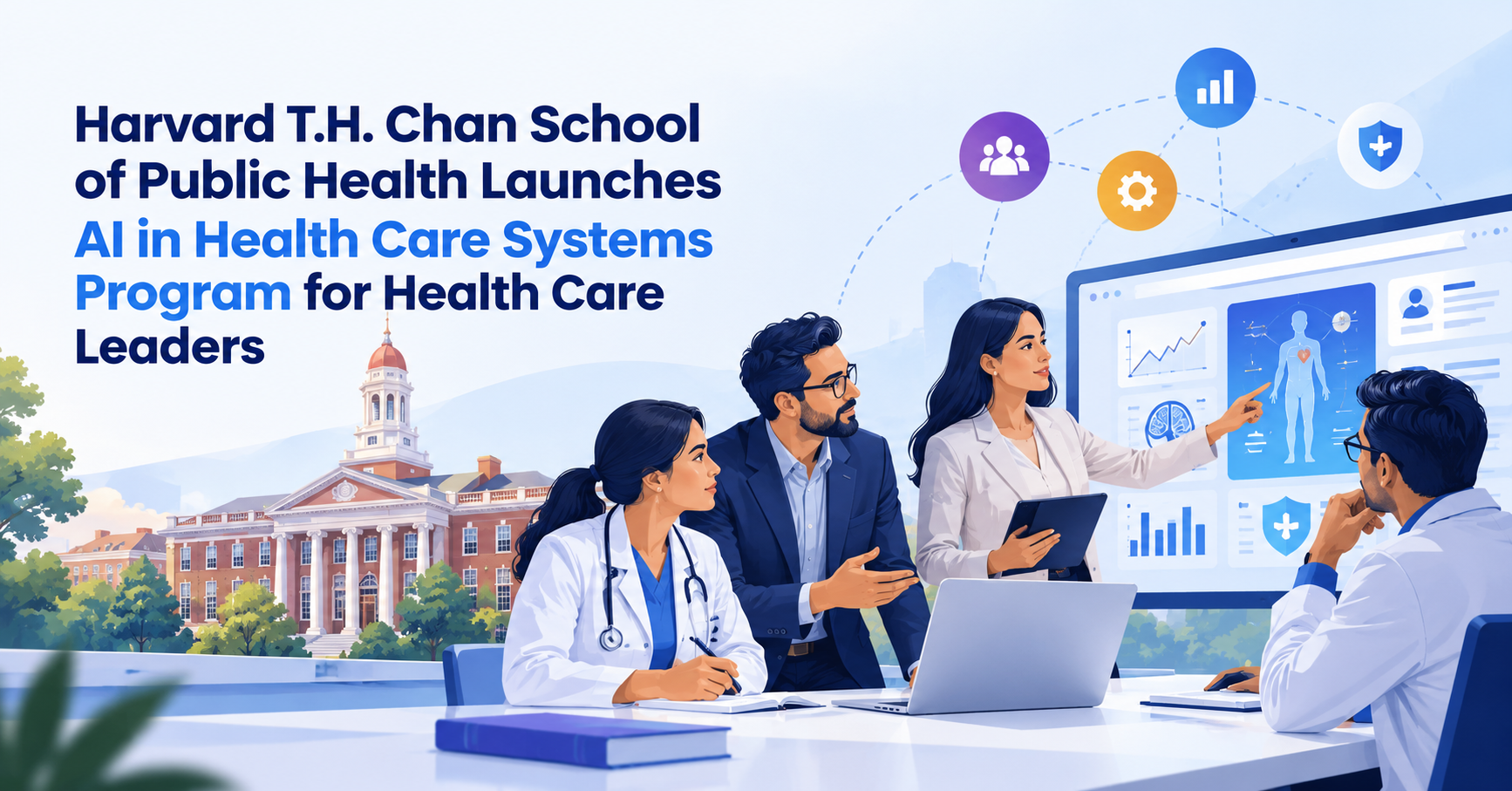
Harvard T.H. Chan School of Public Health has launched AI in Healthcare Systems: Deploying AI Solutions at Scale, a 12-week online program designed for health care leaders and decision-makers involved in adopting and implementing AI across health systems.
The program comes as health care organizations face increasing pressure to improve performance and resource utilization. According to McKinsey & Company, health care industry EBITDA margins are projected to decline to 8.7% by 2027.
Harvard Applied Nutrition and Behavior Change
Learn to design effective nutrition interventions and promote lasting dietary behavior change. This Harvard T.H. Chan School program combines nutritional science with behavioral economics to improve public health.
Why Is AI Deployment Becoming a Priority for Health Care Systems?
Moving AI beyond a pilot requires more than selecting a model or technology. Health care organizations also need to determine where AI can create value, integrate solutions into existing workflows, manage implementation risks, and establish appropriate oversight.
The program addresses these challenges through Harvard's High-Value Health System framework, combining health systems science, AI deployment models, workflow integration, scaling strategies, and governance frameworks focused on safety, equity, and performance.
Curriculum and Learning Outcomes
The curriculum progresses through four stages: framing health-system problems, understanding different AI approaches, engineering AI into real systems, and governing AI throughout its lifecycle. Each week connects a learning outcome with a real-world case.
Participants examine predictive AI for demand forecasting and workforce capacity, Generative AI for clinical documentation and patient communication, deep learning for medical imaging, and Agentic AI for clinical workflows.
Later modules address deployment, health-system analytics, scaling across different contexts, and post-deployment governance.
Which AI Applications and Health Care Use Cases Does the Program Explore?
The curriculum uses use cases from clinical, operational, and population health settings. These include predictive staffing models, AI-supported clinical documentation, medical imaging, multi-agent clinical workflows, unified patient-data platforms, and AI-enabled care delivery.
One case examines Qure.ai's experience scaling an imaging solution across more than 105 countries and different income levels, while another explores clinician-supervised care delivery for underserved populations.
The program also addresses responsible AI, including algorithmic bias, explainability, safety, privacy, security, human oversight, and monitoring.
What Is the Capstone Project?
As part of the capstone, participants identify a real health-system problem and design an end-to-end AI solution. The project covers problem prioritization, solution design, deployment, regulatory considerations, algorithmic bias, safety, scaling, and post-deployment monitoring.
Participants also define measures of value across effectiveness, efficiency, equity, and health outcomes.
How Is the Program Delivered?
The program runs for 12 weeks, with an expected commitment of 6–8 hours per week. Learning combines recorded lectures, live masterclasses led by Harvard Chan faculty, and weekly live mentorship sessions with practitioners and operators who have deployed AI in health care systems.
Faculty and industry practitioners include Rifat Atun, Professor of Global Health Systems at Harvard University and Faculty Director, along with experts associated with Massachusetts General Hospital, Boston Children's Hospital, Qure.ai, Akido Labs, Ferrum Health, Heim Health, and the Coalition for Health AI.
Who Is the Program Designed For?
The program is intended for health care administrators and program managers, health system and clinical leaders, payer leaders, health informatics and analytics leaders, health care consultants, and public, population, and government health professionals involved in AI strategy, implementation, or governance.
What Certificate Do Participants Earn?
Participants who successfully complete the program receive a Certificate of Completion from Harvard T.H. Chan School of Public Health.
FAQs
Does the program cover Agentic AI in health care?
Yes. The curriculum explores Agentic AI and multi-agent systems, including human-in-the-loop orchestration, tool use, coordination across clinical workflows, and the risks associated with deploying agents in health care settings.
Does the program focus on AI governance as well as implementation?
Yes. The curriculum covers AI governance across the lifecycle, including risk and impact assessment, responsible data management, privacy, security, monitoring, validation, and adverse-event reporting.
How does the application process work for the program?
Applications are rolling and remain open until the cohort is full. Applicants complete an online form, eligible applications are reviewed by a Great Learning panel, and selected candidates receive an offer letter.
About Harvard T.H. Chan School of Public Health
Harvard T.H. Chan School of Public Health brings together expertise across public health, health systems, medicine, and related disciplines. The program draws on this research-driven and interdisciplinary environment to examine how AI can be deployed, scaled, and governed across health care systems, with attention to safety, equity, and health outcomes.
About Great Learning
Great Learning is a global ed-tech company focused on professional and higher education. It develops industry-relevant programs in partnership with leading academic institutions, including Harvard T.H. Chan School of Public Health, across technology, data, business, and related domains. Its programs have reached more than 15 million learners across over 170 countries.