- 1. Data Analyst or Data Scientist: Which Role Are You Preparing For?
- 2. Starting Without Technical Experience? Build the Fundamentals First
- 3. Moving Beyond Excel? Focus on SQL and Practical Analytics
- 4. Preparing for a Data Scientist Role? Look Beyond Programming
- 5. Evaluate the Portfolio You’ll Build, Not Only the Certificate
- 6. Check Credentials, Career Support, and Learning Flexibility
- 7. Which Great Learning Data Science Pathway Fits Your Career Goals?
- Choosing a Program Based on Your Next Career Move
Choosing a data science program is not simply about finding a course covering Python, SQL, or machine learning. The bigger question is whether the program prepares you for the responsibilities of your next job.
Consider a marketing professional who wants to become a data analyst and a software engineer planning to transition into data science.
Both need technical training, but their learning requirements differ considerably. The marketing professional might need SQL, statistics, and data visualization, while the software engineer needs deeper preparation in statistical modeling, machine learning, and experimentation.
The right program should close the gap between your existing experience and your target role.
Great Learning offers data science learning pathways across different career stages, including free foundational courses, Pro+ applied learning, and university-partnered data science certificate programs.
Understanding where each pathway fits helps learners make informed decisions without committing to training beyond their immediate needs.
1. Data Analyst or Data Scientist: Which Role Are You Preparing For?
Data analysts and data scientists work with similar information but often solve different business problems.
A data analyst at an e-commerce company might investigate declining sales using SQL, identify underperforming product categories, and create a Power BI dashboard explaining the findings.
A data scientist at the same company might build a predictive model to estimate future demand or identify customers at risk of leaving.
These differences should influence the curriculum you choose.
| Skills | Data Analyst | Data Scientist |
| SQL | Essential | Important |
| Excel | Commonly used | Useful |
| Python | Valuable | Core skill for many roles |
| Statistics | Descriptive and inferential | Advanced statistical modeling |
| Visualization | Power BI, Tableau | Python and analytical visualization |
| Machine learning | Introductory understanding | Core competency |
| Projects | Business analysis and dashboards | Predictive models and end-to-end analysis |
For professionals transitioning from marketing, finance, operations, or reporting, an analytics-focused learning path is often a practical starting point. Those with programming, engineering, or quantitative experience might benefit from deeper data science preparation.
2. Starting Without Technical Experience? Build the Fundamentals First
Someone working in marketing might already understand conversion rates, customer acquisition costs, and campaign performance but have no experience writing Python or SQL.
For someone entering analytics without programming experience, the first objective is to develop an understanding of how business data moves from raw records to useful decisions. SQL, basic statistics, and data visualization provide a practical foundation. Python becomes important as the work expands into automation, statistical analysis, and machine learning.
Great Learning Academy offers a free Data Science with Python course covering Python programming, NumPy, Pandas, Matplotlib, Seaborn, statistics, and introductory regression techniques.
The course lists 17.25 learning hours and includes quizzes and case-study demonstrations. Instruction is provided by Dr. Abhinanda Sarkar, who holds a PhD in Statistics from Stanford University.
Another option, Data Science Essentials, introduces concepts including A/B testing, time series, and SQL versus NoSQL.
These courses are relevant for beginners exploring data science, professionals refreshing foundational concepts, and learners preparing for more advanced study.
The learning content is free, although certificate-related charges should be checked separately.
3. Moving Beyond Excel? Focus on SQL and Practical Analytics
For professionals already preparing business reports, learning advanced algorithms might not be the immediate priority.
Consider a finance analyst who spends several hours each month combining spreadsheets to prepare revenue reports. SQL and improved data analysis skills would help the analyst retrieve information more efficiently, investigate patterns, and reduce repetitive reporting work.
For professionals who already work with spreadsheets, targeted analytics training is often more relevant than a broad data science curriculum.
Great Learning’s Pro+ Master Data Analytics in SQL & Excel course addresses these competencies through SQL queries, joins, subqueries, window functions, Excel functions, PivotTables, dashboards, and exploratory data analysis.
Data Analytics in SQL & Excel Course
Learn how to turn data into actionable insights with our SQL & Excel course. Build skills in data management, analysis, and reporting to boost your career and solve real-world problems.
The published course details include eight hours of learning content, 39 coding exercises, and four projects.
For professionals primarily interested in strengthening spreadsheet-based analysis, Master Data Analytics in Excel offers 5.5 hours of content and two projects.
Learn Excel for powerful data analysis and enhance your skills for better decision-making.
These focused courses provide options for developing specific competencies without immediately committing to a comprehensive data science program.
4. Preparing for a Data Scientist Role? Look Beyond Programming
Knowing Python doesn’t automatically prepare someone to solve data science problems.
Imagine a subscription company wants to predict customer churn. An AI assistant might generate Python code for a classification model, but deciding which variables matter, evaluating predictions, and understanding statistical limitations still require analytical judgment.
Suppose the model reports 98% accuracy. If only 2% of customers cancel their subscriptions, a model predicting every customer will stay achieves the same accuracy while failing to identify any departing customers.
This is why statistical reasoning, model evaluation, and practical experience matter.
For professionals seeking comprehensive preparation, Great Learning offers the Post Graduate Program in Data Science with Generative AI, associated with the McCombs School of Business at The University of Texas at Austin.
Post Graduate Program in Data Science with Generative AI: Applications to Business
Learn how to turn data into strategy in this UT Data Science and Business Analytics Course — now with a focus on Generative AI. Gain practical experience through 7 hands-on projects over a 7-month duration.
The 12-month online program covers Python, data exploration, statistical foundations, machine learning, and generative AI applications.
Published program information describes more than 225 hours of hands-on project work, nine or more case studies, live mentorship sessions, recorded learning content, and career assistance.
This pathway deserves consideration from experienced analysts, professionals with quantitative backgrounds, and working professionals seeking structured preparation for more advanced data science responsibilities.
5. Evaluate the Portfolio You’ll Build, Not Only the Certificate
A certificate demonstrates completion of learning requirements. A portfolio shows how someone approaches analytical problems.
For a data analyst role, useful projects include customer transaction analysis using SQL, sales dashboards, and statistical investigations.
For data scientist roles, predictive modeling, demand forecasting, and classification projects provide opportunities to demonstrate more advanced skills.
Before enrolling, examine whether the program’s projects require learners to:
- Define a business problem and identify relevant data.
- Clean and prepare datasets independently.
- Select appropriate analytical methods.
- Evaluate results and explain limitations.
- Communicate findings and recommendations.
Great Learning’s Pro+ offerings include practical exercises and projects, while the university-partnered data science program describes more extensive project work and case studies.
The distinction between guided exercises and independently completed projects matters when preparing for technical interviews.
6. Check Credentials, Career Support, and Learning Flexibility
For US professionals evaluating data science education, curriculum quality is only one consideration.
University-associated professional certificates and academic degrees represent different credentials. Before enrolling, verify the issuing institution, academic credit status, and the university’s role in curriculum development and instruction.
Career support deserves similar scrutiny. Resume reviews, technical interview preparation, mentorship, and portfolio feedback are useful services, but availability varies across programs.
Great Learning’s UT Austin-associated data science program advertises mentorship and career assistance. Prospective learners should review the specific services and eligibility conditions rather than assuming employment placement is guaranteed.
Working professionals should also compare weekly study requirements, live-session schedules, assignment deadlines, and total program duration.
A suitable program needs to fit both professional objectives and available learning time.
7. Which Great Learning Data Science Pathway Fits Your Career Goals?
Once you have identified your target role and current skill gaps, the next step is selecting an appropriate level of training.
| Current background | Learning objective | Relevant Great Learning pathway |
| Complete beginner | Learn Python and data science fundamentals | Free Data Science with Python |
| Nontechnical professional | Understand introductory analytics concepts | Free Data Science Essentials |
| Excel professional | Develop SQL and analytical skills | Pro+ Master Data Analytics in SQL & Excel |
| Reporting professional | Strengthen Excel-based analysis | Pro+ Master Data Analytics in Excel |
| Experienced analyst | Develop predictive modeling capabilities | University-partnered data science program |
| Software engineer | Strengthen statistics and machine learning | Advanced data science learning pathway |
A beginner exploring data science might find introductory courses sufficient for an initial assessment of their interests. Someone already working with business data might benefit more from targeted SQL and analytics training.
Professionals pursuing advanced predictive modeling should examine comprehensive curricula covering statistics, machine learning, and applied projects.
Choosing a Program Based on Your Next Career Move
A useful data science learning journey begins with understanding the work you want to perform and identifying the skills missing from your current experience.
For beginners, Python, SQL, and introductory statistics provide a foundation. For reporting professionals, practical analytics and visualization skills support progression toward data analyst responsibilities. For experienced technical professionals, statistical modeling, machine learning, and substantial projects become more important.
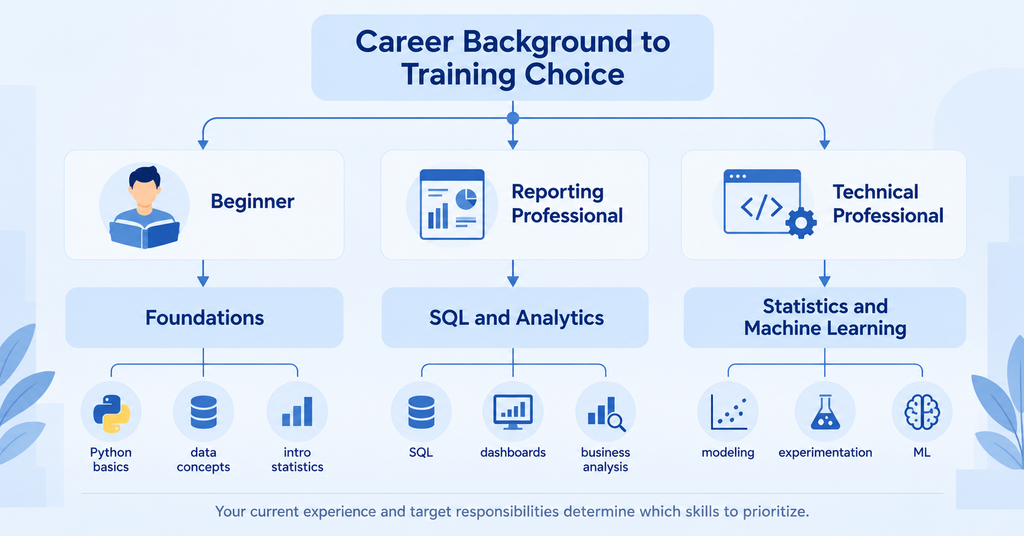
Great Learning brings these learning pathways together through free courses, Pro+ applied programs, and university-partnered data science education, supporting learners at different stages of their professional development.
The strongest program choice is the one whose curriculum, projects, and learning structure match the responsibilities of your intended role.
Frequently Asked Questions
Is a data science certificate enough to become a data analyst?
A certificate demonstrates completed learning, but employers also evaluate SQL proficiency, analytical reasoning, practical projects, communication, and relevant experience.
Should beginners learn SQL or Python first?
SQL is often a sensible starting point for aspiring data analysts. Python becomes increasingly important for data science, automation, and machine learning.
Do data scientists need a master’s degree?
Not every data scientist position requires a master’s degree. Educational expectations vary by employer, industry, and the technical responsibilities involved.
Are free data science courses useful for career changers?
Free courses help establish fundamentals and explore career interests. More advanced positions generally require deeper technical preparation and practical experience.