- What Is the Average Generative AI Engineer Salary in 2026?
- How Does Generative AI Engineer Salary Change With Experience?
- What Does a Generative AI Engineer Do?
- Which Skills Increase Generative AI Engineer Salary?
- How Does Generative AI Engineer Salary Vary by Role?
- How Does Generative AI Engineer Salary Vary by Location and Industry?
- What Does Generative AI Career Growth Look Like in 2026?
- How Can You Increase Your Generative AI Engineer Salary in 2026?
- Learn the Skills Needed for a Generative AI Career
- Final Thoughts
- Frequently Asked Questions Generative AI Engineer Salary
Generative AI has moved from experimentation to production. Organizations are using large language models (LLMs), multimodal models, retrieval-augmented generation (RAG), AI agents, and other generative AI technologies to build products and automate business workflows.
This shift has created demand for professionals who can do more than write prompts or experiment with models.
Generative AI Engineers combine software engineering, machine learning, data, cloud infrastructure, and model integration to build AI systems that work reliably in real-world environments.
This makes Generative AI Engineer Salary an increasingly relevant career consideration. In the United States, current 2026 job-posting data from Prosfy reports a median salary of $146,228 per year, based on 1,140 salaries published in job postings. The reported 80% salary range is approximately $45,557 to $244,973.
However, salary can vary significantly depending on experience, location, technical specialization, company, and compensation structure.
What Is the Average Generative AI Engineer Salary in 2026?
There is no single global salary for a Generative AI Engineer. The role is relatively new, job titles vary between employers, and salary databases use different methodologies.
The table below presents country-level salary figures attributed to Prosfy's 2026 Generative AI Engineer job-posting dataset. These figures represent reported annual base salaries, excluding bonuses and equity.
Because only postings with disclosed salaries contribute to the estimates, the figures should be treated as indicative benchmarks rather than a complete picture of compensation across each market.
| Market | 2026 Salary Benchmark | Compensation Type |
| United States | $146,228/year | Median base salary |
| United Kingdom | £62,591/year | Median base salary |
| Canada | C$117,844/year | Median base salary |
| Australia | A$116,928/year | Median base salary |
| Germany | €68,246/year | Median base salary |
| India | ₹4,53,318/year | Median base salary |
The U.S. figure is based on 1,140 salary-declared postings, while the UK figure is based on 160, Canada on 371, Australia on 35, Germany on 133, and India on 661 salary-declared postings. The data is current through September 2026.
These figures should be treated as market benchmarks rather than guaranteed salary ranges. Differences in experience, job responsibilities, company size, industry, and city can result in substantially different compensation.
For example, within the United States, Prosfy's 2026 data reports a median Generative AI Engineer salary of approximately $201,240 in San Francisco, compared with $146,228 across the country.
In India, its city-level data reports approximately ₹5.79 lakh in Bangalore, although the city-level sample is smaller than the country-level dataset.
What Determines a Generative AI Engineer's Salary?
Several factors influence compensation:
- Years of experience
- Software engineering ability
- LLM and GenAI expertise
- MLOps and cloud knowledge
- AI system design skills
- Industry
- Location
- Company size
- Scope of responsibility
- Base salary, bonuses, and equity
The same title can therefore represent substantially different responsibilities and compensation levels. Consider two professionals with the same job title. One builds an internal chatbot using an existing LLM API.
The other designs a customer-facing AI application involving retrieval, access controls, evaluation, monitoring, and production deployment.
Both work with Generative AI, but their responsibilities, technical risks, and experience requirements differ substantially. Comparing their salaries without examining the job descriptions would give an incomplete picture.
How Does Generative AI Engineer Salary Change With Experience?
Experience changes the type of engineering problems professionals are trusted to solve. Early-career engineers often implement individual features, while senior engineers make decisions about architecture, scalability, security, and operating costs.
These differences help explain why experience matters in salary discussions, although compensation also depends on the employer and local market.
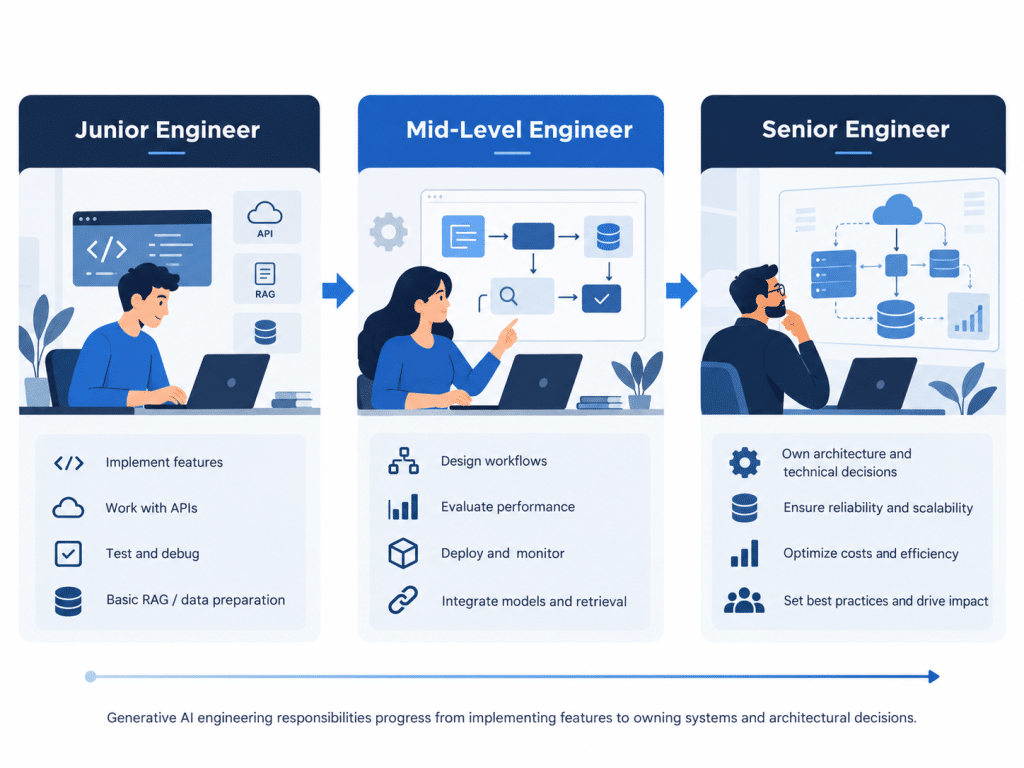
Entry-Level Generative AI Engineer
Entry-level professionals generally work under the guidance of experienced engineers and contribute to specific components of AI applications.
Typical responsibilities include:
- Building Python-based AI applications
- Working with model APIs
- Preparing and processing data
- Creating basic RAG pipelines
- Writing prompts and evaluation scripts
- Integrating AI models into applications
- Testing model outputs
- Working with APIs and databases
A strong foundation in Python, SQL, machine learning, APIs, Git, and basic cloud concepts can help candidates move beyond simple prompt-based experimentation.
At this stage, employers may also evaluate candidates through practical projects. A portfolio containing a working RAG application, AI-powered API, document-processing system, or simple AI agent can demonstrate skills that are difficult to show through theoretical knowledge alone.
Mid-Level Generative AI Engineer
At the mid-level, engineers are more likely to own complete components of an AI system.
Responsibilities may include:
- Designing RAG architectures
- Building evaluation pipelines
- Integrating multiple model providers
- Developing AI agents
- Managing vector databases
- Deploying applications to cloud infrastructure
- Improving inference latency and cost
- Implementing monitoring and observability
The role begins to shift from “using an AI model” to “engineering a reliable AI system.”
Professionals at this stage may also be expected to make decisions about model selection, retrieval strategies, API architecture, security, and application performance.
Senior Generative AI Engineer
Senior engineers typically take ownership of architecture, reliability, scalability, and technical decisions.
They may:
- Design enterprise-scale GenAI platforms
- Select models and infrastructure
- Establish evaluation frameworks
- Optimize inference costs
- Design agentic architectures
- Set engineering standards
- Mentor other engineers
- Work directly with product and business teams
At this level, compensation can also include bonuses or equity depending on the employer and market.
More importantly, the role shifts from implementing individual features to owning technical outcomes across an AI system.
What Does a Generative AI Engineer Do?
A Generative AI Engineer typically sits at the intersection of software engineering, machine learning, and AI application development.
The exact responsibilities vary by company, but common work includes:
| Area | Typical Responsibilities |
| LLM applications | Integrating and orchestrating language models |
| RAG | Connecting models to enterprise or domain-specific data |
| AI agents | Building systems that use tools and execute multi-step tasks |
| Evaluation | Measuring accuracy, relevance, safety, latency, and reliability |
| APIs | Connecting models with existing applications |
| Data | Preparing, transforming, and retrieving information |
| Deployment | Running AI systems in production |
| MLOps/LLMOps | Monitoring, versioning, testing, and maintaining AI systems |
| Optimization | Reducing latency, infrastructure usage, and model costs |
This is why Generative AI Engineering should not be confused with prompt engineering alone. Prompting can be one component of the job, but production GenAI systems require software architecture, data pipelines, evaluation, security, deployment, and monitoring.
Which Skills Increase Generative AI Engineer Salary?
The most valuable skill combinations increasingly span the entire AI application lifecycle.
The World Economic Forum's Future of Jobs Report 2025 identifies AI and big data as the fastest-growing skills through 2030 and lists AI and Machine Learning Specialists among the fastest-growing technology-related job categories.
1. Python and Software Engineering
Python remains one of the most important programming languages for GenAI development.
Engineers should also understand:
- REST APIs
- Git and GitHub
- Testing
- Databases
- Authentication
- Data structures
- System design
- Backend development
The important distinction is that a Generative AI Engineer needs to build software around AI models, not simply interact with them.
2. Large Language Models
Understanding LLMs is central to modern GenAI engineering.
Important concepts include:
- Transformers
- Tokens and context windows
- Embeddings
- Model inference
- Fine-tuning
- Quantization
- Model selection
- Prompt design
The goal is not simply to know how an LLM works but to understand when and how to use one within a larger system.
3. RAG and Vector Databases
RAG has become a common architecture for connecting generative models to external knowledge.
Relevant skills include:
- Document ingestion
- Chunking
- Embeddings
- Vector search
- Retrieval strategies
- Reranking
- Context construction
- RAG evaluation
Popular technologies include vector databases and search systems such as Pinecone, Weaviate, Milvus, Elasticsearch, and pgvector.
A strong RAG implementation requires more than connecting a model to a vector database. Engineers must also consider retrieval quality, context size, latency, data freshness, security, and evaluation.
4. AI Agents
AI agents extend GenAI applications by allowing models to interact with tools, APIs, databases, and external systems.
Engineers working in this area may need knowledge of:
- Tool calling
- Agent orchestration
- Memory
- Planning
- Workflow design
- Multi-agent systems
- Agent evaluation
- Guardrails
This is becoming an important specialization as companies move from standalone chat interfaces toward AI systems capable of executing multi-step workflows.
5. Cloud, MLOps, and LLMOps
Production AI requires infrastructure.
Useful skills include:
- AWS
- Microsoft Azure
- Google Cloud
- Docker
- Kubernetes
- CI/CD
- Model serving
- Monitoring
- Observability
- LLMOps
An engineer who can deploy, monitor, and optimize an AI system can take responsibility for significantly more of the production lifecycle.
6. AI Evaluation and Safety
As GenAI applications become more complex, evaluation becomes essential.
Engineers may need to measure:
- Accuracy
- Relevance
- Hallucination rates
- Latency
- Cost per request
- Retrieval quality
- Tool-use accuracy
- Safety
- Reliability
These capabilities become particularly important for enterprise AI systems where an impressive demo is not enough.
How Does Generative AI Engineer Salary Vary by Role?
Generative AI Engineering overlaps with several related roles.
| Role | Main Focus |
| Generative AI Engineer | Building applications powered by generative models |
| LLM Engineer | Developing and optimizing LLM-based systems |
| AI Engineer | Broader AI application development |
| Machine Learning Engineer | Developing and deploying ML systems |
| MLOps Engineer | AI/ML infrastructure and deployment |
| AI Agent Engineer | Building tool-using and autonomous workflows |
| AI Solutions Architect | Designing enterprise AI architectures |
| AI Research Engineer | Experimentation and advanced model development |
The differences are often more important at the job-description level than at the title level.
For example, one company may advertise an AI Engineer who spends most of their time building RAG applications, while another may use the same title for someone developing computer-vision models.
Therefore, when comparing salaries, candidates should evaluate the actual responsibilities, required skills, seniority, and compensation structure rather than relying only on the title.
How Does Generative AI Engineer Salary Vary by Location and Industry?
Location influences GenAI Engineer compensation through differences in employer demand, local salary structures, industry concentration, and the types of roles being advertised.
National salary benchmarks also hide differences between cities. For professionals evaluating job opportunities, a country-level median is a useful starting point, but city, employer, experience, and compensation structure offer a more relevant basis for comparison.
The United States has a large market for GenAI engineering roles, with a median salary of $146,228 per year in Prosfy's 2026 dataset. Its U.S. data also shows that salaries vary significantly by city, with San Francisco at approximately $201,240 and New York at approximately $193,833.
In Canada, the median Generative AI Engineer salary is approximately C$117,844, based on 371 salary-declared job postings. In the United Kingdom, the median is approximately £62,591, based on 160 postings.
Australia reports a median of approximately A$116,928, although the sample is smaller at 35 salary-declared postings. Germany reports approximately €68,246, based on 133 postings.
India's country-level median is approximately ₹4.53 lakh, based on 661 salary-declared postings. Bangalore's city-level figure is approximately ₹5.79 lakh, illustrating the difference that location within a country can make.
These figures should not be interpreted as direct predictions of what an individual will earn. They are market-level salary benchmarks, and the sample size and job mix differ by country.
Industries Hiring Generative AI Engineers
Generative AI opportunities are appearing across:
- Financial services
- Healthcare
- Software and technology
- Manufacturing
- Retail
- Telecommunications
- Consulting
- Automotive
- Education
- Professional services
Technology remains a major source of demand, but organizations in traditional industries are increasingly integrating GenAI into products, customer service, analytics, internal workflows, and software development.
The expansion beyond technology companies is important because GenAI is increasingly being used to solve domain-specific business problems, rather than operating only as a standalone technology product.
What Does Generative AI Career Growth Look Like in 2026?
A typical technical career path can look like:
Junior AI Engineer → Generative AI Engineer → Senior Generative AI Engineer → Staff/Principal AI Engineer → AI Architect
Professionals can also specialize:
Software Engineer → GenAI Engineer → LLM Engineer → AI Agent Engineer
Or move toward infrastructure:
ML Engineer → GenAI Engineer → AI Platform Engineer → AI Architect
Another option is leadership:
Generative AI Engineer → Senior Engineer → AI Engineering Manager → Head of AI
Career progression is increasingly tied to scope. Early-career engineers may implement individual features, while senior engineers are expected to design systems, make architectural decisions, manage technical risk, and connect AI capabilities to business outcomes.
LinkedIn's 2026 research also reports continued expansion in AI-related job postings. However, broader AI job-posting figures should not be interpreted as direct forecasts for Generative AI Engineer hiring.
How Can You Increase Your Generative AI Engineer Salary in 2026?
If you want to improve your earning potential, focus on increasing the technical scope of the problems you can solve.
1. Strengthen Software Engineering
Learn backend development, APIs, databases, testing, system design, and production coding.
2. Move Beyond Prompt Engineering
Learn how to build complete LLM applications involving retrieval, tools, evaluation, deployment, and monitoring.
3. Build Production Projects
Create projects that demonstrate real engineering ability rather than simple chatbot demonstrations.
For example:
- Enterprise RAG application
- AI customer-support agent
- Document intelligence platform
- Multi-tool AI agent
- LLM evaluation framework
- AI-powered developer tool
4. Learn Cloud and LLMOps
Understand how AI applications are deployed, monitored, scaled, and optimized in production.
5. Develop a Specialization
Choose a direction such as:
- LLM engineering
- AI agents
- RAG
- Multimodal AI
- AI infrastructure
- MLOps
- AI evaluation
6. Understand Cost and Performance
Senior GenAI Engineers need to think about more than model quality. They also need to consider latency, inference cost, scalability, reliability, and user experience.
7. Develop Domain Expertise
Combining AI engineering with knowledge of finance, healthcare, manufacturing, cybersecurity, marketing, or another industry can help you work on more specialized problems.
8. Improve Communication and Problem-Solving
Technical skills remain essential, but the ability to understand requirements, explain trade-offs, and work with product and business teams becomes increasingly important as responsibilities grow.
Learn the Skills Needed for a Generative AI Career
A successful Generative AI Engineer needs skills in software engineering, machine learning, LLMs, data, cloud, and production AI to build and deploy real-world solutions.
Great Learning offers specialized programs to help professionals develop the technical skills needed to advance their AI careers and explore emerging opportunities in the AI industry.
The Artificial Intelligence Engineering course from Johns Hopkins University, in collaboration with Great Learning, is a 22-week online program focused on building, deploying, and scaling AI systems. It covers Generative AI, Agentic AI, MLOps, LLMOps, RAG, and cloud deployment.
JHU Certificate Program in AI and Agentic AI Engineering
Designed for software developers, data and AI professionals seeking hands-on technical expertise in building, deploying, and scaling AI and Agentic AI systems using MLOps, LLMOps, and cloud platforms.
The program features faculty-led masterclasses, live industry mentorship, hands-on projects, and a Certificate of Completion with 16 CEUs from Johns Hopkins University.
The AI Engineering course by IIT Bombay is also a 5-month online program focused on building and deploying scalable AI systems. It covers distributed machine learning, high-performance computing, scalable data pipelines, large model training, cloud infrastructure, and production MLOps.
IIT Bombay Certificate in AI Engineering and MLOps
Build, scale, and manage AI systems with hands-on training in AI engineering, MLOps, distributed computing, and production AI workflows.
Through live faculty-led sessions and hands-on projects, participants gain practical experience in AI engineering and deployment. The program also awards a Certificate of Completion from IIT Bombay.
Both programs help professionals prepare for emerging AI career opportunities. The Generative AI program is suited to roles such as Generative AI Engineer, LLM Application Developer, and AI Agent Developer.
The AI Engineering and MLOps program is ideal for those pursuing roles such as AI Engineer, MLOps Engineer, and AI Infrastructure Engineer, with a focus on scalable AI systems and production deployment.
Ready to advance your AI career? Choose the program that aligns with your goals, strengthen your technical expertise through hands-on learning, and prepare to build and deploy AI solutions for real-world business challenges.
Final Thoughts
Generative AI Engineer Salary in 2026 varies significantly by location, experience, specialization, company, and compensation structure. Current salary data across the United States, United Kingdom, Canada, Australia, Germany, and India shows that there is no single global pay scale for the role.
The role itself is also evolving rapidly. Generative AI Engineers are increasingly expected to build reliable, scalable, and measurable AI systems, rather than simply experiment with individual AI tools.
For professionals entering the field, a strong foundation in software engineering and machine learning can provide the base for developing specialized expertise in LLMs, RAG, AI agents, MLOps, AI evaluation, and production GenAI systems.
As generative AI becomes embedded in more products and business processes, engineers who can connect models with data, software, infrastructure, and real-world business requirements can take on increasingly complex technical responsibilities.
Frequently Asked Questions Generative AI Engineer Salary
1. What is the average Generative AI Engineer Salary in 2026?
Current U.S. job-posting data from Prosfy reports a median salary of $146,228 per year for Generative AI Engineers, based on 1,140 salary-declared postings through September 2026.
2. How much does a Generative AI Engineer earn in India?
Prosfy's 2026 data reports a median salary of approximately ₹4.53 lakh per year in India, based on 661 salary-declared job postings. Its Bangalore city-level data reports approximately ₹5.79 lakh per year.
3. Which country pays Generative AI Engineers the most?
Salary figures vary by methodology, experience, location, and sample size, so country-level salary data should be compared as market benchmarks rather than used to identify a single highest-paying market.
4. What skills are required to become a Generative AI Engineer?
Important skills include Python, machine learning, LLMs, RAG, embeddings, vector databases, AI agents, APIs, cloud computing, MLOps, evaluation, and software engineering.
5. Is Generative AI Engineering different from AI Engineering?
The roles overlap significantly. Generative AI Engineering generally focuses more heavily on technologies such as LLMs, RAG, generative models, multimodal systems, and AI agents, while AI Engineering can cover a broader range of AI applications.
6. Is prompt engineering enough to become a Generative AI Engineer?
Prompt engineering can be useful, but it is generally only one part of the broader skill set. Production GenAI engineering also involves software development, APIs, data, model integration, evaluation, deployment, security, and monitoring.
7. What can a Generative AI Engineer become after gaining experience?
Potential career paths include Senior Generative AI Engineer, Staff AI Engineer, Principal AI Engineer, LLM Engineer, AI Architect, AI Platform Engineer, AI Engineering Manager, or Head of AI.