
The rise of AI-powered coding tools has sparked one of the most debated questions in the tech world today: Are programmers still needed?
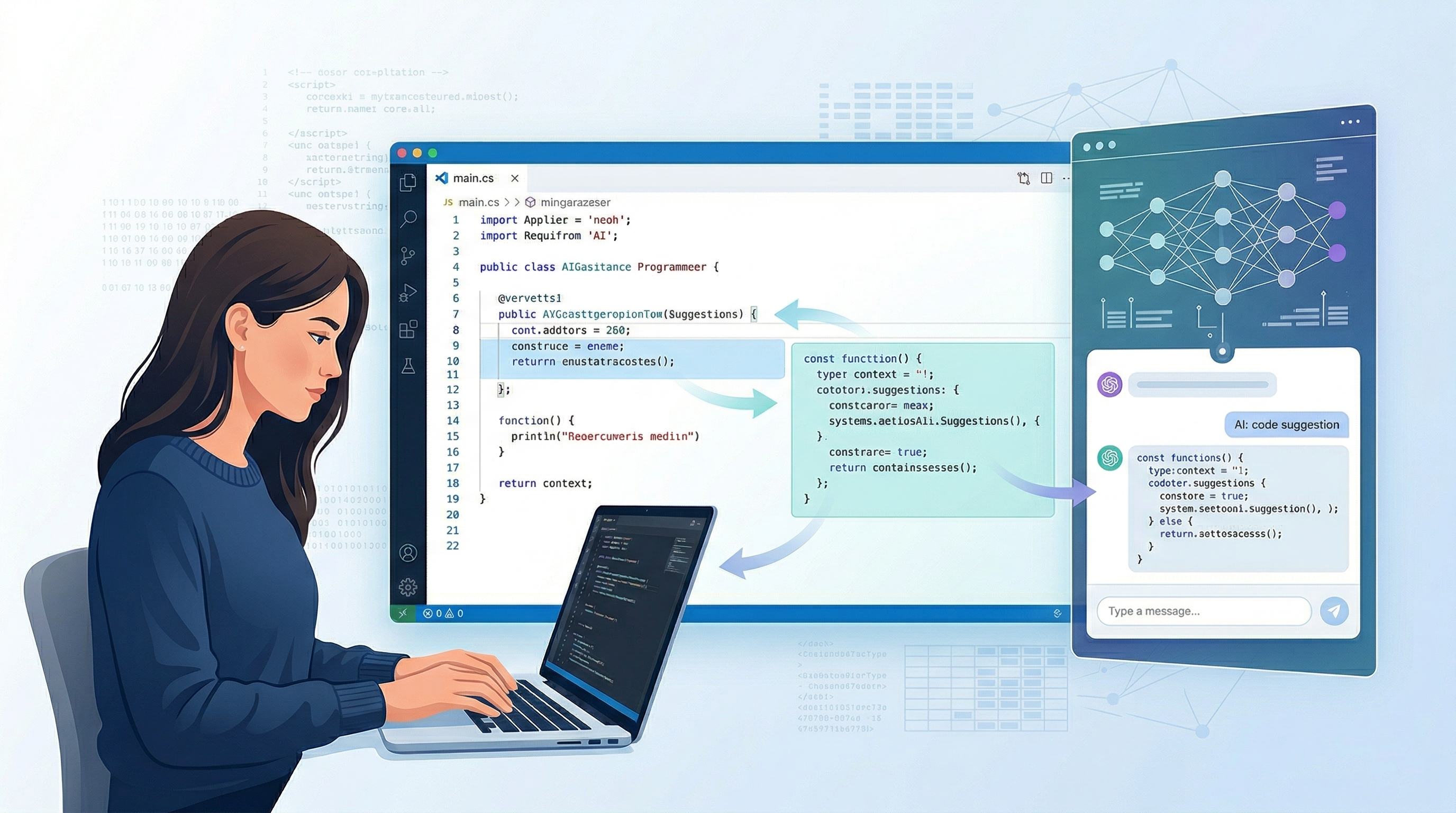
Over the past two years, tools like GitHub Copilot, Amazon Q Developer, and Codex have entered the daily workflow of software developers across the globe. They write code, fix bugs, suggest logic, and generate entire functions from a single line of instruction. For many, this looks like the beginning of the end for traditional programming roles. But is it really?
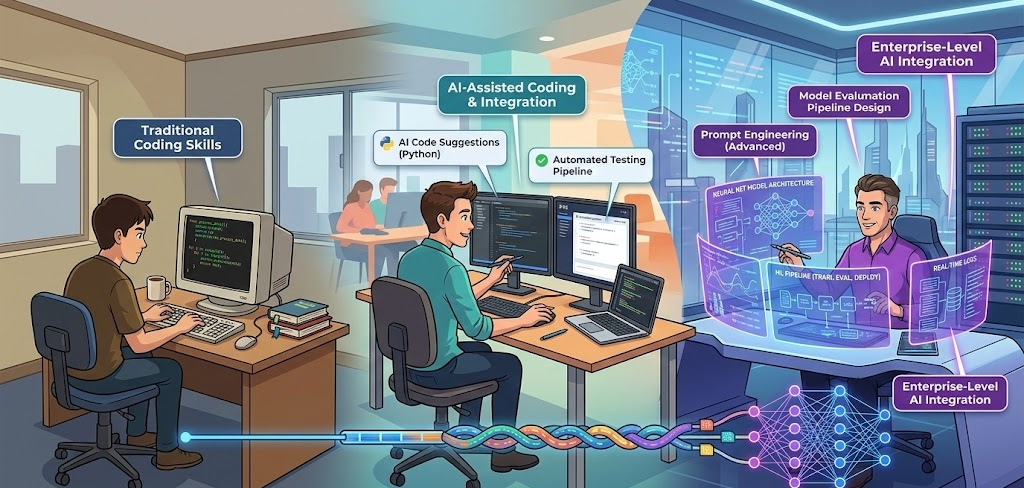
The answer is more complex than it seems. These tools are not replacing programmers; they are reshaping what programmers do.
The shift is from writing every line of code manually to guiding, reviewing, and directing AI-generated output. To understand whether AI will ai replace jobs, we must look closely at how these tools actually function in real work environments:
This article breaks down both sides of the debate, what AI genuinely cannot do, and what skills developers need to stay ahead. If you are just starting to think about this, understanding how early-career professionals are building AI-ready skills is a useful first step.
What Are AI Coding Assistants?
AI coding assistants are built on large language model systems like GPT-4 and Meta's Llama that are trained on enormous amounts of code, documentation, and technical text.
They learn patterns from billions of lines of real-world code and use that knowledge to predict, generate, and explain code in real time. When this technology is embedded into a development environment, it becomes a tool like GitHub Copilot, Tabnine, ChatGPT, or Amazon CodeWhisperer assistants that sit alongside a developer as they work.
Their core features include:
- Intelligent Autocomplete: AI coding assistants go beyond finishing a word; they can predict entire functions or blocks of logic based on the context of what the developer has already written, significantly cutting down the time spent on repetitive syntax tasks.
- Code Generation From Natural Language: Developers can describe what they want in plain English, and the tool generates working code. This is especially useful for boilerplate setup, database queries, API calls, and standard patterns that would otherwise take considerable time.
- Debugging Suggestions: These tools can identify potential errors, suggest fixes, and explain why a particular section of code may not work as expected, helping developers resolve issues faster without extensive manual testing.
- Refactoring Support: AI assistants can suggest cleaner, more efficient ways to write existing code, improving readability, performance, and adherence to best practices without requiring the developer to rewrite everything from scratch.
- Documentation Assistance: Generating docstrings, inline comments, and README content becomes much faster when an AI assistant can automatically describe what a function does based on its logic.
- Reduced Time On Boilerplate Code: Tasks that once took hours to set up project structures, write configuration files, or create standard templates can now be completed in minutes.
- Rapid Prototyping: Teams can go from an idea to a working prototype much faster, enabling quicker testing of concepts and faster feedback loops during early product development.
For professionals wanting to understand the core technology behind these features, the LLM Essentials free course is an excellent resource. This program helps you learn the essentials of Large Language Models. You will understand what LLMs are and their practical applications. It is perfectly designed to help beginners grasp foundational concepts quickly.
Moreover, if you want to see how generative tools like ChatGPT can help with coding and learn essential tips and hacks for developers, watch the video below.
Do These Tools Reduce the Need for Programmers?
The debate around this topic is complex, and we must examine both sides carefully to understand the future. Recent studies show that these smart assistants can boost developer productivity by 26%, which strongly shifts how companies hire. Understanding what to learn vs what's hype as AI becomes mainstream is essential for navigating this divide:
The “Yes” Perspective
- Accelerated Project Timelines
With AI handling boilerplate code, teams can ship features at unprecedented speeds. High productivity means companies can finish massive software projects much faster, potentially requiring fewer total developers to meet their strict deadlines.
- Automation of Repetitive Tasks
Routine coding chores are now effortlessly managed by LLMs. Automated systems easily handle repetitive, basic programming tasks, directly reducing the immediate corporate need to hire large numbers of junior developers whose primary role once revolved around this foundational work.
- Democratization of Basic Software Creation
No-code and AI-driven development platforms are empowering "citizen developers." The barrier to entry is lowering, allowing non-technical workers to build simple software applications without needing a dedicated, highly paid engineering team to bypass traditional development bottlenecks.
- Streamlined Prototyping and MVPs
Taking an idea from concept to a Minimum Viable Product (MVP) is faster than ever. Rapid prototyping allows businesses to test new ideas instantly, cutting down the long development cycles that traditionally required many dedicated human hours, allowing startups to iterate at a fraction of the cost.
- Efficient Code Maintenance and Refactoring
Legacy code updates and routine bug hunting are being streamlined by AI analysis. Code maintenance is becoming highly automated, reducing the need for massive teams to manually update old systems and fix basic syntax errors, which frees up engineers for higher-level strategic work.
The “No” Perspective
- The Code Volume Paradox
AI can generate thousands of lines of code in seconds, but more code means a larger surface area for bugs and technical debt. The productivity paradox shows that generating more code automatically actually creates a massive need for senior developers to review and approve it carefully.
- Mitigation of AI Hallucinations
LLMs lack true comprehension and simply predict the next most likely token. As a result, AI systems frequently hallucinate and confidently provide incorrect code, requiring highly skilled human programmers to identify and fix these hidden, dangerous mistakes before they reach production environments.
- The Necessity of Architectural Vision
Writing code is only a fraction of software engineering; designing the blueprint is the true challenge. Designing complex, scalable system architecture requires deep human context and business understanding that automated assistants simply cannot process or replicate today.
- Heightened Security Risks
Because AI models are trained on vast repositories of public code, they can inadvertently suggest outdated or insecure practices. Security vulnerabilities can be easily introduced by automated suggestions, making expert human security engineers more valuable and necessary than ever before to protect sensitive data.
Rather than replacing developers, AI is evolving their day-to-day responsibilities. As we observe how developers adapt to generative AI, it is clear that managing and prompting these tools, stitching together various AI outputs into a cohesive product, remains a strictly human capability.
What AI Still Cannot Replace and Skills You Should Develop?
To survive and thrive today, technology workers must upgrade their current capabilities and adopt completely new ways of thinking. Understanding how early-career professionals build AI-ready skills is essential for anyone entering the job market now. You must actively upskill with generative AI IT professionals to maintain your competitive career edge:
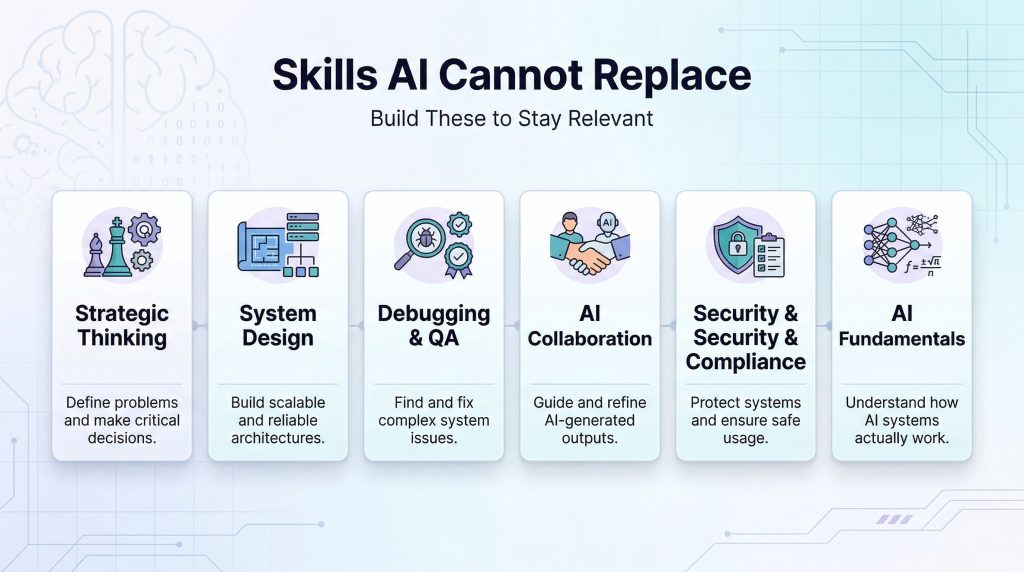
- Strategic Thinking & Problem Solving
AI can generate code, but it cannot understand why a problem needs to be solved or evaluate trade-offs between different solutions. Human judgment remains essential for defining problems and making the right technical decisions.
- System Design & Architecture Expertise
Building scalable and secure systems requires a holistic understanding of how components interact. Developers must design architectures, ensure reliability, and integrate AI-generated code into complex environments.
- Advanced Debugging & Quality Assurance
AI struggles with cross-system failures and hidden bugs. Strong debugging skills, along with expertise in testing and quality assurance, are critical to ensure code reliability and performance.
- AI Collaboration & Prompt Engineering
Effectively working with AI tools is a key skill. Developers must know how to guide, refine, and validate AI-generated outputs to avoid errors and maximize productivity.
- Security, Compliance & Domain Knowledge
Understanding data privacy laws, security risks, and industry-specific requirements (such as healthcare or finance) is crucial. These areas demand human expertise to prevent costly and critical failures.
- Understanding AI Systems Themselves
Knowing how generative AI works helps developers troubleshoot limitations, reduce errors, and use these tools more effectively in real-world scenarios.
To deeply understand the business impact of these technical limitations, watching this detailed video on Generative AI Explained: An Overview of LLMs and Their Business Impact provides excellent professional insights, and after completion, you can test your knowledge of these advanced concepts by taking helpful technical quizzes.
If you want to transform from a traditional developer into a strategic AI role, the Certificate Program in Generative AI & Agents Fundamentals by Johns Hopkins University offers the exact structured pathway you need, completely eliminating the barrier of requiring prior programming experience. Here is exactly how this program specifically equips you for long-term success:
Certificate Program in Generative AI & Agents Fundamentals
A program focused on the foundational concepts of Generative AI and AI agents. It covers topics like NLP, Prompt Engineering, and Responsible AI, with practical applications for various industries.
- Real-World Case Studies: You will gain highly practical experience by applying Generative AI to real business use cases, including crafting compelling marketing copy, automating content optimization, and streamlining complex legal document reviews.
- Comprehensive AI Foundation: You will thoroughly understand key concepts in Natural Language Processing (NLP), Large Language Models (LLMs), and Prompt Engineering to strategically implement AI technologies across various roles and industries.
- Agentic AI Mastery: You will explore the evolution, autonomy, memory, reasoning, and tool use of AI agents, learning how to optimize complex product development workflows and autonomously qualify B2B sales leads. Moreover, you can explore different project ideas after this course to further solidify your new skills.
- Responsible AI Implementation: You will learn essential Responsible AI principles, allowing you to recognize ethical compliance risks and successfully mitigate dangerous biases in critical systems like AI-powered hiring platforms.
Opportunities Created by AI Coding Assistants
While some fear job losses, top artificial intelligence trends and tools are actually creating entirely new career paths and massive business opportunities.
Proper LLM management and deployment have become a massive sub-industry in their own right. Using generative AI for business allows companies to scale their operations faster than ever before, and creates new job roles such as:
| Job Title | What They Do | US Salary (PayScale) |
| AI Engineer | Builds, deploys, and maintains AI-powered systems and applications. Integrates LLMs into products, manages model pipelines, and ensures AI outputs are production-ready and reliable. | Avg. $138,581/yr |
| Machine Learning Engineer | Designs and trains ML models, builds data pipelines, and deploys models into scalable production environments. Works closely with AI coding tools to accelerate model development cycles. | Avg. $125,090/yr; range $89k–$183k |
| AI Prompt Engineer | Designs, tests, and optimises prompts for large language models to improve output quality, reduce hallucinations, and align AI responses with business goals. Critical for teams deploying LLM-powered products. | Avg. $127,939/yr (AI Researcher equivalent) |
| MLOps Engineer | Manages the full lifecycle of machine learning models in production — including deployment, monitoring, retraining, and version control. Ensures AI systems run reliably at scale using tools like Docker, Kubernetes, and CI/CD pipelines. | Avg. $125,090–$163,700/yr (ML Engineer to Senior ML Engineer) |
| AI Integration Engineer | Connects LLM-powered tools and APIs with existing software products and enterprise systems. Builds workflows that allow AI coding assistants and agents to operate within real business environments. | Avg. $100,556/yr (Software Engineer with AI skills) |
| AI Developer / LLM Application Developer | Builds end-to-end applications powered by large language models — including chatbots, code assistants, RAG systems, and AI agents. Combines software engineering skills with a deep understanding of how LLMs behave in production. | Avg. $134,047/yr (ML Engineer with AI skills) |
To successfully transition into these highly lucrative engineering roles, professionals must master building robust applications while actively leveraging modern AI tools, and the program, such as the Professional Certificate in Generative AI and Agents for Software Development by Texas McCombs, provides the exact structured training needed to achieve this. Here is how this program specifically equips you for long-term success:
GenAI for Software Development
Build, test, and deploy AI-powered web applications. Gain hands-on experience with full-stack development using Node.js, Express, MongoDB, and React while integrating Generative AI into real-world applications.
- Comprehensive GenAI Integration: You will learn to empower your coding journey by applying powerful tools like ChatGPT, GitHub Copilot, Claude Code, and LangChain effectively across your entire coding, testing, debugging, and documentation workflow.
- Full-Stack Application Development: You will build modern web applications using the MERN stack (MongoDB, Express.js, React, Node.js) along with scalable REST APIs and secure authentication methods.
- Hands-On Portfolio Creation: You will gain highly practical experience by completing 10 full-stack projects, allowing you to develop a compelling e-portfolio that clearly showcases your technical mastery to future employers.
- LLM and API Mastery: You will learn exactly how to integrate Large Language Models into live applications using well-structured prompts and robust OpenAI API calls.
Conclusion
AI coding assistants are not reducing the need for programmers; they are transforming the role itself. Rather than replacing developers, these tools act as powerful co-pilots that accelerate coding while still requiring human oversight, decision-making, and system-level thinking.
The modern developer must evolve from simply writing code to designing, reviewing, and strategically guiding AI-driven outputs. Ultimately, those who learn to collaborate effectively with AI will stay relevant and lead in this changing era, while those who resist adaptation risk falling behind.