
- The Direct Link Between Training and Automation?
- How do Employees Train the Software Daily?
- Global Job Vulnerability Estimates
- Future Job Trends Through 2030
- Identifying the Most Vulnerable Roles
- The Illusion of Increased Free Time
- How do Productivity Expectations Change?
- The Gap Between Theory and Reality
- Implementation Roadblocks for Corporations
- Emerging Legal Limits and Protections
- The Role of Labor Unions
- Actionable Defensive Strategies for Employees
- Conclusion
Every time you clean up a clunky draft generated by workplace AI, fix a data error in an automated report, or patch a piece of code a chatbot spat out, you aren't just being efficient. You are actively giving away your value. This is the uncomfortable loop of modern desk jobs: knowledge workers are quietly being paid to train the exact LLMs designed to inherit their roles.
By constantly feeding real-time corrections and human expertise back into these systems, employees are inadvertently closing the capability gap between real talent and automated tools. It feels like simple task management today, but this constant model refinement is laying the groundwork for a massive corporate restructuring tomorrow.
However, full human replacement remains incredibly difficult and legally complex. The current dynamic has shifted from automating factory floors to targeting non-routine cognitive tasks performed by knowledge workers. Understanding this transition is critical for professionals who want to protect their careers.
The Direct Link Between Training and Automation?
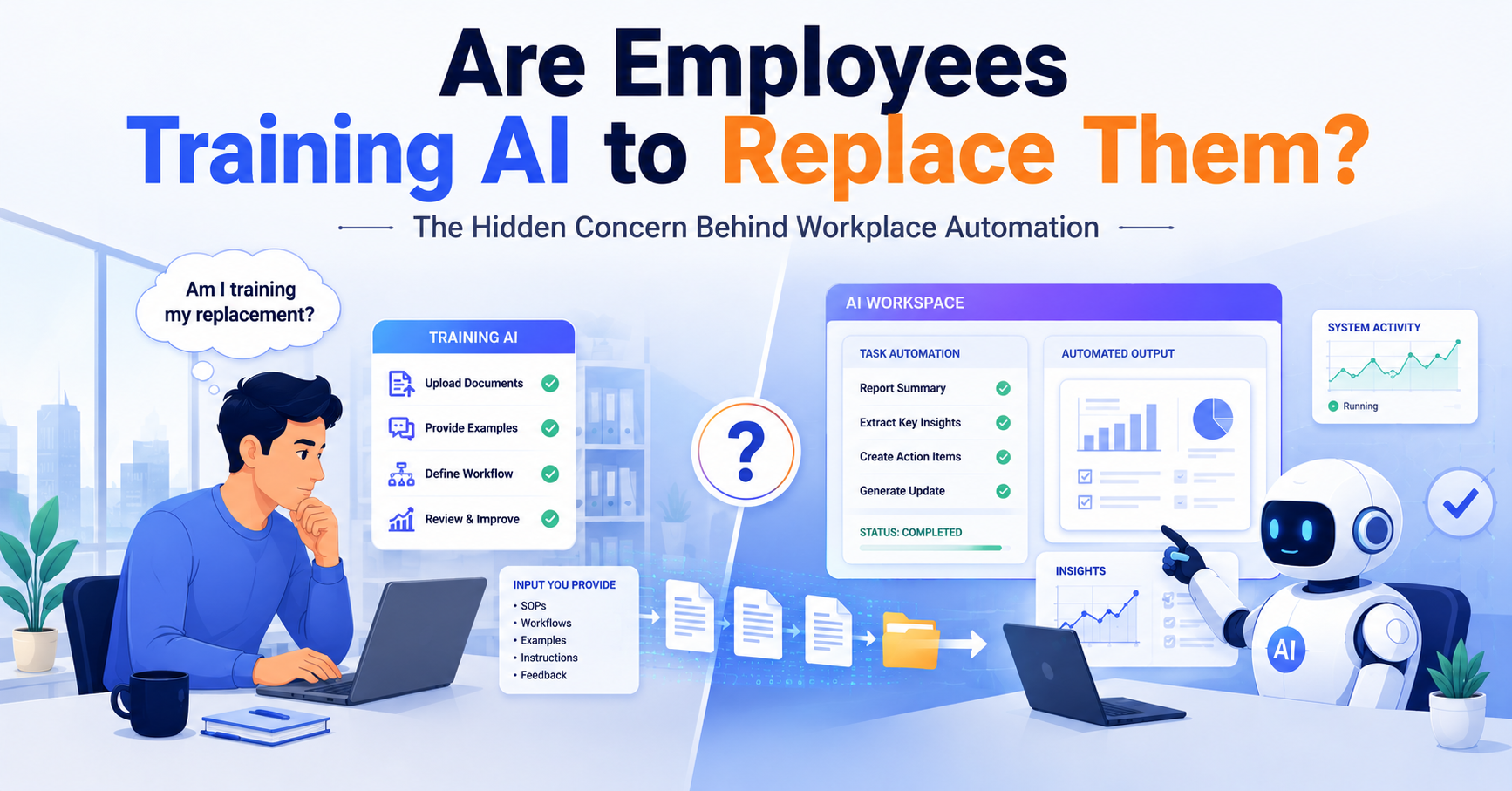
Workers participating in their own obsolescence is now an established reality in the corporate world. Many companies hire employees specifically to train models that will eventually automate their respective industries. Every time a worker corrects an automated mistake, they feed valuable data back into the system.
This continuous feedback loop relies entirely on the institutional knowledge of the current workforce. Over time, the software requires less human intervention to complete the same tasks accurately. The underlying corporate goal is almost always long-term efficiency and margin expansion.
| Key Aspect | Details & Impact |
|---|---|
| The Current Reality | Workers participate in their own obsolescence by correcting automated mistakes, which feeds valuable data back to the models. |
| The Mechanism | A continuous feedback loop extracts institutional knowledge, gradually reducing the need for human intervention. |
| The Corporate Goal | Companies utilize this automation cycle to drive long-term efficiency and expand profit margins. |
| The Required Shift | Professionals must proactively transition from passively training models to actively commanding them. |
| Recommended Action | Master these systems by taking the Generative AI & Prompt Engineering Course to become an indispensable human overseer. |
Instead of simply feeding data into these systems, professionals need to move up the value chain and learn how to design, orchestrate, and supervise AI-driven workflows. The individuals who thrive in this transition won’t be the ones competing with automation. They’ll be the ones building and managing it.
For professionals looking to make that shift, the AI-Native Professional: Workflows & Agents for Productivity program provides a practical path forward. Over six weeks, participants learn how to build AI-powered workflows, create reusable prompt systems, connect leading tools such as ChatGPT, Claude, Gemini, Perplexity, and NotebookLM, and develop no-code AI agents that automate repetitive work.
Rather than becoming part of the automation cycle, professionals learn how to lead it, turning AI into a productivity multiplier while focusing their time on higher-value decision-making, creativity, and problem-solving.
The Generative AI & Prompt Engineering Course offers premium training on mastering prompt engineering and leveraging these exact systems, ensuring you remain the indispensable human overseer rather than an automated asset.
Learn about Generative AI and how to apply it for creating art, generating content, and exploring endless possibilities. Perfect for anyone eager to dive into the future of technology.
How do Employees Train the Software Daily?
Employees often do not realize they are training their future replacements during routine work. The knowledge transfer happens in small, incremental steps throughout the workday.
Common ways employees train these systems include:
- Correcting drafts: Editing an automated email or report teaches the software the preferred corporate tone.
- Adjusting projections: Fixing errors in auto-generated financial models improves the software's future accuracy.
- Rating bot responses: Scoring a customer service bot's helpfulness trains it to handle queries without human agents.
- Evaluating code: Fixing bugs in auto-generated code helps the system learn standard software architecture.
Global Job Vulnerability Estimates
The scale of potential disruption across the global economy is massive. Goldman Sachs Research estimates that roughly 300 million jobs globally are exposed to some level of automation. The firm predicts that algorithms could eventually automate tasks accounting for 25% of all work hours in the US.
If enterprise adoption happens quickly, the economy could see a noticeable spike in the overall unemployment rate. Companies are highly incentivized to facilitate this transition to reduce their ongoing labor costs.
Future Job Trends Through 2030
The World Economic Forum’s Future of Jobs Report 2025 confirms these technological advancements will be highly transformative. The report surveyed over 1,000 global employers representing 14 million workers. It highlights that digital access and automation will drive both the fastest-growing and fastest-declining roles by 2030.
While new specialized roles like machine learning engineers will grow, traditional administrative roles face severe contraction. Workers in data-processing roles are exceptionally vulnerable over the next few years.
Identifying the Most Vulnerable Roles
Understanding which specific functions are at risk helps clarify the threat level for individual workers. Manual labor remains largely insulated, but traditional office roles face significant and immediate exposure.
The prime targets for immediate automation share common characteristics, such as predictable workflows and heavy reliance on text.
Based on recent economic analyses, the following areas are seeing the highest level of task automation:
- Data Entry: Roles centered entirely on moving information between databases are highly exposed.
- Customer Service: Traffic increasingly routes to software, handling common problems without human agents.
- Routine Programming: Basic coding and bug-fixing tasks are easily covered by specialized models.
- Copywriting: Drafting standard corporate communications and basic marketing copy is frequently automated.
- Junior Research: Summarizing long-form documents can be done instantly, impacting entry-level analysts.
The Illusion of Increased Free Time
A popular corporate narrative claims that automating tasks gives employees more free time for strategic thinking. However, historical trends show that technology rarely decreases the overall workload for employees. Instead, companies simply raise their performance expectations and demand higher output.
When software drafts an email in seconds, managers expect dozens of emails rather than just a few. Efficiency gains are almost always absorbed by the employer to increase overall production. These gains are rarely gifted back to the employee as extended leisure time.
How do Productivity Expectations Change?
Employees who successfully train software to do their busy work often find themselves buried under more work. Workers must be careful about how they frame their hyper-efficiency to corporate leadership. Demonstrating too much efficiency can backfire if management decides a three-person department only needs one employee.
To survive, workers must actively demonstrate the value of their newly freed time. They should initiate strategic projects that require a distinctly human touch.
To navigate this change, professionals must first understand the fundamental mechanics of the technology altering their industries. Grasping exactly how large language models and generative AI systems operate demystifies both their capabilities and their limitations.
If you are just starting to explore this shift, watching a comprehensive Generative AI crash course can provide the essential foundation needed to transition from a passive user to an informed overseer of these tools.
The Gap Between Theory and Reality
Despite the alarming statistics, theoretical capability does not immediately translate to mass job loss. A recent Anthropic research paper on labor market impacts highlights that actual coverage remains low. For example, current systems only cover about 33% of all tasks in the broader computer and math category.
Replacing an entire job function is much harder than automating a single, isolated task. Most knowledge work involves complex problem-solving and stakeholder management that software cannot replicate. An algorithm might draft a budget report, but it cannot negotiate the necessary budget cuts with a department head.
While a gap exists between AI’s potential and its implementation, closing that divide is where professionals become indispensable. The UT Austin Professional Certificate in Generative AI and Agents for Software Development bridges this gap through a 14-week, project-based curriculum.
By mastering AI agents with LangChain and full-stack integration, you transition from a passive user to a specialized architect who commands the technology.
GenAI for Software Development
Build, test, and deploy AI-powered web applications. Gain hands-on experience with full-stack development using Node.js, Express, MongoDB, and React while integrating Generative AI into real-world applications.
Implementation Roadblocks for Corporations
Companies face significant implementation hurdles when trying to deploy these automated systems at scale. Integrating new software into legacy corporate infrastructure is expensive and highly prone to error. Security concerns and data privacy laws also create massive roadblocks for enterprise adoption.
This friction naturally slows down the rate at which businesses can safely remove human workers. The transition will likely happen in stages, giving the workforce some time to adjust.
Emerging Legal Limits and Protections
As companies aggressively pursue efficiency, legal systems are beginning to establish firm boundaries to protect workers. In May 2026, a court in Hangzhou, China, issued a ruling setting limits on automation-based firings. The decision signals that courts may refuse to accept software efficiency as a blanket defense for mass layoffs.
This legal pushback disrupts the corporate calculus of immediate human replacement. If businesses cannot easily terminate employees, they are forced to retrain them for new internal roles.
The Role of Labor Unions
Labor unions and worker advocacy groups are demanding specific protections in their modern contracts. These negotiations often mandate strict transparency about what software is being used in the workplace. They also seek guarantees against involuntary layoffs caused directly by new technology.
Collective bargaining will likely become a primary tool for workers to maintain leverage. Staying organized is a highly effective defense against sudden, tech-driven career disruption.
Actionable Defensive Strategies for Employees
Given these realities, employees must adapt their career strategies rather than simply resisting the technology. The most effective approach is to become the indispensable human overseer of these automated systems. By mastering the tools, workers can increase their output and shift their focus to high-value initiatives.
Developing skills that are inherently difficult to automate is another crucial defensive strategy. These irreplaceable human skills include:
- Emotional Intelligence: Managing complex team dynamics and resolving interpersonal conflicts.
- Cross-Functional Leadership: Guiding different departments toward a unified corporate goal.
- Strategic Negotiation: Handling delicate client relationships and vendor contracts.
- Creative Problem Solving: Addressing unprecedented business challenges that lack historical data.
Conclusion
Employees are entirely justified in their concern that training workplace software could eventually lead to automation. The act of correcting algorithms directly transfers human expertise into corporate code. Economic data confirms that non-routine cognitive jobs are increasingly vulnerable to this structural transition.
However, full human replacement is rarely an immediate or straightforward process for businesses. Technological limitations, high integration costs, and emerging legal protections all slow down the pace of job destruction. In the near term, the modern workplace will see roles fundamentally restructured rather than entirely eliminated.
The key to surviving this economic transition is rapid adaptation and strategic skill development. By embracing technology for routine work while aggressively developing irreplaceable soft skills, employees can protect their livelihoods. The software may learn the basic tasks, but the human worker can still control the final outcome.