
- 1. Agent Payments Protocol (AP2): A New Standard for Agent-Led Transactions
- 2. MedGemma and AIIMS Health Models: New Tools for Leprosy and Reproductive Health
- 3. Sec-Gemini v3: An AI Agent for Incident Investigation and Malware Analysis
- 4. Gemini on Google Distributed Cloud in India: In-Country Processing for Regulated Sectors
- 5. ATL Saathi: A Gemini-Powered App for Atal Tinkering Labs Teachers
- 6. CAPSEM and Device Bound Session Credentials: Isolating Agents and Securing Login Tokens
- 7. 10 Years of Google Accelerators in India: 277 Startups and Three New Cohorts
- Final Thoughts
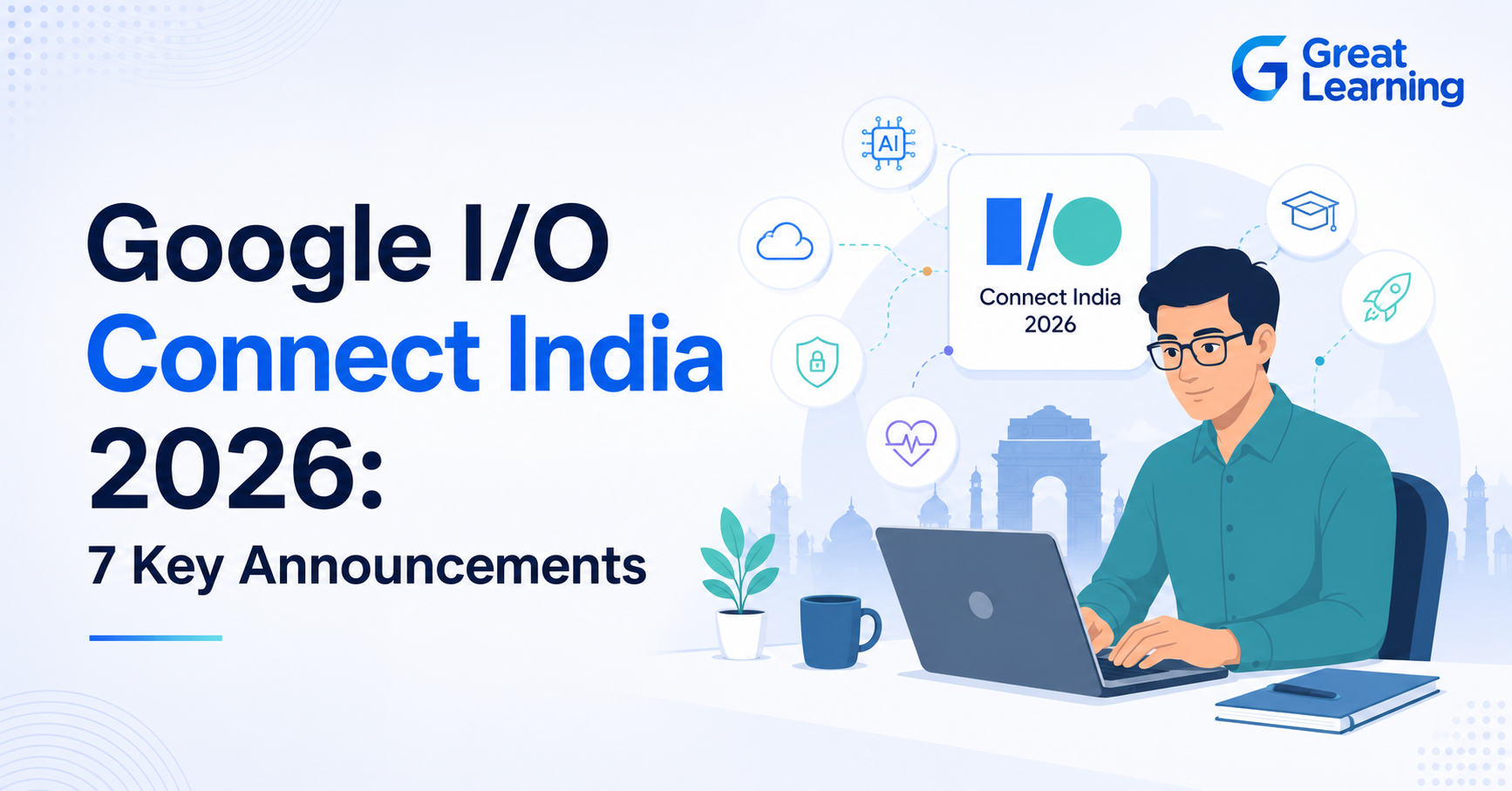
Google I/O Connect India 2026 took place on July 14, bringing together announcements across AI safety, healthcare, cloud infrastructure, education, and the startup ecosystem. The updates came from three official posts published by the Google India Team.
Here's a detailed look at seven of the biggest stories, with facts checked and linked back to the original source.
1. Agent Payments Protocol (AP2): A New Standard for Agent-Led Transactions
As Artificial Intelligence moves from answering questions to taking independent action, someone has to set the rules for how autonomous agents transact.
Google framed this as part of a broader shift: agents can now interpret intent, use tools, and act on their own, which means security must be built into the architecture from day one rather than added at the end.
To address the payments side of this, Google introduced AP2 (Agents-to-Payments), an open standard that works alongside the existing Agent2Agent (A2A) protocol.
AP2 is designed to make authorized, low-value agent-led financial transactions, specifically those under $100, secure and accountable without requiring a human to approve each individual step.
The goal is common, interoperable "traffic rules" for agent commerce, so trust in the ecosystem doesn't depend on any single company's proprietary technology.
Source: Building the safety foundations for India's agentic future
2. MedGemma and AIIMS Health Models: New Tools for Leprosy and Reproductive Health
India's healthcare system got a significant update through Google's multimodal MedGemma open models. AIIMS, India's flagship medical institute, is expanding its use of MedGemma to address more India-specific health challenges.
This builds on AIIMS's existing work: IndusDerma, an AI-powered dermatology screening application, and an OPD triaging system already in use.
Now, AIIMS researchers are developing new models for leprosy and sexual and reproductive health, which will help patients and healthcare professionals identify and manage conditions based on image and text inputs.
AIIMS plans to make these localized clinical health models available to India's broader developer ecosystem rather than keep them in-house.
Separately, the National Health Authority used Gemma 4 alongside Google's open-source Medical Data Toolkit to build Aarogya Setu 2.0, the country's new public health record app, marking a concrete example of open models feeding into India's Digital Public Infrastructure.
Source: Deepening our commitment to India's AI ambition
3. Sec-Gemini v3: An AI Agent for Incident Investigation and Malware Analysis
Google is rolling out Sec-Gemini v3, its specialized cybersecurity agent, to trusted government and enterprise testers, including Flipkart.
Sec-Gemini is built to reason across complex security data and help security operations teams automate tasks such as incident investigation, digital forensics, and malware analysis, all at machine speed rather than the pace of manual review.
Google also pointed to work further upstream in the development process. Project Zero's Big Sleep research showed that an AI agent could uncover exploitable zero-day vulnerabilities in real-world open-source software that human reviewers had missed.
Building on that, Google's CodeMender agent takes it a step further: it automatically writes security fixes and contributes them directly back to open-source projects, rather than just flagging the problem.
Source: Building the safety foundations for India's agentic future
If the idea of AI agents handling real tasks and workflows interests you, Great Learning's AI Native Professional program is a 6-week, no-code program that teaches you to build these agents yourself using tools like ChatGPT, Claude, Gemini, and NotebookLM.
AI-Native Professional: Workflows & Agents for Productivity
Transition from basic AI usage to building automated, multi-step workflows and deploying AI agents. Perfect for functional professionals with no coding background.
4. Gemini on Google Distributed Cloud in India: In-Country Processing for Regulated Sectors
For regulated industries and the public sector, Google addressed a long-standing trade-off between using frontier AI and meeting strict compliance obligations.
Indian enterprises and public sector organizations can now run Gemini on Google Distributed Cloud entirely from within Indian data centers.
Prompts, model weights, and outputs never leave the organization's perimeter, and all supporting services run fully disconnected from the public internet, creating what Google calls a "physical airlock" that mitigates the risk of external data breaches.
Google also expanded access to Gemini 3.5 Flash for Indian enterprises and startups through the Gemini Enterprise Agent Platform and the Gemini Enterprise app, with strict in-country machine-learning processing commitments in place from the start.
Source: Deepening our commitment to India's AI ambition
5. ATL Saathi: A Gemini-Powered App for Atal Tinkering Labs Teachers
To support educators building India's next generation of innovators, Google DeepMind deepened its collaboration with the Atal Innovation Mission through a new tool called ATL Saathi.
It's a desktop web application powered by Gemini that provides teachers with an AI assistant to deliver the Atal Tinkering Labs curriculum and curate hands-on experiments for students.
The rollout starts with 100 schools this year, with Google's stated ambition to eventually reach 10,000 schools that run Atal Tinkering Labs.
This sits alongside Google DeepMind's separate AI Research Foundations curriculum, a free 56-hour program already adopted by IISc Bangalore and now available through NASSCOM's Future Skills Prime platform, which has surpassed 38,000 enrollments globally.
Source: Deepening our commitment to India's AI ambition
6. CAPSEM and Device Bound Session Credentials: Isolating Agents and Securing Login Tokens
As agents take on more autonomous tasks, Google is trying to make sure a single compromised agent can't take down an entire system. It open-sourced CAPSEM (Capabilities Security for Agents), a secure runtime environment built by its Privacy and Security Research team.
CAPSEM places each AI agent inside its own isolated virtual machine, strictly limiting what the agent can access and keeping raw credentials entirely out of its reach. If an agent is compromised or targeted by a malicious prompt, the wider system remains protected.
Google is also pushing Device Bound Session Credentials (DBSC), an open W3C standard that cryptographically ties active login tokens to a user's physical device hardware. This makes stolen session cookies useless to attackers, since a stolen token won't work on a different device.
To ground this work locally, Google is starting new research collaborations with IIT Delhi, focused on early detection of online scams and financial fraud infrastructure, and IIT Madras, examining cryptographic protections in firmware.
As a real-world example of safety paying off commercially, the Indian gaming and social platform STAN used Gemini's safety stack to automate audio moderation, processing over 200,000 hours of local-language audio.
This expanded their moderation coverage 14 times over, cut errors by 90 percent, and lifted user retention by 23 percent.
Source: Building the safety foundations for India's agentic future
7. 10 Years of Google Accelerators in India: 277 Startups and Three New Cohorts
Google marked 10 years of its Accelerator programs in India, which have supported 277 startups so far, with 94 percent of alumni still building and scaling today.
As the ecosystem shifts from mobile-first to AI-first, Google restructured its support into what it calls a full-stack pipeline, covering build, scale, commercial, and human-infrastructure layers.
On the build side, this includes Google for Startups Sprints (single-day architecture sessions with Google Customer Engineers), an Immersion Program with Antler culminating in investment-pitch tracks for the top 30 startups in Bangalore, and a new GFS Hub in Hyderabad with T-Hub, which hosts 100 startups.
For scaling, Google announced three new cohorts: 20 AI-first startups joining the Google for Startups Accelerator: India 2026 cohort, working on autonomous agents and physical AI across sectors like climate, healthcare, and finance; a Google Play Accelerator India cohort launching this month for advanced apps and on-device AI experiences; and a Google DeepMind Accelerator APAC program focused on "AI for the Planet," with applications open until July 26.
On the commercial side, the Google Market Access Program helps AI-first startups bridge the gap from a successful pilot to enterprise adoption by combining global sales expertise with direct access to Google's enterprise network. The current cohort has collectively raised $200 million in venture funding.
Underpinning all of this, Google says it has trained more than 1.5 million Indians over the past three years, and its AI Startup School, run with MeitY Startup Hub and Startup India, has trained over 35,000 founders and aspiring entrepreneurs.
Eight Indian startups, Policybazaar, Emergent, redBus, Adya, VideoSDK, Sivi, Superjoin, and Knit, were spotlighted at the event for using Google's AI stack to solve real-world problems at scale.
Source: A Full-Stack Engine for India's Startups
Final Thoughts
Looking across all seven announcements, a clear pattern emerges: Google is no longer just selling India a product; it's building the full stack the country needs to adopt AI safely and at scale.
Models like MedGemma and Gemma 4 are being open-sourced into public infrastructure. Cloud is being localized for compliance. Startups are getting funding, mentorship, and market access through a single pipeline.
And as agents start acting and transacting on their own, Google is trying to get ahead of the safety problem with CAPSEM, AP2, and Sec-Gemini v3, rather than patching it after the fact.
For India specifically, the emphasis on local languages, in-country data residency, and institutions like AIIMS and IITs signals that Google sees India as a market that needs tailored infrastructure, not a one-size-fits-all rollout of global products. Whether these initiatives deliver at the scale promised- 10,000 schools, 10,000 developers, millions skilled- will be worth tracking over the next year.
Further reading: For the full recap, Google's overview page for the event is here: Google I/O Connect India 2026. A recording of the event is also available on YouTube.