
- The Suspension That Blindsided Millions of Users
- Quick Recap: What Are Fable 5 and Mythos 5?
- What Did the Government Actually Say?
- Anthropic's Position: We Disagree, But We're Complying
- What Actually Gets Exposed by a "Narrow Jailbreak"?
- The Real Stakes: What This Means for AI Governance
- What Does This Mean If You Were Using Fable 5?
- Key Takeaways
- Frequently Asked Questions
The Suspension That Blindsided Millions of Users
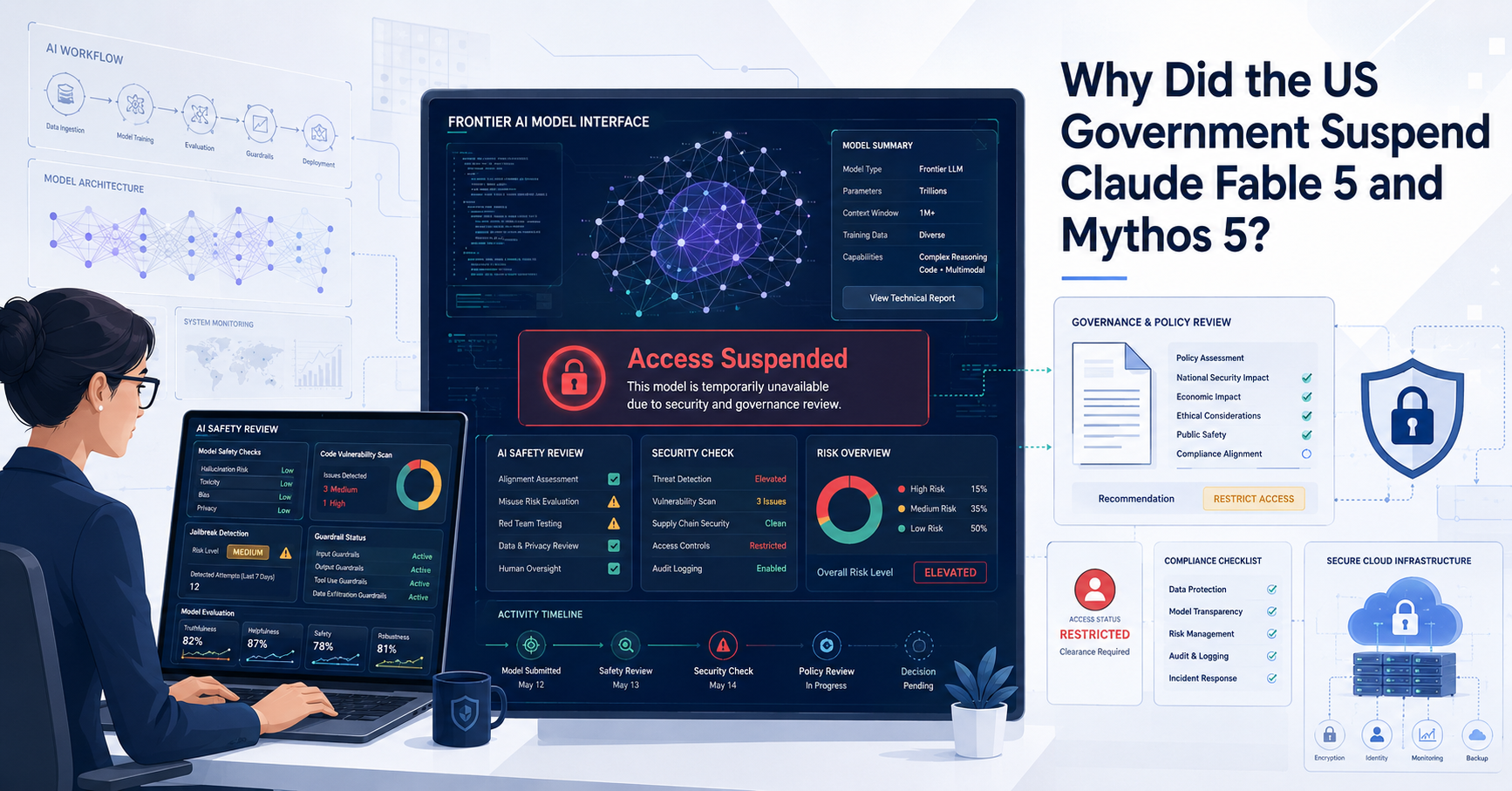
On June 12, 2026, Anthropic disabled access to two of its most advanced AI models: Claude Fable 5 and Claude Mythos 5. It's not because of a technical failure, but because the US government ordered it to.
The directive, issued under national security authorities, cited concerns about a method of bypassing the models' safety guardrails, commonly called a "jailbreak." Access was cut for all users globally, including foreign national Anthropic employees.
For anyone who had been following this story, the timing was jarring. Claude Fable 5 had only launched publicly on June 9, 2026 i.e. three days before it was yanked offline.
This article breaks down exactly what happened, what Anthropic says about it, and what it means for the broader AI industry.
Quick Recap: What Are Fable 5 and Mythos 5?
If you're not familiar with these models, here's the short version.
Claude Mythos is Anthropic's most advanced frontier AI model, built specifically for deep cybersecurity tasks: scanning millions of lines of code, identifying hidden vulnerabilities, and writing patches for flaws that human auditors had missed for years.
It was never meant to be a general-purpose assistant. Anthropic kept it locked inside Project Glasswing, a private program for vetted organizations and companies like AWS, Microsoft, Google, Cisco, and JPMorganChase, who used it strictly for defensive security work.
Claude Fable 5 was the public-facing version of that model, released on June 9, 2026, with carefully layered safety guardrails in place. It was the first time a Mythos-class model was accessible to regular users on paid plans.
If you're interested in understanding how developers use Claude for coding workflows and AI-assisted programming, you can also explore this free Claude Code course to learn the fundamentals of Claude Code and practical development use cases.
Three days later, both models went dark.
To understand where models like Fable 5 fit within today's AI ecosystem, it helps to first understand what Generative AI is and how Large Language Models(LLMs) power advanced reasoning, coding, and conversational systems.
What Did the Government Actually Say?
Anthropic received the directive at 5:21 PM ET on June 12, 2026.
The letter did not explain its national security concern in detail. Anthropic's understanding is that the government believed it had identified a method of bypassing, or jailbreaking, Fable 5, a technique that could theoretically unlock capabilities that the model's safeguards were built to restrict.
Here is where it gets technically significant: Anthropic reviewed a demonstration of the specific jailbreak technique being used. According to the company, it led to a small number of previously known, minor vulnerabilities, and critically, Anthropic states that the capability level demonstrated was already achievable through other publicly available models without any jailbreak.
For readers unfamiliar with how these attacks work, understanding the basics of Prompt Engineering can help explain why certain prompts sometimes succeed in eliciting responses that a model would ordinarily refuse.
In Anthropic's own words, the finding appears to amount to asking the model to read a specific codebase and fix any software flaws. That is something security professionals do every day.
Anthropic's Position: We Disagree, But We're Complying
Anthropic is following the government's legal directive. They have removed access to both models.
They are also saying clearly that they disagree with the reasoning behind it.
Their position rests on several points:
1. The jailbreak was narrow and non-universal
A "non-universal" jailbreak means it works in specific circumstances, not broadly. It cannot unlock the full range of a model's restricted capabilities. Anthropic has publicly stated that no tester has yet found a universal jailbreak for Fable 5, one that broadly bypasses its safeguards across a wide range of use cases.
2. The capabilities exposed are already available elsewhere
According to Anthropic's review, the level of capability demonstrated by the jailbreak was already achievable using other publicly available models, including OpenAI's GPT-5.5, without requiring any bypass at all. If the concern is about those capabilities existing in the world, Anthropic contends that suspending Fable 5 does not address that.
3. Anthropic contends its defense-in-depth strategy was working
Before launching Fable 5, Anthropic spent weeks working with the US government, the UK AI Safety Institute, and multiple private third-party teams to red-team the model's safeguards for thousands of hours. Those tests confirmed that Fable 5's safeguards were substantially stronger than any previously deployed model.
Anthropic's approach was not "make the model jailbreak-proof", because they believe perfect jailbreak resistance is currently impossible for any model provider. Their approach was: make jailbreaks narrow, make them expensive to produce, and combine that with thorough monitoring to detect and shut down successful attacks quickly.
4. The standard being applied would halt the entire industry
This is Anthropic's sharpest argument. If a narrow, non-universal jailbreak is sufficient grounds to recall a commercially deployed model, that standard, if applied consistently,would prevent every frontier model provider from deploying new models. Anthropic believes this sets a precedent that does not serve safety, transparency, or users.
What Actually Gets Exposed by a "Narrow Jailbreak"?
To understand why this matters, it helps to understand what a jailbreak is and what it isn't.
Universal jailbreak: A technique that broadly bypasses a model's safety guardrails, unlocking a wide range of restricted capabilities, dangerous synthesis instructions, detailed exploit writing, and so on. Anthropic says none has been found for Fable 5.
Non-universal (narrow) jailbreak: A technique that works in specific situations, revealing a limited set of outputs the model would otherwise decline. The capability exposed is narrow. The technique may not work even slightly differently on the same model.
Think of it like this: a non-universal jailbreak is closer to finding a side door in one specific room than finding a master key to the building. The government's concern appears to be about a narrow jailbreak that led to the model identifying software flaws in a specific codebase, which is what Fable 5 was explicitly built to do for legitimate security teams.
Understanding why jailbreaks succeed or fail requires more than simply using AI tools; it requires understanding prompts, AI agents, workflows, and how modern AI systems behave in real-world scenarios.
The agentic AI course by Great Learning is a 6-week live online program that helps professionals build practical AI skills through hands-on training in AI workflows, automation, prompt design, and no-code AI agents.
AI-Native Professional: Workflows & Agents for Productivity
Transition from basic AI usage to building automated, multi-step workflows and deploying AI agents. Perfect for functional professionals with no coding background.
The Real Stakes: What This Means for AI Governance
Regardless of who is technically correct here, this event exposes a structural problem in how AI safety decisions get made.
Anthropic has stated publicly that it supports the government's right to block unsafe AI deployments. But they want that process to be: transparent, technically grounded, fair, and governed by statute.
What happened here was none of those things. A directive arrived at 5:21 PM with no specific technical disclosure, no prior engagement on the finding, and no formal statutory process. Notably, Anthropic states it has received only verbal evidence of the potential jailbreak from the government, meaning no written technical documentation has been shared to support the directive. Hundreds of millions of users lost access to a tool overnight based on reasoning that Anthropic, after reviewing the demonstration, believes is not technically supported.
This is not an argument that the government should stay out of AI regulation. It is an argument that AI regulation needs to be built on a framework that actually works: one where companies and governments share technical evidence, where findings are reviewed, where decisions are proportionate to actual risk, and where users are not collateral damage in disputes that happen behind closed doors.
As AI safety and governance become increasingly important, professionals need a deeper understanding of the technologies shaping these discussions. The agentic AI course by Johns Hopkins University covers agentic AI, multi-agent systems, prompt engineering, RAG, and responsible AI through hands-on, project-based learning.
Certificate Program in Agentic AI
Learn the architecture of intelligent agentic systems. Build agents that perceive, plan, learn, and act using Python-based projects and cutting-edge agentic architectures.
What Does This Mean If You Were Using Fable 5?
Access to all other Anthropic models like Claude Opus 4.8, Claude Sonnet 4.6, and Claude Haiku 4.5 is unaffected. Only Fable 5 and Mythos 5 are suspended.
Anthropic has called this a misunderstanding and is working to restore access. No timeline has been confirmed publicly.
If you were relying on Fable 5 for security workflows, code review, or complex reasoning tasks, Opus 4.8 is the current alternative. For context: Fable 5 scored 80.3% on SWE-Bench Pro, compared to Opus 4.8's 69.2%, indicating a capability gap, particularly in complex coding and analytical tasks.
Key Takeaways
- The US government issued an export control directive suspending global access to Claude Fable 5 and Mythos 5, citing national security concerns about a potential jailbreak.
- Anthropic reviewed the jailbreak demonstration and found that it yielded capabilities already available in other public models, with no Mythos-specific uplift.
- Anthropic is complying with the legal directive but publicly disagrees that this finding justifies a full model recall.
- All other Anthropic models remain available and unaffected.
- The incident highlights a critical gap in how governments and AI labs need to build shared frameworks for safety decisions — one that is technically rigorous, transparent, and proportionate.
Frequently Asked Questions
1. Why did the US government suspend Claude Fable 5?
The government cited national security concerns related to a potential jailbreak method that could bypass Fable 5's safety guardrails. The directive did not disclose specific technical details.
2. Is Claude Fable 5 permanently shut down?
No. Anthropic describes this as a misunderstanding and says it is working to restore access. The suspension is framed as temporary compliance with a legal directive.
3. What is a jailbreak in the context of AI models?
A jailbreak is a technique used to bypass an AI model's built-in safety restrictions, getting it to produce outputs it would normally decline. A "non-universal" jailbreak works only in narrow, specific circumstances.
4. Can I still use Claude?
Yes. Claude Opus 4.8, Sonnet 4.6, and Haiku 4.5 are all available. Only Fable 5 and Mythos 5 are suspended.
5. What is Claude Fable 5?
Claude Fable 5 is the public version of Claude Mythos, Anthropic's most capable model, released on June 9, 2026. It was optimized for advanced coding, reasoning, and defensive cybersecurity tasks. You can read the full breakdown of Claude Mythos here.
6. Does this affect Project Glasswing?
Yes. Mythos 5, the model used by Project Glasswing partners for defensive cybersecurity, is also suspended under the directive.
If you're looking to continue building your skills with Claude, you can explore these Free Claude Courses to learn more about Claude and its practical use cases.