
- What is GPT-5.6 Sol?
- What's New in GPT-5.6 Sol?
- New Reasoning Modes
- Better Performance for Developers
- Improvements in Scientific Research
- Stronger Cybersecurity Capabilities
- A Stronger Safety System
- Limited Preview Before Wider Release
- GPT-5.6 Sol vs Terra vs Luna
- Why GPT-5.6 Sol Matters
- Final Thoughts
- Frequently Asked Questions (FAQs)
Artificial intelligence is evolving rapidly, and OpenAI has introduced another major milestone with the GPT-5.6 model family. The new release includes three models—GPT-5.6 Sol, GPT-5.6 Terra, and GPT-5.6 Luna—designed for different user types and workloads.
Among them, GPT-5.6 Sol is OpenAI's most advanced model yet. It offers significant improvements in coding, scientific research, cybersecurity, and long-term AI reasoning while introducing stronger safety measures than previous generations. During its initial rollout, the model is available as a limited preview before a broader public release.
In this article, we'll explain everything you need to know about GPT-5.6 Sol, including its capabilities, new features, safety improvements, and how it compares with earlier OpenAI models.
What is GPT-5.6 Sol?
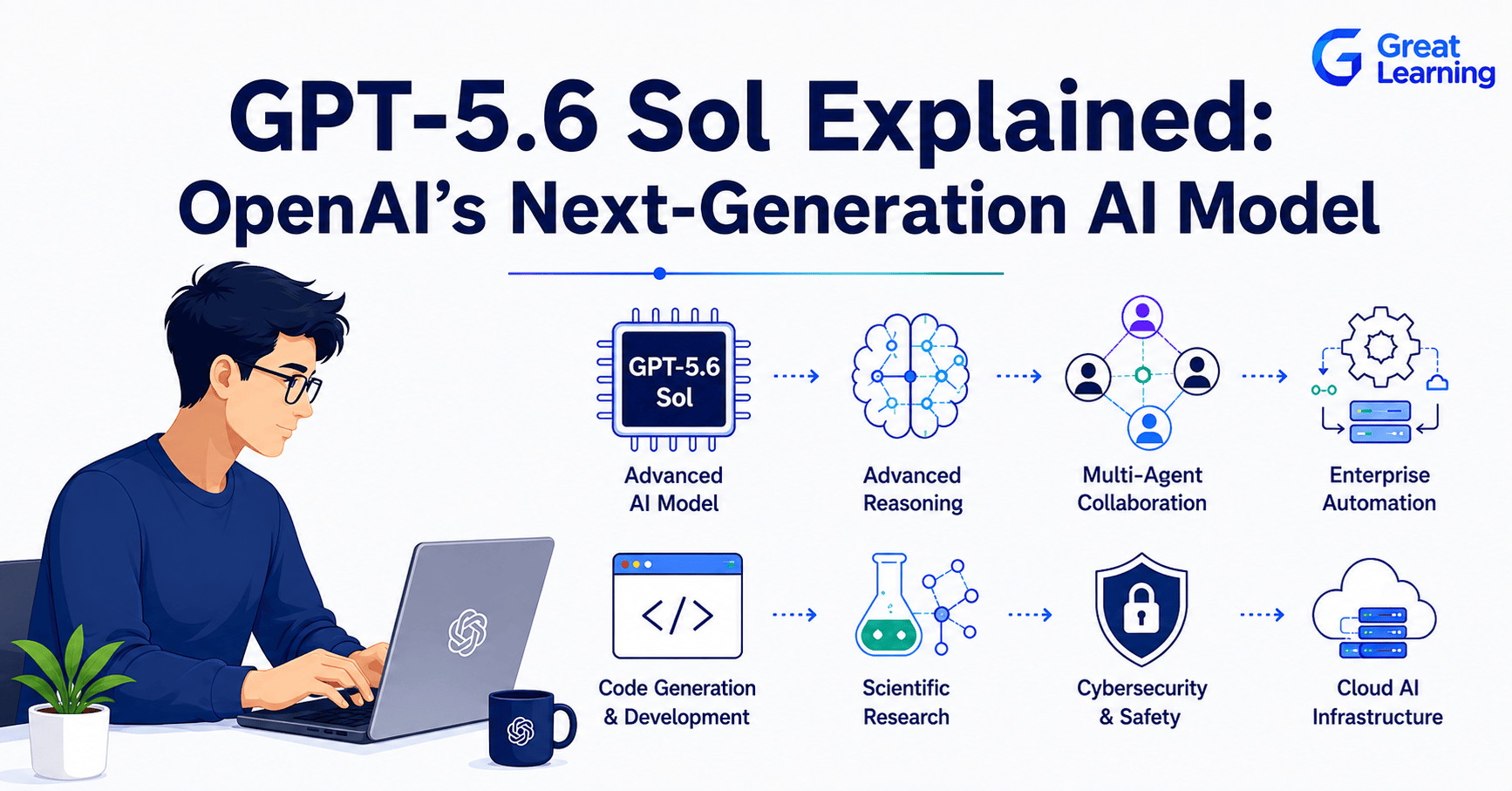
GPT-5.6 Sol is OpenAI's new flagship large language model. It is built for complex reasoning, long-running AI workflows, software engineering, scientific research, and enterprise applications.
Unlike previous releases that focused mainly on conversational improvements, GPT-5.6 Sol is designed to handle multi-step tasks that require planning, tool usage, and sustained reasoning over long periods.
OpenAI has also launched two companion models:
- GPT-5.6 Terra – A balanced model that offers performance comparable to GPT-5.5 while costing about half as much.
- GPT-5.6 Luna – A lightweight model optimized for speed, affordability, and high-volume workloads.
Together, these three models allow developers and businesses to choose the right balance between intelligence, speed, and cost.
What's New in GPT-5.6 Sol?
OpenAI describes GPT-5.6 Sol as its strongest AI model so far. Instead of improving only one capability, the model delivers advances across multiple domains.
Some of the biggest improvements include:
- Better software development and debugging
- More accurate scientific reasoning
- Stronger cybersecurity assistance
- Improved long-term planning
- Better coordination with external tools
- Enhanced agentic workflows
- More efficient reasoning with fewer tokens
These improvements make GPT-5.6 Sol suitable for developers, researchers, security professionals, and enterprises working on complex projects.
New Reasoning Modes
One of the most interesting additions in GPT-5.6 Sol is the introduction of two new reasoning modes.
Max Reasoning
The Max mode allows the model to spend more time thinking before generating a response.
Instead of producing the fastest answer possible, the model performs deeper analysis for tasks involving:
- Complex programming
- Research
- Scientific analysis
- Multi-step planning
- Difficult reasoning problems
This improves accuracy for problems that require careful thinking.
Ultra Mode
OpenAI also introduced Ultra Mode, which goes beyond a single AI agent.
Rather than relying on a single reasoning process, Ultra Mode uses multiple sub-agents working together to solve complex problems faster and more effectively.
This makes GPT-5.6 Sol especially useful for large enterprise workflows and advanced AI automation.
As AI systems become better at reasoning and executing complex tasks, writing effective prompts is becoming an essential skill. To understand this growing field, explore How to Become a Prompt Engineer, which explains the evolving role of prompt engineering in the age of large language models.
As GPT-5.6 Sol continues to push the boundaries of AI-powered software engineering, professionals will need more than just access to advanced models—they'll need the skills to build with them.
Enrolling in a Generative AI course by IIT Bombay can help developers understand large language models, prompt engineering, AI application development, and enterprise GenAI workflows, making it easier to leverage the capabilities of next-generation models in real-world projects.
IIT Bombay Certificate in Generative AI
Learn Generative AI from IIT Bombay. Build hands-on skills in LangChain, LLMOps, and Agentic AI. Apply now!
Better Performance for Developers
Software engineering continues to be one of OpenAI's biggest focus areas.
GPT-5.6 Sol performs particularly well on coding benchmarks that test real-world development tasks rather than simple code generation.
The model can:
- Understand large codebases
- Plan multi-step implementations
- Debug complex software
- Coordinate multiple development tools
- Improve command-line workflows
According to OpenAI, GPT-5.6 Sol achieves state-of-the-art performance on Terminal-Bench 2.1, a benchmark designed to evaluate realistic software engineering tasks requiring planning, iteration, and tool coordination.
GPT-5.6 Sol's coding capabilities also reflect a broader transformation in software development, with AI-powered coding assistants becoming an integral part of developers' workflows. To understand how professionals are adapting to this change, read how developers adapt to Generative AI and stay relevant in an AI-driven workplace.
Improvements in Scientific Research
OpenAI has also expanded GPT-5.6 Sol's capabilities for scientific work.
The model performs better in areas such as:
- Biology
- Genomics
- Data analysis
- Research planning
- Scientific reasoning
On GeneBench v1, OpenAI reports that GPT-5.6 Sol outperforms GPT-5.5 while using fewer output tokens, making it both more capable and more efficient.
These improvements make the model valuable to researchers working with large datasets and complex scientific problems.
Stronger Cybersecurity Capabilities
Cybersecurity is another area where GPT-5.6 Sol shows significant progress.
The model is better at:
- Finding software vulnerabilities
- Reviewing secure code
- Identifying security weaknesses
- Assisting with defensive testing
- Supporting patch development
Importantly, OpenAI emphasizes that the model is designed primarily for defensive cybersecurity rather than offensive use.
While GPT-5.6 Sol is better at identifying vulnerabilities, OpenAI says it does not autonomously carry out complete real-world cyberattacks under its testing conditions.
A Stronger Safety System
As AI models become more capable, safety becomes increasingly important.
OpenAI says GPT-5.6 Sol launches with its most robust safety stack to date.
The company strengthened protections through multiple layers, including:
- Improved model training
- Real-time safety checks
- Monitoring systems
- Abuse detection
- Account-level protections
- Automated red-teaming
- Continuous security testing
Instead of relying on a single safeguard, GPT-5.6 uses multiple defense mechanisms working together to reduce misuse while still supporting legitimate research, education, debugging, and security work.
Limited Preview Before Wider Release
Unlike previous launches, GPT-5.6 is not immediately available to everyone.
OpenAI is beginning with a limited preview for a small group of trusted partners while continuing safety testing and working with U.S. government agencies on processes for deploying frontier AI.
The company has stated that it plans to make GPT-5.6 Sol, Terra, and Luna broadly available in the coming weeks, although it does not expect this limited-access approach to become the long-term standard.
GPT-5.6 Sol vs Terra vs Luna
Although all three models belong to the GPT-5.6 family, they serve different purposes.
| Model | Best For |
| GPT-5.6 Sol | Advanced reasoning, coding, cybersecurity, scientific research, enterprise AI |
| GPT-5.6 Terra | Everyday business tasks with strong performance at lower cost |
| GPT-5.6 Luna | Fast, affordable, high-volume applications like chatbots and automation |
This tiered approach allows businesses to choose a model based on their performance and budget requirements instead of relying on a single AI system.
Why GPT-5.6 Sol Matters
GPT-5.6 Sol represents an important shift in AI development.
Instead of focusing only on generating better text, OpenAI is building models that can:
- Think through long, complex problems
- Coordinate multiple tools
- Assist with real software engineering
- Support scientific discovery
- Strengthen cybersecurity defenses
- Operate safely in enterprise environments
These capabilities move AI closer to becoming a reliable collaborator for professionals rather than simply a chatbot.
As AI continues to evolve from conversational assistants into intelligent systems capable of reasoning, planning, and collaborating with external tools, building practical expertise becomes increasingly important.
Enrolling in a Gen AI course by Johns Hopkins University can help professionals gain hands-on experience with Generative AI and emerging agentic AI concepts, making it easier to apply these technologies confidently in real-world business and development scenarios.
Certificate Program in Applied Generative AI
Master the tools and techniques behind generative AI with expert-led, project-based training from Johns Hopkins University.
Final Thoughts
GPT-5.6 Sol is OpenAI's most capable AI model so far, bringing meaningful improvements in reasoning, software engineering, scientific research, cybersecurity, and agentic workflows.
The introduction of Max and Ultra reasoning modes, along with the Terra and Luna models, gives developers and organizations more flexibility to choose the right balance of performance, speed, and cost.
At the same time, OpenAI has paired these advances with its strongest safety framework yet, aiming to expand AI capabilities while reducing the risk of misuse.
Although GPT-5.6 is currently available only through a limited preview, its broader release is expected to make these next-generation capabilities accessible to more developers, enterprises, and researchers in the near future.
Frequently Asked Questions (FAQs)
1. What is GPT-5.6 Sol?
GPT-5.6 Sol is OpenAI's most advanced AI model. It is designed for complex reasoning, coding, scientific research, cybersecurity, and enterprise AI applications.
2. How is GPT-5.6 Sol different from GPT-5.5?
GPT-5.6 Sol offers better reasoning, improved coding performance, stronger scientific capabilities, enhanced cybersecurity assistance, and more advanced safety measures than GPT-5.5.
3. What are GPT-5.6 Terra and Luna?
GPT-5.6 Terra is a balanced model that provides strong performance at a lower cost, while GPT-5.6 Luna is optimized for speed and high-volume AI tasks. Together with GPT-5.6 Sol, they make up the GPT-5.6 model family.
4. Is GPT-5.6 Sol available to everyone?
No. GPT-5.6 Sol is currently available as a limited preview. OpenAI plans to expand access after completing additional testing and safety evaluations.
5. What can GPT-5.6 Sol be used for?
GPT-5.6 Sol can be used for software development, debugging, scientific research, cybersecurity, AI agents, enterprise automation, and solving complex business problems.