
- What Motivated Djiba Diallo to Learn AI?
- How Did the Non-Coding Curriculum Align With Her Strategic Objectives?
- How Did the Program Structure Facilitate Practical Application?
- What Were the Measurable Outcomes of Applying AI to Everyday Business Problems?
- What Guidance Does Djiba Offer to Professionals Navigating AI Transformation?
- Program Overview
- Frequently Asked Questions (FAQs)
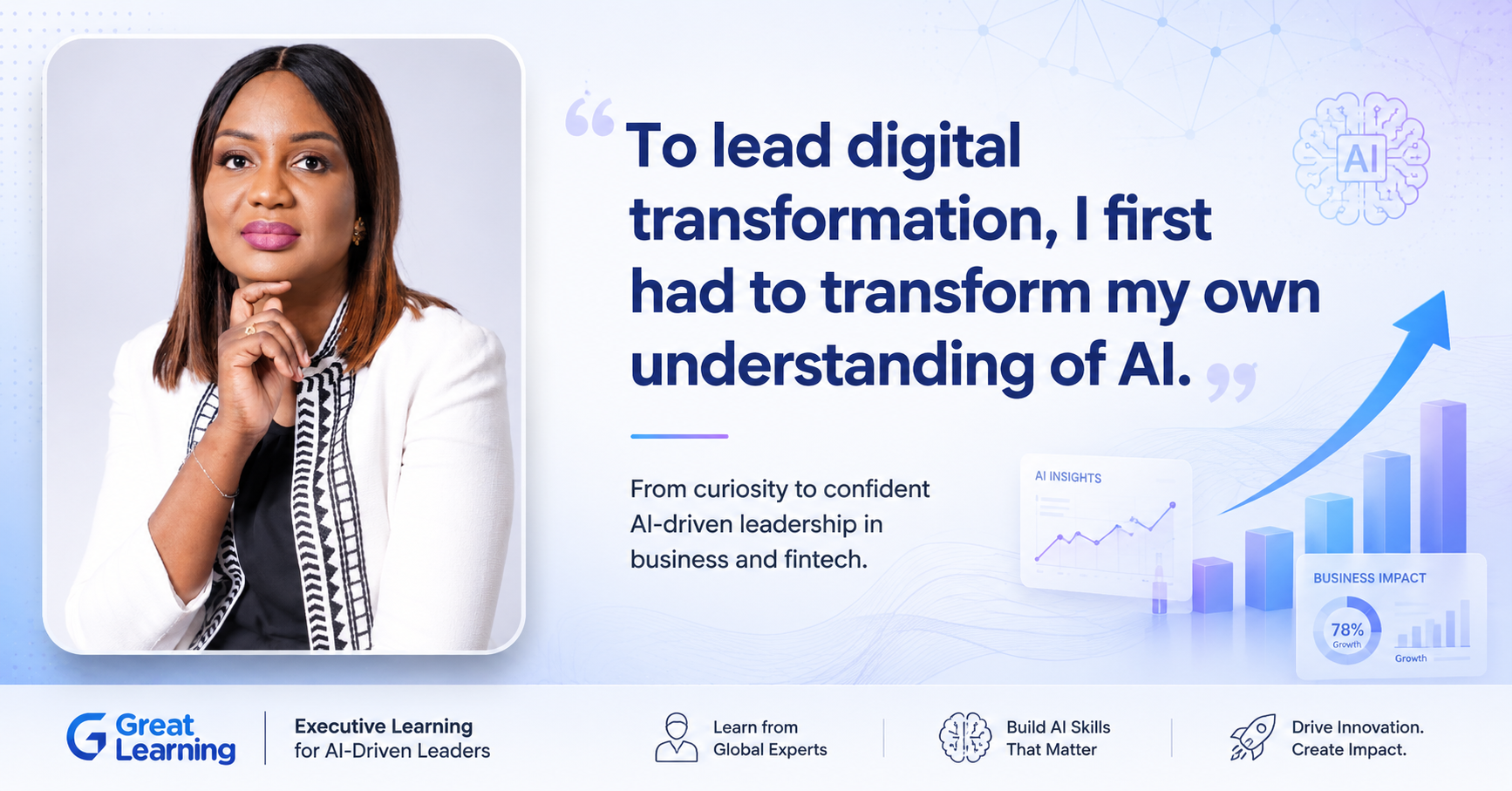
This success story explores how a seasoned technology and FinTech leader leveraged the No Code and Agentic AI program, formerly known as (No Code AI and Machine Learning: Building Data Science Solutions certificate program) from MIT Professional Education, delivered in collaboration with Great Learning, to strengthen her AI and data science capabilities and adapt to the evolving demands of the digital economy.
Currently serving as Director of Business Development – Digital Partnerships at Mastercard, Djiba Diallo previously served as Senior FinTech Advisor at Ecobank, one of Africa’s leading banking groups. Based in Senegal, she holds a master’s degree in computer science from Pierre and Marie Curie University in France.
Over the course of her career, she has worked extensively with developers, startups, and innovation ecosystems across Africa, contributing to technology-led growth and digital transformation initiatives.
With years of experience at the intersection of finance and technology, she recognized AI's growing impact on the future of business and decided to deepen her expertise to stay ahead in an increasingly AI-driven landscape.
This is the story of her proactive journey to get back on track, bridge a critical knowledge gap, and leverage AI to solve real-world business problems.
What Motivated Djiba Diallo to Learn AI?
While she acquired foundational knowledge of artificial intelligence during her university studies, she recognized that the technology has evolved dramatically since then. To remain effective as a leader driving organizational transformation, she identified a strategic need to update her expertise as she stated:
"During my studies at university, I learned a little bit of artificial intelligence, but of course, at that time, it was not as developed as it is today. So now that artificial intelligence is booming, it's crucial for me to get back on track and strengthen my knowledge on artificial intelligence so that I can help businesses better."
How Did the Non-Coding Curriculum Align With Her Strategic Objectives?
To bridge this knowledge gap, Djiba enrolled in the No Code and Agentic AI program, formerly known as (No Code AI and Machine Learning: Building Data Science Solutions certificate program)
Despite her formal background in computer science, she chose a curriculum that prioritized conceptual understanding and business applications over deep, line-by-line programming. Djiba shared:
"The non-code option was ideal for me because it really helped me get a very deep understanding without getting too much into the details of programming. The objective of participating in this program was to remain relevant and effective in my current role, while also playing an active role as a leader in driving transformation.”
Watch Djiba’s full testimonial detailing her learning journey here:
How Did the Program Structure Facilitate Practical Application?
For Djiba, the learning experience successfully balanced academic theory with actionable business strategies. The program structure allowed her to rapidly prototype and test ideas, bringing abstract concepts into focus.
“It was great. The program was very well structured and articulated. It was very well balanced between theoretical learning and practical application. I particularly appreciated the real-world case studies that brought AI concepts to life.”
She also appreciated how accessible the curriculum was for professionals from different backgrounds:
“The content was quite accessible. Even if you don't have a full technology background, it was quite interesting to see that you could still be able to follow up and make sure that you are learning something concrete.”
Djiba further highlighted the robust support ecosystem designed to help learners succeed throughout the program:
“What I really appreciate is the learning support provided. It was really outstanding because it helped us remain on track, make sure that we were making progress, and that we take full advantage of the program and the training.”
What Were the Measurable Outcomes of Applying AI to Everyday Business Problems?
The hands-on projects were a transformative part of the journey. By utilizing specialized no-code platforms, Djiba was able to immediately translate her new skills into strategic business applications, effectively bridging the gap between business and technology.
“One of my favorite parts was obviously the hands-on projects because it enabled us to quickly prototype machine learning models without writing a single line of code.”
She also emphasized how the program strengthened her ability to connect AI capabilities with practical business outcomes.
“I also liked the fact that it helped us bring together business and technology. It was about how we could use technology to solve real business problems that we are facing every day.”
The program equipped her with practical AI deployment capabilities while also sharpening her strategic thinking around innovation and product impact.
“First of all, I am now able to design and deploy ML models without coding at all by using no-code platforms. Something very important is that I learned how to frame business problems in a way that AI can effectively address them.”
“It also helped me develop a strong understanding of model training, evaluation, and deployment of new ML/AI models without programming at all.”
“It also helped me strengthen my strategic thinking on how we could leverage AI into products or services that we make available so that we can effectively drive measurable impact.”
What Guidance Does Djiba Offer to Professionals Navigating AI Transformation?
For professionals considering a similar path to upskill and earn a certificate of completion from MIT Professional Education, Djiba offers this direct advice:
“I would suggest embracing the learning journey with curiosity and never hesitating to ask questions. Make sure to actively engage in projects throughout the training and start thinking about how you can apply the insights and learnings from the program to real-world challenges, whether within your industry or in ways that could benefit the community you live in.”
Program Overview
| Feature | Details |
| Program Name | No Code and Agentic AI |
| Provider | MIT Professional Education |
| Education Collaborator | Great Learning |
| Live Sessions | Benefit from live online sessions from MIT Faculty |
| Mentorship | Mentorship by industry experts |
| CEUs | Earn 10 CEUs |
| Credential | Earn a Certificate of Completion from MIT Professional Education |
Frequently Asked Questions (FAQs)
What is the MIT No Code and Agentic AI program?
The MIT No Code and Agentic AI program is a 14-week online learning experience designed by MIT Professional Education. It empowers professionals to design, build, and deploy multi-agent AI systems and intelligent workflows without writing a single line of code.
Who is the ideal candidate for this program?
The program is specifically designed for professionals without a technical background. It is highly recommended for:
- Business analysts and product managers aiming to create rapid AI prototypes.
- Business leaders and functional heads looking to lead AI initiatives.
- Functional managers in marketing, operations, legal, and finance seeking intelligent workflows.
- Entrepreneurs and consultants aiming to build practical AI solutions.
Do I need programming experience to enroll?
No prior coding knowledge is required to participate in this program. However, learners are expected to have a high-school-level understanding of mathematics and statistics.
What specific tools and platforms will I learn to use?
The curriculum takes a hands-on approach, allowing learners to build a portfolio of industry-relevant projects using various platforms, including:
- KNIME
- n8n
- Google AI Studio
- NotebookLM
What certification will I earn upon completing the program?
Upon successful completion, participants receive a globally recognized Certificate of Completion from MIT Professional Education. Learners also earn 10 Continuing Education Units (CEUs).