
- How Lived Experience Inspired Nicole Speers’ Vision for Cancer Survivorship
- Can Non-Technical Professionals Use Agentic AI to Build Healthcare Apps?
- Why Evidence-Based Science Matters in Healthcare AI Implementation
- The Future of Healthcare: How Non-Technical Healthcare Experts Can Lead with AI
- Frequently Asked Questions (FAQs)
When we picture the architects of modern Healthcare AI, we usually imagine data scientists in tech hubs or software engineers staring at endless lines of code. We rarely picture a patient.
But Nicole Speers’ story flips the script entirely. It proves that the most powerful AI solutions don't start with a line of code; they start with a profound understanding of human suffering, a deep well of empathy, and an unyielding refusal to let a vital idea die.
How Lived Experience Inspired Nicole Speers’ Vision for Cancer Survivorship
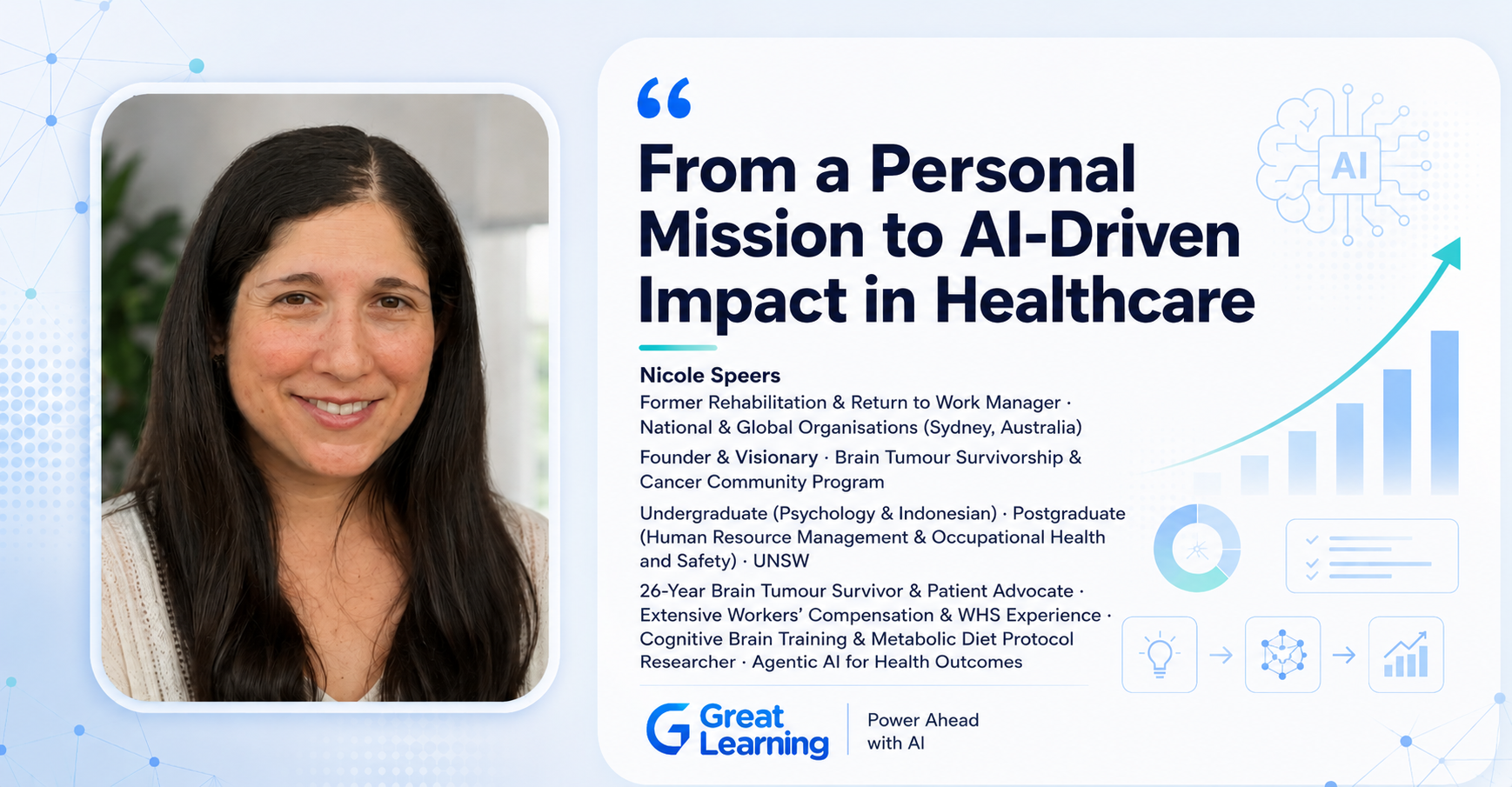
In 2000, just after her 23rd birthday, Nicole Speers' life changed overnight. She was diagnosed with an incurable, rare brain tumor. At the time, she was building a strong academic foundation in Sydney, Australia, studying Psychology and Indonesian as an undergraduate and Human Resource Management/Occupational Health and Safety as a Postgraduate at the University of NSW. She even began a Counseling Diploma and a Certificate in Safety Science—both of which had to be indefinitely deferred so she could undergo several neurosurgeries after her initial diagnosis and several recurrences.
Navigating the terrifying world of cancer treatment is a lonely road, but surviving the tumor was only her first battle. The aftermath, the cognitive fog, the career disruption, the strain on loved ones, and the lack of a structured roadmap for life after treatment revealed a gaping chasm in the Healthcare system.
“I have had an idea since 2000, when I was diagnosed, to set up a survivorship program for young adult brain tumor patients that was not available for me, and still 26 years later, not many individuals who have survived surgery and treatment are offered long-term assistance in their survivorship.
My aim was to include cognitive brain training exercises suited to the structure of the brain that has been damaged by surgery and/or treatment and to combine these cognitive exercises with a strict high-antioxidant and low-inflammatory diet following the metabolic school of thought to reduce inflammation and cancer cell proliferation, causing "autophagy."
Nicole envisioned to build a holistic, continuous ecosystem that provides:
- Cognitive brain training exercises suited to the structure of the brain that has been damaged by surgery and/or treatment.
- A strict high-antioxidant and low-inflammatory diet following the metabolic school of thought to reduce inflammation and cancer cell proliferation, causing "autophagy."
- Remote career transition opportunities.
- Essential support systems for both patients and their careers.
Why Traditional Healthcare Systems Stall Patient-Led Innovation
For over two decades, Nicole tried to get her idea off the ground through traditional channels. She built a successful professional career in Workers’ Compensation Insurance and Work, Health and Safety, having worked as a Rehabilitation Manager and Return to Work Manager for many national and global organizations, as well as working as a successful Recruitment Consultant prior to her own health scare. Yet, despite her domain expertise, the traditional Healthcare and charity sectors moved painfully slow.
- The Premature App Concept: In 2015, she proposed an app idea for this concept, but it seemed too premature at the time, as she was unfortunately unable to find any collaborators.
- The Outdated Literature Gap: As a patient and professional, Nicole noticed a terrifying reality: the information her original diagnosis was based on was severely outdated, and neurosurgeons were still relying on lagging literature and providing the wrong treatment for patients, such as radiotherapy, which is not indicated. She knew current evidence-based research offered safer, more personalized treatment options based on the current evidence-based literature and the individual-specific biomarkers of the patient, but she lacked the technical mechanism to distribute this knowledge.
Faced with a rigid technical divide and systemic inertia, Nicole realized she had to upskill herself to build the resource the community so desperately needed. She enrolled in the Johns Hopkins University (JHU) AI in Healthcare Program to bridge the gap between clinical empathy and cutting-edge technology.
Transform healthcare with AI. Apply now for Johns Hopkins AI in Healthcare Program and enhance patient outcomes with cutting-edge skills
Can Non-Technical Professionals Use Agentic AI to Build Healthcare Apps?
With Johns Hopkins' AI in Healthcare program, Nicole discovered that she didn't need to learn how to code; she needed to learn how to direct. The catalyst for this revelation was her introduction to Agentic AI.
Unlike Generative AI, which simply responds to prompts like a search engine, Agentic AI operates with goal-oriented autonomy. It can execute multi-step workflows, manage complex tasks, and act as an intelligent digital workforce. Using accessible AI platforms like Gemini, Open Evidence, and Claude, Nicole realized she could act as the ultimate architect of her solution. A key takeaway was learning the difference between standard AI and Agentic AI, and how best to move forward with her idea.
Instead of writing code, she could use her 20+ years of professional rehabilitation experience to design the clinical logic of her platform:
- Automated Care Pathways: Mapping out empathetic, step-by-step cognitive training routines suited specifically to the structure of the brain that has been damaged by surgery and/or treatment.
- Dynamic Resource Distribution: Feeding the AI current, evidence-based medical literature and individual-specific biomarkers to bypass outdated practices like non-indicated radiotherapy.
- Scalable Support Ecosystems: Designing workflows that don't just stop at brain tumor patients but can be seamlessly translated to help other cancer patients, the chronically ill, and dementia patients.
Why Evidence-Based Science Matters in Healthcare AI Implementation
Because Nicole’s heart is firmly rooted in the patient experience, she didn't want to build a flashy, superficial app; she wanted a solution grounded in clinical safety.
In the JHU program, she found a shared philosophy in the teachings of Professor Ian McCulloh and Dan Byrne. She was deeply inspired by Professor McCulloh's patient's perspective of applying AI for “better health outcomes,” alongside Dan Byrne's fierce emphasis on backing up patient protocols with “rigorous science” to also improve patient outcomes with “randomized controlled pragmatic clinical trials to ensure validity and reliability of patient protocols."
For Nicole, Agentic AI isn't an execution shortcut; it is a clinical amplifier. It ensures that the digital tool she builds delivers safe, measurable, and scientifically validated improvements to a patient's daily quality of life.
The Future of Healthcare: How Non-Technical Healthcare Experts Can Lead with AI
Nicole Speers’ journey sends a powerful message to every nurse, doctor, therapist, and patient advocate who has ever thought, "I have an idea to fix Healthcare, but I am not a tech person."
Your domain expertise—your empathy, your lived experience, and your understanding of the patient's tears and institutional roadblocks—is the most valuable asset in Healthcare innovation. Technology can be taught, and Agentic AI can bridge the development gap. But technology without empathy is just empty code.
"This program should enable me to realize my idea, firstly for the brain tumor community and from there for other cancer patients, the chronically ill, and also dementia patients."
Nicole’s story proves that tomorrow's Healthcare breakthroughs won't just come from data centers. They will come from survivors who refuse to forget what it felt like to be left in the dark, utilizing Agentic AI as a lantern to guide others home.
Frequently Asked Questions (FAQs)
1. Why is AI education important for Healthcare innovators?
As artificial intelligence becomes increasingly integrated into Healthcare, understanding its capabilities and limitations is essential. Educational programs like the Johns Hopkins AI in Healthcare Program help Healthcare leaders develop the knowledge needed to implement AI responsibly, improve patient outcomes, support evidence-based care, and identify opportunities for innovation within complex Healthcare systems.
2. How can Agentic AI improve cancer survivorship care?
Agentic AI can provide personalized cognitive rehabilitation programs, deliver evidence-based educational resources, track patient progress, support career transitions, and connect survivors with long-term support services beyond active treatment.
3. Can non-technical Healthcare professionals build AI-powered Healthcare solutions?
Yes. Modern AI tools and no-code platforms allow Healthcare professionals, patients, and subject matter experts to design workflows, create knowledge systems, and develop Healthcare applications without traditional software engineering expertise.
4. What is patient-led Healthcare innovation?
Patient-led Healthcare innovation occurs when individuals with lived experience identify unmet needs and develop solutions to improve Healthcare delivery, patient outcomes, and quality of life for others facing similar challenges.
5. How can AI help personalize cancer treatment and survivorship planning?
AI can analyze clinical research, patient biomarkers, treatment histories, and health data to help deliver personalized recommendations, educational resources, and survivorship pathways tailored to individual patient needs.
6. What can Healthcare professionals learn from Nicole Speers' journey?
Nicole's story demonstrates that lived experience, professional expertise, and modern AI tools can combine to create meaningful Healthcare innovation, even without a traditional technology background.
7. How can brain tumor survivors use AI to improve their quality of life?
Brain tumor survivors can use AI-powered tools to access personalized cognitive rehabilitation programs, evidence-based educational resources, symptom tracking, nutrition guidance, career transition support, and long-term survivorship planning. AI can help provide ongoing assistance that extends beyond traditional treatment and follow-up care.