


In the current corporate environment, the ability to navigate technological shifts has moved from a specialized functional requirement to a core leadership mandate.
While many executives acknowledge the utility of automation and data processing, a significant gap exists between those who merely use these tools and those who command authority through them.
In this blog, we examine the strategic transition from basic literacy to recognized AI authority, illustrating how decision-makers can leverage artificial intelligence to fortify their influence and drive organizational excellence.
Why AI Knowledge Matters for Leaders?
The modern executive’s authority is increasingly tied to their ability to interpret and direct emerging technologies. AI influence in leadership is no longer just a technical asset; it is a primary driver of strategic credibility.
- Strategic Decision-Making: Leaders with a foundational grasp of AI can distinguish between speculative trends and scalable solutions. This clarity allows for more precise capital allocation and long-term planning.
- Stakeholder Confidence: Investors, boards, and employees look to leaders who can articulate a clear vision for the future. Understanding the mechanics of AI reduces ambiguity, fostering trust in the leader’s ability to navigate disruption.
- Enhanced Governance: Authority is maintained when a leader can oversee complex systems without being misled by technical jargon. AI literacy ensures that governance is proactive rather than reactive.
- Competitive Positioning: Leaders who master AI concepts can identify market shifts faster than their peers, turning knowledge into a first-mover advantage.
Transitioning from an AI User to an Authoritative AI Strategist
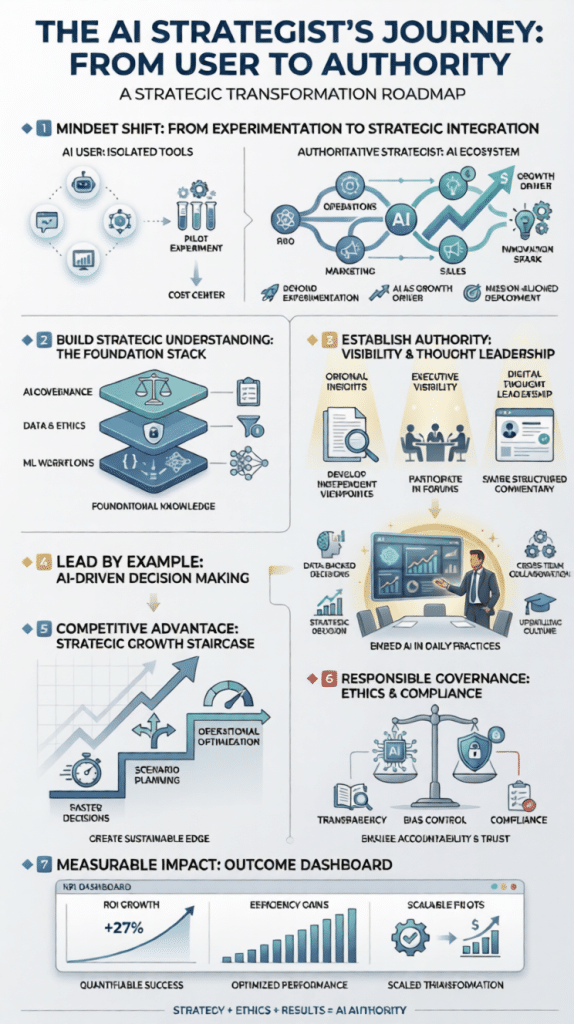
Recognition as an authority requires a shift in mindset. Leaders must move beyond surface-level adoption, where tools are used in isolation, to a state of strategic integration where AI informs the entire business model.
1. Moving Beyond Surface-Level Adoption
Authority is not built by simply implementing popular software. It is built by understanding how these tools reshape value chains. This involves:
- Moving away from "pilot paralysis," where small experiments never scale.
- Transitioning from viewing AI as a cost-cutting tool to seeing it as a revenue and innovation driver.
- Aligning every AI deployment with the broader organizational mission.
Defining Clear Business Objectives: Strategic leaders avoid implementing technology for its own sake. They prioritize high-impact use cases that offer measurable outcomes, such as:
- Improving customer retention through predictive modeling.
- Streamlining supply chains via automated logistics.
- Enhancing product development cycles using generative design.
Building Foundational Understanding
True authority is grounded in a grasp of core principles. Leaders do not need to write code, but they must understand machine learning workflows, the difference between supervised and unsupervised learning, and the ethical frameworks required to manage data privacy and bias.
2. Establishing Authority Through Credibility and Strategic Visibility
Knowledge alone does not grant authority; it must be communicated and validated. Leaders must actively cultivate a reputation for expertise through disciplined visibility.
Emphasizing Original Insights:
Rather than echoing industry buzzwords, authoritative leaders develop independent viewpoints. They analyze how AI specifically affects their unique sector and share these insights through high-level internal reports and external white papers.
External Recognition:
Authority is often validated by the broader professional community. This is achieved through:
- Participation in executive-level forums and industry-shaping panels.
- Pursuing specialized executive education that demonstrates a commitment to continuous learning.
- Collaborating on research or pilot programs with academic or industry partners.
Consistent Digital Presence:
A leader’s professional profile should reflect a higher understanding of technology. This means sharing structured, thoughtful commentary on the implications of AI rather than just announcing new product launches.
3. Demonstrating AI-Driven Leadership Practices
Leadership authority is proven through action. When executives embed AI into their own daily practices, they signal its importance to the entire organization.
Leading by Example:
Executives gain respect when they are seen as active participants in the technological journey. This includes sponsoring major data initiatives and using data-backed insights to justify high-stakes decisions during board meetings.
Encouraging a Culture of Innovation:
A leader’s authority is amplified when they empower others. By creating a "safe-to-fail" environment, leaders encourage calculated risk-taking. This can be done through:
- Incentivizing Collaboration: Breaking down silos between data scientists and business unit heads.
- Iterative Learning: Treating AI implementation as a series of learning cycles rather than a single, static project.
Human-Centric Leadership
Recognized authority is also compassionate. Leaders must address the "human element" of AI by:
- Promoting upskilling programs to ensure the workforce remains relevant.
- Transparently discussing how AI will augment jobs rather than simply replacing them.
- Managing the psychological transition of the team during periods of rapid automation.
For leaders seeking to formalize this authority, the Doctor of Business Administration (DBA) in Artificial Intelligence and Machine Learning from Walsh College provides a rigorous framework to lead AI adoption confidently.
Doctor Of Business Administration in Artificial Intelligence and Machine Learning
Earn a doctorate in AI & ML while balancing your career—gain business leadership, drive intelligent innovation, and earn status as a Walsh College alum.
This 100% online, three-year AI leadership program enables leaders to master the technical foundations and strategic applications necessary to lead innovation and R&D projects.
The program is structured to move you from foundational literacy to advanced executive research, using a curriculum that is identical in both its domestic and international offerings:
- Foundational Mastery: The journey begins with deep dives into Python and Applied Statistics, ensuring you can assess the reliability of business estimates and data-driven decisions regarding AI's influence in leadership.
- Advanced Technical Strategy: Master the architectures that power the modern economy, including Deep Learning (CNNs, RNNs, LSTMs), Natural Language Processing, and Computer Vision.
- Leadership and Governance: Specific modules on "AI Strategy for Leaders" teach you how to build AI-ready teams, manage ethical considerations, and ensure data governance and compliance.
- Hands-On Experience: Gain hands-on familiarity with the industry-standard languages and tools covered in the program, such as Python, TensorFlow, Keras, NumPy, and SQL.
- Master the Title and the Tech: Earn the prestigious title of "Dr." while gaining the expertise needed to lead and apply AIML in high-level business settings.
- Strategic Decision-Making: Learn to interpret and implement AI models to create new knowledge paradigms and extract actionable insights for organizational growth.
4. Competitive Advantage Through AI Leadership
The ultimate goal of building AI authority is to create a sustainable competitive edge. Leaders who command this space see tangible benefits across the enterprise.
- Accelerated Agility: Authority allows leaders to make faster "go/no-go" decisions. With a firm grasp of AI capabilities, experimentation cycles are shortened, and the organization can pivot more effectively in response to market changes.
- Advanced Scenario Planning: By leveraging predictive insights, leaders can anticipate disruptions before they manifest. This proactive stance changes the role of the executive from a problem-solver to a future-shaper.
- Optimization of Performance: AI-led organizations often see superior operational efficiency. Data-backed optimization ensures that resources are deployed where they will yield the highest return on investment.
5. Advancing Ethical and Responsible AI Governance
A leader’s authority can be destroyed by ethical lapses. Therefore, true authority is inseparable from responsible governance.
- Transparency in Decision-Making: Leaders must ensure that AI-enabled outcomes are explainable. This involves creating accountability frameworks that dictate who is responsible when an automated system makes a high-impact error.
- Addressing Bias and Privacy: Authoritative leaders take a stand on data ethics. They implement rigorous bias detection processes and ensure that data governance structures comply with global regulations, protecting the organization’s reputation and stakeholder trust.
6. Delivering Measurable and Impactful Outcomes
The final component of authority is results. Without evidence of success, AI knowledge remains theoretical.
Initiating Focused Pilot Projects
To build credibility early, leaders should select "low-hanging fruit" projects that are manageable in scope but high in visibility. Successfully scaling a small-scale predictive tool into a department-wide solution provides a blueprint for larger transformations.
Communicating Results Through Metrics- Authority is reinforced when data speaks for leaders:
- Quantitative Reporting: Showing exactly how AI reduced overhead or increased throughput.
- Qualitative Milestones: Highlighting improvements in employee engagement or customer satisfaction scores following AI integration.
Pitfalls and Practical Considerations
Even experienced leaders can face challenges that weaken their authority if not managed carefully. Recognizing common pitfalls reflects a practical and mature approach to AI strategy.
1. The “Magic Wand” Mindset
Some leaders expect AI to quickly solve major business problems or fully automate complex roles. In reality, AI is not a quick fix; it depends on high-quality data, proper context, and human oversight. Effective leaders set realistic expectations and position AI as a tool to enhance decision-making, not replace core business fundamentals.
2. The Pilot Trap and Lack of Scale
Many organizations successfully launch AI pilots but fail to scale them across the enterprise because scalability and integration were not planned from the beginning. Sustainable impact comes from aligning AI initiatives with long-term business workflows and ensuring they can be expanded beyond experimentation.
3. Poor Data Quality
AI systems are only as reliable as the data they use. When data is fragmented, outdated, or inconsistent, results become inaccurate or biased. Strong AI leadership requires prioritizing data governance, regular validation, and cross-functional collaboration to maintain a solid data foundation.
4. Ignoring the Human Factor
Even technically sound AI projects can fail if employees resist change or feel threatened by automation. Many implementation challenges are people-related rather than technical. Leaders must focus on change management, encourage continuous learning, and clearly communicate how AI supports employees instead of replacing them.
5. Treating AI as a One-Time Initiative
Viewing AI as a one-time deployment can lead to declining performance over time, as models require updates and monitoring. Long-term success depends on continuous improvement, performance tracking, and adapting systems to evolving business and market conditions.
Conclusion
Turning AI knowledge into a recognized AI authority is a deliberate process of blending technical literacy with strategic execution. It requires a commitment to moving beyond the role of a passive observer and becoming an active architect of technological integration.
By focusing on credible communication, ethical governance, and measurable outcomes, leaders transform a complex tool into a source of enduring professional influence.
Ultimately, the leaders who will define the next era of industry are those who treat AI not as a hurdle to be cleared, but as the foundation upon which they build their strategic legacy.