phone iconSpeak with our expert +1 248 970 1937

Trusted by millions of learners

Learn more about the course

Get details on syllabus, projects, tools, and more

Name
Email
Mobile Number

By submitting this form, you consent to our Terms of Use & Privacy Policy and consent to be contacted via email, phone (including by AI-generated/pre-recorded voice calls), SMS, or WhatsApp.

Doctor Of Business Administration in Artificial Intelligence and Machine Learning

Doctor Of Business Administration in Artificial Intelligence and Machine Learning

Application closes 5th May 2026

What's new?

  • List icon

    Build expertise in Generative AI

    Learn Generative AI using tools like ChatGPT and Hugging Face to build LLM-powered applications.

  • List icon

    Modules on MLOps and Multimodal AI

    With our Artificial Intelligence course, master MLOps for seamless model deployment alongwith Multimodel AI to integrate and process diverse data types effectively

overview icon

Program Outcomes

Transform business and drive growth with AI

Drive business transformation as a strategic AI leader

  • List icon

    Gain strategic insights to manage and execute AI projects effectively

  • List icon

    Build innovative AI-powered products and services to drive growth

  • List icon

    Boost your career with a globally recognized credentials

  • List icon

    Demonstrate mastery and earn the title of 'Dr.'

Earn dual certificates

  • Ranked #1 among Top 10 Online DBA Degrees of 2024

    Ranked #1 among Top 10 Online DBA Degrees of 2024

    Forbes

  • Top Tier 1 ranking for DBA

    Top Tier 1 ranking for DBA

    Global DBA Ranking by CEO Magazine

  • Accredited by the HLC

    Accredited by the HLC

    Accreditation agency recognized by US Dept. Edu.

Key program highlights

Why choose the DBA in AI & ML program

  • List icon

    Top ranked DBA by Forbes

    Ranked among top 10 online DBA degrees of 2024 by Forbes for academic quality and industry relevance.

  • List icon

    Hands-on projects followed by thesis

    Work on numerous real world projects followed by capstone projects and a final dissertation with dedicated guidance from top faculty and industry experts.

  • List icon

    WES recognized and HLC accredited

    Ensures global acceptance and enhances career and academic opportunities.

  • List icon

    Alumni status from Walsh College

    Earn alumni status from Walsh College upon program completion.

  • List icon

    Expert mentorship and support

    Engage with AI experts for project guidance, get 1:1 support, weekly sessions, and dedicated program manager assistance.

  • List icon

    Earn 60 Semester credit hours in this program

    Complete a rigorous, research-driven DBA in AI & ML with 60 Semester Credit Hours(SCH) qualifying you for senior leadership roles and global recognition.

  • List icon

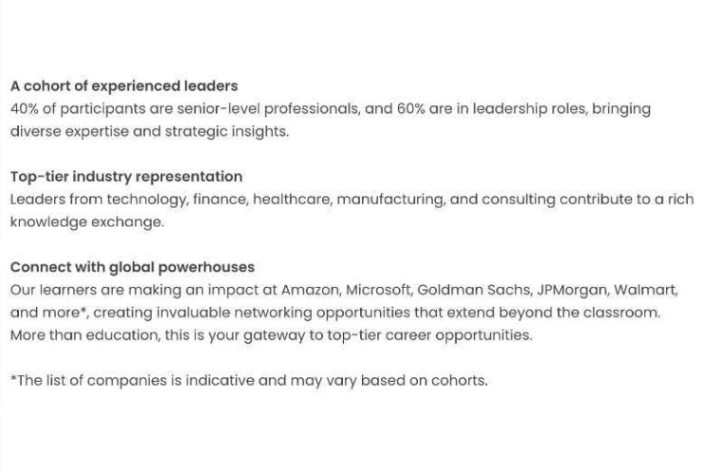
    A cohort of experienced leaders

    87% of participants are senior professionals, 45% in leadership roles—bringing diverse expertise from sectors like tech, finance, healthcare, and more.

  • List icon

    Powerful Global Network

    Network with professionals from leading firms like Amazon, Microsoft, and JPMorgan, and unlock career opportunities beyond the classrooms.

Generative AI

Prompt Engineering

Machine Learning

Research Methodology

Academic Writing & Publication

Deep Learning

Neural Networks

Business Intelligence Using AI

Agentic AI

AI Strategy & Ethics

Generative AI

Prompt Engineering

Machine Learning

Research Methodology

Academic Writing & Publication

Deep Learning

Neural Networks

Business Intelligence Using AI

Agentic AI

AI Strategy & Ethics

view more

  • Overview
  • Learning Journey
  • Curriculum
  • Tools
  • Certificate
  • Faculty
  • Career Support
  • Fees
  • FAQ
optimal icon

This program is ideal for

DBA in AI & ML empowers leaders to drive innovation, transformation and research-led impact.

View Batch Profile

  • Senior professionals

    Elevate your career with advanced leadership skills, applied research capabilities, and AI-driven business strategies

  • Domain experts and functional Leaders

    Integrate AI/ML into functional areas like marketing, finance, operations, and HR to solve complex business problems

  • CXOs and business heads

    Strengthen your strategic edge and guide your organization’s AI transformation with global insights and doctoral-level expertise

  • Technology leaders

    Lead AI initiatives and innovation teams with a deep understanding of technical architectures and their business impact

Learn with self-paced videos

Our pedagogy is designed to ensure career growth and transformation

  • banner-image

    Learn with self-paced videos

    Learn critical concepts from video lectures by faculty & AI experts

  • banner-image

    Engage with your mentors

    Clarify your doubts and gain practical skills during the weekend mentorship sessions

  • banner-image

    Work on hands-on projects

    Work on projects to apply the concepts & tools learnt in the module

  • banner-image

    Get personalized assistance

    Our dedicated program managers will support you whenever you need

Get an exclusive preview of the course

Explore faculty videos and mentorship sessions. Get insights into relevant case-studies and projects.

preview banner

Curriculum

This DBA in AI & ML syllabus, developed by esteemed experts from Walsh College and Great Learning, offers comprehensive insights into AI and Machine Learning. A unique research-led curriculum which allows you to work with dedicated guidance from top faculty and industry experts to help you master the AI & ML domain.

Year 1

Course: Pre-Work

This course equips beginners with Python basics, laying the foundation for AI and ML. It also covers Generative AI concepts, including ChatGPT and other AI tools, with practical demonstrations of their business applications. Introduction to AI Landscape 1. Introduction to key terminology- Artificial Intelligence Machine Learning Deep Learning Generative AI Large Language Model 2. History and Evolution of AI 3. Business Problems and Solution Spaces across different industries Python Programming Fundamentals 1. Introduction to Python 2. Environment Setup - Google Colab 3. Fundamental Python Programming Constructs Variables Data types Data structures (list, dictionary) Conditional statements

Course 01: Python Foundations

This course guides you to read, explore, manipulate, and visualize data to tell stories, solve business problems, and deliver actionable insights and business recommendations by performing exploratory data analysis using some of the most widely used Python packages. 1. Introduction to Python Python is a widely used, high-level, interpreted programming language with a simple, easy-to-learn syntax that emphasizes code readability. This module will cover Python programming fundamentals and help you take the first steps in organizing data with Python. Variables and Datatypes Data Structures Conditional and Looping Statements Functions 2: Data Manipulation NumPy is a Python package for mathematical and scientific computing and involves working with arrays and matrices. Pandas is a fast, powerful, flexible, and simple-to-use open-source library in Python to manipulate and analyze data. This module will cover these important libraries and provide a deep understanding of how to use them to explore data. NumPy arrays and functions Accessing and modifying NumPy arrays Saving and loading NumPy arrays Pandas Series (Creating, Accessing, and Modifying Series) Pandas DataFrames (Creating, Accessing, Modifying, and Combining DataFrames) Pandas Functions Saving and loading datasets using Pandas 3: Exploratory Data Analysis Exploratory Data Analysis, or EDA, is a process of examining and visualizing data to uncover patterns and extract meaningful insights, which facilitates storytelling. This module provides a deep insight into how to conduct EDA using Python and utilize the insights extracted to drive business decisions. Data overview Univariate analysis (Histogram, Boxplots, and Bar graphs) Bivariate/Multivariate analysis (Line Plot, Scatterplot, Lmplot, Jointplot, Violin Plot, Striplot, Swarmplot, Catplot, Pairplot, Heatmap) Customizing of Plots Missing value treatment Outlier detection and treatment

Course 02: Machine Learning

This course helps you build an understanding of the concept of learning from data, build linear and non-linear models to capture the relationships between attributes and a known outcome, and discover patterns in and segment data with no labels. 1: Linear Regression Machine Learning (ML), a subset of Artificial Intelligence (AI), focuses on developing algorithms capable of learning patterns in data and making predictions without being explicitly programmed to do so. Linear Regression is one of the most popular supervised ML algorithms that identifies the degree of linear relationship in data. This module introduces participants to ML and explores how linear regression can be used for predictive analysis. Introduction to learning from data Types of machine learning Business Problem and Solution Space - Regression, Correlation and Linear Relationships, Simple and Multiple Linear Regression, Categorical Variables in Linear Regression, Regression Metrics 2: Decision Trees Decision trees are supervised ML algorithms that utilize a hierarchical structure for decision-making and can be used for both classification and regression problems. This module dives into how a decision tree can be used to model complex, non-linear data and how to improve the performance of decision trees using pruning techniques. Business Problem and Solution Space - Classification, Introduction to Decision Trees, Impurity Measures and Splitting Criteria, Classification Metrics, Pruning, Decision Trees for Regression 3: K-means Clustering K-means clustering is a popular unsupervised ML algorithm that is used for identifying patterns in unlabeled data and grouping it. This module dives into the workings of the algorithm and the important points to keep in mind when implementing it in practical scenarios. Business Problem and Solution Space - Clustering, Distance Metrics, Introduction to Clustering, Types of Clustering, K-means Clustering, t-SNE for visualizing high-dimensional data

Course 03: Advanced Machine Learning

This course helps you explore how to combine the decisions from multiple models using ensemble techniques to improve model performance and make better predictions, and employ feature engineering techniques and hyperparameter tuning to arrive at generalized, robust models to optimize associated business costs. 1: Bagging Random forest is a popular ensemble learning technique that comprises several decision trees, each using a subset of the data to understand patterns. The outputs of each tree are then aggregated to provide predictive performance. This module will explore how to train a random forest model to solve complex business problems. Introduction to Ensemble Techniques Introduction to Bagging Sampling with Replacement Introduction to Random Forest 2: Boosting Boosting models are robust ensemble models that comprise several sub-models, each of which is developed sequentially to improve upon the errors made by the previous one. This module will cover essential boosting algorithms like AdaBoost and XGBoost that are widely used in the industry for accurate and robust predictions. Introduction to Boosting Boosting Algorithms (Adaboost, Gradient Boost, XGBoost) Stacking Week 3: Model Tuning Model tuning is a crucial step in developing ML models and focuses on improving the performance of a model using different techniques like feature engineering, imbalance handling, regularization, and hyperparameter tuning to tweak the data and the model. This module covers the different techniques to tune the performance of an ML model to make it robust and generalized. Feature Engineering Cross-validation Oversampling and Undersampling Model Tuning and Performance  Hyperparameter Tuning Grid Search Random Search Regularization

Course 04: Introduction to Neural Networks

This course helps you implement neural networks to synthesize knowledge from data, demonstrate an understanding of different optimization algorithms and regularization techniques, and evaluate the factors that contribute to improving performance to build generalized and robust neural network models to solve business problems 1: Introduction to Neural Networks Artificial Neural Networks (ANN) are inspired by biological neurons and utilize a collection of artificial neurons stacked and connected in layers to model complex data. This module dives deeper into the underlying functionality of neural networks and how to use common, open-source Deep Learning (DL) libraries Keras and Tensorflow to build neural networks to solve business problems. Deep Learning and history Multi-layer perceptron Types of Activation functions Training a neural network Backpropagation 2: Optimizing Neural Networks Different optimization algorithms are used in practical setups to improve the performance of neural networks, and deploying regularization techniques like dropout and batch normalization helps in ensuring neural networks gain a better understanding of the patterns in complex data. This module dives deeper into the concepts of optimization and regularization to illustrate the best practices for building generalized and robust neural networks to solve business problems. Optimizers and their types Weight Initialization and its techniques Regularizations and its techniques Types of neural networks

Course 05: Natural Language Processing with Generative

This course will help you get introduced to the world of natural language processing, gain a practical understanding of text embedding methods, gain a practical understanding of the working of different transformer architectures that lie at the core of large language models (LLMs), explore how retrieval augmented generation (RAG) integrates information retrieval to improve the accuracy and relevance of responses from an LLM, and design and implement robust NLP solutions using open-source LLMs combined with prompt engineering techniques. 1: Word Embeddings Natural Language Processing (NLP) is a branch of AI that focuses on processing and understanding human language to facilitate the interaction of machines with it. Word embeddings allow us to numerically represent complex textual data, thereby enabling us to perform a variety of operations on them. This module introduces participants to the world of NLP, covers different word embedding techniques, and the steps involved in designing and implementing hands-on solutions combining word embedding methods with machine learning techniques for solving NLP problems Introduction to NLP History of NLP Sentiment Analysis Introduction to Word Embeddings Word2Vec GloVe Semantic Search 2: Attention Mechanism and Transformers Transformers are neural network architectures that develop a context-aware understanding of data and have revolutionized the field of NLP by exhibiting exceptional performance across a wide variety of tasks. This module dives into the underlying workings of different transformer architectures and how to use them to solve complex NLP tas Introduction to Transformers Components of a Transformer Different Transformer Architectures Applications of Transformers 3: Large Language Models and Prompt Engineering Large Language Models (LLMs) are ML models that are pre-trained on large corpora of data and possess the ability to generate coherent and contextually relevant content. Prompt engineering is a process of iteratively deriving a specific set of instructions to help an LLM accomplish a specific task. This module introduces LLMs, explains their working, and covers practices to effectively devise prompts to solve problems using LLMs. Introduction to LLMs Working of LLMs Applications of LLMs Introduction to Prompt Engineering Strategies for Devising Prompts 4: Retrieval Augmented Generation Retrieval augmented generation (RAG) combines the power of an encoder and a generative model to produce more informative and accurate outputs from an external knowledge source. This module will provide a thorough coverage of the importance of external knowledge sources in enhancing an LLM’s accuracy and contextual awareness, using vector databases to store and efficiently retrieve information from data, and evaluating the quality and relevance of the LLM-generated text. External Knowledge Sources Data Chunking Vector Databases Retrieval-Augmented Generation (RAG) Evaluating RAG Systems

Course 06: AI Agents for Automation

This course introduces participants to the shift from traditional automation to the world of Agentic AI, covering how to build intelligent agents using LangChain, equip them with dynamic tool-use capabilities, integrate memory into AI agents, understand the mechanics of planning and the ReAct framework to enable agents to decompose and solve complex, multi-stage tasks. Finally, you will learn to evaluate AI agents to enable reliable AI solutions enhanced with human oversight. 1: Introduction to AI Agent Workflows Agentic AI marks the transition from static LLM interactions to autonomous, problem-solving systems capable of executing complex tasks. This module introduces the core architecture of AI agents, detailing the role of LLMs as intelligent reasoning engines and the necessity of external tools to expand their functional capabilities, and covering the essential techniques to build functional agentic AI workflows with tool usage using LangChain. The Need for AI Agents The Role of LLMs in AI Agents The Need for External Tools Types of Tools The Need for Memory Short-term vs Long-term Memory Building Agentic AI Workflows with LangChain 2: Planning and Reasoning in AI Agents The cognitive mechanics of planning and multi-step reasoning enable AI agents to move beyond simple execution to autonomous, complex problem-solving. This module explores the critical role of these concepts in decomposing high-level objectives into actionable, structured tasks and delves into the ReAct (Reasoning and Acting) framework to execute business workflows with high reliability. The Role of Planning The Role of Reasoning Task Decomposition Introduction to ReAct Framework 3: Evaluating AI Agents A critical part of Agentic AI development is ensuring reliability, transparency, and operational excellence in production environments. This module covers the concepts of grounding and validation to minimize hallucinations, a rigorous framework for evaluating agentic performance, moving beyond simple output checks to analyze quantitative metrics such as task completion rates, tool call accuracy, reasoning trajectory coherence, and cost efficiency, and hwo to implement Human-in-the-Loop (HITL) evaluation to establish robust, trustworthy agentic AI workflows. Grounding and Validation Agentic AI Evaluation Metrics (Task Completion Rate, Tool Call Accuracy, Reasoning Trajectory Coherence, Efficiency) Human in the Loop evaluation

Course 07: Model Deployment

This course will help you comprehend the role of model deployment in realizing the value of an ML model and how to build and deploy an application using Python. 1: Introduction to Model Deployment Model deployment is the process of making a trained machine learning model accessible to a wider audience by operationalizing it. This module introduces participants to model deployment, provides an overview of its need in generating business value from ML models, and serializing and deploying ML models using Python libraries like Streamlit. Introduction to Model Deployment Serialization Deployment using Streamlit 2: Containerization Containerization is the process of packaging applications and their dependencies into self-contained units called containers to ensure consistent execution across different environments. This module dives into packaging ML models and their dependencies into containers using Docker and simplifying the deployment of the ML models using Python libraries like Flask. Introduction to Containerization Docker Deployment using Flask

Course 08: Introduction to SQL

This course will help you gain an understanding of the core concepts of databases and SQL, gain practical experience writing simple SQL queries to filter, manipulate, and retrieve data from relational databases, and utilize complex SQL queries with joins, window functions, and subqueries for data extraction and manipulation to solve real-world data problems and extract actionable business insights. 1: Data Retrieval & Aggregation Essentials SQL is a widely used querying language for efficiently managing and manipulating relational databases. This module provides an essential foundation for understanding and working with relational databases. Participants will explore the principles of database management and Structured Query Language (SQL), and learn how to fetch, filter, and aggregate data using SQL queries, enabling them to extract valuable insights from large datasets efficiently. Introduction to Databases and SQL Fetching data Filtering data Aggregating data 2: Querying Techniques for Relational Data Analysis SQL offers a wide range of numeric, string, and date functions, gaining proficiency in leveraging these functions to perform advanced calculations, string manipulations, and date operations. SQL joins are used to combine data from multiple tables effectively, and window functions enable performing complex analytical tasks such as ranking, partitioning, and aggregating data within specified windows. This module provides a comprehensive exploration of the various functions and joins available within SQL for data manipulation and analysis, enabling them to summarize and analyze large datasets effectively. In-built functions (Numeric, Datetime, Strings) Joins Window functions 3: Advanced Querying for Enhanced Proficiency and Insights Subqueries allow one to nest queries within other queries, enabling more complex and flexible data manipulation. This module will equip participants with advanced techniques for filtering data based on conditional expressions or calculating derived values to extract and manipulate data dynamically. Subqueries Order of query execution

Course 09: Introduction to Computer Vision

This course will introduce you to the world of computer vision, demonstrate an understanding of image processing and different methods to extract informative features from images, build convolutional neural networks (CNNs) to unearth hidden patterns in image data, and leverage common CNN architectures to solve image classification problems. 1: Image Processing Computer Vision is a branch of AI that focuses on understanding and extracting meaningful insights from image data. This module provides an overview of the world of computer vision and covers techniques to process images and extract meaningful patterns from them. Overview of Computer Vision Color pixel and image representation Edge Detection Kernels Padding Strides and Pooling Flattening to a 1D Array 2: Convolutional Neural Networks Given the complex nature of image data, convolutional neural networks (CNNs) are utilized to capture relevant spatial information in images. Transfer learning is a method to leverage the underlying knowledge needed to solve one problem for other problems. This module will cover the fundamentals of CNNs, how to build them from scratch, and how to leverage common CNN architectures via transfer learning to solve different image classification problems. ANN Vs CNN CNN Architecture Introduction to Transfer Learning Common CNN Architectures

Course 10: Advanced Agentic AI

This course explores advanced concepts in Agentic AI, beginning with advanced reasoning and agent protocols, and multi-agent systems, where learners delve into the interaction and coordination between multiple AI agents to solve complex problems collaboratively. The module also addresses the crucial aspect of securing agentic AI solutions, emphasizing the importance of implementing robust security measures to protect AI systems from vulnerabilities and ensure safe deployment in real-world applications. 1: Advanced Reasoning and AI Agent Protocols Agentic AI Workflows focus on transitioning from static prompts to autonomous systems capable of independent reasoning and tool use. This module explores advanced architectural patterns - such as Self-Reflection and Plan-and-Execute - while introducing industry-standard frameworks like LangGraph and the Model Context Protocol (MCP) for seamless tool integration. Self-Reflection Plan-and-Execute LangGraph MCP 2: Multi-Agent Systems Multi-Agent Systems explore the evolution from standalone models to collaborative ecosystems designed to overcome the reasoning and scaling limitations of single-agent AI. This module covers coordination strategies, diverse architectural patterns, and specialized frameworks, while examining Agentic RAG and the emergent behaviors that arise when multiple specialized agents interact to solve complex, high-stakes problems. Challenges of single-agent LLM systems Multi-agent systems as a coordination solution Common multi-agent architectures Multi-agent system frameworks and protocols Emergent behavior in multi-agent systems Agentic RAG 3: Securing Agentic AI Solutions Agentic Security and Governance applies the CIA Triad to the unique risks of autonomous systems, focusing on protecting the integrity of agent-led decision-making. This module covers the detection of Prompt Injection, the implementation of multi-layered Guardrails, and the critical role of Transparent Logging and Access Control in ensuring that autonomous agents operate within secure, ethical, and privacy-compliant boundaries. LLM Security Framework: The CIA Triad (Confidentiality, Integrity, Availability) Common Security Risks in LLMs Prompt Injection Attacks Mitigation and Guardrail Layers Responsible AI Checklist Data Security and Privacy Agent Behavior Security Logging Decision Making for Transparency Access Control and Identity

Course 11: MLOps and LLMOps for Scalable Deployment

This course provides a guide to the lifecycle of machine learning and generative AI applications, bridging the gap between development and production. You will explore the fundamentals of DevOps and MLOps by implementing robust version control and automating workflows with GitHub Actions, transition into building CI/CD pipelines, where you will leverage MLflow for experiment tracking and end-to-end model lifecycle management, and explore the specialized field of LLMOps, gaining the technical expertise to architect scalable serving infrastructure, optimize inference, and manage the unique deployment challenges of Generative AI solutions. 1: Introduction to DevOps and MLOps MLOps Fundamentals covers the essential tools for managing software delivery. This module introduces Git for tracking changes, branching, and merging within remote repositories, before advancing to GitHub Actions to design, configure, and optimize automated workflows for seamless integration and deployment. Introduction to Git, Branching, Merging, and Remote Repositories Introduction to GitHub Actions Creating and Configuring Workflows Advanced Workflow Configuration 2: Building CI/CD Pipelines Machine Learning Lifecycle Management introduces MLflow as a unified platform for managing the end-to-end machine learning process. This module covers essential workflows for experiment tracking and versioning, methods for packaging reproducible code into running projects, and strategies for overseeing the full model lifecycle from development to deployment. Overview of MLflow Basic Workflows Experiment Tracking Packaging Code and Running Projects Model Lifecycle Management 3: LLMOps for GenAI Solutions Inference and Model Serving focuses on the architectural requirements for deploying large language models at scale. This module covers the core components of a production-ready environment, including API gateways and intelligent routing, while exploring load balancing strategies and inference optimization techniques to ensure high availability, low latency, and cost-effective performance across distributed systems. LLM serving infrastructure Scaling API gateway Routing Load balancing Inference optimization

Course 12: Capstone

This course will help you identify and define a real-world problem, considering factors such as data availability, feasibility, and potential impact, design and develop an AI solution that addresses the identified problem, explore, analyze, and process the data, apply and evaluate appropriate AI techniques to implement the solution effectively, and communicate insights and implications to stakeholders.

Additional Modules: Learn at your Own Pace

Course 1: Multimodal Generative AI (Masterclass only) This course will help you explore how to solve business problems by generating code using Generative AI tools, examine the capabilities of text-to-image and image-to-text GenAI tools like DallE through business use cases, and explore the speech recognition capabilities of audio-to-text GenAI tools like Whisper through business use cases. Code Generation using GenAI Image Creation using GenAI Speech Recognition using GenAI Course 2: Fine-tuning LLMs This course covers Parameter-Efficient Fine-Tuning (PEFT), which is a method to adapt massive pre-trained models to specific tasks while updating only a fraction of their parameters. It explores techniques like Prompt Tuning and Prefix Tuning, which optimize continuous vectors rather than model weights, and advances to state-of-the-art reparameterization methods like LoRA and QLoRA that use low-rank matrices and quantization to drastically reduce memory and hardware requirements. Parameter-Efficient Fine-Tuning Prefix Tuning Prompt Tuning LoRA and QLoRA Course 3: Object Detection and Segmentation This course will help you understand the concept and importance of object detection and image segmentation in computer vision tasks, identify and describe different algorithms and techniques used for object detection and image segmentation, and explore real-world applications of the algorithms and techniques across different domains. Introduction to Object Detection and Image Segmentation Algorithms for Object Detection (Region-based, Single-shot, Two-stage) Semantic and Instance Segmentation Siamese Networks Applications of Object Detection and Image Segmentation Course 4: Recommendation Systems This course will help you get introduced to recommendation systems and learn how to build recommendation systems that use past product purchase and satisfaction data to make high-quality personalized recommendations Introduction to Recommendation Systems Market Basket Analysis Popularity-based and Content-based Recommendation Systems Collaborative Filtering Hybrid Recommendation Systems Course 5: Reinforcement Learning  This course will help you understand the fundamental principles and components of reinforcement learning (RL), explore the working mechanisms of different components of reinforcement learning, gain proficiency in implementing Q-learning and SARSA algorithms, and apply the algorithms to real-world reinforcement learning tasks Reinforcement Learning Framework Q-Learning SARSA Algorithm Course 6: Applied Statistics  This course will help you perform statistical analysis using Python to evaluate the reliability of a particular business estimate using confidence intervals and test hypotheses (assumptions) before putting them into action and committing resources by analyzing data distributions and performing hypothesis testing. Probability Fundamentals Probability Distributions Sampling and Central Limit Theorem Estimation Theory Hypothesis Testing Course 7: Model Interpretability This course covers model interpretability and explainability to deconstruct "black-box" model predictions. It explores Hypothesis Testing to determine the statistical significance of individual parameters, alongside industry-standard local and global explanation tools: SHAP (SHapley Additive exPlanations), which leverages game theory for consistent feature attribution, and LIME (Local Interpretable Model-agnostic Explanations), which approximates complex models with simpler, interpretable surrogates. Parameter Significance using Hypothesis Testing SHAP LIME Course 8: Time Series Forecasting  In this course, you will learn how to describe components of a time series data and analyze them using special techniques and methods for time series forecasting. Introduction to Time Series Analysis Introduction to Forecasting ARIMA & SARIMA

Year 2

Term 1

IT 721 : APPLIED RESEARCH TOPICS IN DEEP LEARNING THEORY & PRACTICAL APPLICATIONS: In this course, you will master CNNs, RNNs, LSTMs, autoencoders, and state-of the-art generative models like GPT, PaLM, CLIP, and DALL·E and gain the industry-critical skills of transfer learning, prompt engineering, and RAG & LoRA fine-tuning to create domain-specific AI systems ready for real-world impact.Database storage technologies have transformed into complex systems that support knowledge management and decision support systems. This course takes a look at the foundations of database storage technologies. Students will learn about database storage architecture, types of database storage systems (legacy, current and emerging), physical data storage, transaction management, database storage APIs, data warehousing, governance and big data systems. The student will tie this all together to see how database storage technologies apply to data analytics. Introduction to Deep Learning Neural Networks & Backpropagation CNN, RNN, LSTM Autoencoders & Generative Models Transfer Learning Prompt engineering basics Foundation Models GPT, PaLM, CLIP, DALL·E RAG, LoRA IT 547 : DATA STORAGE TECHNOLOGIES: Database storage technologies have transformed into complex systems that support knowledge management and decision support systems. This course takes a look at the foundations of database storage technologies. Students will learn about database storage architecture, types of database storage systems (legacy, current and emerging), physical data storage, transaction management, database storage APIs, data warehousing, governance and big data systems. The student will tie this all together to see how database storage technologies apply to data analytics. Upon successful completion of this course, you will be able to: Evaluate different database storage technologies. Compare systems used in data analytics. Investigate legacy, current, and emerging systems. Assess database storage solutions through hands-on labs.

Term 2

BTC 771 : AI STRATEGY FOR LEADERS: The course integrates real-world case studies from industry leaders such as Tesla, Amazon, JPMorgan Chase, and Microsoft, providing students with insights into AI successes and challenges. Through case study analyses, discussions, and practical assignments, students will develop leadership strategies for AI integration, ensuring responsible and effective AI adoption in their organizations. AI Fundamentals and Business Applications AI Vision and Strategy Development Ethical AI Leadership Building AI-Ready Teams AI Tools and Technologies Data Governance and Compliance Measuring AI Impact and Risks The Future of AI Leadership QM 625 : Mathematics of Artificial Intelligence & Machine Learning This course introduces and explains the fundamental mathematical concepts that form the backbone of artificial intelligence and deep learning. It emphasizes a strong understanding of linear algebra and analytic geometry, which are essential for building and optimizing AI models. Learners will explore how these mathematical principles directly apply to modern algorithms and neural networks. By the end of the course, participants will gain the analytical skills needed to interpret and implement AI techniques effectively. Course Learning Outcomes: Upon successful completion of this course, students will be able to: Analyze the role of scalars, vector spaces, tensors, matrices, derivatives, and gradient descent in AI and ML. Apply fundamental linear algebra and its mathematics to solve problems in AI and ML. Evaluate and select the most effective optimization methods and their mathematics for specific AI and ML problems. Differentiate between the roles of probability in predicting future events and statistics in analyzing past events for their applications in AI and ML.

Term 3

QM 625 : CAPSTONE PROJECT: The Capstone Project provides the opportunity for integrating program learning within a project framework. Each student identifies or defines a professionally relevant need to be addressed that represents an opportunity to assimilate, integrate or extend learning derived through the program. The student will work with the Capstone Project Mentor to develop a proposal. After review and approval by the Capstone Project Mentor, the student will be authorized to complete the project.The student will present the completed project at the end of the semester.Upon successful completion of this course, you will be able to: Demonstrate the knowledge gained from the previous courses in the program. Write a formal research paper or conduct a detailed project. Apply the objectives of research to a practical information technology problem. Create a project plan to successfully present a solution/goal to the stated problem. Use research tools for an applied research paper or project. Evaluate the validity and reliability of statistics and other forms of research. IT 720 : APPLIED RESEARCH IN NATURAL LANGUAGE PROCESSING: (Only for Doctorate learners) This course is designed to provide students with advanced knowledge and practical skills in natural language processing (NLP) research and applications. Students will delve into cutting-edge techniques, methodologies, and tools used in NLP, with a focus on applied research and real-world use cases. Through a combination of lectures, hands-on projects, and literature review assignments, students will explore topics such as text classification, sentiment analysis, named entity recognition, machine translation, question answering, and more. Emphasis will be placed on understanding the underlying algorithms, evaluating model performance, and conducting empirical studies to address real-world NLP challenges. Upon successful completion of this course, students will be able to: Evaluate and apply advanced natural language processing models and architectures to solve domain-specific language tasks. Design, implement, and optimize NLP models using state-of-the-art algorithms, evaluation metrics, and experimental design principles. Critically analyze the ethical, societal, and fairness implications of NLP technologies, and propose responsible solutions. Develop NLP systems that extract, generate, and interpret structured and unstructured data for diverse real-world applications. Conduct applied NLP research by formulating hypotheses, implementing models, and interpreting results to advance the field.

Term 4

RES 712 : QUALITATIVE AND EXPLORATORY RESEARCH METHODS This course explores non-statistical forecasting and other qualitative research methods. Qualitative research methodologies have become more prevalent in research as a viable and valid form of inquiry, especially as they pertain to human behavior in organizations. Qualitative research techniques examined include ethno methodology; grounded theory; and phenomenological research. Nonparametric statistical analysis will also be examined. By the conclusion of this class, you will gain a solid foundation regarding the qualitative research approach and its various traditions along with their theoretical and applied constructs. This will allow you to prepare a qualitative problem for research as well as structure a valid qualitative research design for conducting the actual research itself (i.e., your doctoral dissertation or future research problems in your area of interest or specialization). RES 713 : QUANTITATIVE RESEARCH METHODS I DATA MANAGEMENT AND NON-EXPERIMENTAL: This course is a combination of quantitative research methods, multivariate statistics, and forecasting. The course assumes the doctoral student has had a graduate level statistics/quantitative methods course covering parametric statistics and hypothesis testing. DOCTORAL RESIDENCY I: This course is the first of three residencies. The residencies occur simultaneously with coursework throughout the student's doctoral journey. The intent of a residency experience is to provide students with a chance to connect directly with faculty/mentor and fellow students within the doctoral program. Students will attend information sessions, meet with faculty/mentors regarding subject matter and research methodology experts, and present their problem/purpose statement to a review board for feedback and direction.  Outcome: Finalisation of project problem and purpose statements.

Year 3

RES 714 : QUANTITATIVE RESEARCH METHOD II

This course is designed to build an advanced body of knowledge (BOK) that will allow students to utilize an extensive array of complex statistical models, tools, and software applications in the analysis of numerical data. Additionally, students will be able to use these advanced techniques to perform predictive analytics. This course is designed to build upon the non-experimental methods and techniques explored in RES 713. The comparative method will be explored along with the issue of ecological inference, aggregate vs. group assessment, and data reduction. Students will then assess the three main traditions associated with the experimental approach-pre-experiment, quasi-experiment, and the "true" experiment. Advanced Non-experimental and Experimental Quantitative Research Methods Quasi-experimental Design and Analysis True Experimental Design and Analysis Research across Time and Space Explanation, Prediction and Simulation Big Data, AI, ML and other inductive Methods and Approaches

DOCTORAL RESIDENCY II

Transition from coursework to dissertation research. Develop your dissertation proposal, gain ethical research approval, and begin collecting data for your study.

DOCTORAL RESIDENCY III

Advance your dissertation research and writing. Analyze your data, draft your dissertation chapters, and receive ongoing feedback from your dissertation committee.

DISSERTATION COURSES

This dissertation program provides the structure and resources to complete your doctoral research and successfully defend your thesis.   Dissertation I - Chapter 1: Develop a strong foundation for your dissertation. Learn to write a compelling introduction, craft a clear research question, and define your methodology.   Dissertation II - Chapter 2: Understand the literature review. Explore relevant research, identify theoretical frameworks, and demonstrate your understanding of the existing scholarship.   Dissertation III - Chapter 3: Focus on your research methodology. Refine your data collection plan, discuss data analysis techniques, and ensure ethical research practices.   Dissertation IV- Chapter 4: Analyze your research data. Learn to interpret findings, draw conclusions, and identify potential limitations.   Dissertation V - Chapter 5: Write your discussion and conclusion. Integrate your findings with existing literature, discuss the study's significance, and outline future research directions.

Master in-demand AI & ML tools

Get AI training with 27+ tools to enhance your workflow, optimize models, and build AI solutions

  • tools-icon

    Python

  • tools-icon

    SQL

  • tools-icon

    NumPy

  • tools-icon

    Pandas

  • tools-icon

    Seaborn

  • tools-icon

    Scikit-Learn

  • tools-icon

    Keras

  • tools-icon

    TensorFlow

  • tools-icon

    Transformers

  • tools-icon

    ChatGPT

  • tools-icon

    OpenCV

  • tools-icon

    SpaCy

  • tools-icon

    LangChain

  • tools-icon

    Docker

  • tools-icon

    Flask

  • tools-icon

    Whisper

  • tools-icon

    ML Flow

  • tools-icon

    Github

  • tools-icon

    Gemini

  • tools-icon

    Dall.E

Get certificates from the world's leading institutions

Earn Doctoral and Master's Degrees from the World's Leading Institution

  • thumbs-up

    Internationally recognized DBA

    Gain global recognition with HLC accreditation and WES recognition, ensuring wide international acceptance and credibility.

  • thumbs-up

    Prestigious credentials

    Earn Doctoral and Master's Degrees from the World's Leading Institution

  • thumbs-up

    Lifetime alumni Status

    Gain full alumni status from Walsh College and join an elite network of AI consultants, C-suite leaders, and entrepreneurs.

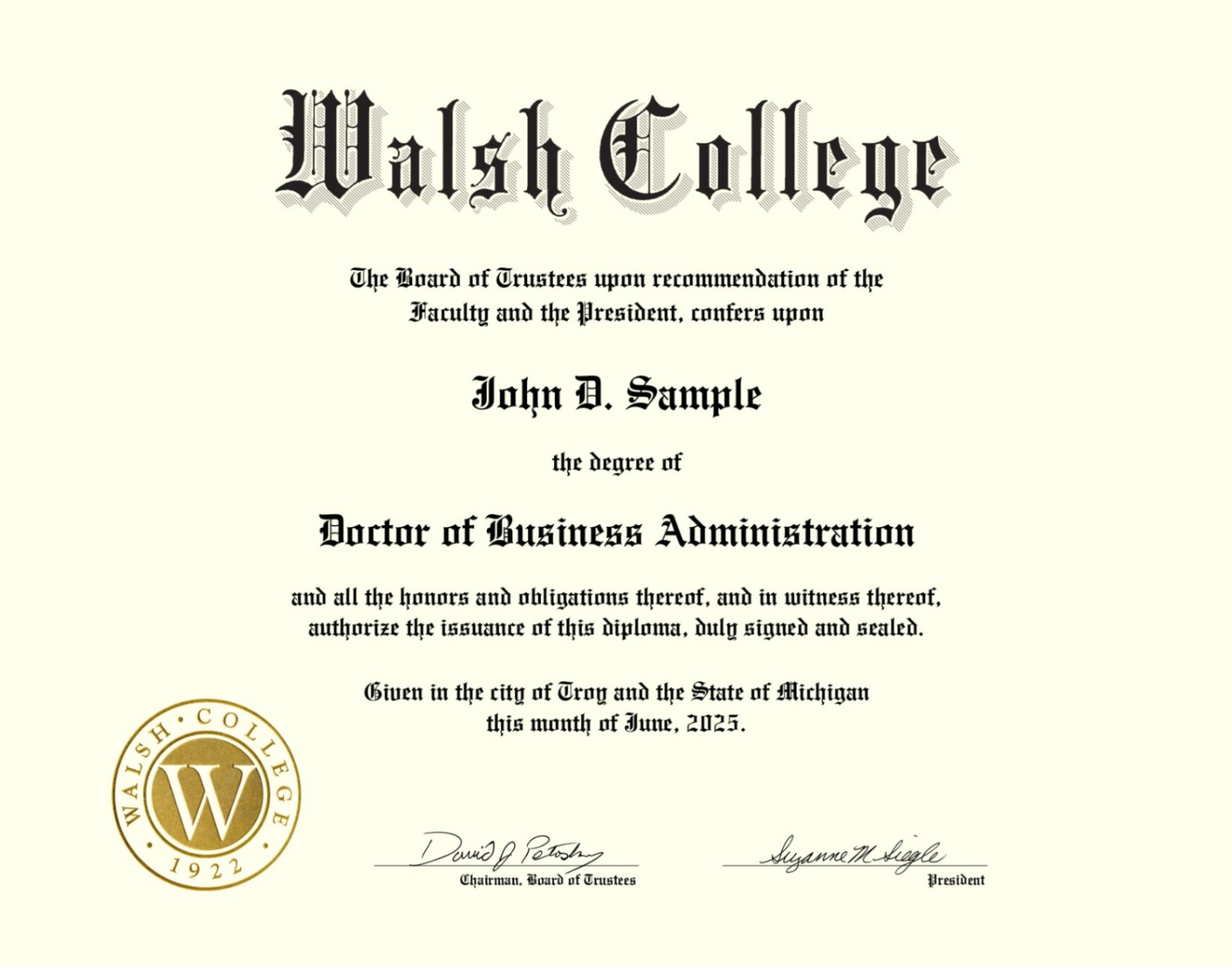
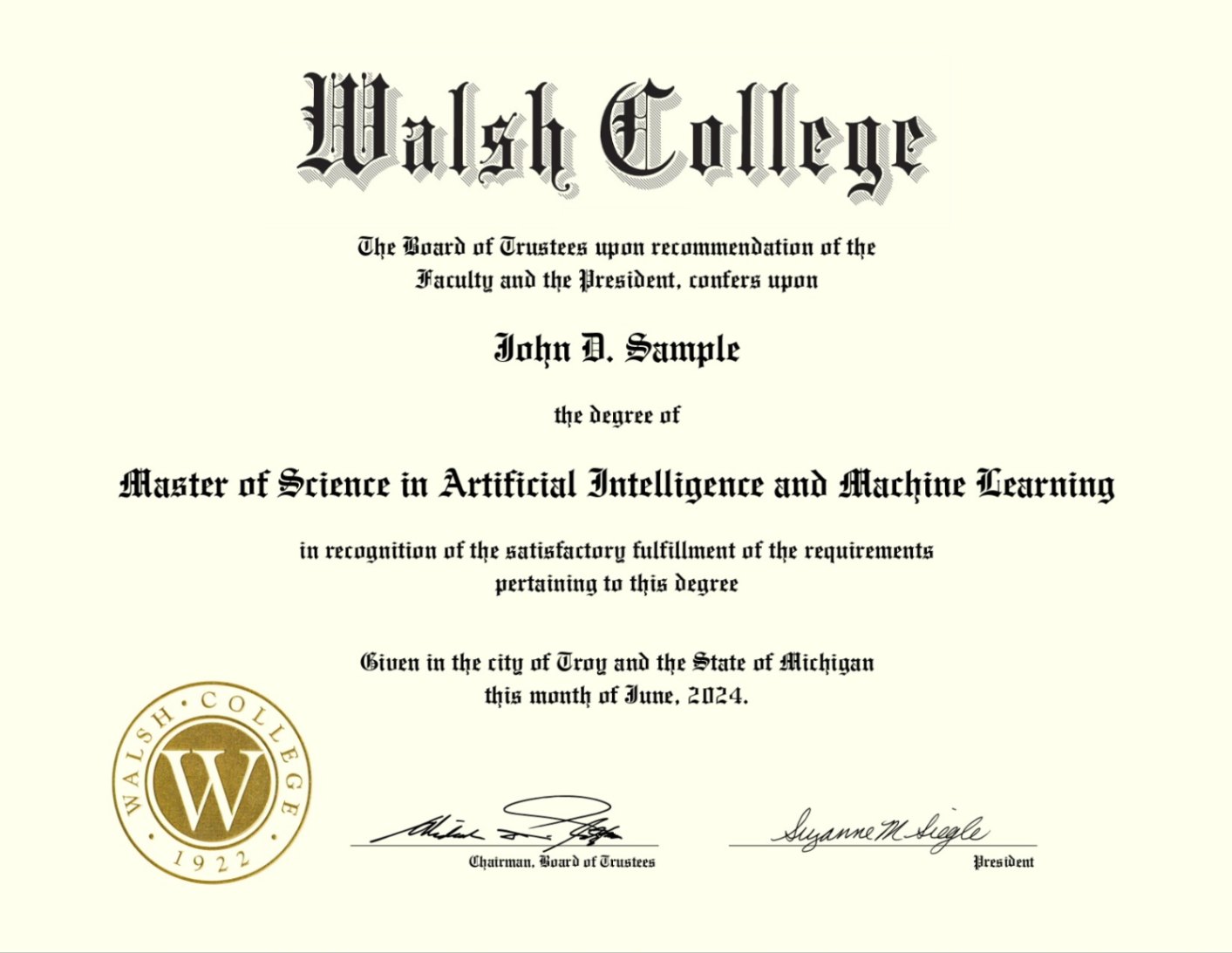
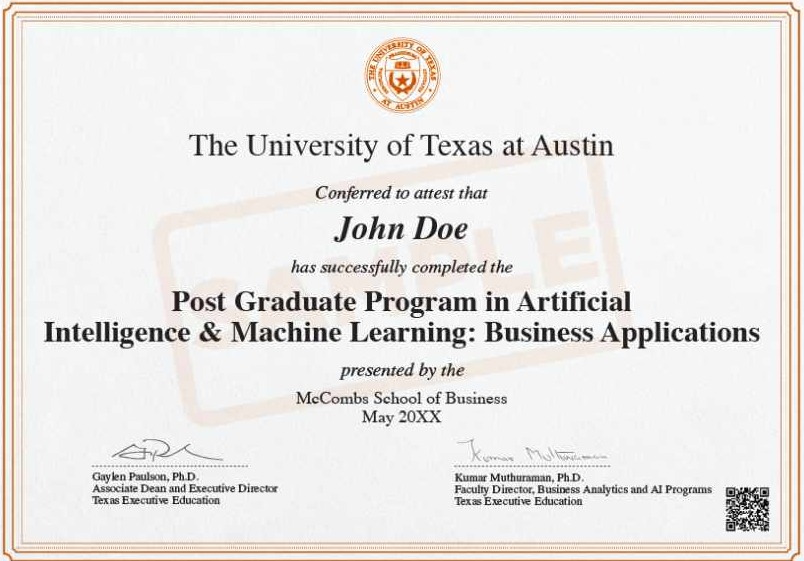
  • certificate image 0
  • certificate image 1
  • certificate image 2

* Image for illustration only. Certificate subject to change.

Meet your faculty

  • Javed Katibai - Faculty Director

    Javed Katibai

    Chassis System Architect - General Motors

    Know More
    Company Logo
  • James Gerrity - Faculty Director

    James Gerrity

    PhD, Adjunct Associate Professor

    Know More
    Company Logo
  • Dr. Dave Schippers - Faculty Director

    Dr. Dave Schippers

    VP and Academic Dean

    Know More
    Company Logo
  • Thomas Petz - Faculty Director

    Thomas Petz

    CIO/COO, Assistant Professor of IT

    Know More
    Company Logo
  • Christopher Heiden - Faculty Director

    Christopher Heiden

    Program Lead at IT, Associate Professor of Business Information Technology

    Know More
    Company Logo
  • Michael Rinkus  - Faculty Director

    Michael Rinkus

    DBA, Lawrence Technological University

    Know More
    Company Logo
  • Drew Smith - Faculty Director

    Drew Smith

    PhD, Pacifica Graduate Institute

    Know More
    Company Logo
  • Abbas Raftari  - Faculty Director

    Abbas Raftari

    Adjunct Instructor

    Know More
    Walsh College Logo
  • Kurt Godden  - Faculty Director

    Kurt Godden

    Senior Analytics Scientist - Ford Motor

    Know More
    Company Logo

Get industry ready with dedicated career support

  • banner-image

    1:1 mentorship from industry experts

    Get 1:1 career mentorship from our industry experts to prepare for jobs in AI and ML

  • banner-image

    Interview prep with experts

    Participate in mock interviews and access our tips & hacks on the latest interview questions of top companies

  • banner-image

    Resume & profile review

    Get your resume/cv and LinkedIn profile reviewed by our experts to highlight your AI & ML skills & projects

  • banner-image

    Access to Great Learning Job Board

    Apply directly to top opportunities from leading companies with Great Learning Job Board

Course Fees

The course fee is USD 12,550

Invest in your career

  • benifits-icon

    Gain global recognition with HLC accreditation and WES recognition

  • benifits-icon

    Earn alumni status from Walsh College upon program completion

  • benifits-icon

    Master AI & ML to solve complex, data-driven business problems

  • benifits-icon

    Earn a ‘Dr.’ title & get recognised as a specialist in your field

Take the next step

timer
00 : 00 : 00

Apply to the program now or schedule a call with a program advisor

Unlock exclusive course sneak peek

Application Closes: 5th May 2026

Application Closes: 5th May 2026

Talk to our advisor for offers & course details

Application process

Our admissions close once the requisite number of participants enroll for the upcoming batch . Apply early to secure your seats.

  • steps icon

    1. Fill the application form

    Apply by filling a simple online application form.

  • steps icon

    2. Interview Process

    Go through a screening call with the Admission Director’s office.

  • steps icon

    3. Join program

    An offer letter will be rolled out to the select few candidates. Secure your seat by paying the admission fee.

Eligibility

  • Applicants must hold a 3 or 4-year bachelor’s degree or equivalent in any discipline with a minimum of 60% marks from a UGC-recognized university or institution. The medium of instruction must be in English.
  • No GRE/GMAT or any English proficiency test scores are required.

Batch Start Date

Got more questions? Talk to us

Connect with our advisors and get your queries resolved

Speak with our expert +1 248 970 1937 or email to walsh.dba@mygreatlearning.com

career guidance

Frequently asked questions

Program Details
Faculty, Curriculum and Projects
Eligibility, Admissions, and Fees
Career-Related Queries
Program Details

What is the DBA in Artificial Intelligence (AI/ML) program about?

The Doctor of Business Administration (DBA) in Artificial Intelligence and Machine Learning is a doctoral-level program designed to help professionals understand, apply, and lead AI and ML initiatives in business contexts. The program combines rigorous academic foundations with real-world applications, enabling learners to use AI and ML for data-driven decision-making and organizational leadership

Is this DBA degree globally recognized?

Yes, this DBA Program by Walsh College is ranked among the top 10 Best online DBA degrees of 2024.

Are the Master's Degree and Doctorate WES-approved?

Yes. Walsh College is recognized by the World Education Services (WES). Students can showcase their educational accomplishments with a verified WES report that is accepted and respected by licensing boards, academic institutions, and employers throughout the US and Canada.

What is the duration and mode of the DBA in the Artificial Intelligence and Machine Learning program?

The program is 3 years long and offered 100% online.

How is the Walsh DBA better than other doctorate degrees in Business Administration?

#1 Ranking for Best Online DBA Programs by Forbes; Awarded Top-Tier Global DBA Ranking by CEO Magazine ; WES recognized; Accredited by The Higher Learning Commission (HLC), a regional accreditation agency recognized by the U.S. Department of Education.

Why should you choose this DBA course in AIML?

The program is ranked among the Top 10 Best Online DBA Degrees, is 100% online, and integrates advanced AI and ML with business strategy and applied research. It is designed for professionals seeking doctoral-level expertise with real-world relevance

What is the structure of this program?

The Doctor of Business Administration (DBA) in Artificial Intelligence and Machine Learning is delivered in a 2-phase structure, designed to build advanced AI and ML expertise before progressing to doctoral research.


Phase 1: Postgraduate Program in Artificial Intelligence and Machine Learning (AIML)
Learners begin with a Postgraduate program in AIML delivered by an academic partner institution.


Phase 2: Doctoral Program in AIML (DBA)
Upon successful completion of the postgraduate phase, learners progress to the Doctor of Business Administration in AIML offered by Walsh College.


Credentials Awarded:
Graduates earn a globally recognized DBA in Artificial Intelligence and Machine Learning from Walsh College, along with a Postgraduate Certificate from the partner institution associated with the learner’s pathway.

What kind of certificate will students receive upon completion?

Upon successful completion of the program, learners are awarded a globally recognized Doctor of Business Administration (DBA) in Artificial Intelligence and Machine Learning from Walsh College, along with a Postgraduate Certificate from the academic partner institution associated with their learning pathway.


For detailed information specific to your enrollment pathway, learners are encouraged to contact their Program Advisor.

What is the deadline to enroll in this program?

Admissions for the upcoming batch will close once we reach the required number of participants. Seats are limited and given out on a first-come, first-served basis. We encourage you to apply early to secure your spot in the program.

What possible assistance is provided to students in the final year of the dissertation?

The final year comprises a Dissertation, and to ensure students complete it without any challenges or rejection at a later stage, a Walsh faculty member will be assigned as a guide to show you the right direction.

What support does Walsh College provide to learners of the DBA Program?

The Doctor of Business Administration in Artificial Intelligence and Machine Learning (Walsh College) provides the following support to its learners:


  • Flexible Learning: The program is 100% online, allowing learners to balance their studies with professional commitments. 
  • Capstone Projects and Dissertation Guidance: Learners undertake capstone projects in Year 1 and Year 2 and work with a capstone mentor, followed by a thesis (dissertation) in Year 3 under the supervision of faculty/mentors.
  • Alumni Status: Graduates receive alumni status from Walsh College, which can foster networking and career support.

What are the learning outcomes?

Upon successful completion of the DBA program, you will be able to:


  1. Interpret and implement relevant AI and ML models to create new knowledge paradigms.
  2. Propel the field forward by expanding upon existing literature.
  3. Apply new-age AI techniques to solve real-world business problems.
  4. Develop research methodologies in alignment with philosophical paradigms.
  5. Generate fresh insights and offer justified recommendations.
  6. Upskill yourself as an ideal AI innovator with the latest skills to extract actionable insights for growth.
  7. Work as subject matter experts in your respective organizations and lead innovation/R&D projects.

Why is the DBA in AIML a better choice compared to other Doctor of Business Administration programs?

Unlike many programs that offer only basic AI exposure and limited career support, this DBA uniquely combines an MS, DBA, and PG Certificate with career guidance from Year 1. Recognized by global bodies such as the Higher Learning Commission and World Education Services, it ensures strong academic rigor and international credibility, making it an exceptional choice for professionals seeking both AI expertise and career growth.

How many hours per week are required for the DBA program?

Learners are encouraged to review the program structure and discuss workload expectations with a program advisor.

Faculty, Curriculum and Projects

Who are some notable faculty members in this DBA program?

Name

Credentials/Background

Affiliation/Expertise

Dr. Abbas Raftari

Dual Ph.D., 25+ years at GM and Ford

Teaches advanced courses in Vehicle Safety, AI, and Data Security at Walsh College.

Kurt Godden

Senior Analytics Scientist

Ford Motor

Javad Katiibai

Assistant Professor - Quantitative Methods

Walsh College; Chassis System Architect - General Motors

Christopher Heiden

Program Lead at IT, Associate Professor of Business Information Technology

Walsh College

James Gerrity

Ph.D., Adjunct Associate Professor

Walsh College; Portfolio Associate and Business Service Manager - Morgan Stanley

Dr. Dave Schippers

VP and Academic Dean, Assistant Professor at Automotive Cybersecurity

Walsh College

Michael Rinkus

DBA, Lawrence Technological University; MA, Central Michigan University; BS, Wayne State University

Walsh College

Drew Smith

Ph.D. Pacifica Graduate Institute; MA, Pacifica Graduate Institute; BS, Rochester University

Walsh College

*Faculty list is indicative and subject to change.

What are the key subjects covered in the curriculum?

The program is structured across 3 years, progressing from foundational AI skills to advanced applications and research. For a detailed breakdown of modules and learning outcomes, learners are advised to refer to the official program brochure.

Are there hands-on projects included in the program?

Yes, the program includes Capstone Projects in Year 1 and Year 2, followed by a thesis in Year 3.

Is there a residency course component in the program?

Yes, the DBA curriculum includes Doctoral Residency I, II, and III courses.

What are the languages and tools covered in this program?

The languages and tools covered are Python, TensorFlow, NumPy, Matplotlib, Statsmodels, Keras, Scikit-learn, and Seaborn.

Eligibility, Admissions, and Fees

What are the eligibility requirements for this DBA program?


  • Applicants must hold a 3- or 4-year bachelor's degree (or equivalent) in any discipline from a UGC-recognized university.
  • The medium of instruction must be English.
  • No GRE/GMAT scores are required.

For clarification on individual eligibility, applicants are encouraged to contact their program advisor.

Are international learners eligible for this online DBA?

The program is delivered online and supports learners across regions. Eligibility and documentation requirements may vary, and applicants are advised to speak with a program advisor for details

Is this an online DBA suitable for working professionals?

Yes. The program is offered in a 100% online format and is designed to support professionals alongside their existing work commitments. The structure emphasizes flexible learning while maintaining doctoral-level academic rigor

What is the admission process?

Step 1: Apply online
Fill out a fast and easy application form. No additional tests or prerequisites are needed. 


Step 2: Pre-screening
Our team will contact you by phone to confirm your eligibility for the program. 


Step 3: Application assessment
The admissions team will assess your application and provide a timely response. 


Step 4: Join the program.
If selected, you will receive an acceptance letter with instructions on how to pay and join the program.


Note: Admission to the program is subject to Walsh College acceptance.*

Does the applicant need a Master’s degree to start the DBA?

No. A Master’s degree is not required to enroll in the Doctor of Business Administration (DBA) in Artificial Intelligence and Machine Learning. Applicants are eligible with a 3- or 4-year bachelor’s degree (or equivalent) from a recognized institution, as outlined in the program eligibility criteria.

What is the DBA online program fee?

For the most up-to-date information on the course fee, please refer to the official program page here.

Career-Related Queries

What career advantages does a DBA in AI & ML offer compared to a PhD?

The DBA focuses on applied research, business leadership, and real-world AI implementation, making it suitable for senior professionals and industry leaders. In contrast, a PhD is typically more theory-oriented and academically focused.

What skills will I gain after completing the program?

The skills you will gain after completing the DBA program include:


  • Implementing AI and ML models
  • Applying AI techniques to solve business problems
  • Developing research methodologies
  • Generating insights
  • Implementing Strategic AI Leadership

Who typically enrolls in this program?

The cohort consists mostly of professionals from IT (47.6%), manufacturing (19.05%), finance, education, marketing, consulting, pharma, and other industries, with work experience ranging primarily from 3 to 15+ years.


*This data is indicative and may vary based on cohorts.

Will I receive alumni status after completion?

Yes, graduates receive alumni status from Walsh College.

Will I receive any career support after completing the program?

Yes, you will receive career support from Great Learning, India’s renowned ed-tech platform for professional development and higher education. 

T&C valid*

Can I publish research papers during the DBA program?

Yes. The program includes capstone projects, applied research modules, and a doctoral dissertation, which support scholarly research and the development of publishable work (subject to approval, if required, before publishing any findings related to a company involved)

What are the career opportunities after I complete a DBA degree online?

Here are high-impact career roles typically pursued by graduates of a DBA in AI and ML:


  1. Chief AI officer
  2. Director – AI strategy
  3. AI/ML solutions architect
  4. Senior data scientist
  5. Head of AI/ML research
  6. AI and ML consultant