
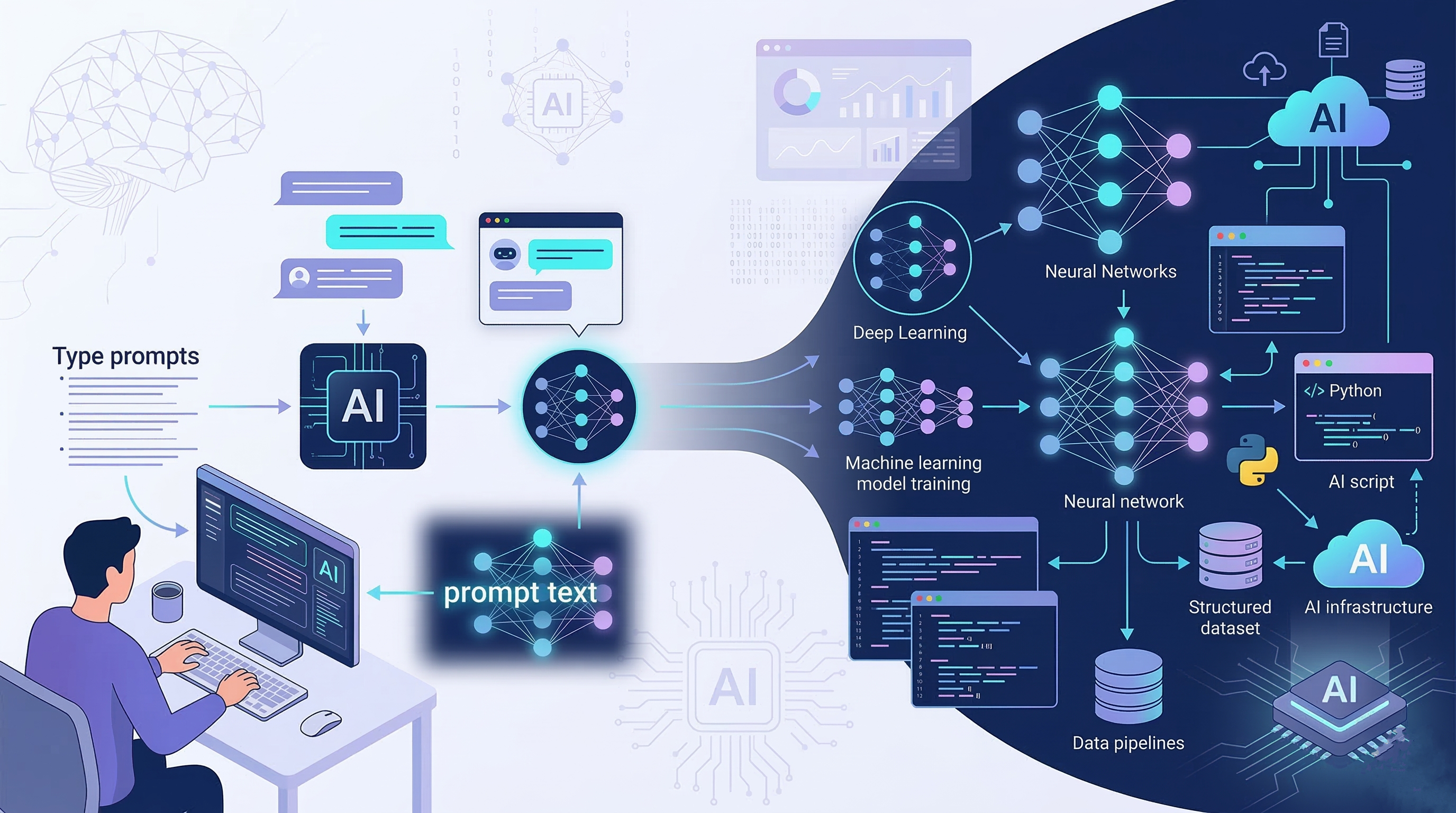
With the rapid rise of prompt engineering in recent years, many professionals believe that learning to write effective prompts is enough to secure roles in AI.
However, this assumption is incorrect. A Gartner report predicts that in 2026, nearly 30 percent of Generative AI projects will be abandoned after the proof of concept stage due to poor data quality, weak risk controls, and rising operational costs, challenges that prompt engineering alone cannot solve.
Although jobs requiring AI literacy have grown by 70 percent year over year in the United States, organizations are looking for professionals who can:
- Evaluate AI Outputs
- Implement Safety Guardrails
- Optimize Systems For Reliability And Cost
- Integrate AI Solutions Into Real Production Environments
In this blog, we explain why relying only on prompt engineering can be risky and highlight the broader technical skills required to remain competitive in the AI field.
Why Prompt Engineering Alone Isn't Enough?
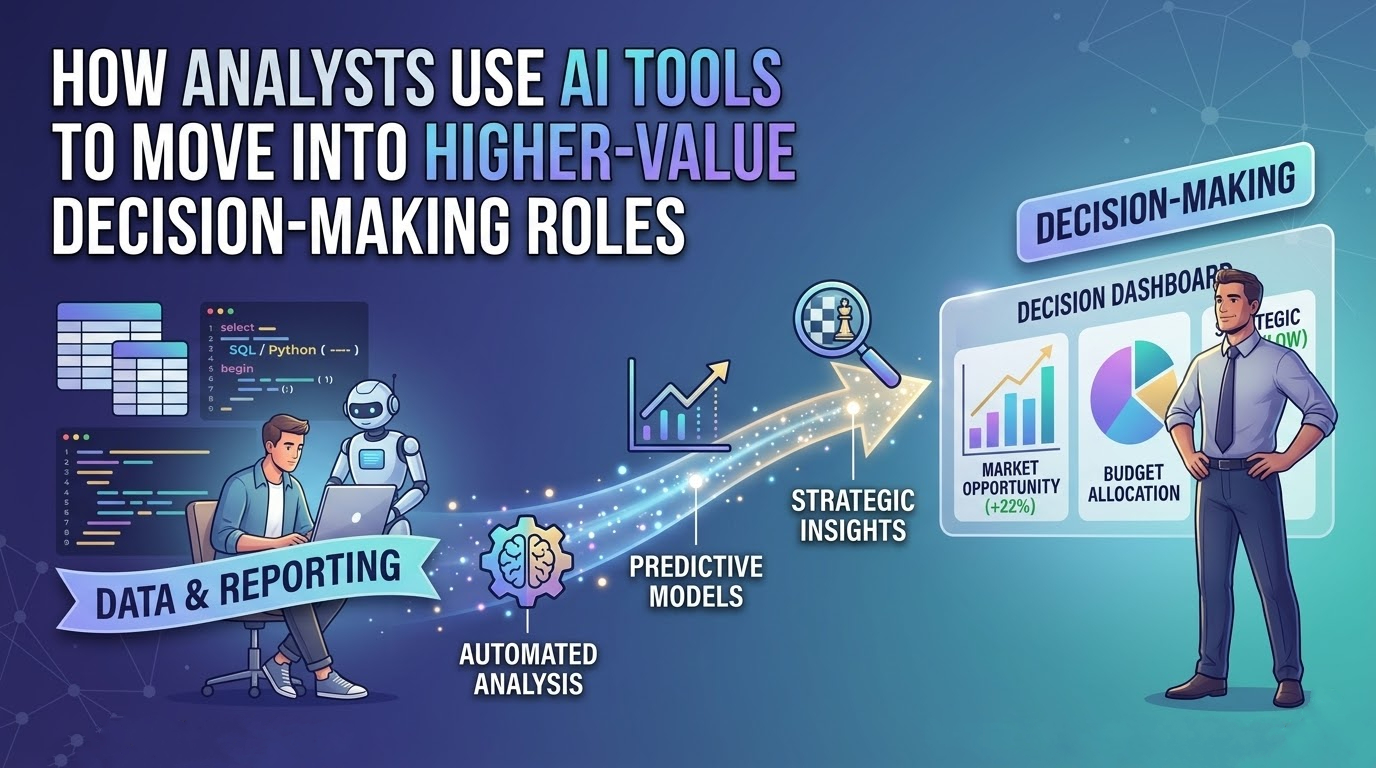
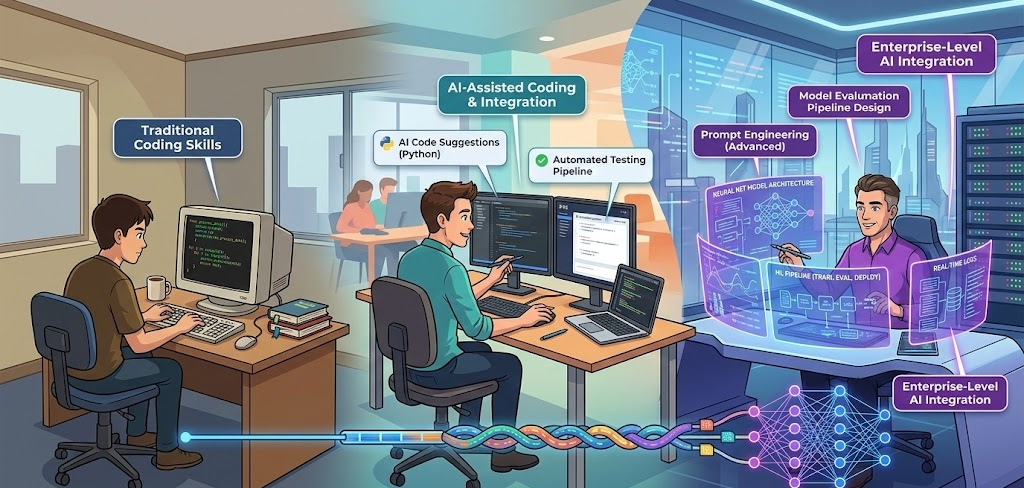
The tech industry is rapidly moving beyond the simple use of conversational AI chatbots. Modern companies are actively looking for skilled professionals who can build, integrate, and optimize complex AI solutions, not just end-users who know how to talk to them.
While deeply understanding prompt engineering is indeed a fantastic starting point, the modern job market heavily demands a much deeper understanding of the underlying systems.
Here are the main reasons why relying on this single skill falls short:
1. The Automation of Prompting Itself
Modern Large Language Models (LLMs) are rapidly becoming smart enough to optimize their own prompts automatically. Tools are now designed to understand vague human instructions and rewrite them internally to get the best result. As this automation improves, the dedicated role of a human manually typing detailed instructions will slowly disappear.
2. Missing Core Technical Depth
Relying strictly on text inputs means you completely skip learning how the underlying systems actually work. To build a secure career in artificial intelligence, you must understand the architecture, data processing, and algorithms behind the models.
Without this technical depth, you cannot fix broken models or integrate them into company servers. If you want to build this foundational knowledge from scratch, the Introduction to Artificial Intelligence free course is a great starting point.
This course helps you understand what artificial intelligence is and its domains, covering neural networks, the basics of natural language processing (NLP), and computer vision. It includes examples like image classification, face recognition, and video analytics to enhance your practical knowledge.
3. Narrow Scope of Business Impact
A professional who only knows how to write prompts is severely limited in their ability to solve large-scale business problems.
Companies want people who can build end-to-end data pipelines and deploy software, not just people who can generate text.
To truly understand what generative AI is and how to use it fully, you must look beyond the chat interface and learn how to connect these models to real applications.
4. Extreme Vulnerability to Market Shifts
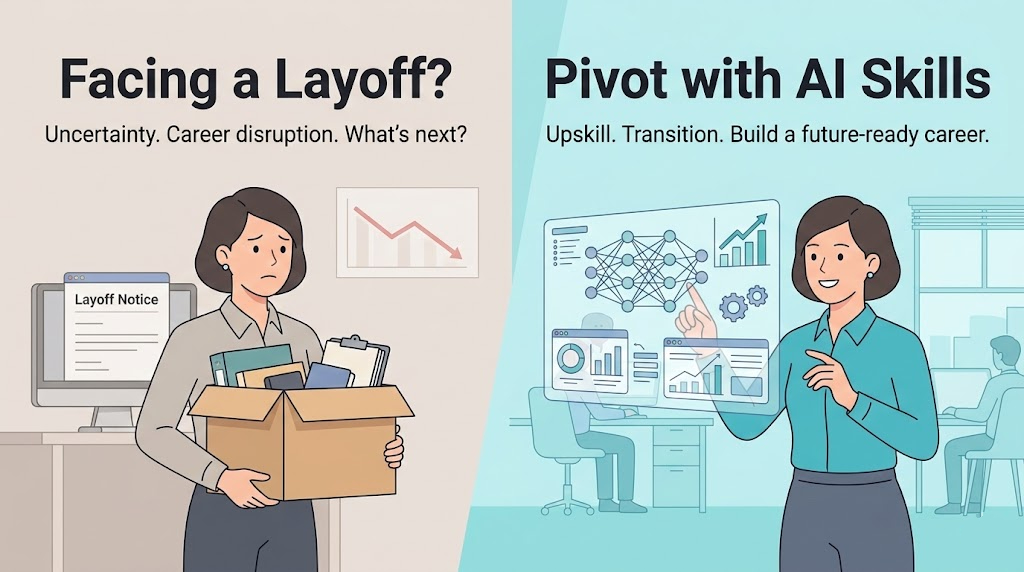
When the job market changes, roles that require very little technical training are always the first to be replaced or combined with other roles. The future of artificial intelligence belongs to those who have a diverse and adaptable skill set.
Having a broader foundation ensures that you remain valuable even when specific tools or interfaces become outdated. To successfully navigate these rapid transitions and plan your long-term professional journey, exploring a comprehensive guide on Careers and Roadmap provides excellent, practical advice on building a stable path in the AI sector.
What You Need for a Secure Career in AI/LLMs?
The top AI/ML recruitment trends show that companies no longer want only end users; they demand developers, architects, and strategic problem solvers.
To make your career genuinely secure, you must actively build a wide set of skills that go far beyond typing text into a prompt box.
Here is a specific list of the most demanded capabilities you should learn to protect your professional future:
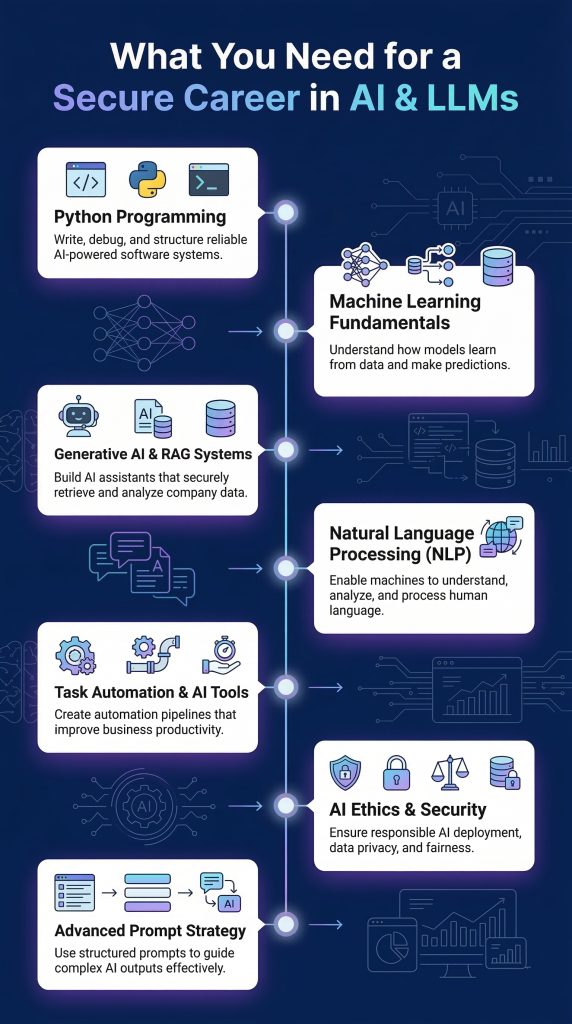
1. Python Programming and Architectural Oversight
While some industry observers mistakenly believe that artificial intelligence will entirely replace the need to write code, this is a dangerous misconception.
AI can certainly generate basic scripts, but it completely lacks the complex human reasoning needed to validate intricate logic, review code for deep security flaws, and integrate new software into existing enterprise systems safely.
Companies strongly demand professionals who deeply understand programming logic to act as critical architectural reviewers. You must learn to debug complex errors that AI cannot resolve and structure the codebase properly, and programs like the Master Python Programming course help you achieve this exact goal.
In this course, you will learn the fundamentals of Python: from basic syntax to mastering data structures, loops, and functions. You will also explore OOP concepts and objects to build robust programs.
This course teaches you Python basics, data structures, loops, functions, object-oriented programming (OOP), RegEx, and exception handling through 51 coding exercises.
It allows you to build real-world tools like a virtual banking application, a virtual pet, and a Wikipedia extractor, ensuring you gain hands-on coding skills to write clean and reliable code.
2. Machine Learning Fundamentals
Moving past simple software usage means fundamentally understanding how the actual models are trained and evaluated from the ground up. You need to learn how supervised and unsupervised learning algorithms process raw data to make highly accurate predictions.
When you understand these internal mechanisms, you can correctly evaluate which model to use for a specific business problem, rather than just guessing blindly. This deep understanding is one of the biggest advantages of pursuing a career in machine learning.
Employers highly value this technical depth because it allows them to build custom solutions that are highly accurate and tailored to their specific industry needs, keeping your role critical and secure.
You can actively test your current technical knowledge of these core concepts by taking our engaging quizzes, which perfectly help identify specific areas where you might need further study.
3. Applied Generative AI Workflows (RAG and Agents)
Knowing how to securely integrate foundational models with private company data is in demand today. You need to learn how to build Retrieval-Augmented Generation (RAG) systems and autonomous AI agents.
This vital skill helps you create custom AI assistants that can search through secure corporate documents and provide accurate, private answers safely. Companies desperately need this because public AI tools cannot access their internal files securely.
To build these capabilities, the Johns Hopkins University Certificate Program in Applied Generative AI is highly recommended.
Certificate Program in Applied Generative AI
Master the tools and techniques behind generative AI with expert-led, project-based training from Johns Hopkins University.
This comprehensive program makes your technical skill set completely indispensable by teaching you exactly how Large Language Models (LLMs) function, alongside using Generative AI to generate, interpret, debug, and execute Python code for practical applications.
Furthermore, it equips you to build advanced Agentic workflows with LangChain, such as highly autonomous Web and Database agents, while mastering RAG search techniques, including Byte-Pair Encoding, computing sentence embeddings, and fine-tuning basic models.
By ultimately learning how to successfully identify and mitigate algorithmic biases while applying relevant laws for secure and responsible AI usage, you solidify your position as a trusted organizational leader who can safely deploy transformative technology, guaranteeing your absolute relevance in a highly competitive job market.
4. Natural Language Processing (NLP)
To work effectively with complex text-based data, you must study exactly what natural language processing (NLP) is. This involves fully learning how machines tokenise text, understand human sentence structure, and convert words into mathematical vectors.
Learning NLP helps you build sophisticated systems that can rapidly analyze customer feedback, summarize large technical reports, and translate languages accurately.
Businesses demand this specific skill because it completely automates their customer support and data analysis processes, saving massive amounts of operational time and money.
Having this specialized skill ensures you are always needed to properly maintain and improve these language-based corporate systems.
5. Task Automation and Tool Creation
The unique ability to build useful programs to solve daily workplace problems is extremely valuable across all departments.
You should learn how to strategically automate repetitive tasks like screening thousands of resumes or filtering massive datasets by creating intelligent automation pipelines powered by machine learning models, natural language processing systems, and large language model-based workflows that can analyze unstructured data, extract meaningful insights, and support scalable AI-driven decision making.
This helps your team work much smarter and faster without doing menial activities manually. Organizations strongly demand professionals who can turn repetitive business operations into working tools that drastically improve overall productivity.
6. AI Ethics, Security, and Governance
As these powerful systems become more common, ensuring they are used safely is absolutely non-negotiable for modern corporations.
You must learn how to carefully identify algorithmic biases, completely protect user data privacy, and deploy models responsibly. This crucial skill helps you legally protect the company from massive financial risks and public relations disasters.
Companies actively look for experts who truly understand AI ethics because a single data breach or biased decision can severely damage their brand reputation.
Your career remains highly secure when you become the trusted technical gatekeeper who ensures all technology is implemented securely and fairly. For a deeper look into how these systems impact businesses and why customized security matters, the video Generative AI Explained: An Overview of LLMs and Their Business Impact provides excellent insights.
7. Advanced Prompt Strategy and Refinement
Finally, even though prompting alone is never enough, doing it at an advanced technical level is still a necessary piece of the broader puzzle.
You need to confidently learn advanced techniques like few-shot prompting and complex chain-of-thought reasoning to accurately guide difficult AI outputs. This strategically helps you get highly accurate responses on the very first try, heavily saving on computational API costs and time.
To understand how these advanced methods work practically in the industry, you should watch Prompt Engineering: From Basics to Advanced Strategies. It clearly breaks down how to carefully structure multi-step commands and thoughtfully refine AI behaviour for the absolute best business results.
To build a secure and future-proof career in AI, professionals must go beyond basic tool usage and develop strong technical, analytical, and strategic capabilities.
By continuously strengthening these core skills, you position yourself as a high-value contributor who can drive real business impact in an increasingly AI-driven world.
Conclusion
The core question is definitely not whether learning how to become a prompt engineer is a valuable endeavour; it most certainly is a fantastic starting point. However, treating it as a singular career lifeline is an exceptionally risky strategy.
The true power in the modern workforce lies in combining clear AI communication with a robust understanding of computer programming, advanced data science, and complex system architecture.
The AI revolution is already here, and professionals who actively choose to master its profound technical depths will undoubtedly be the successful leaders forging the path ahead.