You do not need to be an expert programmer or mathematician to begin Machine Learning. However, understanding a few core concepts will make it easier to follow how models use data and produce predictions. A readiness check can help you decide whether to begin now or prepare further.
What Skills Do You Need Before Learning Machine Learning?
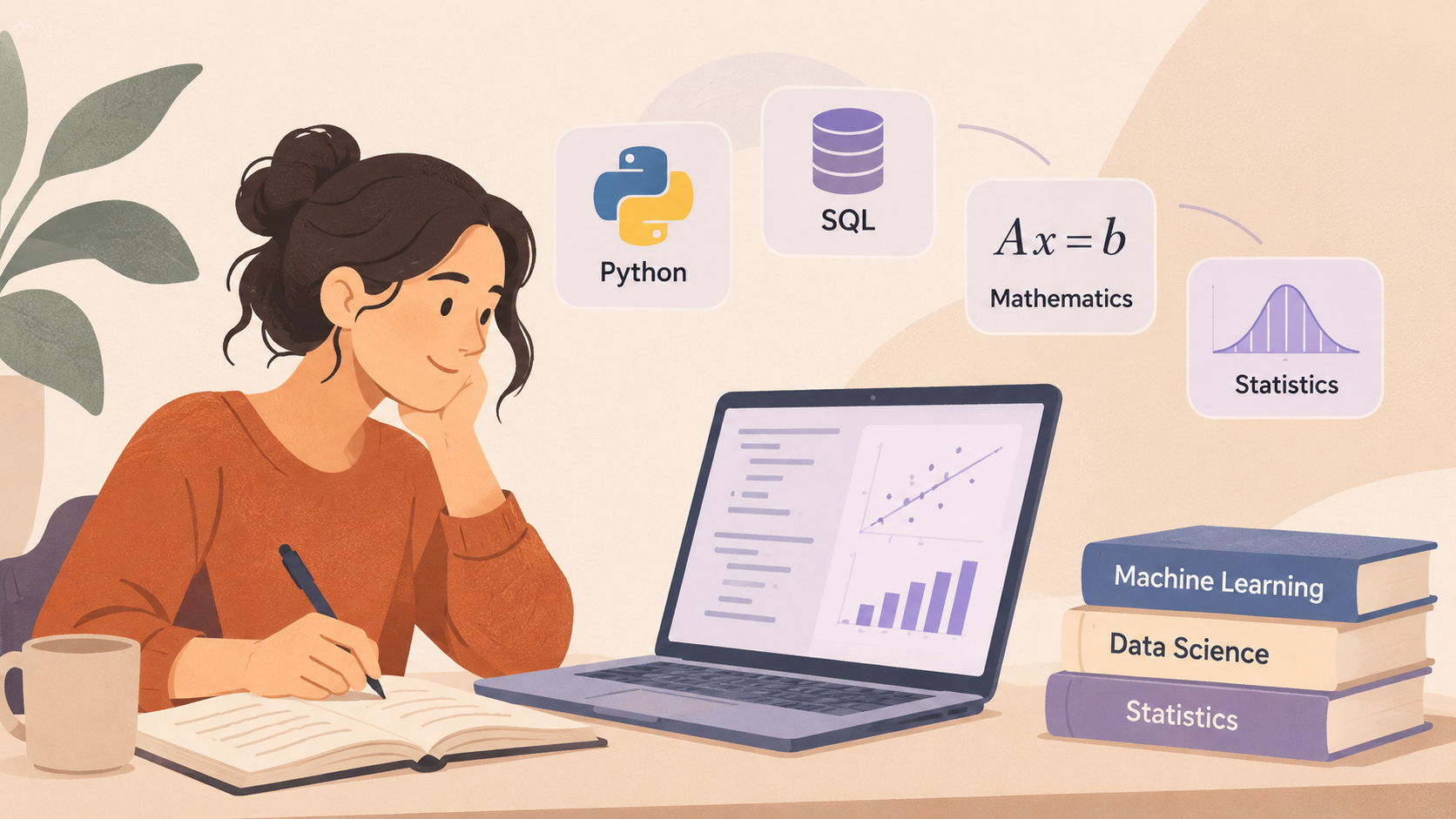
Machine Learning draws on several connected areas:
- Programming: Basic Python, including variables, functions, loops, and common data structures.
- Data handling: Familiarity with SQL and the process of loading, organizing, and cleaning datasets.
- Mathematics: Foundational algebra, equations, functions, vectors, and matrices.
- Statistics: Descriptive statistics, probability, variation, and distributions.
You do not need advanced expertise in every area before beginning Machine Learning. Focus on understanding the fundamentals well enough to follow introductory lessons and work with simple datasets. As you progress, you will encounter concepts that connect programming, mathematics, statistics, and data analysis.
For example, the Applied AI and Data Science Program from MIT Professional Education brings these areas together through a structured learning pathway. Its focus on applied AI and data science illustrates how foundational knowledge supports more advanced concepts, including working with data, understanding machine learning methods, and applying AI techniques to practical problems. This can help you understand the skills you may want to develop as you progress beyond introductory Machine Learning.
MIT Professional Education's Data Science Course
Gain the expertise top companies seek and open doors to Data Science jobs.
How Do You Know If You Are Ready to Learn Machine Learning?
Use these questions to check whether you can apply the foundations, not just recognize the terminology.
| Practical check | Ask yourself |
| Write code | Can I create a short Python function and explain its output? |
| Query data | Can I retrieve and filter records from a table? |
| Interpret numbers | Can I explain what an average or variation in a dataset indicates? |
| Inspect a dataset | Can I identify missing or inconsistent values? |
| Explain a finding | Can I describe a pattern without assuming it proves cause and effect? |
Mostly yes means you can begin with introductory Machine Learning. A mix of yes and no points to specific areas for practice. Mostly no suggests revisiting the relevant fundamentals before moving to model-building.
Once you are comfortable with these fundamentals, you can test your understanding of key Machine Learning concepts and algorithms. Explore these Machine Learning interview questions and answers to familiarise yourself with commonly discussed topics, from supervised and unsupervised learning to model evaluation and optimization.
What Should You Learn First If You Are New to Machine Learning?
Turn the gaps you identified into a short preparation plan. Work on one area at a time, use beginner exercises, and repeat each task until you can complete it without step-by-step guidance.
Next, combine your learning in one small dataset exercise: load and clean a dataset, summarize its contents, and explain a pattern you notice. This helps you practice a complete data workflow before taking on complex Machine Learning algorithms.
How Can You Get Started with Machine Learning?
If you are looking for a structured way to build Machine Learning skills, consider the e-Postgraduate Diploma (ePGD) in Artificial Intelligence and Data Science from IIT Bombay. This 18-month online program, designed and delivered by IIT Bombay faculty, covers Programming for Machine Learning and Data Science, Statistical Foundations of Machine Learning, Machine Learning, and Deep Learning and GenAI.
IIT Bombay ePGD in AI & Data Science
Master AI and data analytics with IIT Bombay's e-Postgraduate Diploma. Build hands-on skills to advance your career.
You can also see how structured learning translates into practical skill development through this AI and Machine Learning learning experience of a front-end architect. Start with the fundamentals, practise with real datasets, and gradually build your ability to develop, evaluate, and interpret Machine Learning models.