
- Why Do Nutrition Studies Sometimes Disagree?
- Does Statistical Significance Mean a Nutrition Finding Matters?
- Is Personalized Nutrition Supported by Evidence?
- How Can You Tell If a Nutrition Claim Is Reliable?
- Why Should You Be Careful With Nutrition Headlines?
- How Can Nutrition Professionals Apply Evidence More Effectively?
- What Does Evidence-Based Nutrition Really Mean?
- FAQs
Nutrition advice is everywhere, but not all nutrition information is equally reliable. A 2023 systematic review of 64 content-analysis studies found that almost half of the studies assessing online nutrition information classified its quality (48.8%) or accuracy (48.9%) as poor. The researchers also noted limitations, including a high risk of bias in some studies’ sample selection and quality or accuracy assessments.
This can make it difficult to separate evidence-based nutrition from oversimplified claims. So, how should you evaluate a nutrition claim before accepting it as fact?
Why Do Nutrition Studies Sometimes Disagree?
Conflicting nutrition findings do not necessarily mean that nutrition science is unreliable. Studies can differ in their design, participants, outcomes, and research questions.
For example, an observational study may identify an association between a dietary factor and a health outcome, while a randomized controlled trial may examine the same topic under controlled conditions.
The population also matters. A finding observed in one group may not apply to everyone. Similarly, a study measuring a biomarker may not tell us whether an intervention improves a meaningful health outcome.
Does Statistical Significance Mean a Nutrition Finding Matters?
Not necessarily.
Statistical significance addresses whether a result is unlikely to be explained by chance under the study's assumptions. Clinical or practical significance asks whether the size of that effect is large enough to matter in real-world settings.
These are not interchangeable. A nutrition study can report a statistically significant result without showing a substantial or meaningful change in health outcomes.
That distinction is particularly important when interpreting attention-grabbing research headlines.
Is Personalized Nutrition Supported by Evidence?
Personalized nutrition is promising, but the evidence is not uniform.
A 2024 randomized controlled trial involving 347 adults found that an app-based personalized dietary program produced a modest reduction in triglycerides at 18 weeks, while LDL cholesterol did not differ between the personalized and standard-advice groups. The study also noted limitations related to adherence, intervention length, and its combination of multiple components. Read the 2024 Nature Medicine study.
A systematic review of nine randomized trials, meanwhile, found no consistent benefit of personalized nutrition across dietary, behavioral, or health outcomes.
The takeaway is not that personalized nutrition is ineffective. Rather, its value needs to be assessed based on the specific intervention, population, and outcome. Digital tools can generate additional nutrition data, such as food image recognition and calorie prediction, but the usefulness of such technologies still depends on how accurately they measure what they claim to measure. More data does not automatically mean better decisions.
How Can You Tell If a Nutrition Claim Is Reliable?
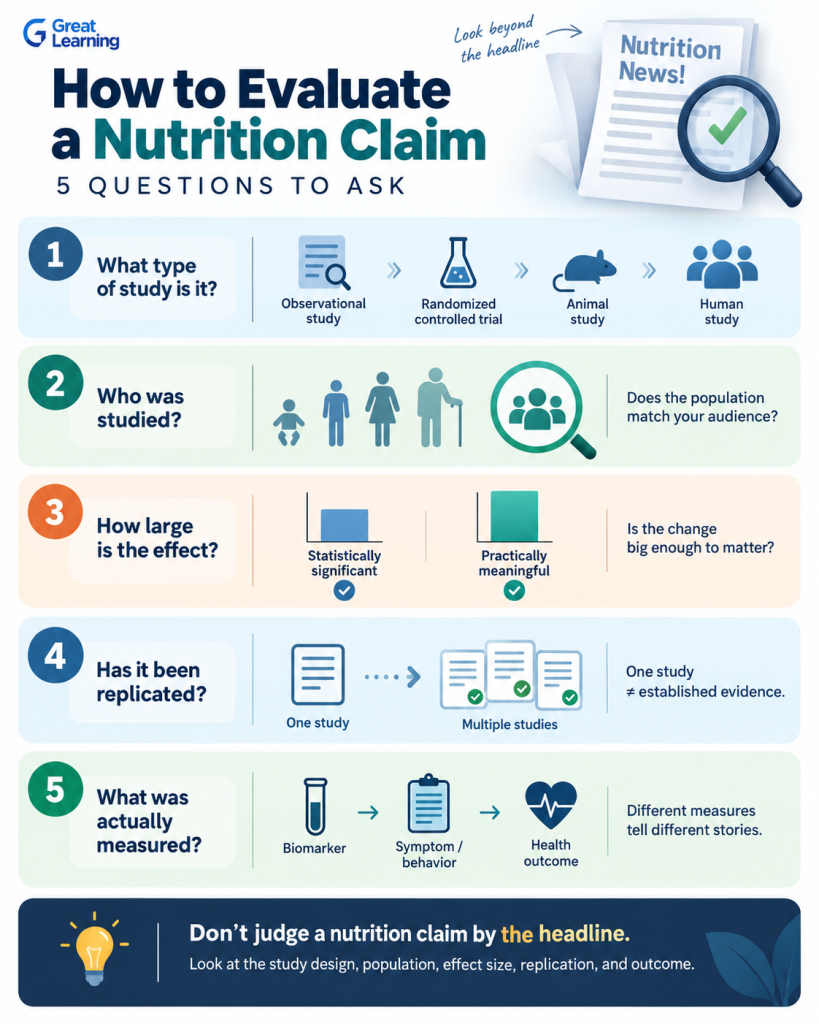
Before accepting a nutrition claim, ask these five questions:
1. What type of study is it?
Determine what type of study it is, for example, an observational study or randomized controlled trial; and whether it was conducted in animals or humans.
2. Who was studied?
Consider whether the study population resembles the people to whom the claim is being applied. Findings from a specific population may not be universally applicable.
3. How large is the effect?
Look beyond whether a result is statistically significant. Consider whether the size of the effect is practically meaningful.
4. Has the finding been replicated?
A single study can provide an important signal, but replication helps establish whether a finding is consistent.
5. What was actually measured?
Was the study measuring a biomarker, symptom, behavior, or meaningful health outcome? These measures do not necessarily tell the same story.
Why Should You Be Careful With Nutrition Headlines?
Nutrition headlines can sometimes make findings sound more definitive than the underlying research supports. An observed association, for example, does not necessarily establish cause and effect, while findings from animal studies or specific populations may not apply broadly to humans.
Similarly, research comparing one dietary approach with another does not prove that it is the best option for everyone. Looking beyond the headline at the study design, population, outcomes measured, and size of the effect can provide a more accurate understanding of what the evidence actually shows.
How Can Nutrition Professionals Apply Evidence More Effectively?
For nutrition and health professionals, interpreting research is increasingly important as new approaches in precision nutrition, digital health, behavioral science, and weight management emerge. The growing use of GLP-1 medications, for example, has alsho raised questions about nutrition and GLP-1 in weight management.
The Applied Nutrition and Behavior Change Program from Harvard T.H. Chan School of Public Health is designed for health care leaders, public health and institutional nutrition professionals, and health and wellness practitioners. Its curriculum integrates nutrition science with precision nutrition, behavioral science, clinical applications, and public health strategy.
Harvard Applied Nutrition and Behavior Change
Learn to design effective nutrition interventions and promote lasting dietary behavior change. This Harvard T.H. Chan School program combines nutritional science with behavioral economics to improve public health.
The nine-week online program includes nine live sessions with industry mentors, two masterclasses from Harvard Chan faculty, recorded faculty content, and a 5–7 hour weekly learning commitment. Learners earn a Certificate of Completion from Harvard School of Public Health upon completion.
Its curriculum also covers research methodology, RCTs, cohort studies, meta-analyses, methodological bias, precision nutrition, and the microbiome. Learn more about the Harvard Applied Nutrition and Behavior Change program, including its key highlights and learning outcomes.
What Does Evidence-Based Nutrition Really Mean?
Nutrition science is becoming more nuanced, not necessarily less reliable. The key is to look beyond individual headlines and ask what the evidence actually shows, how strong it is, and whether it applies to the population in question.
Instead of asking only, “Which diet is right?”, a more useful question may be: “What evidence would convince me?”
FAQs
What are nutrition myths?
Nutrition myths are widely repeated claims about food, diets, nutrients, or health that may oversimplify or extend beyond what available evidence demonstrates.
Why do nutrition studies have conflicting results?
Studies may differ in research design, population, outcomes measured, and methodology, leading researchers to answer different questions.
How can you identify evidence-based nutrition information?
Look at the study type, population, effect size, replication, and outcome measured before drawing conclusions.