The demand for Agentic AI Engineers in India grew 260% in 2026 compared with 2025, according to CIEL HR's analysis of technology workforce demand.
As organisations explore AI systems that can plan tasks, use tools, and execute multi-step workflows, software developers have an opportunity to move into this emerging engineering role.
The transition does not require starting from scratch. Your experience in programming, application architecture, API integration, testing, and deployment provides a strong foundation. The key is to extend these skills to building AI-powered systems that can perform tasks with greater autonomy.
What Changes When You Move From Software Development to Agentic AI Engineering?
Software developers already have experience building, integrating, testing, and deploying applications. These capabilities transfer directly to Agentic AI engineering, but developers must extend them to support LLM-powered decision-making and autonomous task execution.
| Existing skill | How it applies to Agentic AI | Skills to build on |
| Programming (Python, Java) | Developing agent logic | Python, LLM integration |
| API integration | Connecting agents to external tools | LLM APIs, tool calling |
| Backend development | Supporting agent workflows | Orchestration, memory, state management |
| Database management | Retrieving relevant information | Embeddings, vector databases, RAG |
| Testing and debugging | Validating agent behaviour | Agent evaluation, failure recovery |
| Cloud deployment and CI/CD | Deploying AI applications | AgentOps, monitoring, security |
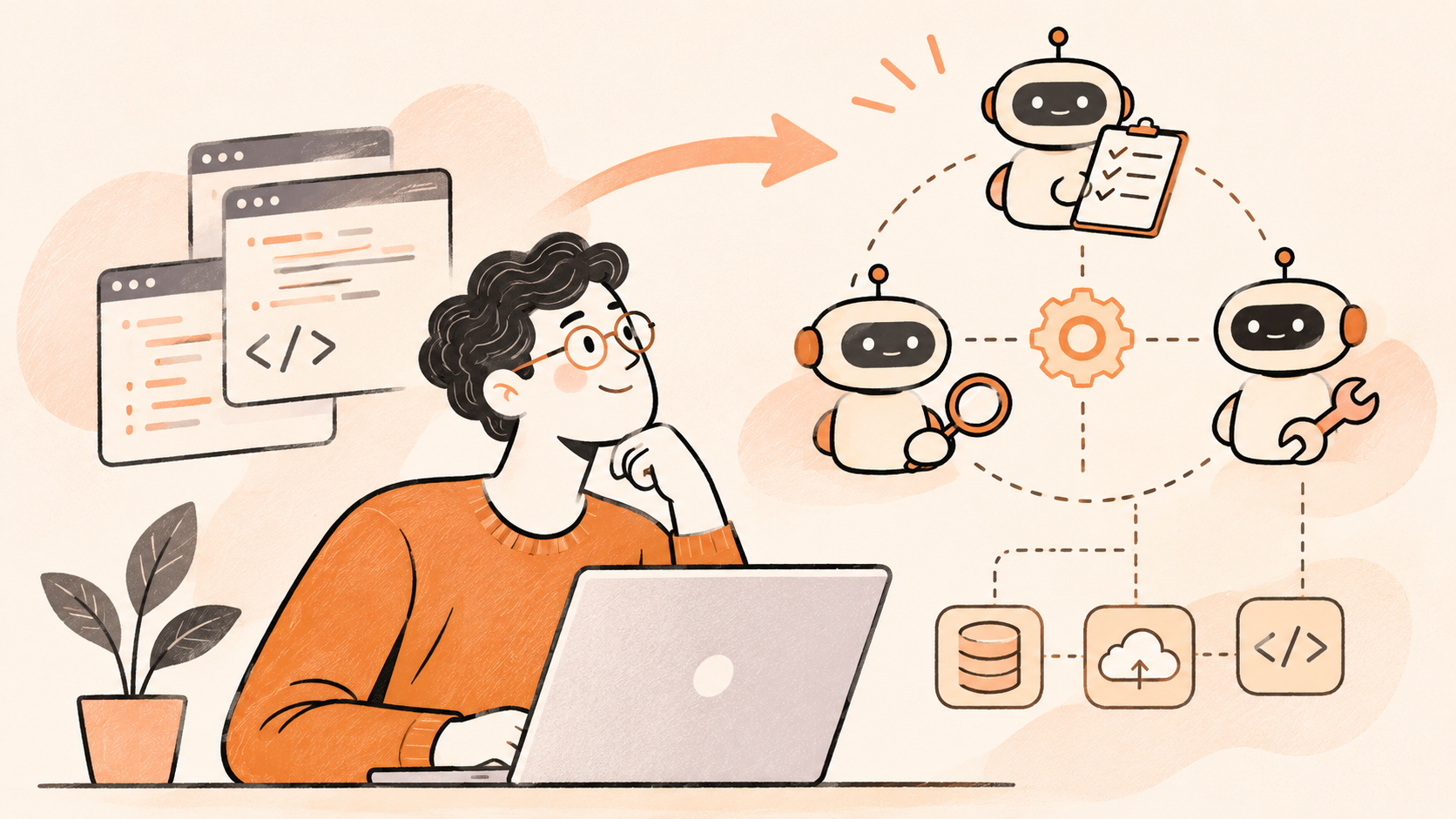
An Agentic AI Engineer builds AI systems, powered by Large Language Models (LLMs), that can interpret goals, plan tasks, select and use tools, and execute multi-step workflows with varying degrees of autonomy.
For example, instead of relying entirely on predefined customer support workflows, an engineer can build an AI agent that interprets customer queries, retrieves relevant customer information, checks order status through APIs, and recommends or performs appropriate actions, subject to authorization and business rules.
How to Become an Agentic AI Engineer: A 4-Step Roadmap
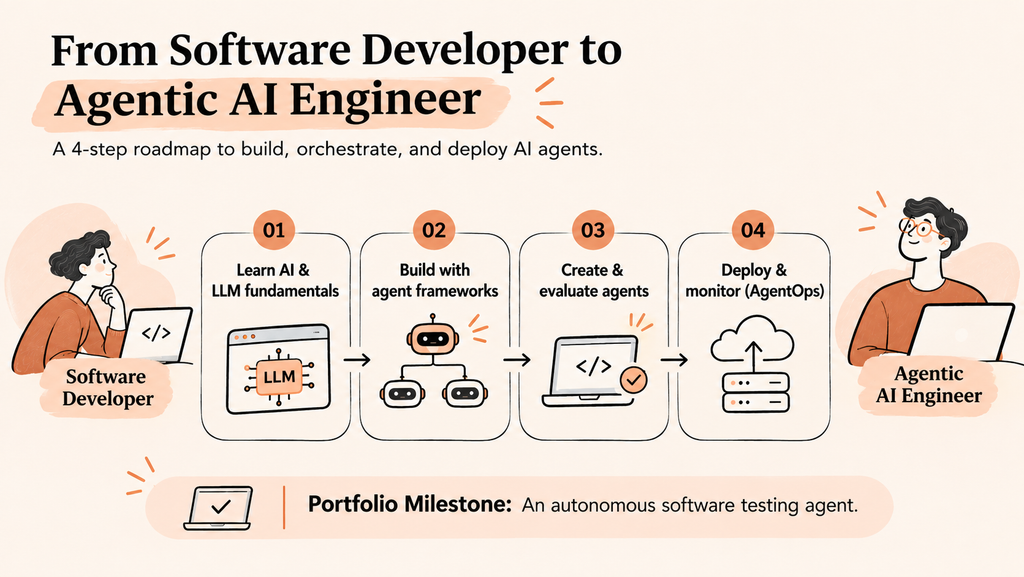
1. Understand how LLMs work and where they fit
Learn how large language models generate responses, interpret instructions, and handle context. Explore prompt engineering and understand model limitations, including hallucinations, context constraints, and inconsistent outputs. This helps you identify which tasks are suitable for AI agents and where human intervention is necessary.
For developers looking to strengthen their production AI engineering skills, the Certificate Program in Artificial Intelligence and Agentic AI Engineering by Johns Hopkins University covers end-to-end AI system development. Its curriculum includes MLOps pipelines, LLMOps, multi-cloud deployment, Agentic AI orchestration, monitoring, and responsible AI practices.
2. Start building AI agents
Move beyond standalone LLM applications by exploring frameworks such as LangChain and LlamaIndex. Understand tool calling, memory, planning, and reasoning patterns such as ReAct. Then learn how multiple agents can collaborate through supervisor-worker or planner-executor architectures. Experiment with connecting agents to APIs, databases, and external services.
If you are looking to specialise in building autonomous AI systems can explore the Johns Hopkins University Certificate Program in Agentic AI. The program offers hands-on experience with Python, LangChain, LangGraph, RAG, and MCP, covering the development and evaluation of single-agent and multi-agent systems.
3. Develop an end-to-end agentic AI project
Apply your learning through a project such as an autonomous software testing system. Design a workflow where one agent interprets development requirements, another generates code, and a third runs test cases. Include a human approval stage before changes are finalised.
Document the architecture, implementation decisions, and project outcomes. This gives you a demonstrable portfolio project for technical interviews.
4. Prepare agents for real-world use
Move beyond prototypes by understanding what it takes to operate agents in production. Focus on access controls, human-in-the-loop approvals, execution limits, audit trails, and handling unexpected agent actions. Learn how to make agentic applications secure, scalable, and manageable in enterprise environments.
The Microsoft Agentic AI for Practitioners program offers practical exposure to this stage of development. Its curriculum includes 15+ hands-on use cases, Azure labs, and projects involving single-agent and multi-agent systems.
Microsoft Agentic AI for Practitioners
Build Agentic AI systems on Azure with hands-on projects. Master AI workflows, multi-agent orchestration, and deployment while preparing for Microsoft AI-103 certification.
How Can You Build a Portfolio for an Agentic AI Engineer Role?
Build an end-to-end project that solves a practical problem, such as an autonomous software testing system. Document its architecture, implementation choices, and results. Publish the code and a working demonstration on GitHub to give recruiters tangible evidence of your capabilities.
Structured learning can help you develop these projects with guidance. For example, the Microsoft Agentic AI for Practitioners program includes single-agent and multi-agent projects, along with a self-directed capstone that learners scope, build, and deploy. This provides an opportunity to develop a portfolio project that demonstrates your ability to take an agentic AI solution from concept to implementation.
What Career Opportunities Can Agentic AI Engineering Open Up?
Software developers with Agentic AI expertise can explore roles such as:
- Agentic AI Engineer: Develops and integrates autonomous AI agents.
- AI Application Engineer: Builds applications powered by AI models.
- LLM Engineer: Develops and optimises LLM-powered applications.
- Multi-Agent Systems Developer: Designs systems where multiple agents collaborate on complex tasks.
With experience, these roles can also lead to opportunities in AI solution architecture and technical leadership.