Moving into Artificial Intelligence and Machine Learning can be a natural progression for experienced IT professionals, but it requires more than familiarity with technology.
The right specialization depends on your existing technical skills, career aspirations, and interest in working with data-driven and intelligent systems. Understanding how your experience translates to AI/ML can help you decide whether this is the right next step.
TL;DR
Experienced IT professionals can transition into AI/ML by building on existing skills in software development, data engineering, cloud, DevOps, QA, or cybersecurity. This guide explains the prerequisites, helps assess career fit, and compares broad AI/ML and focused Generative AI learning paths.
How Can Your Existing IT Skills Help You Transition to AI/ML?
Your current specialization may provide foundations that transfer to AI/ML. Identify what you already know and which capabilities you would need to develop further.
| Existing experience | Transferable foundation | What you may need to add |
| Software development | Programming, APIs, application architecture | Statistics, ML algorithms, model evaluation |
| Data engineering or analytics | SQL, data pipelines, data preparation | Predictive modelling, ML methods |
| Cloud and DevOps | Infrastructure, automation, deployment | Model serving, MLOps and LLMOps |
| QA and testing | Validation, debugging, reliability | Model and output evaluation |
| Cybersecurity | Risk analysis, system protection | AI security, model risks and governance |
Your existing IT experience can provide a useful foundation for learning AI/ML, but transferable skills alone do not guarantee readiness. The knowledge you need to develop further will depend on your chosen specialization and the type of AI/ML work you want to pursue.
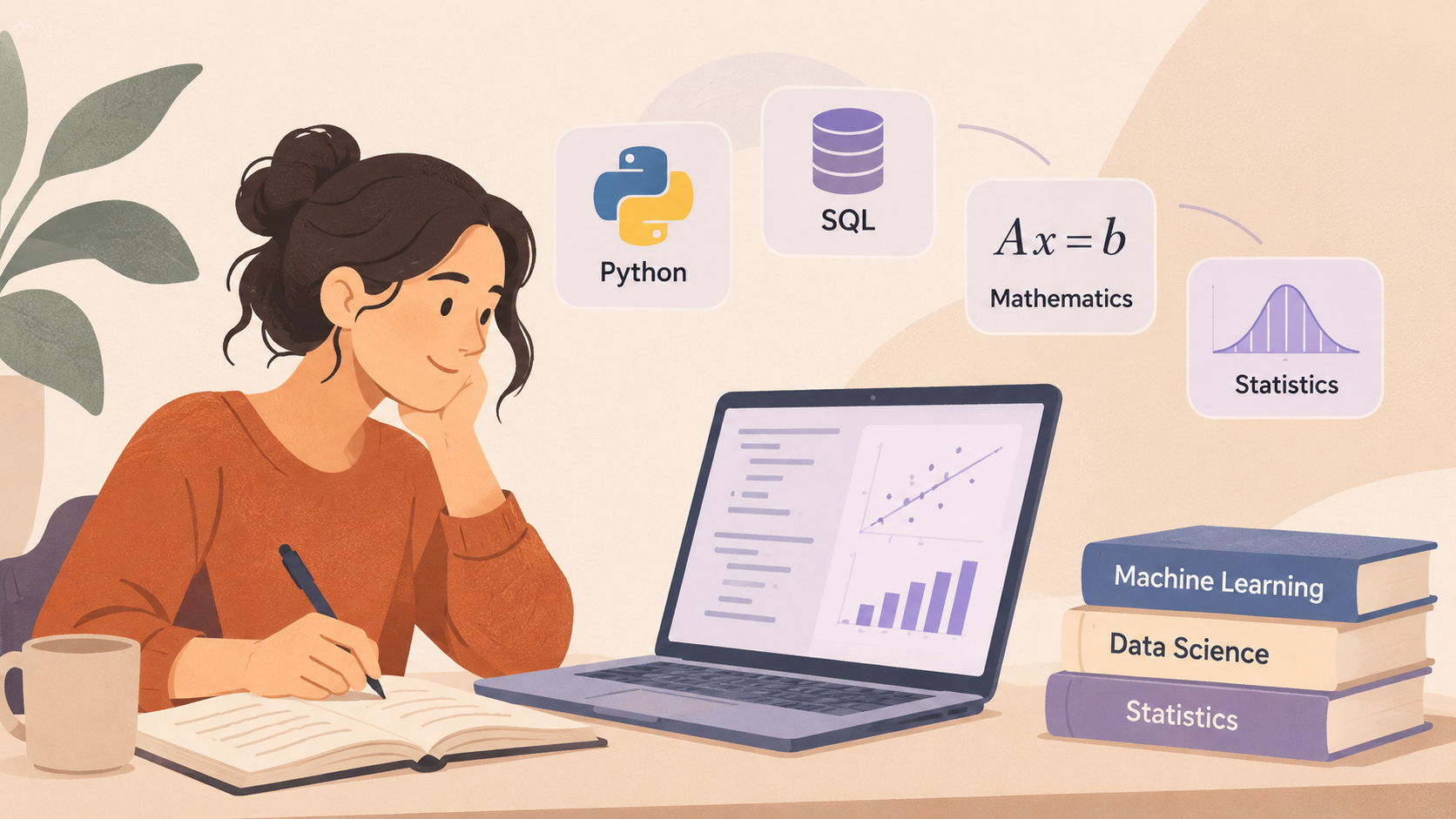
Understanding the machine learning prerequisites can help you assess your current knowledge and identify areas where you may need to build stronger foundations.
How Do You Know If AI/ML Is the Right Specialization for You?
Technical experience alone does not determine fit. Consider whether you want to spend more time analysing data, identifying patterns, experimenting with models, evaluating predictions, or integrating intelligent features into software.
AI/ML may be less aligned with your interests if you prefer to focus on infrastructure reliability, network architecture, security operations, or core application engineering without taking on model-focused work.
Ask yourself:
- Am I interested in model behaviour, experimentation, and evaluation?
- Am I willing to deepen my knowledge of Python, statistics, and ML concepts?
- Does my current work involve problems where predictive or generative AI could be useful?
A strong fit means having a genuine interest in the problems and methods involved, along with a willingness to invest in the required learning.
Should You Choose AI/ML or Specialize in Generative AI?
AI/ML provides a broader foundation across statistical analysis, predictive models, deep learning, and intelligent-system deployment. Generative AI focuses more specifically on applications built with large language models (LLMs), retrieval-augmented generation (RAG), and AI agents.
Your choice should depend on the technical capabilities you want to develop and the kind of AI solutions you want to build.
Consider these two learning paths:
1. For a broad AI/ML specialization
PG Program in Artificial Intelligence and Machine Learning from McCombs School of Business at the University of Texas at Austin
- Key topics: Python, Machine Learning, Deep Learning, NLP, Computer Vision, Generative AI, Agentic AI, MLOps, and LLMOps.
- Learning experience: Faculty masterclasses, weekly industry mentorship, hands-on projects, and a four-week capstone.
- Best for: Experienced IT professionals who want to build expertise across AI/ML disciplines and develop end-to-end AI solutions.
Post Graduate Program in AI & Machine Learning: Business Applications
Earn dual certification from UT Austin & Great Lakes with real-world projects, GenAI modules, and dedicated career support to fast-track your AI journey.
2. For a focused Generative AI specialization
Certificate in Generative AI from IIT Bombay
- Duration: 5 months (online)
- Key topics: LLM applications, RAG, AI agents, LLMOps, and AI governance.
- Learning experience: Weekly interactive faculty sessions, guided labs, hands-on projects, and optional one-day campus immersion at IIT Bombay.
- Best for: IT professionals looking to build LLM-powered applications, enterprise AI workflows, and AI agents.
IIT Bombay Certificate in Generative AI
Learn Generative AI from IIT Bombay. Build hands-on skills in LangChain, LLMOps, and Agentic AI. Apply now!
How Do You Choose the Right AI/ML Program for Your Experience?
Once you have identified the AI/ML specialization that aligns with your interests and career goals, the next step is to evaluate available programs. Look beyond course titles and consider whether the curriculum provides the technical depth and practical experience needed for your intended career direction.
If you are exploring different options, compare AI and Machine Learning courses based on their subject coverage, learning formats, and project components. Great Learning offers programs covering Machine Learning, Deep Learning, Generative AI, and practical AI applications.
Before enrolling, assess the program's hands-on projects, faculty expertise, industry mentorship, and schedule flexibility. The right program should help you build on your existing technical experience while developing the additional skills needed to design, implement, and deploy AI/ML solutions.