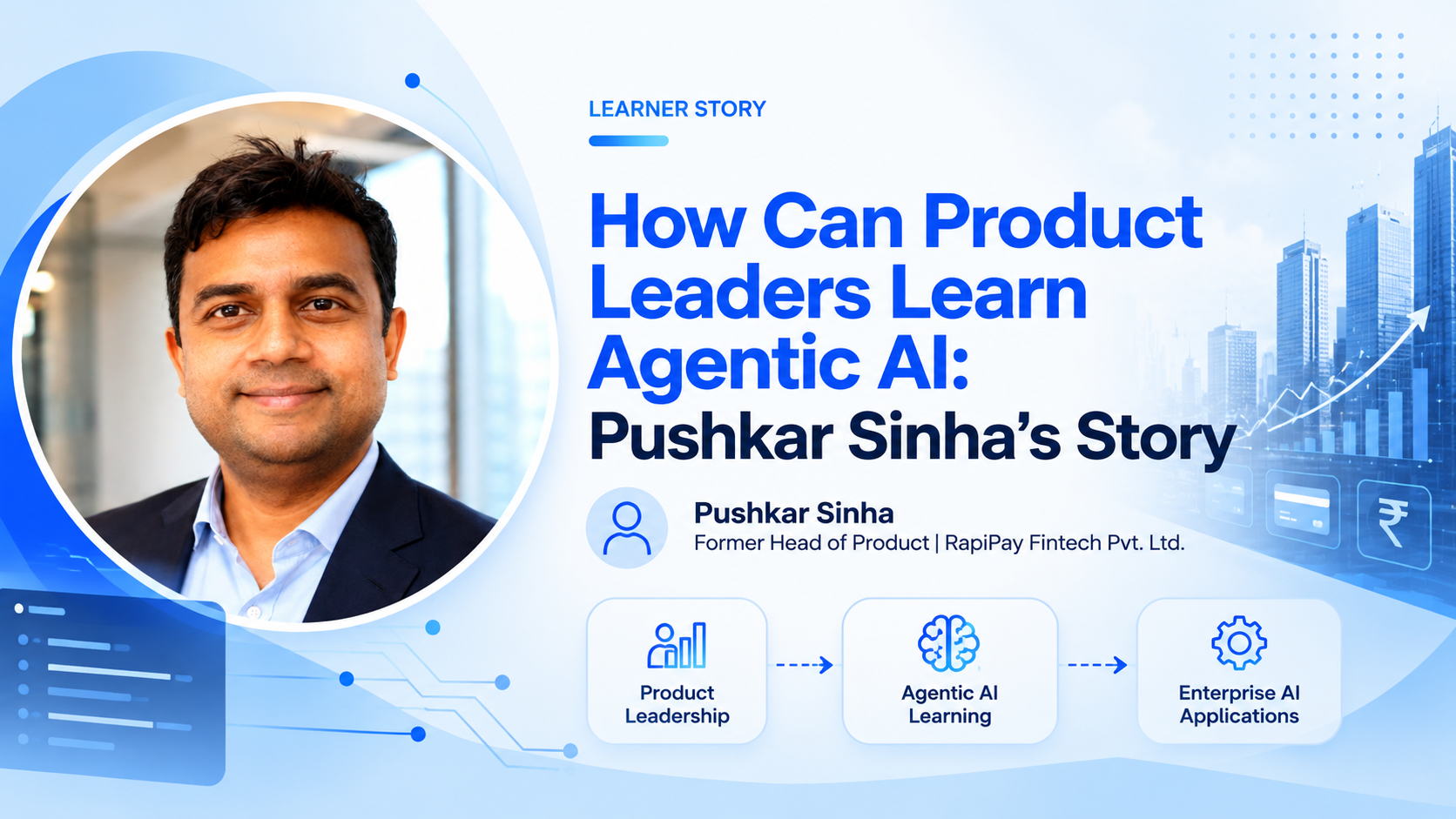
Product leaders can learn Agentic AI by understanding how AI agents reason, use tools, coordinate tasks, and integrate with existing business systems. Pushkar Sinha’s experience in the IIT Bombay Certificate in Agentic AI illustrates how professionals can build this technical understanding on top of their existing product and industry expertise.
IIT Bombay Certificate in Agentic AI
Master the future of autonomy with IIT Bombay. Build, orchestrate, and deploy sophisticated multi-agent systems using LangGraph, CrewAI, and AutoGen.
The need for these skills is becoming more relevant in India. According to a February 2026 backgrounder from the Government of India’s Press Information Bureau, citing the NASSCOM AI Adoption Index, 87% of Indian enterprises were actively using AI solutions as of December 2025.
For Pushkar Sinha, former Head of Product at RapiPay Fintech Pvt. Ltd., learning Agentic AI was an opportunity to understand how autonomous, tool-using systems could influence the way businesses build and operate digital products. With more than two decades of experience across fintech, digital payments, and financial services, he joined the IIT Bombay Certificate in Agentic AI to connect his product leadership expertise with a deeper understanding of AI technologies.
Why Product Leadership Experience Led Pushkar Toward Agentic AI
Pushkar joined the IIT Bombay Agentic AI program to develop the technical understanding needed to evaluate AI solutions, identify relevant use cases, and collaborate more effectively with engineering and data science teams.
Pushkar's experience in fintech had already exposed him to the demands of building digital products across payments, lending, investments, risk, and compliance. His work at organizations including Airtel Payments Bank, Paisabazaar, PAYBACK, and RapiPay gave him a broad perspective on the relationship between product decisions, technical systems, and business requirements.
As AI-driven systems became an area of professional interest, he wanted to understand how the underlying technology worked. His focus extended to large language models, retrieval-augmented generation, agent orchestration, and AI-driven decision systems.
Moving Beyond AI Concepts to Agent Orchestration and Tool Integration
Pushkar explored how LangGraph, agentic memory, state management, and Model Context Protocol (MCP) can work together to support AI applications that coordinate multiple steps and interact with external tools.
Three areas stood out in his learning journey:
- Agent orchestration with LangGraph: He explored how multiple agents can collaborate, invoke tools, maintain context, and progress through structured workflows.
- Memory and state management: These concepts helped him understand how agents can retain relevant information and track progress as they work through tasks.
- Model Context Protocol (MCP): He learned how standardized interfaces can help AI agents discover and invoke tools that connect them with enterprise capabilities.
For product leaders, these concepts offer a way to connect business requirements with the architecture behind AI-enabled applications.
Pushkar found that understanding how these components interact was particularly valuable. Rather than viewing an LLM as an isolated component, he could see how agents could collaborate, maintain context, make decisions, and invoke tools within a controlled workflow.
How Can Agentic AI Be Used To Solve Real Fintech Problems?
For Pushkar, the relevance of Agentic AI extended to familiar areas of fintech, including fraud monitoring, credit decisioning, customer support, collections, and internal analytics.
These were potential applications he identified for exploration, rather than documented production implementations.
Consider a fraud investigation workflow. An AI agent might retrieve transaction information, identify patterns requiring further investigation, and assemble findings for a human reviewer. In customer support, an agent might connect with approved systems to retrieve account information and coordinate follow-up actions.
In financial services, such applications also raise questions about data access, reliability, accountability, and regulatory compliance. Understanding those constraints is an important part of evaluating whether an agentic approach is appropriate for a particular product workflow.
Understanding the underlying architecture can help product leaders assess where Agentic AI may be useful, how it could interact with existing systems, and which decisions should remain under human control.
How Can Professionals Make the Most of Agentic AI Training?
“The real learning happens when you experiment beyond what is asked.”
Pushkar's advice reflects his emphasis on practical exploration. He encourages learners to modify an implementation, observe how its behavior changes, and understand the reasons behind the results.
He also recommends connecting concepts such as retrieval-augmented generation, memory, orchestration, tools, MCP, and evaluation rather than studying each separately.
For experienced product professionals, this approach offers a way to develop technical judgment without necessarily becoming full-time AI engineers. Understanding how components interact provides a stronger basis for discussing requirements, evaluating architectural choices, and questioning proposed solutions.
Should Product Leaders Learn Agentic AI?
Product leaders should consider learning Agentic AI if they need to evaluate AI-driven product opportunities, understand technical trade-offs, or work closely with teams building intelligent enterprise applications.
Pushkar’s experience demonstrates one approach: building on years of product and industry expertise while developing a deeper understanding of AI architecture and orchestration.
For professionals considering this path, the IIT Bombay Certificate in Agentic AI was Pushkar’s chosen route to structured learning and hands-on exploration. The value of such learning depends on individual goals, existing technical knowledge, and the ability to connect concepts with practical problems.
His journey reinforces a useful principle for product leaders: understanding how AI systems work can help bridge the gap between identifying a business opportunity and evaluating the technology needed to address it.