
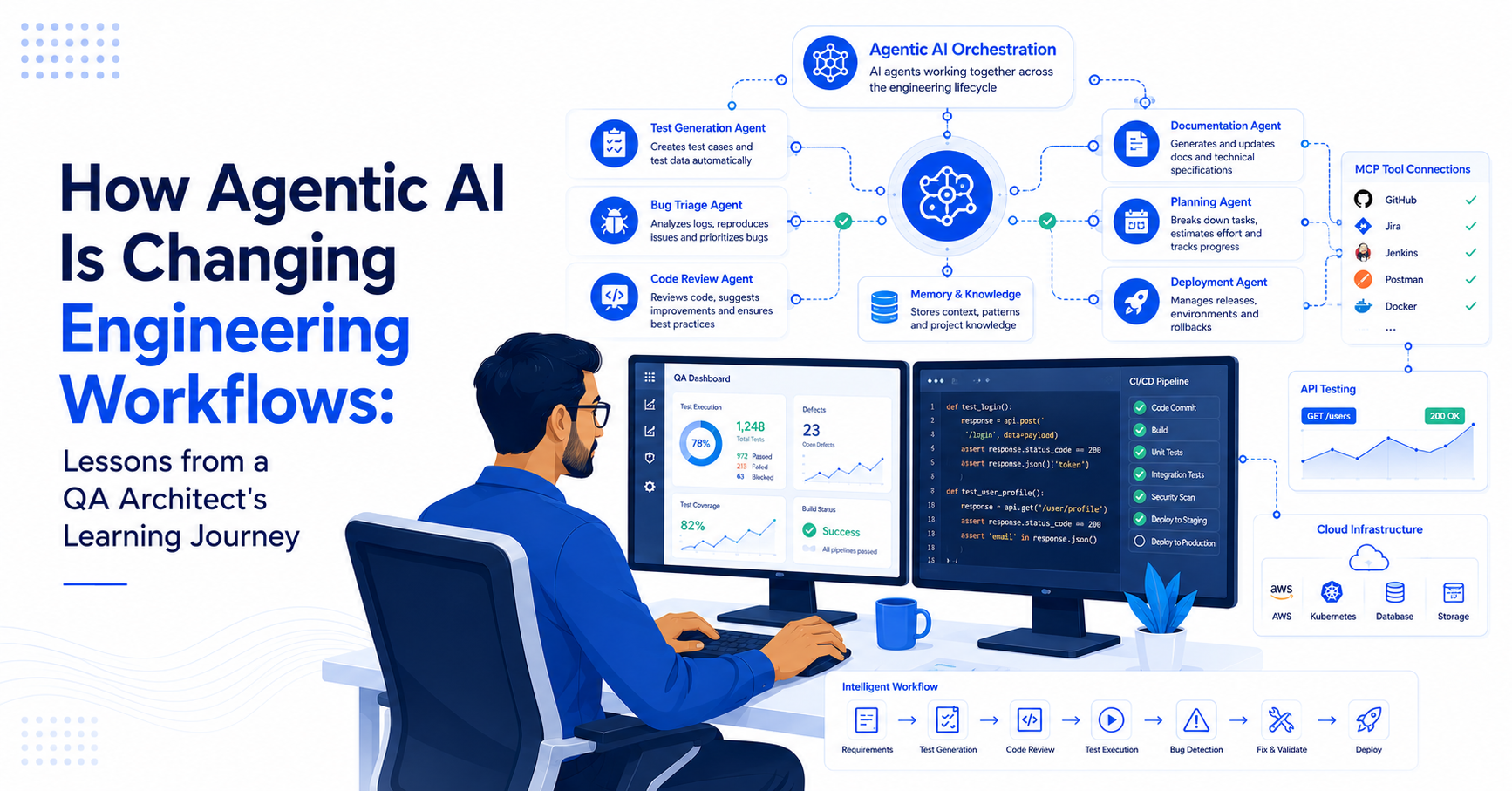
Software engineering has continually evolved, from manual testing to automated pipelines and cloud-native development. Today, the next shift is being driven by Agentic AI, where intelligent systems can reason, plan, and execute tasks with minimal human intervention.
The change is already visible. Stack Overflow reported in May 2026 that 59% of survey respondents used AI agents at work at least occasionally, up from 31% in its 2025 Developer Survey. The increase points to growing workplace adoption, although most agent use still involves human oversight. As AI becomes more integrated into software development, many professionals are looking beyond traditional automation to understand how these systems can support real-world engineering workflows.
For Rakesh Arrepu, a QA and Test Architect at Oracle, this wasn't simply another technology trend; it was an opportunity to prepare for the future of engineering. Rather than waiting for AI agents to become commonplace, he chose to understand how they could complement his experience in quality assurance and software testing.
Why Did an Experienced QA Architect Decide to Learn Agentic AI?
Rakesh chose to learn Agentic AI to understand how intelligent AI agents can improve engineering workflows beyond traditional automation. As an experienced QA Architect, he wanted to stay relevant, build practical expertise in AI systems, and prepare for the future of software engineering.
Explaining what motivated him to enrol in the Certificate Program in Agentic AI by Johns Hopkins University, Rakesh said:
"I wanted to move beyond traditional automation and truly understand how AI agents can transform engineering workflows. As someone working in QA and test architecture, I realized that the future is not just automation but intelligent, decision-making systems. Upskilling in Agentic AI felt like the right strategic step to stay relevant and future-ready."
For Rakesh, learning Agentic AI wasn't about replacing his existing expertise. Instead, it was about building on years of engineering experience and understanding how autonomous AI systems could fit into modern software development.
Certificate Program in Agentic AI
Learn the architecture of intelligent agentic systems. Build agents that perceive, plan, learn, and act using Python-based projects and cutting-edge agentic architectures.
Discovering a New Way of Thinking About AI
Rakesh expected to strengthen his understanding of AI fundamentals, but the program introduced him to something broader: how AI agents are designed, orchestrated, and applied to solve real engineering challenges.
Reflecting on the curriculum, he shared:
"The program exceeded my expectations in both depth and practical exposure. The curriculum was well-structured, covering core AI foundations and gradually progressing into real-world agent design, orchestration patterns, and applied use cases."
For an experienced QA professional, this changed how he viewed AI. Instead of seeing it as another technology to learn, he began to understand how intelligent agents could support engineering workflows by reasoning, coordinating tasks, and adapting to different situations.
How Can Hands-On Learning Help Engineers Understand Agentic AI?
Hands-on learning helps engineers understand Agentic AI because it demonstrates how AI agents solve real engineering problems. Applying concepts in practical scenarios builds confidence that theory alone cannot.
As Rakesh explained:
"What stood out most was the balance between theory and implementation. The hands-on exercises and case discussions helped me connect concepts directly to real engineering challenges. It was not just learning AI but learning how to think in terms of systems and agents."
This shift in thinking became one of the most valuable outcomes of his learning journey. It helped him see how Agentic AI could complement established engineering practices rather than simply automate existing tasks.
Learning with the Support of Mentors
Balancing a full-time technical role while learning an emerging technology is rarely easy. For Rakesh, guidance from mentors and interactions with fellow learners made the experience more meaningful.
Reflecting on the support he received, he said:
"The support throughout the program was exceptional. Mentors were knowledgeable, approachable, and genuinely invested in student success. Doubts were addressed clearly, feedback was constructive, and the learning community was collaborative and motivating. The structured guidance and timely assistance made the entire journey smooth and engaging."
The collaborative environment gave him the confidence to explore new concepts while connecting them to the engineering challenges he encounters in his professional role.
What Was Rakesh's Biggest Takeaway from Learning Agentic AI?
For Rakesh, the biggest outcome of the program was a deeper understanding of where engineering is headed and the confidence to contribute to that future.
Summing up his experience, he shared:
"Overall, the Certificate Program in Agentic AI has significantly enhanced my perspective and technical confidence. I would highly recommend it to professionals who want to build practical expertise in AI systems and stay ahead in the evolving technology landscape."
His journey reflects a mindset shared by many experienced software professionals today. As AI becomes part of everyday engineering, staying relevant isn't about replacing years of technical expertise; it's about expanding it.