
- Why Is Upskilling Important When Returning to Work After a Career Break?
- Why Did She Choose an AI and Machine Learning Program?
- What Made the Learning Experience Different?
- How Can Flexible Learning Help Professionals Managing Multiple Responsibilities?
- Can Learning AI Improve Your Confidence for Interviews?
- How Did AI Upskilling Help Her Restart Her Career?
- Tips for Professionals Planning a Career Comeback
- Frequently Asked Questions
Restarting a career after years away from the workplace is rarely just about updating a resume. It often means rebuilding confidence, learning new technologies, and proving that your skills are relevant in a rapidly changing job market. In India, workforce participation among women has continued to improve, with the female labor force participation rate reaching 35.3% in early 2026, reflecting a growing number of women re-entering the workforce.
For professionals returning after an extended break, however, the biggest question remains: How do you bridge the gap between past experience and today's workplace expectations?
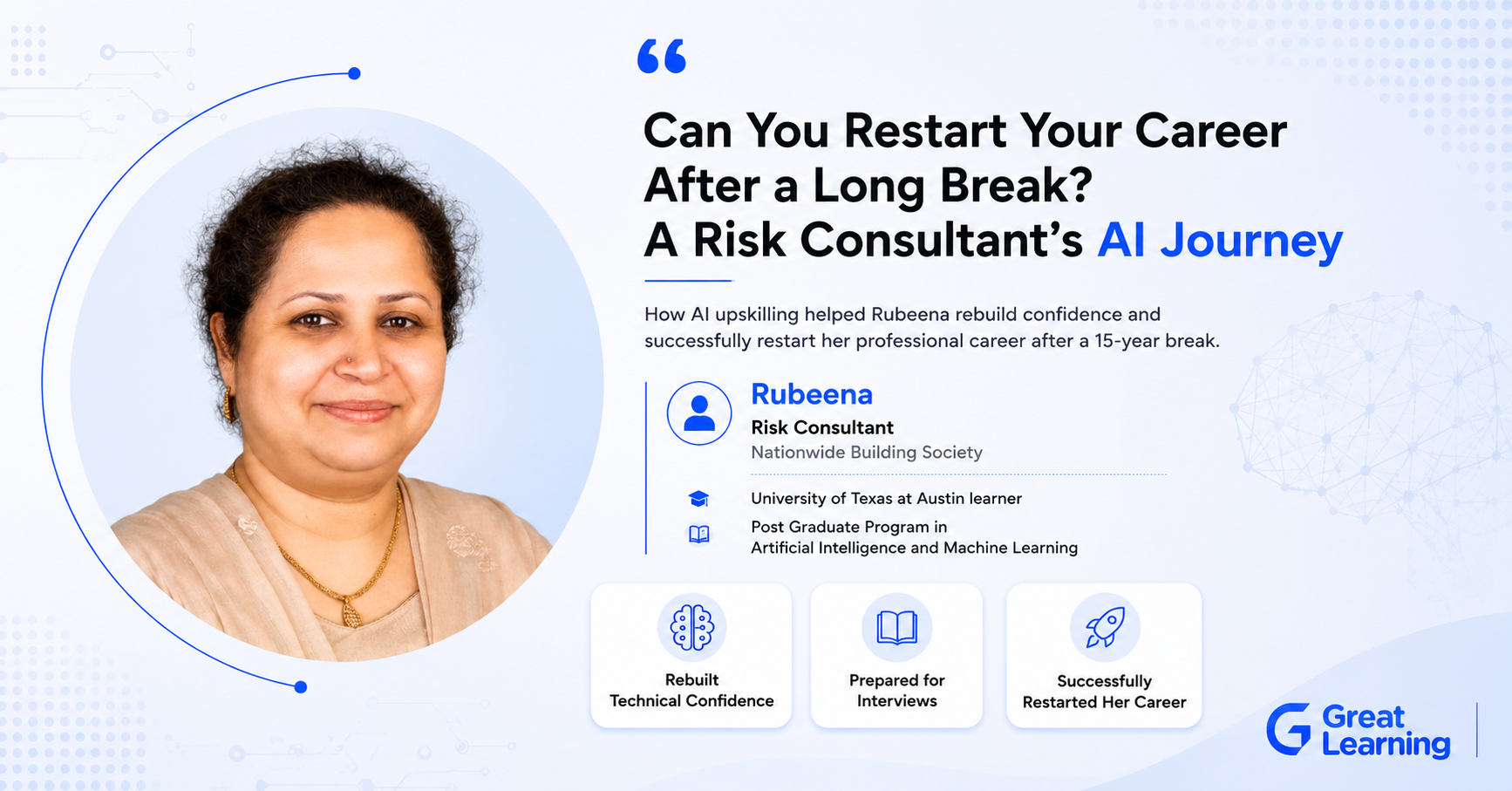
For Rubeena, a Risk Consultant at Nationwide Building Society with eight years of experience in analytics, the answer began with learning Artificial Intelligence and Machine Learning. After spending 15 years away from the corporate world, she wanted to return with skills that matched where the industry was heading.
"After a 15-year break from the corporate world, I was looking to restart my career."
Why Is Upskilling Important When Returning to Work After a Career Break?
Technology evolves quickly. Over the last decade, AI, automation, Cloud Computing, and data-driven decision-making have transformed how businesses operate. For professionals planning a career comeback, demonstrating familiarity with these technologies can help close the gap between previous experience and current employer expectations.
For Rubeena, upskilling wasn't about earning another credential. It was about rebuilding technical confidence and preparing herself for the opportunities she wanted to pursue next.
Instead of relying on self-learning alone, she wanted a structured program that combined academic rigor with practical industry relevance.
Why Did She Choose an AI and Machine Learning Program?
Before enrolling, Rubeena explored multiple learning options. She wanted a program backed by a reputed institution and one that had earned positive feedback from past learners.
That search eventually led her to the PG Program in AI & Machine Learning by Texas McCombs.
PG Program in AI & Machine Learning
Master AI with hands-on projects, expert mentorship, and a prestigious certificate from UT Austin and Great Lakes Executive Learning.
"I explored several programs offered by reputed institutions before choosing the AIML course from Great Learning. I had heard positive reviews about it, which encouraged me to enroll."
The decision wasn't driven by convenience alone. She was looking for a program that would help her understand emerging technologies in a structured way while preparing her to re-enter a competitive job market.
What Made the Learning Experience Different?
For many professionals returning to education after a long gap, the quality of teaching can determine whether learning feels overwhelming or empowering.
Rubeena found value in learning from faculty with strong academic backgrounds while also benefiting from mentors who brought industry experience into every discussion. Rather than limiting the curriculum to theory, the program connected AI and Machine Learning concepts to practical business applications.
"The professors are from esteemed institutions and have deep academic expertise. The mentors bring strong industry experience and share practical insights that helped me understand real-world applications of AI and ML concepts."
This combination helped her reconnect with technical learning while understanding how AI is applied in today's workplaces.
How Can Flexible Learning Help Professionals Managing Multiple Responsibilities?
Flexible learning helps professionals continue building new skills by allowing them to balance coursework with work, family, and other personal commitments without losing momentum.
For professionals returning to education after a long break, juggling multiple responsibilities can be one of the biggest challenges. A learning experience that offers flexibility and responsive learner support can make it easier to stay committed, even when unexpected priorities arise.
Rubeena experienced this firsthand during the program. Whenever she found it difficult to keep up with coursework alongside her work and home responsibilities, the support team helped her stay on track.
"Whenever I struggled to balance my coursework with work and home responsibilities, they provided timely extensions and continuous support."
Rather than feeling pressured to choose between her responsibilities and her learning goals, she was able to progress through the program at a sustainable pace, bringing her one step closer to restarting her career.
Can Learning AI Improve Your Confidence for Interviews?
Career breaks often create uncertainty, not only about technical skills but also about interview readiness.
For Rubeena, the program became more than a way to learn AI. It helped her rebuild confidence in her own abilities.
As she strengthened her technical foundation, she also felt better prepared to discuss concepts during interviews and demonstrate that her skills were current.
"The program helped me rebuild my confidence, strengthen my technical skills, and prepare effectively for interviews."
Rather than focusing on the years she had spent away from work, she was now able to focus on the value she could bring to a new role.
How Did AI Upskilling Help Her Restart Her Career?
Every career comeback has a defining moment.
For Rubeena, it wasn't simply completing the program; it was securing a new professional opportunity that reflected the work she had put into updating her skills.
"It played a key role in helping me secure a very good job opportunity."
Her story demonstrates that career breaks don't erase professional experience. When combined with relevant, up-to-date skills, previous expertise can become a strong foundation for a successful return to work.
Tips for Professionals Planning a Career Comeback
If you're considering returning to work after a career break, Rubeena's journey offers a few practical takeaways:
- Refresh your skills to align with current industry demands rather than relying only on past experience.
- Choose a structured learning program that combines academic knowledge with practical application.
- Learn from faculty and mentors who can connect concepts to real business challenges.
- Look for learner support that helps you stay on track while balancing personal commitments.
- View a career break as a pause, not the end of your professional journey.
Frequently Asked Questions
Is learning AI a good option for professionals returning to work?
AI has become an important capability across industries, making it a valuable area of study for professionals looking to refresh their technical skills and improve their career prospects.
How can an AI program help improve interview confidence?
Learning current technologies, understanding practical applications, and strengthening technical knowledge can make it easier to discuss your skills during interviews and approach technical questions with confidence.
Why is learner support important in an online program?
Flexible learner support can help professionals balance coursework with family and personal responsibilities, making it easier to complete the program successfully.
What should professionals look for in an AI upskilling program?
Look for a curriculum that combines theory with practical application, experienced faculty and mentors, flexibility for working learners, and career support that prepares you for interviews and job opportunities.