
- Is AI Replacing HR Jobs?
- Which HR Functions Are Most Affected by AI?
- Why Are HR Professionals Learning Data Analytics?
- What Data Analytics Skills Do HR Professionals Need?
- Can an Online MBA Help HR Professionals Build These Skills?
- What HR Jobs Will Be in Demand in the AI Era?
- Should HR Professionals Learn AI and Data Analytics?
- FAQs
Artificial intelligence is changing how human resources teams work. From screening resumes and scheduling interviews to analyzing employee data, AI is increasingly being used to automate repetitive HR tasks. But does this mean AI will replace HR professionals?
The shift is already visible in India: 65% of respondents in PwC’s 2025 Future of Work Survey said automation or GenAI has led to changes in HR team structures or roles. The survey also highlights the growing use of HR analytics as organisations automate routine and transactional work and move towards more data-driven workforce strategies.
Is AI Replacing HR Jobs?
AI is unlikely to replace HR professionals entirely because many HR responsibilities require human judgment, communication, empathy and relationship-building. Instead, AI is changing the tasks HR professionals perform and how quickly they can complete them.
For example, AI can assist with resume screening, interview scheduling, employee queries, payroll processes, HR reporting and workforce data analysis. This can reduce the time HR teams spend on repetitive administrative activities.
As these tasks become increasingly automated, HR professionals can focus more on areas such as employee engagement, talent development, workforce planning, conflict resolution and strategic decision-making.
The key shift is therefore from task automation to role transformation. HR professionals who can work effectively with AI and data may be better positioned for the changing workplace.
Which HR Functions Are Most Affected by AI?
HR functions that involve large volumes of repetitive, rules-based activities are generally more suited to automation. AI can support several areas of HR in different ways:
| HR Function | Potential AI Application |
| Recruitment | Resume screening, candidate matching and interview scheduling |
| HR Operations | Documentation, reporting and employee queries |
| Payroll | Routine calculations and processing |
| Learning & Development | Personalized learning recommendations |
| People Analytics | Employee data analysis and workforce forecasting |
AI is not only changing existing HR tasks; it is also creating new ways for HR teams to use workforce data. HR professionals may increasingly be expected to evaluate AI-generated recommendations, monitor workforce trends, identify risks, and use analytics to support business decisions.
This does not necessarily mean these HR functions will disappear. Instead, professionals working in them may need to develop skills that allow them to interpret AI-generated insights, make decisions, and apply them within a human context.
Why Are HR Professionals Learning Data Analytics?
Modern HR generates and uses significant amounts of workforce data. Organizations track metrics such as employee turnover, absenteeism, recruitment costs, engagement, compensation, performance and productivity.
Understanding this data allows HR professionals to move beyond simply preparing reports and start using data to answer business questions.
For example, traditional HR reporting might show that employee turnover has increased. A data-driven HR professional can go further by examining which employee groups are leaving, when they are leaving and which factors may be associated with attrition.
This makes data analytics increasingly valuable in areas such as recruitment, retention, workforce planning and employee experience.
HR professionals do not necessarily need to become data scientists. Instead, they need sufficient data literacy to interpret information, identify patterns, use dashboards and translate insights into practical business decisions. Common tools used in HR analytics include spreadsheets, dashboards, visualization platforms, HR information systems, and analytics tools used for workforce reporting.
What Data Analytics Skills Do HR Professionals Need?
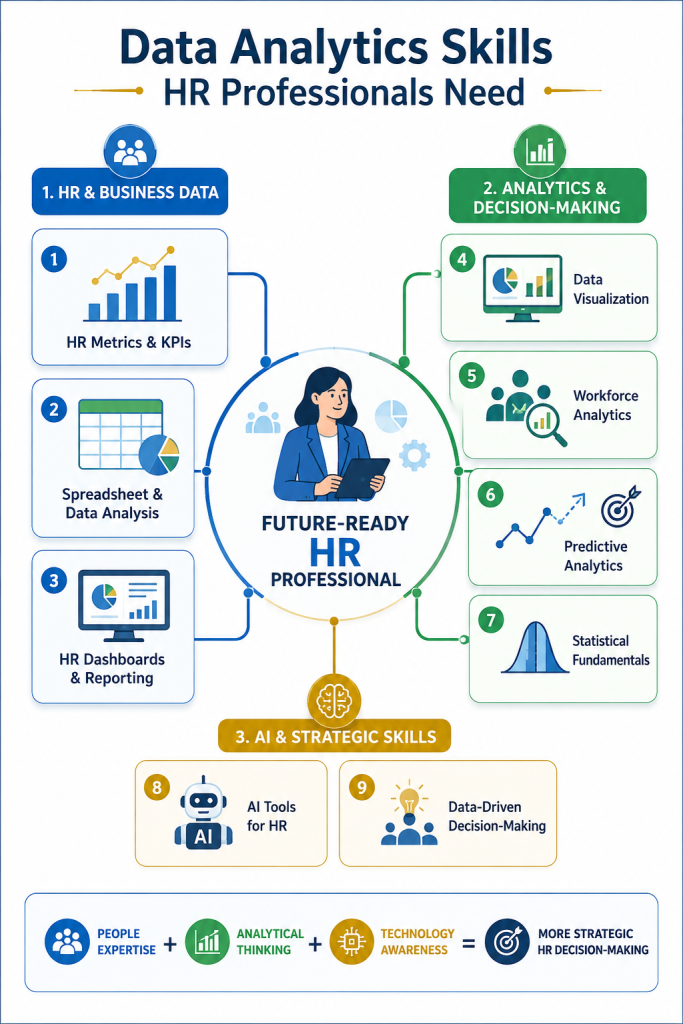
As HR becomes more data-driven, professionals can benefit from developing skills such as:
- HR metrics and key performance indicators
- Spreadsheet and data analysis
- Data visualization
- Workforce analytics
- Predictive analytics
- Statistical fundamentals
- AI tools for HR
- Data-driven decision-making
- HR dashboards and reporting
These skills can complement traditional HR capabilities rather than replace them. The combination of people expertise, analytical thinking and technology awareness can help HR professionals contribute more strategically to organizational decisions.
Can an Online MBA Help HR Professionals Build These Skills?
An online MBA degree can help HR professionals build a broader combination of business, analytical, and management skills while continuing to work. For professionals adapting to AI-driven changes in HR, this combination can help connect workforce insights with wider organizational goals.
Advance your career with SRMIST's UGC-entitled Online MBA. Choose from 11 industry-focused specializations including Finance, Marketing, HR, AI & Data Science, Healthcare & Hospital Management and more.
The SRMIST’s online MBA curriculum includes Business Statistics and Quantitative Methods, Information Management, and Human Resource Management. Its HR Management electives include Human Resource Metrics and Analytics, Employee Relations, Compensation and Benefits Management, Performance Management Systems, and Leadership and Team Dynamics.
| SRMIST MBA Curriculum Area | Relevance to HR Professionals |
| Business Statistics and Quantitative Methods | Interpret HR metrics and workforce data |
| Human Resource Metrics and Analytics | Analyze workforce trends and HR metrics |
| Data Visualization for Managers | Present workforce insights through visual dashboards |
| Business Forecasting | Support workforce and business planning |
| AI for Business Leaders | Understand AI from a management perspective |
| Strategic HRM | Connect HR practices with broader organizational priorities |
For professionals looking to specialize in HR, an online MBA in HR provides a more focused pathway through HR-oriented subjects. The curriculum also includes Strategic HRM and International HRM.
The online format can be particularly relevant for working professionals. The program combines live online classes and recorded lectures, allowing learners to balance their studies with work schedules.
SRMIST Online MBA in HR Management
Designed for graduates and working professionals, this UGC-entitled program combines business fundamentals, HR analytics, and strategic HRM to prepare you for careers in talent management and people operations.
What HR Jobs Will Be in Demand in the AI Era?
The future of HR is likely to create greater demand for professionals who can combine human expertise with analytical and technological skills.
Potential career paths include HR Business Partner, People Analytics Specialist, Talent Analytics Manager, HR Technology or HRIS Specialist, Workforce Planning Specialist, and Strategic HR Manager.
Across these roles, the ability to understand employee needs, interpret data, and use technology effectively can become increasingly important.
Should HR Professionals Learn AI and Data Analytics?
Yes. HR professionals do not necessarily need to become AI engineers or advanced programmers, but developing AI and data analytics literacy can help them adapt as technology transforms routine HR work. For a deeper look at why these skills are becoming important for HR professionals, read our guide on investing in AI and automation skills for HR. An online MBA can be one pathway to combine management knowledge, HR expertise, business understanding, and analytical skills.
FAQs
Will AI replace HR managers?
AI can automate some administrative and analytical tasks performed by HR managers, but it cannot fully replace responsibilities involving leadership, employee relations, conflict resolution, strategic workforce planning and organizational decision-making.
What is HR analytics?
HR analytics is the use of workforce data and analytical methods to understand employee trends and support decisions related to hiring, retention, performance, workforce planning and employee experience.
Do HR professionals need coding for AI?
Not necessarily. HR professionals can benefit from learning data literacy, analytics, visualization and AI tools without needing advanced programming skills.
Is an online MBA useful for an HR career?
An online MBA can help working professionals develop management, business, and analytical skills while continuing their employment, depending on the program's curriculum, quality, and recognition.