- 1. Check How Flexible the Online MBA Schedule Is
- 2. Estimate the Weekly Study Hours and Workload
- 3. Evaluate Program Recognition and Curriculum
- 4. Compare Learning Support and Interaction Opportunities
- 5. Assess Career Relevance, Fees, and Return on Investment
- 6. Create a Realistic Work-and-Study Plan
- Conclusion
- Frequently Asked Questions
Choosing an online MBA that fits around your job requires evaluating class flexibility, weekly study hours, program recognition, and career relevance before enrolling. For working professionals in India, the right program should help build management skills without making it difficult to meet professional and personal commitments.
India's MBA education landscape offers different study formats to meet learners' needs. According to a NITI Aayog report based on AISHE data, enrolment in distance MBA programs declined from approximately 1.57 lakh in 2017–18 to 1.20 lakh in 2021–22. However, this trend relates to distance education and does not establish demand for online MBA programs specifically.
For working professionals considering an online MBA, the key is to look beyond the delivery format and assess whether the program's schedule, workload, curriculum, and learning support fit their career goals and personal commitments.
1. Check How Flexible the Online MBA Schedule Is
First, determine whether an online MBA schedule matches your working hours. Look beyond the promise of online learning and understand how classes are actually delivered.
Advance your career with SRMIST's UGC-entitled Online MBA. Choose from 11 industry-focused specializations including Finance, Marketing, HR, AI & Data Science, Healthcare & Hospital Management and more.
Check whether the program offers:
- Live and recorded classes: Can you watch lectures later if work meetings run over?
- Flexible class timings: Are live sessions scheduled during evenings or weekends?
- Attendance requirements: Are you required to attend every session, or are recordings accepted?
- Study pace: Can you manage the coursework alongside your existing responsibilities?
If your job involves frequent travel, rotating shifts, or unpredictable deadlines, access to recorded lectures and a clearly defined attendance policy may be particularly important.
2. Estimate the Weekly Study Hours and Workload
An online MBA requires more than attending lectures. Assignments, case studies, examinations, group projects, and independent reading can all add to your weekly commitments.
Before enrolling, ask the institution about the expected weekly study commitment. Find out how much time is required for live classes, recorded lectures, assignments, and independent study.
For example, if you work from 9 AM to 6 PM, check whether compulsory sessions overlap with office hours and whether assignment deadlines leave enough time for preparation. Also review examination schedules, especially if your job involves travel, rotational shifts, or unpredictable deadlines.
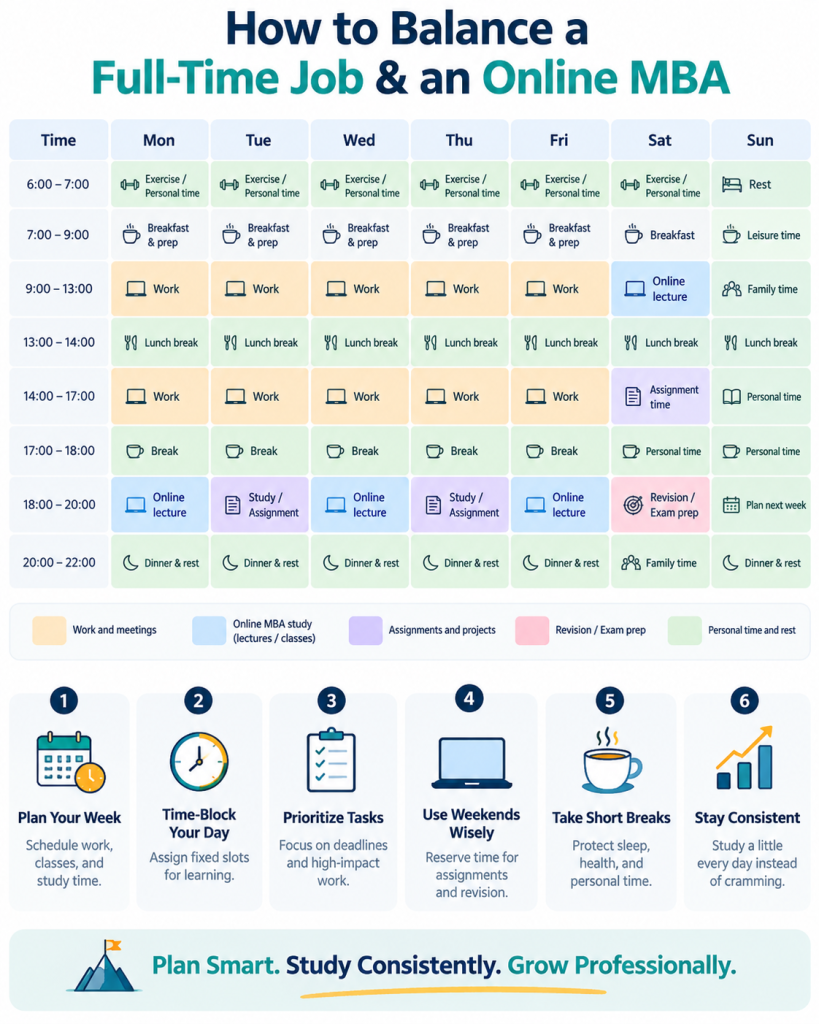
A practical approach is to map your work schedule against your available study time. For example, you could reserve weekday evenings for lectures and weekends for assignments, provided this fits your actual routine.
Choose a program whose expected workload you can sustain consistently, including during busy periods at work, rather than one that looks manageable only during a typical week.
3. Evaluate Program Recognition and Curriculum
A flexible schedule is valuable only if the program also meets your educational and career requirements. Check the institution's recognition status and verify that the specific online MBA is approved or entitled for the relevant academic session.
In India, the UGC Distance Education Bureau provides a list of higher education institutions and their online and distance-learning programs. Verify the exact program rather than relying solely on an institution's name or marketing claims. You should also check the MBA eligibility criteria to understand the academic qualifications and other criteria you may need to meet before applying.
Next, assess the curriculum. Look for subjects such as finance, marketing, operations, strategy, and business analytics, depending on your goals. Case studies, business projects, and practical assignments can help you apply management concepts to workplace challenges.
Before choosing an online MBA, review the MBA course syllabus to understand the subjects covered and compare them with the skills required for your target role.
4. Compare Learning Support and Interaction Opportunities
Online learning does not have to mean studying in isolation. The quality of academic support can influence how effectively you learn while managing a full-time job.
Before enrolling, check whether the program provides:
- Faculty interaction and doubt-clearing sessions.
- Peer discussions, group projects, and networking opportunities.
- Academic mentoring and technical support.
- Access to recorded lectures and learning resources.
Consider how these services fit your schedule. For instance, if you frequently miss live sessions, access to recordings and alternative opportunities to interact with faculty may be especially useful.
A good online MBA should offer flexibility while providing enough support to help you stay engaged and make progress.
5. Assess Career Relevance, Fees, and Return on Investment
An online MBA should align with what you want to achieve professionally. Identify your primary goal before comparing programs, whether it is moving into a managerial role, changing career functions, or strengthening your business and decision-making skills.
Your preferred specialization should reflect the skills you want to develop and the career path you intend to pursue. For example, you can compare online MBA in Finance,online MBA in Marketing, and online MBA in Human Resource Management programs based on your professional interests.
Consider a marketing professional who wants to move from campaign execution to managing budgets, teams, and business strategy. Rather than choosing a specialization based on its title alone, they should examine whether the curriculum develops financial understanding, strategic decision-making, and leadership skills relevant to those responsibilities.
The same approach applies if you work in finance, operations, or human resources. Start with the responsibilities you want to take on, then compare the subjects and practical learning opportunities offered by each program.
Evaluate these factors:
- Curriculum relevance: Does the program develop skills you can apply in your current or target role?
- Total cost: Consider tuition, examination fees, and other applicable charges.
- Career support: Check whether career guidance, networking, or placement assistance is available and what it includes.
- Practical application: Can you use assignments and projects to address relevant workplace problems?
Compare the total investment with your career goals and financial capacity. An MBA does not guarantee a promotion or salary increase; its value depends on the program, your prior experience, and how effectively you apply what you learn.
6. Create a Realistic Work-and-Study Plan
Before committing to an online MBA, build a weekly schedule around your existing responsibilities. This helps you determine whether the program is manageable in practice, not just in theory.
Use this checklist:
- Identify fixed work hours, meetings, and personal commitments.
- Reserve recurring time for lectures, reading, and assignments.
- Keep additional time for examinations and project deadlines.
- Discuss your study plans with family members if their support would help.
- Compare your schedule with the program's academic calendar before enrolling.
You may need to adjust your routine during demanding work periods. Planning for those weeks in advance can help you maintain consistency without relying on last-minute study sessions.
Conclusion
Choosing the right online MBA involves more than finding a program with convenient class timings. Evaluate its flexibility, workload, recognition, curriculum, learning support, and overall cost before making a decision. The best online MBA for working professionals is one that supports their long-term career goals while remaining manageable alongside their existing responsibilities.
Frequently Asked Questions
Can I pursue an online MBA while working full-time?
Yes. An online MBA can be manageable alongside a full-time job if the class schedule, attendance requirements, and weekly workload align with your professional and personal commitments.
How many hours a week should I set aside for an online MBA?
Study requirements vary by institution and course structure. Check the program's expected weekly workload, including lectures, assignments, projects, and examination preparation, before enrolling.
Is an online MBA worth it for working professionals?
An online MBA may be worthwhile if its curriculum, recognition, learning support, and cost align with your career goals. Evaluate the potential benefits against the time and financial investment.