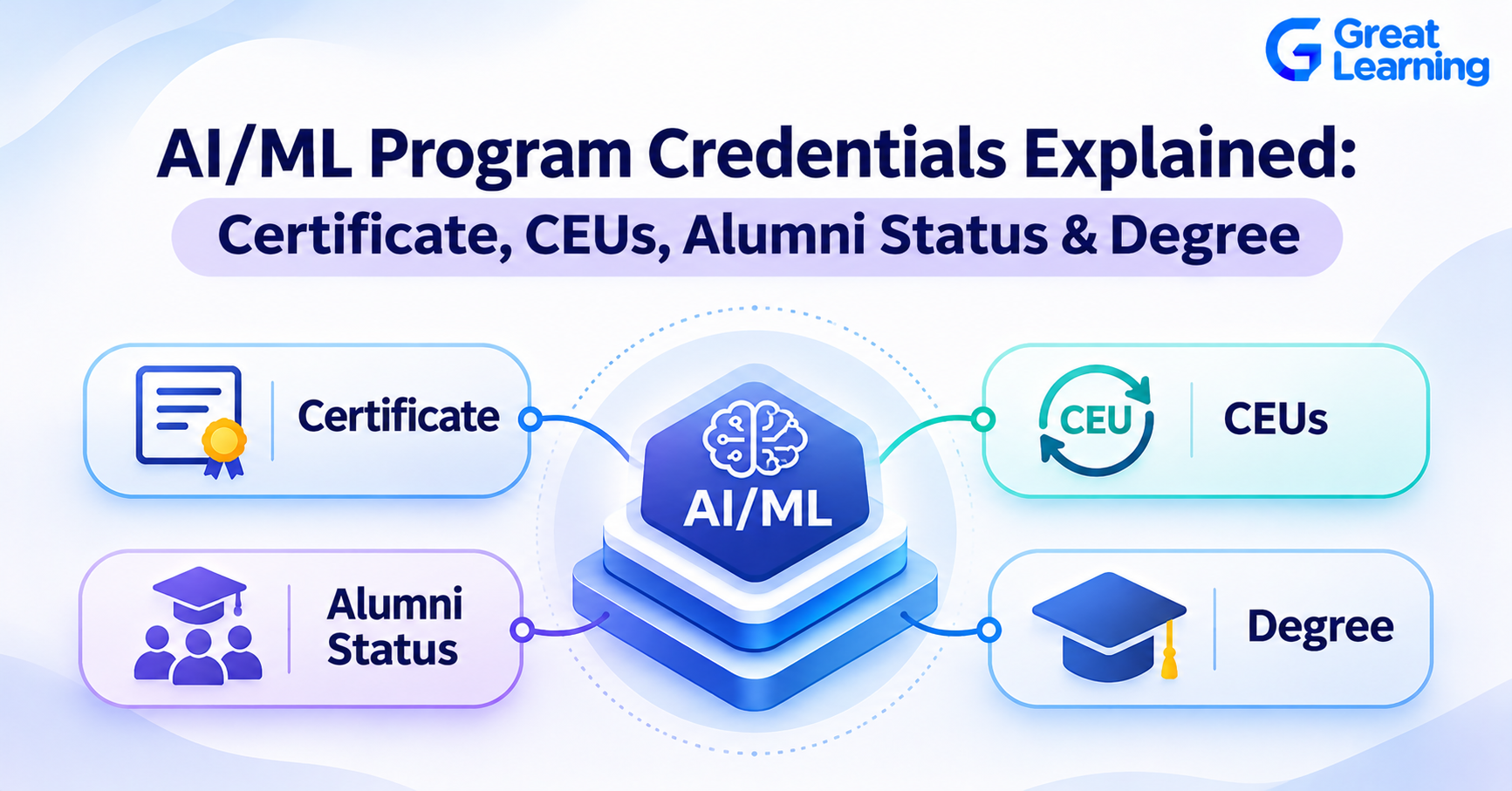
When comparing online Artificial Intelligence and Machine Learning (AI/ML) programs, you may come across terms such as certificates, Continuing Education Units (CEUs), alumni status, and degrees. Although these terms may appear together on program pages, they represent different types of recognition.
Knowing what each one means can help you understand the qualification a program offers and what you can expect upon completion.
TL;DR
AI/ML programs may offer certificates, Continuing Education Units (CEUs), and alumni recognition, but these are not equivalent to academic degrees. Understand what each credential represents, who awards it, and what to verify before enrolling.
What Is the Difference Between a Certificate, CEUs, Alumni Status, and a Degree?
Each credential serves a different purpose and represents a different form of recognition.
| Credential | What it represents |
| Certificate | Recognition of completing a specific course or program |
| CEUs | Documented participation in qualifying continuing education |
| Alumni status | An institutional association granted to eligible learners or graduates |
| Degree | A formal academic qualification awarded after fulfilling academic requirements |
A certificate confirms program completion but does not automatically represent an academic degree. CEUs document continuing education participation and are not equivalent to academic credits or a degree. Alumni status indicates an institutional relationship rather than an academic qualification.
What Should You Verify Before Enrolling in an Online AI/ML Program?
Program descriptions may use terms such as university-backed, certified, or internationally recognized. Rather than relying on these labels, examine the actual credentials and the conditions attached to them.
Consider the following questions before enrolling:
- Who awards the credential? Determine whether the university, business school, or training provider issues it.
- What is the exact credential title? Check whether it is a certificate of completion, postgraduate certificate, or academic degree.
- What are the completion requirements? Look for details about assessments, projects, examinations, and attendance.
- Are CEUs included? Check the number of units and the organization awarding them.
- Does alumni status apply? Find out whether program participants qualify and what benefits, if any, are included.
- Where are these details documented? Refer to the official program page, brochure, and credential information.
These checks help establish what a program actually offers before you commit to enrollment.
How Can an AI/ML Program Offer Multiple Credentials?
A single AI/ML program can offer multiple credentials when different institutions recognize different aspects of the same learning experience. For example, one institution may award a certificate for program completion, while another provides additional institutional recognition. Continuing education units may also be awarded to document qualifying educational participation.
The PG Program in Artificial Intelligence and Machine Learning, offered in collaboration with the McCombs School of Business at The University of Texas at Austin and Great Lakes Executive Learning, follows this approach.
PG Program in Artificial Intelligence & Machine Learning
Master AI, Machine Learning, Generative AI, Agentic AI, NLP, and Deep Learning with expert faculty and industry mentorship. Earn dual certificates from UT Austin and Great Lakes Executive Learning.
Upon successful completion, learners receive:
- PG Certificate from Texas McCombs: Recognizes completion of the program associated with the McCombs School of Business.
- PG Certificate from Great Lakes Executive Learning: Provides additional institutional recognition of program completion.
- 9.5 CEUs from Texas McCombs: Recognize continuing education participation.
These awards represent separate forms of recognition within the same program. Neither PG certificate nor the CEUs should be mistaken for an academic degree.
How Can You Choose an AI/ML Program Based on the Credential You Need?
The credential you should look for depends on what you want to demonstrate through your learning.
- For course completion: Look for a certificate that identifies the program and issuing institution.
- For continuing education: Check whether the program awards CEUs and whether the units meet your professional or organizational requirements.
- For an institutional association: Review the eligibility criteria and benefits associated with alumni status.
- For a formal academic qualification: Look for a degree program offered by an institution authorized to award that qualification.
If a program offers multiple credentials, evaluate each one independently. Check the awarding institution, eligibility requirements, and intended purpose rather than assuming that receiving several credentials is equivalent to earning a degree.
Ultimately, the value of a credential depends on what it represents and whether it meets your educational or professional requirements.