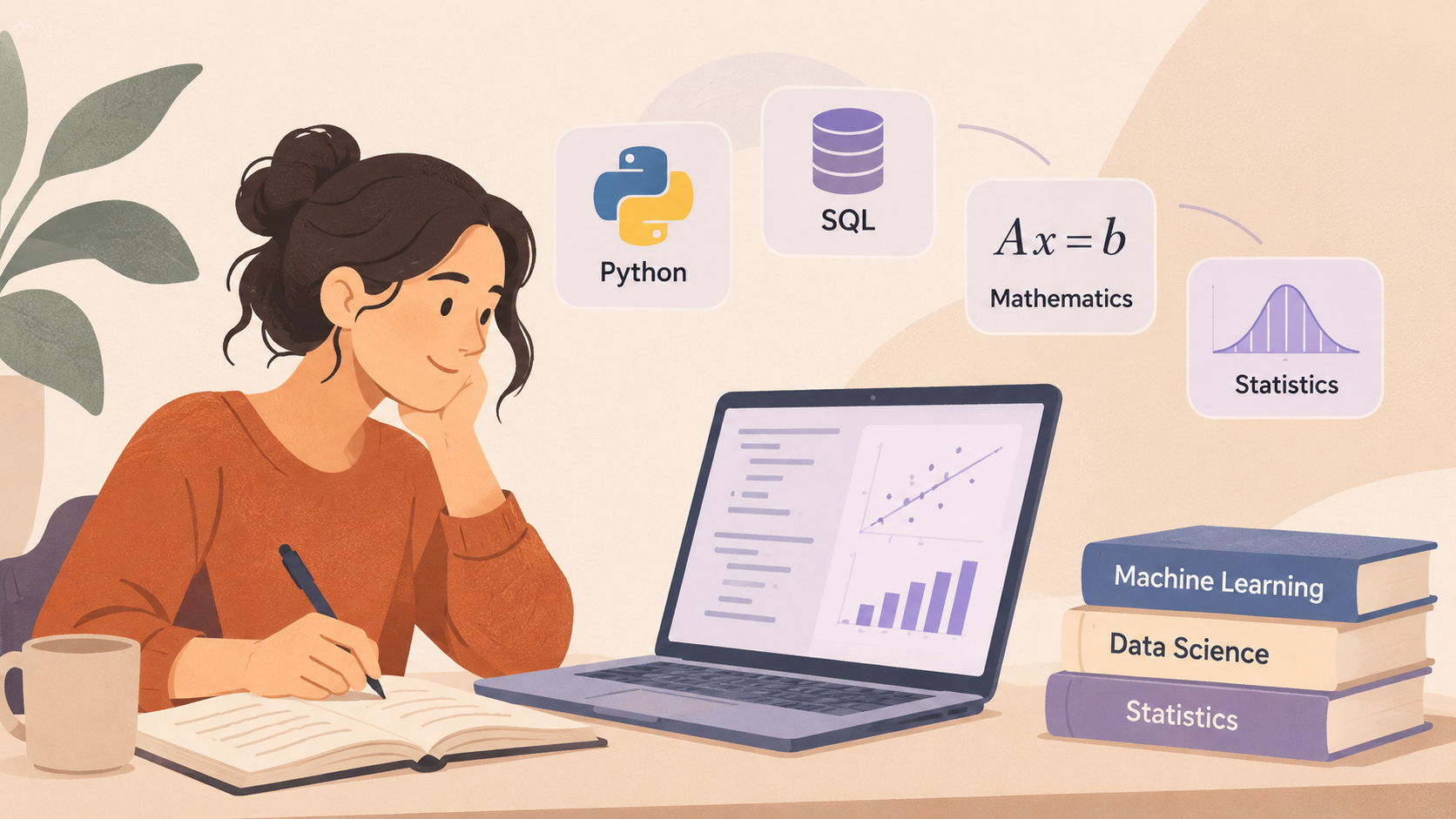
A Computer Science degree is not a requirement for every AI/ML learning pathway. Learners from mathematics, engineering, business, healthcare, and other disciplines can also develop the skills needed to study AI/ML.
However, programming, mathematical reasoning, and analytical thinking remain important. Understanding your existing strengths can help you identify what to prepare before starting.
TL;DR
You don't need a Computer Science degree to start learning AI and Machine Learning. Learners from mathematics, engineering, business, healthcare, and other backgrounds can build relevant skills by developing foundations in Python, algebra, probability, and statistics. Structured programs from Johns Hopkins University and the University of Texas at Austin offer learning pathways with practical projects, mentorship, and hands-on experience.
Does a Non-Computer Science Background Disqualify You from Learning AI and ML?
Different academic disciplines offer skills that can be useful when learning AI and Machine Learning. The strengths you bring and the technical areas you may need to develop depend on your field of study and prior experience.
| Background | Transferable strengths | Areas to develop |
| Mathematics or Statistics | Quantitative reasoning | Programming and data tools |
| Engineering or Physics | Technical problem-solving | Python and ML workflows |
| Business, Finance, or Economics | Data interpretation and domain knowledge | Programming and statistics |
| Healthcare or Life Sciences | Research and evidence-based reasoning | Data analysis and coding |
| Humanities or other fields | Research and critical thinking | Mathematics and programming |
Your academic background does not determine your ability to learn AI. Instead, it helps you identify transferable skills and the technical foundations you may need to develop.
Are You Ready to Handle the Technical Requirements?
Assess your current abilities rather than relying on your degree title.
| Readiness check | Ask yourself |
| Numerical reasoning | Can I work with basic equations, graphs, and statistics? |
| Logical thinking | Can I break a problem into smaller steps? |
| Data interpretation | Can I identify patterns without jumping to conclusions? |
| Programming mindset | Am I willing to learn Python and practice regularly? |
| Time commitment | Can I set aside time for exercises and assignments? |
If most answers are yes, you may be ready to begin introductory learning. If several are no, identify those gaps and prepare before advanced coursework. This is a personal readiness check, not an admission test.
What Should You Prepare For Before Starting an AI/ML Program?
Build a foundation in Python, algebra, probability, and statistics. Practise working with datasets by organizing information, identifying missing values, and interpreting patterns. Reviewing the essential machine learning prerequisites can help you identify areas to strengthen before advanced coursework.
You do not need to master programming before starting an AI/ML learning pathway. Choose a curriculum that introduces technical concepts gradually and offers opportunities for hands-on practice.
The Johns Hopkins University’s Certificate Program in Artificial Intelligence: Applied ML, GenAI, and Agents is a five-month online program covering Python, Machine Learning, Generative AI, and Agentic AI. It includes faculty-led masterclasses, industry mentorship, five projects, and 30+ case studies.
Johns Hopkins Applied AI Certificate Program
Master practical AI implementations and drive real-world impact. Learn to deploy cutting-edge applied AI solutions to transform your organization.
Learners also gain experience with tools such as Python, Pandas, NumPy, Scikit-learn, and Hugging Face. Upon successful completion, they receive a Certificate of Completion and 16 CEUs from Johns Hopkins University.
This structured approach can help professionals from non-CS backgrounds build relevant technical skills and explore practical AI applications.
How Can You Choose an AI/ML Program That Supports Non-CS Learners?
When selecting an AI/ML program, check whether it offers introductory programming support, preparatory resources, and a curriculum that builds technical knowledge progressively.
The PG Program in Artificial Intelligence and Machine Learning from the McCombs School of Business at the University of Texas at Austin offers a free pre-program Python tutorial for learners without prior programming knowledge. Its curriculum begins with Python foundations before covering Machine Learning, Deep Learning, Generative AI, and Agentic AI.
Post Graduate Program in AI & Machine Learning: Business Applications
Earn dual certification from UT Austin & Great Lakes with real-world projects, GenAI modules, and dedicated career support to fast-track your AI journey.
The 12-month program also includes weekly mentorship sessions with industry experts, hands-on projects, and a four-week capstone, giving learners opportunities to apply their technical knowledge.
A Computer Science degree is not the only route into AI/ML. Your existing skills, willingness to learn programming, and preparation for mathematical concepts can all influence how effectively you progress.