India's demand for AI and machine learning talent remained strong through 2026. AI/ML hiring grew 25% year over year in June and 31% in August, before recording another 20% increase in September. The demand is expected to outpace talent availability: India will need 2.3 million AI professionals by 2027, against an estimated supply of 1.2 million.
For learners, this makes an important distinction worth examining: are they learning to build machine learning models or simply use existing AI tools?
AI Tool Proficiency Is Not the Same as Machine Learning
Using ChatGPT, prompting large language models, or assembling automated workflows builds familiarity with AI applications. Machine learning involves preparing data, selecting algorithms, training models, testing performance, and improving predictions. Both skill sets are useful, but they serve different goals.
A no-code course may suit professionals applying AI to business workflows without becoming developers. The MIT Professional Education No Code and Agentic AI program, for example, focuses on no-code tools and applying regression, classification, and clustering through them. This is distinct from learning to implement models in Python.
Build AI and machine learning tools without any coding. Made for professionals ready to lead in the AI-driven world.
What Should a Technical Machine Learning Curriculum Include?
Look for evidence across four areas, not just a long list of software and platforms.
1. Python and Data Handling
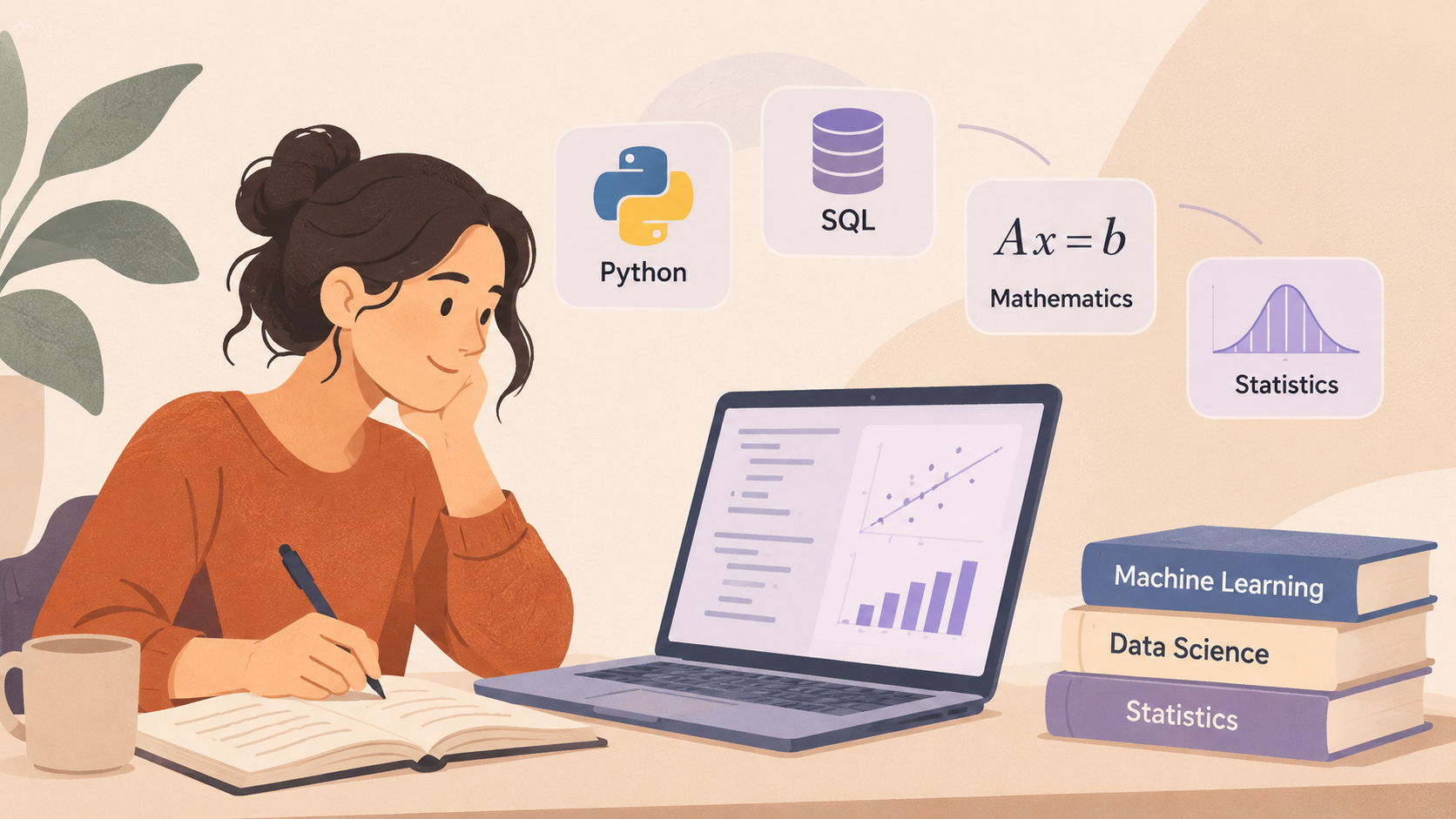
Learners should write and understand Python, work with functions and data structures, and use libraries such as NumPy, Pandas, and Scikit-learn. They should practise loading, cleaning, exploring, and preparing datasets. This machine learning prerequisites guide outlines the relevant foundations in Python, SQL, mathematics, and statistics.
2. Statistics and Mathematical Reasoning
Look for probability, distributions, descriptive statistics, hypothesis testing, linear algebra, and optimisation. These concepts help learners understand model behaviour rather than treat predictions as unexplained outputs.
3. Model Development and Evaluation
A strong syllabus covers supervised and unsupervised learning, including regression, classification, decision trees, ensemble methods, and clustering. Learners should split datasets, engineer features, select evaluation metrics, identify overfitting, and tune models. Merely naming algorithms does not demonstrate technical depth.
4. Applied Projects
A meaningful project asks learners to define a problem, prepare a dataset, select a model, interpret results, and explain trade-offs. For a customer churn project, for instance, they should justify the features and model, evaluate performance, and consider the cost of false predictions, not simply run a prebuilt workflow.

How Can You Verify What You Will Actually Learn?
Read the detailed syllabus, coding assignments, project briefs, and assessment methods, not just the course overview. Check whether you will write code independently, work with real datasets, compare model performance, and receive feedback on your implementation. Ask to see a sample notebook or project rubric showing code, metric selection, model comparisons, and error analysis.
Explore Great Learning’s AI courses to compare learning pathways. For technical detail, inspect the published curricula for the Post Graduate Program in AI and Machine Learning and IIT Bombay’s e-Postgraduate Diploma in AI and Data Science. The IIT Bombay curriculum, for instance, separately identifies programming for ML, statistical foundations, model evaluation, and core algorithms. Compare these details and assessments against your goals rather than relying on titles or tool lists.
Post Graduate Program in AI & Machine Learning: Business Applications
Earn dual certification from UT Austin & Great Lakes with real-world projects, GenAI modules, and dedicated career support to fast-track your AI journey.
The clearest test is what you can do independently: write code, explain the statistical reasoning, train and evaluate a model, and defend your project decisions. Choose learning that builds the capability you need, not simply familiarity with the latest AI tools.