
Multi-agent systems use multiple AI agents that work together to complete tasks that are too complex, specialized, or large for a single agent.
Instead of giving one agent every responsibility, a multi-agent architecture divides the workflow across agents with defined roles, communication paths, and decision-making responsibilities.
For example, one agent can coordinate the workflow, another can research information, and a third can validate the result. The agents can work sequentially, in parallel, or under the control of a supervisor depending on the architecture.
The right multi-agent pattern depends on factors such as task complexity, agent specialization, coordination requirements, latency, and reliability.
This guide explains the most common multi-agent patterns, their architectures, practical use cases, and the failure modes engineers and architects should consider when designing agent teams.
What Is a Multi-Agent System?
A multi-agent system is an AI architecture in which multiple agents collaborate to achieve a shared goal. Each agent typically has a defined role, access to specific tools or knowledge, and responsibility for one part of the overall workflow.
A simple multi-agent workflow can look like this:
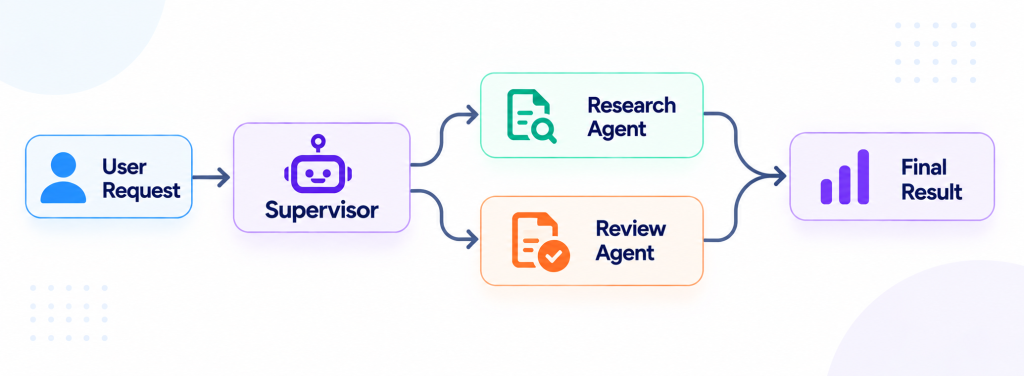
The agents may share information through a central state, messages, events, or another coordination mechanism.
The key advantage is specialization. Instead of building one large agent that must reason about every task, developers can create smaller agents optimized for specific responsibilities.
Depending on how these agents coordinate, common multi-agent system patterns include the supervisor pattern, hierarchical pattern, peer-to-peer pattern, and pipeline pattern.
However, adding more agents does not automatically improve performance. More agents can also introduce communication overhead, coordination failures, duplicated work, increased latency, and additional points of failure.
Model selection also plays an important role in optimizing multi-agent architectures. For a deeper look at how smaller models can reduce latency and costs while handling specialized agent tasks, explore smaller models in multi-agent systems.
Therefore, the architecture should be selected based on the complexity of the task and the level of coordination the application requires.
1. Supervisor Pattern
The supervisor pattern uses a central AI agent to coordinate multiple specialized agents. The supervisor receives the user's request, breaks it into subtasks, decides which agent should handle each task, and combines the resulting outputs.
Architecture
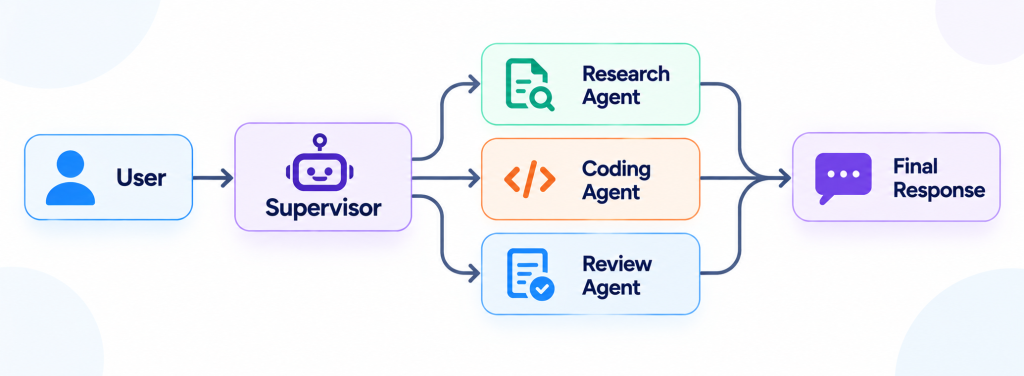
The supervisor acts as the orchestrator, while the other agents focus on specific capabilities. For example, a research agent can gather information, a coding agent can generate implementation logic, and a review agent can check the result.
Example
Consider a software development assistant that receives:
"Analyze this API specification and suggest implementation changes."
The supervisor could route the workflow as follows:
- Send the API specification to the Research Agent to identify relevant requirements.
- Send the requirements to the Coding Agent to propose implementation changes.
- Send the proposed solution to the Review Agent to identify errors or missing requirements.
- Combine the outputs and generate the final recommendation.
When to Use It
Use the supervisor pattern when an application has multiple specialized agents and requires dynamic task routing. It works particularly well when the next step depends on the result of the previous step or when the system needs a central component to control execution.
Failure Mode
The supervisor can become a single point of failure. If it incorrectly interprets the user's request or selects the wrong agent, downstream agents may perform irrelevant work. It can also become a bottleneck when many tasks need to pass through the same supervisor.
To reduce these risks, use clear agent descriptions, structured task inputs, routing rules, and validation of important decisions.
2. Hierarchical Pattern
A hierarchical multi-agent system organizes agents into multiple levels. A top-level agent manages the overall objective, while lower-level supervisors coordinate specialized agents responsible for individual domains or subtasks.
Architecture
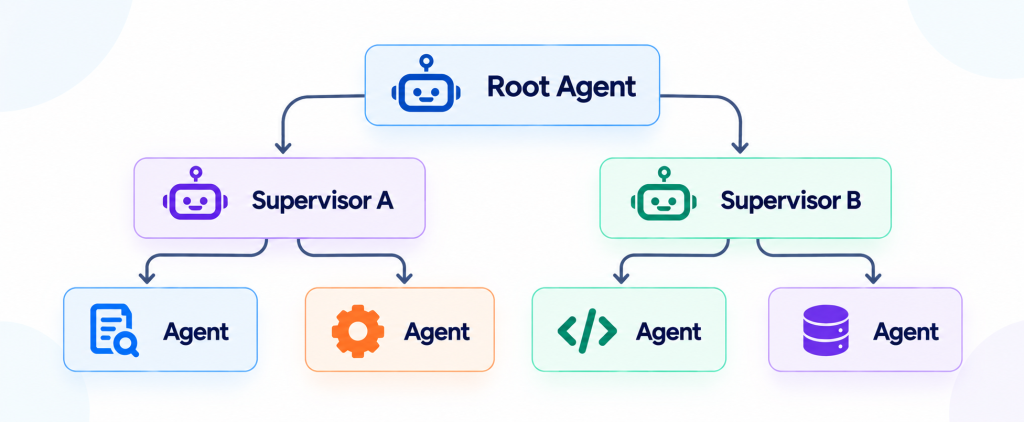
Instead of one supervisor managing every agent directly, responsibility is distributed across multiple levels.
Example
Imagine an enterprise research system that needs to prepare a technical market report.
The Root Agent defines the overall research objective and delegates major areas to two supervisors:
- Research Supervisor: Coordinates market research and data-analysis agents.
- Engineering Supervisor: Coordinates technical research and validation agents.
Each supervisor manages its own group and sends the completed results back to the Root Agent.
When to Use It
Use a hierarchical architecture when the workflow is large, complex, and naturally divided into multiple domains. It is especially useful when a single supervisor would otherwise have to manage too many agents, tools, and decisions.
This pattern can also make organizational responsibilities clearer because each supervisor controls a specific part of the workflow.
Failure Mode
Hierarchical systems can suffer from error propagation across multiple levels. A poor decision made by the Root Agent can affect an entire branch of the workflow.
They can also become difficult to debug because developers may need to trace a decision through several supervisors before finding the source of a failure.
Use clear interfaces between levels, structured outputs, logging, and validation at important handoff points.
3. Peer-to-Peer Pattern
The peer-to-peer pattern allows multiple agents to communicate directly without depending on a central supervisor. Each agent operates as a specialized participant and can exchange information, request additional work, or evaluate another agent's output.
Architecture
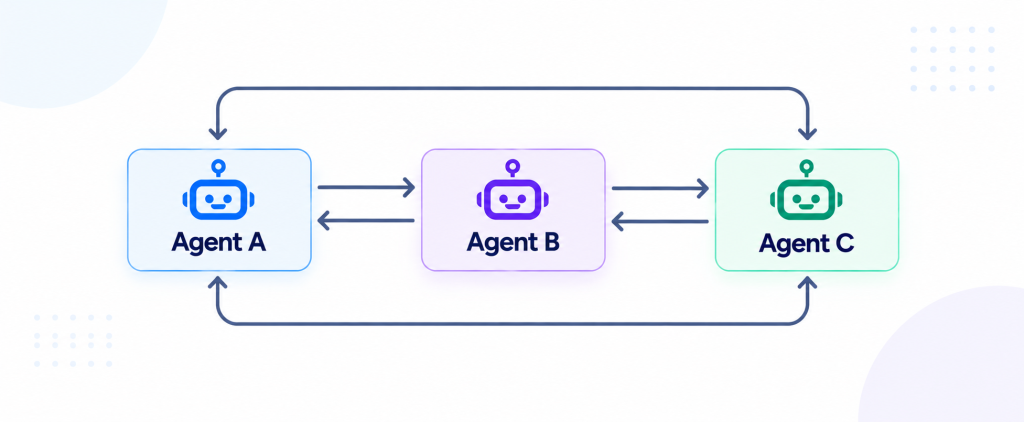
Unlike the supervisor pattern, there is no single agent responsible for controlling the entire workflow. Coordination happens through communication between the agents.
Example
Consider a financial analysis system with four specialized agents:
- Market Agent: Analyzes market conditions.
- Risk Agent: Evaluates potential risks.
- Valuation Agent: Performs valuation analysis.
- Critic Agent: Reviews assumptions and identifies weaknesses.
The agents can exchange their findings before producing a final recommendation. For example, the Risk Agent can challenge an assumption made by the Valuation Agent, while the Critic Agent can identify inconsistencies across both analyses.
When to Use It
Use a peer-to-peer architecture when multiple agents need to collaborate, cross-check information, or contribute independently to a decision.
It can be useful for research, debate-style reasoning, validation, and distributed problem-solving where no single agent needs complete control over the workflow.
Failure Mode
The main challenge is coordination complexity. As the number of agents increases, the number of possible communication paths can also increase.
Agents may duplicate work, disagree on conclusions, or repeatedly communicate without reaching a decision. Without clear termination rules, the system can also enter unnecessary loops.
Define communication protocols, limit unnecessary handoffs, establish decision rules, and introduce a final validation or aggregation mechanism where required.
4. Pipeline Pattern
The pipeline pattern connects multiple agents in a predefined sequence. Each agent performs one stage of the workflow and passes its output to the next agent.
Architecture
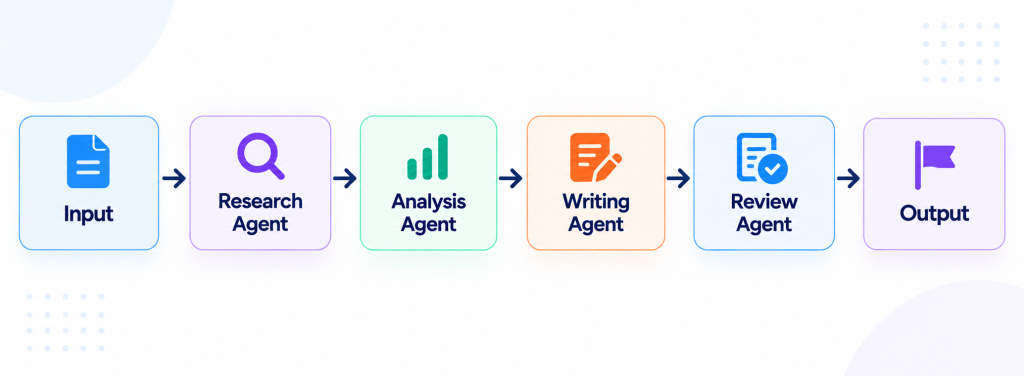
The execution path is generally predictable. Unlike a supervisor architecture, the system does not need to dynamically decide which specialist should execute next.
Example
A content-generation workflow can use four agents:
- Research Agent gathers relevant information.
- Analysis Agent organizes the findings and identifies key insights.
- Writing Agent converts those insights into a draft.
- Review Agent checks the draft for accuracy, completeness, and quality.
Each stage has a specific responsibility, making the workflow easy to understand and monitor.
When to Use It
Use a pipeline architecture when the workflow has a clear sequence of dependent steps and the next stage can be determined in advance.
It is particularly suitable for document processing, content generation, data transformation, software development workflows, and other applications where each stage builds on the previous stage.
Failure Mode
The primary weakness is downstream failure propagation. If the Research Agent produces incorrect information, the Analysis, Writing, and Review Agents may all operate on flawed input.
A pipeline can also become inefficient when every request must pass through every stage, even when some stages are unnecessary.
Add validation between key stages, and use conditional execution when certain steps aren't required for every request.
Similar agentic workflows can be applied beyond content generation to business processes such as customer support, financial analysis, and operational automation.
The AI Agents for Business program by Texas McCombs focuses on applying AI agents and generative AI to practical business workflows and decision-making.
UT Austin PG Program in AI Agents & Generative AI
Master GenAI, large language models, and multi-agent systems to automate business workflows. Learn to build and deploy intelligent AI agents with no coding background.
How to Choose the Right Multi-Agent Pattern
The architecture should match the application's coordination requirements.
| Pattern | Best For | Main Strength | Common Risk |
| Supervisor | Dynamic task routing | Centralized coordination | Supervisor bottleneck |
| Hierarchical | Large complex workflows | Scalable responsibility | Error propagation |
| Peer-to-Peer | Collaborative reasoning | Distributed decision-making | Communication complexity |
| Pipeline | Predictable workflows | Simple execution flow | Downstream failure propagation |
A useful design rule is to start with the simplest architecture that satisfies the workflow requirements.
If one agent can reliably complete a task with a few tools, adding multiple agents may create unnecessary complexity.
A multi-agent design becomes more valuable when tasks require distinct expertise, parallel execution, independent validation, or complex coordination.
Building these systems effectively also requires understanding how agents coordinate, how workflows are evaluated, and how to deploy multi-agent applications reliably.
The AI Agents course by Johns Hopkins University explores these areas through hands-on agentic AI and multi-agent system development.
Certificate Program in Agentic AI
Learn the architecture of intelligent agentic systems. Build agents that perceive, plan, learn, and act using Python-based projects and cutting-edge agentic architectures.
Common Failure Modes in Multi-Agent Systems
Regardless of the architecture, multi-agent systems introduce several recurring engineering challenges.
1. Agent Miscommunication
Agents may interpret instructions differently or exchange incomplete information. Structured messages and clearly defined state schemas can reduce this problem.
2. Duplicate Work
Multiple agents may independently perform the same task. Explicit responsibilities and task ownership help prevent unnecessary execution.
3. Infinite Loops
Agents can repeatedly call one another without reaching a conclusion. Maximum iteration limits, termination conditions, and workflow-level controls are important safeguards.
4. Incorrect Delegation
A supervisor may route a task to an unsuitable agent. Tool descriptions, routing rules, and validation steps should therefore be explicit.
5. Error Propagation
An incorrect output from one agent can become input for several downstream agents. Validation and critic agents can help catch errors before they spread.
6. Cost and Latency
Every additional agent call can increase token usage, latency, and infrastructure costs. Multi-agent architectures should therefore be evaluated against a simpler single-agent design before deployment.
Best Practices for Designing Multi-Agent Architectures
A reliable multi-agent system should define clear agent responsibilities rather than creating agents simply because a task appears complex.
Use structured inputs and outputs between agents so that information can be validated programmatically. Define termination conditions for every workflow that can loop or recursively invoke agents.
It is also important to monitor individual agent performance instead of evaluating only the final response. Logging agent decisions, tool calls, latency, failures, and handoffs makes it easier to identify where a workflow breaks.
Most importantly, treat the multi-agent architecture as a software system, not simply a collection of prompts. The design should account for state management, error handling, observability, security, latency, and cost.
Conclusion
Multi-agent systems divide complex AI workflows among specialized agents that collaborate through defined architectures.
The supervisor pattern provides centralized coordination, hierarchical architectures distribute responsibility across multiple levels, peer-to-peer systems enable collaborative decision-making, and pipeline architectures provide predictable sequential execution.
There is no universally best multi-agent pattern. The right choice depends on the application's workflow, coordination requirements, and operational constraints.
For most systems, starting with a simple architecture and adding agents only when specialization or coordination genuinely improves the outcome is the most practical approach.
Frequently Asked Questions
1. What is a multi-agent system?
A multi-agent system is an AI architecture in which multiple specialized AI agents collaborate to complete a shared task or solve a complex problem. Each agent can have a specific role, tools, knowledge, or responsibility within the workflow.
2. What are the common multi-agent system patterns?
The most common multi-agent patterns include supervisor, hierarchical, peer-to-peer, and pipeline architectures. Each pattern defines how agents communicate, coordinate tasks, and share responsibility.
3. What is the supervisor pattern in multi-agent systems?
The supervisor pattern uses a central agent to coordinate multiple specialized agents. The supervisor decides which agent should handle a task, manages the workflow, and can combine the agents' outputs into a final result.
4. What is the difference between a single-agent and multi-agent system?
A single-agent system uses one agent to manage the workflow, while a multi-agent system distributes responsibilities across multiple agents. Multi-agent systems are useful when a task benefits from specialized capabilities, parallel execution, or independent validation.
5. What are the main challenges of multi-agent systems?
Common challenges include communication failures, incorrect task delegation, duplicate work, infinite loops, error propagation, latency, and increased costs. Clear agent responsibilities, structured communication, validation, and workflow controls can help address these issues.
6. Which multi-agent architecture should I use?
The choice depends on the workflow. Use a supervisor pattern for dynamic task routing, a hierarchical pattern for complex multi-level workflows, a peer-to-peer pattern for collaborative reasoning, and a pipeline pattern for predictable sequential tasks.
7. Do multi-agent systems always perform better than single-agent systems?
No. Adding more agents can increase complexity, latency, and cost without improving results. A multi-agent architecture is most useful when task specialization, collaboration, parallel execution, or independent validation provides a clear benefit.