
- What Are GPT-6.1 Sol and Gemini 4 Argon?
- GPT-6.1 Sol vs Gemini 4 Argon: Key Differences
- Which Model Is Better for Coding?
- Which Model Is Better for Research and Analysis?
- How Do Pricing, Context, and Availability Compare?
- Which Model Should You Choose?
- Final Verdict: GPT-6.1 Sol vs Gemini 4 Argon
- Frequently Asked Questions
AI models are increasingly designed to handle complex tasks that go beyond generating text. Developers use them to debug software, analyze large documents, conduct research, and execute multi-step workflows.
As these capabilities expand, choosing a model involves more than comparing benchmark scores. Cost, reasoning performance, context handling, and availability also influence which model works best for a particular task.
Two models attracting attention in this space are GPT-6.1 Sol from OpenAI and Gemini 4 Argon from Google.
Both target demanding coding and professional workloads, including research and complex analysis, but they differ in their published capabilities, pricing, and access.
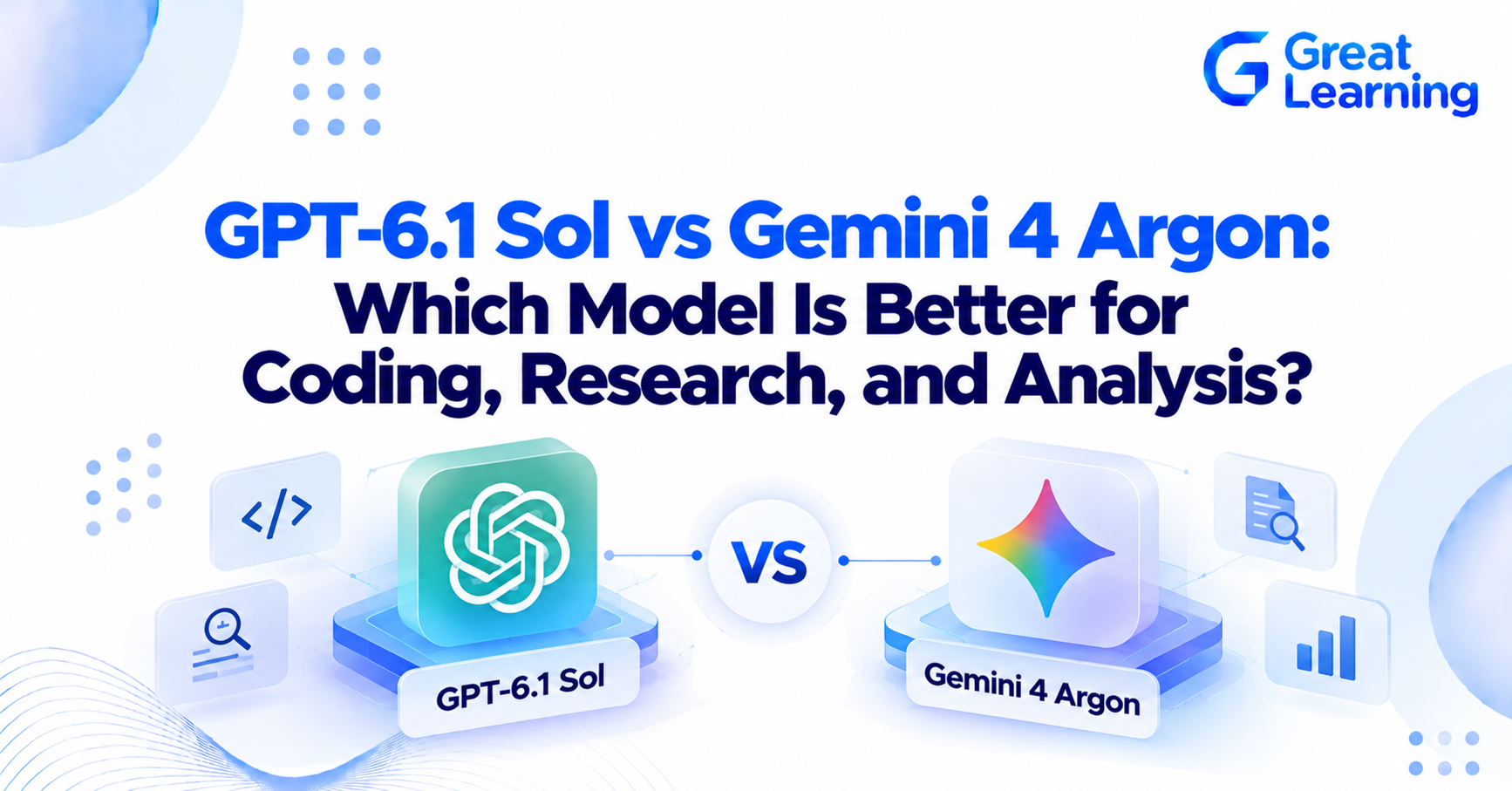
This comparison examines GPT-6.1 Sol vs Gemini 4 Argon across coding, research, analysis, performance claims, and API economics to help developers and professionals evaluate their options.
What Are GPT-6.1 Sol and Gemini 4 Argon?
GPT-6.1 Sol is an OpenAI model designed for complex coding, computer use, and professional workflows.
OpenAI positions it as an upgrade to GPT-6 Sol that approaches the performance of GPT-6 Astra on several demanding tasks at a substantially lower cost. It is available through the OpenAI API and in ChatGPT Work and Codex for eligible plans.
Gemini 4 Argon is Google's frontier model focused on complex, long-running tasks. Google highlights its capabilities in software engineering, financial research, legal work, and defensive cybersecurity.
The company also describes using Argon internally for large-scale code migrations, performance optimization, and research workflows.
The models share a broad goal: helping users accomplish work that requires sustained reasoning and multiple steps rather than simply answering isolated questions.
Their positioning differs in emphasis. GPT-6.1 Sol combines advanced reasoning with cost-efficient API usage, while Gemini 4 Argon is designed to tackle demanding workflows that may require extensive reasoning and unusually long outputs.
GPT-6.1 Sol vs Gemini 4 Argon: Key Differences
The following table summarizes their principal differences based on the information their developers have published.
| Feature | GPT-6.1 Sol | Gemini 4 Argon |
| Developer | OpenAI | |
| Primary focus | Coding, computer use, professional workflows, and scientific tasks | Long-horizon coding, research, enterprise work, and cybersecurity |
| Coding evidence | Matches GPT-6 Astra on DeepSWE v1.1, according to OpenAI | Reports 77.9% on DeepSWE v1.1, according to Google |
| Research capabilities | Scientific workflows, complex documents, and multi-step analysis | Financial research, legal work, document analysis, and complex technical tasks |
| Context and output | 1.05 million-token context window; up to 128,000 output tokens | Up to 1 million output tokens; Google has not stated the context-window size on its announcement page |
| Standard or introductory API price | $2 per million input tokens and $10 per million output tokens | Introductory price of $2 per million input tokens and $10 per million output tokens |
| Availability | API, ChatGPT Work, and Codex, subject to plan and access | Initially limited to trusted cyber defenders, with broader access planned in phases |
Sources: OpenAI's official GPT-6.1 Sol announcement and API documentation, and Google's Gemini 4 Argon announcement.
These specifications do not establish a universal winner. In particular, the output-token limit and context-window size are different measurements, and benchmark scores should not be compared without considering the evaluation setup.
Which Model Is Better for Coding?
Both models are designed to assist with software engineering tasks, including debugging, understanding existing codebases, and handling complex coding workflows.
The more useful comparison is how their reported capabilities translate into practical development work.
GPT-6.1 Sol for coding
OpenAI reports that GPT-6.1 Sol matches GPT-6 Astra on DeepSWE v1.1, a benchmark for solving long-horizon software engineering tasks in real codebases, at approximately one-fifth of Astra's cost.
OpenAI also reports a 6.4-percentage-point improvement over GPT-6 Sol's best score at a lower reasoning effort and cost.
These results make GPT-6.1 Sol an attractive option for developers who need to debug complicated projects, implement features, or build coding agents without paying the higher token rates of a more expensive model.
Its practical value also depends on the surrounding tools. Repository access, test execution, code review, and the ability to inspect errors can matter as much as the model's reasoning capability.
Gemini 4 Argon for coding
Google reports a score of 77.9% on DeepSWE v1.1, describing it as a new state-of-the-art result. The company also highlights internal projects involving large C/C++ to Rust migrations and code optimization.
In one example, Google says Argon agents helped optimize a Rust implementation of its libgav1 video decoder to run 2.7 times faster than an earlier Rust port while maintaining identical video output.
These are company-reported results from specific tasks, not guarantees of the same improvements in other projects.
Argon's reported capabilities make it particularly interesting for engineering teams dealing with large repositories, code modernization, complex debugging, and extended software development tasks.
Coding verdict
There is not enough independently verified, directly comparable evidence to declare one model the definitive coding winner.
Both have strong vendor-reported results, and Google publishes an explicit DeepSWE v1.1 score while OpenAI emphasizes Sol's performance relative to Astra and its lower cost.
For developers choosing a model today, GPT-6.1 Sol has the practical advantage of documented API access and a published cost structure.
Argon deserves consideration for demanding, long-horizon engineering work as its availability expands.
Which Model Is Better for Research and Analysis?
Research and analysis require more than generating a plausible answer. A capable model needs to interpret complex information, identify relevant evidence, compare alternatives, and produce conclusions that can be checked against source material.
GPT-6.1 Sol for research and document analysis
GPT-6.1 Sol is designed for professional workflows involving complex documents and multi-step reasoning.
OpenAI reports results on GDP.pdf, an evaluation that tests how accurately models answer professional questions using documents containing tables, charts, diagrams, and fine-print details.
OpenAI also reports that Sol improved on Terminal-Bench Science 0.1, which evaluates scientific workflows involving tasks such as data analysis, simulations, and theorem proving.
At maximum reasoning effort, OpenAI reports an average cost of $5.47 per task for Sol, compared with $23.80 for GPT-6 Astra in that evaluation.
These capabilities are relevant to analysts, researchers, and professionals who need to extract information from complex documents, perform structured analysis, and use tools as part of a multi-step workflow.
Gemini 4 Argon for research and analysis
Google positions Argon for demanding enterprise knowledge work, particularly financial research, legal research, and complex tasks that involve documents and visual information.
Google reports leading results on the Vals Index, Vals Finance Agent v2, and Harvey's Legal Agent Benchmark. It also reports a score of 51.3% on AutomationBench, which evaluates agents performing end-to-end workflows across business functions.
These claims indicate a focus on research and analysis that involves multiple steps and actions, although independent validation is important when using benchmark results to make procurement decisions.
Argon's announced output limit of up to one million tokens could also be relevant to workflows that require generating very long responses or extended outputs. However, this should not be confused with its input context window, which Google's announcement page does not specify.
Research and analysis verdict
GPT-6.1 Sol has published evidence for document-based professional tasks and scientific workflows, alongside an established API price structure. Argon has promising reported results across financial research, legal work, and complex enterprise workflows.
The better choice depends on the task. For document-heavy analysis and scientific workflows where API access and cost predictability matter, Sol is a practical starting point.
For specialized enterprise research and longer workflows, Argon is worth evaluating when access becomes available.
Neither model eliminates the need to verify sources, check calculations, and validate conclusions.
For professionals looking to move beyond evaluating AI models and develop the skills to build and deploy AI-powered systems, the Artificial Intelligence Engineering course by Johns Hopkins University offers a relevant learning opportunity.
JHU Certificate Program in AI and Agentic AI Engineering
Designed for software developers, data and AI professionals seeking hands-on technical expertise in building, deploying, and scaling AI and Agentic AI systems using MLOps, LLMOps, and cloud platforms.
This 22-week online program covers production-grade AI systems, MLOps, LLMOps, cloud deployment, and the evaluation and monitoring of agentic AI applications.
How Do Pricing, Context, and Availability Compare?
Pricing and technical limits can significantly affect the cost of building applications with AI models, particularly when workflows involve long prompts, repeated tool calls, and large outputs.
API pricing
| Pricing metric | GPT-6.1 Sol (Standard) | Gemini 4 Argon |
| Input tokens per million | $2 | $2 introductory |
| Cached input tokens per million | $0.10 | 95% below the applicable input rate |
| Output tokens per million | $10 | $10 introductory |
| Price after introduction | $2 input / $10 output | $4 input / $20 output |
OpenAI lists GPT-6.1 Sol's standard API pricing at $2 per million input tokens, $0.10 per million cached input tokens, and $10 per million output tokens.
Google lists an introductory price of $2 per million input tokens and $10 per million output tokens for Argon, with standard pricing increasing to $4 and $20 respectively after the introductory period.
Google has not specified the introductory period's end date in its announcement.
At their introductory rates, the models have the same base input and output token prices. After Argon's introductory pricing ends, Sol has lower standard token rates if OpenAI's published pricing remains unchanged.
Actual task costs can differ because of prompt length, cached-token eligibility, reasoning effort, output volume, tool calls, and retries.
Context window and output limits
GPT-6.1 Sol supports a 1.05-million-token context window and up to 128,000 output tokens. Google's Argon announcement states that its output-token limit is up to one million tokens, but does not give a corresponding context-window figure on that page.
These specifications serve different purposes. The context window limits how much input the model can consider in a request, while the output limit controls how much it can generate.
A large output limit can benefit extended report generation, but does not by itself prove that a model can ingest more source material or reason more accurately.
Availability
Availability is one of the biggest practical differences as of October 12, 2026.
GPT-6.1 Sol is available through the OpenAI API and in ChatGPT Work and Codex for eligible users. OpenAI says it is not yet available in the regular ChatGPT interface.
Gemini 4 Argon is in a phased rollout beginning with trusted cybersecurity defenders through Google's Fairwind Program.
Google says broader access is planned to begin with paid API customers and Google AI Ultra subscribers after further testing and safeguards work.
This means developers can evaluate Sol through its documented API today, while Argon's broader availability remains a constraint for many users.
Which Model Should You Choose?
The right model depends on your workload, budget, and ability to access it.
| Your requirement | Recommended starting point | Why |
| Coding and debugging today | GPT-6.1 Sol | Documented API access, strong coding claims, and published pricing |
| Large codebase migration | Evaluate both when possible | Google reports Argon handling extensive internal code migration work; validate performance on your repository |
| Research using complex documents | GPT-6.1 Sol | Published results for professional document analysis and clear API access |
| Financial or legal research workflows | Evaluate both | Google highlights Argon on finance and legal benchmarks; Sol also targets complex professional workflows |
| Cost-sensitive production agents | GPT-6.1 Sol as a baseline | Its standard input and output rates are published and currently lower than Argon's announced post-introductory rates |
| Very long generated outputs | Evaluate Gemini 4 Argon when accessible | Its announced output limit is up to one million tokens |
| Immediate experimentation | GPT-6.1 Sol | More established access through its documented API |
These are starting recommendations, not substitutes for testing. Before choosing a model for production, run representative tasks using the same instructions, input data, tools, and evaluation criteria.
Measure quality, latency, output length, failure rate, and cost per completed task rather than relying only on benchmark rankings.
Professionals looking to build and deploy AI systems can explore AI Engineering course offered by IIT Bombay, to gain practical skills in scalable AI infrastructure, distributed computing, and production MLOps.
IIT Bombay Certificate in AI Engineering and MLOps
Build, scale, and manage AI systems with hands-on training in AI engineering, MLOps, distributed computing, and production AI workflows.
Final Verdict: GPT-6.1 Sol vs Gemini 4 Argon
GPT-6.1 Sol and Gemini 4 Argon are both aimed at complex work involving coding, research, and analysis, but their current practical trade-offs differ.
GPT-6.1 Sol is the more accessible starting point for developers choosing a model today. It combines strong vendor-reported coding and professional-work results with published API pricing, a 1.05-million-token context window, and documented ways to access it.
Gemini 4 Argon is a compelling model to watch for demanding, long-horizon workflows. Google's reports highlight software engineering, finance and legal research, enterprise tasks, and a one-million-token output limit. Its phased rollout, however, makes availability a significant consideration.
There is no universally better model for every task. GPT-6.1 Sol is a practical choice when access and predictable costs are important; Argon merits evaluation for specialized, complex workflows as access expands.
The most reliable way to choose is to test both against the real work you need to complete and compare the quality and cost of successful outcomes.
Frequently Asked Questions
1. What is the difference between GPT-6.1 Sol and Gemini 4 Argon?
GPT-6.1 Sol is OpenAI's model focused on coding, computer use, and professional workflows. Gemini 4 Argon targets long-horizon coding, research, and enterprise tasks, with pricing and availability differences in practice.
2. Which model is better for coding?
Both report strong coding capabilities. OpenAI highlights GPT-6.1 Sol's cost-efficient DeepSWE performance, while Google reports Gemini 4 Argon's benchmark results and complex code-migration work. Testing remains essential before choosing either.
3. Which model is better for research and analysis?
GPT-6.1 Sol reports results on document-based professional and scientific tasks. Gemini 4 Argon emphasizes financial, legal, and enterprise research. Compare both on real tasks before selecting one for your needs.
4. How much does GPT-6.1 Sol cost?
OpenAI lists GPT-6.1 Sol at $2 per million input tokens, $10 per million output tokens, and $0.10 per million cached input tokens through its API at its listed rates today.
5. Does Gemini 4 Argon have a larger context window?
Google's announcement specifies up to one million output tokens for Gemini 4 Argon, but does not state its context-window size there. Output limits and context windows are distinct technical measurements.
6. Is Gemini 4 Argon available to everyone?
Google announced a phased rollout beginning with trusted cybersecurity defenders, with wider availability planned later. Access may remain limited compared with GPT-6.1 Sol through its API for many developers now.
7. Which model should developers choose?
Choose GPT-6.1 Sol when documented API access and predictable published pricing matter. Evaluate Gemini 4 Argon for specialized long-horizon workloads once access permits. Test both on representative tasks before committing.