
In an era of self-paced courses, recorded lectures, and digital learning platforms, professional upskilling has quietly become one of the loneliest endeavors in corporate life. Every evening, thousands of working professionals log in with the determination to learn something new while balancing demanding jobs, family responsibilities, and personal commitments. But even the most motivated learners can find it challenging to stay on track when faced with rigorous coursework and long days.
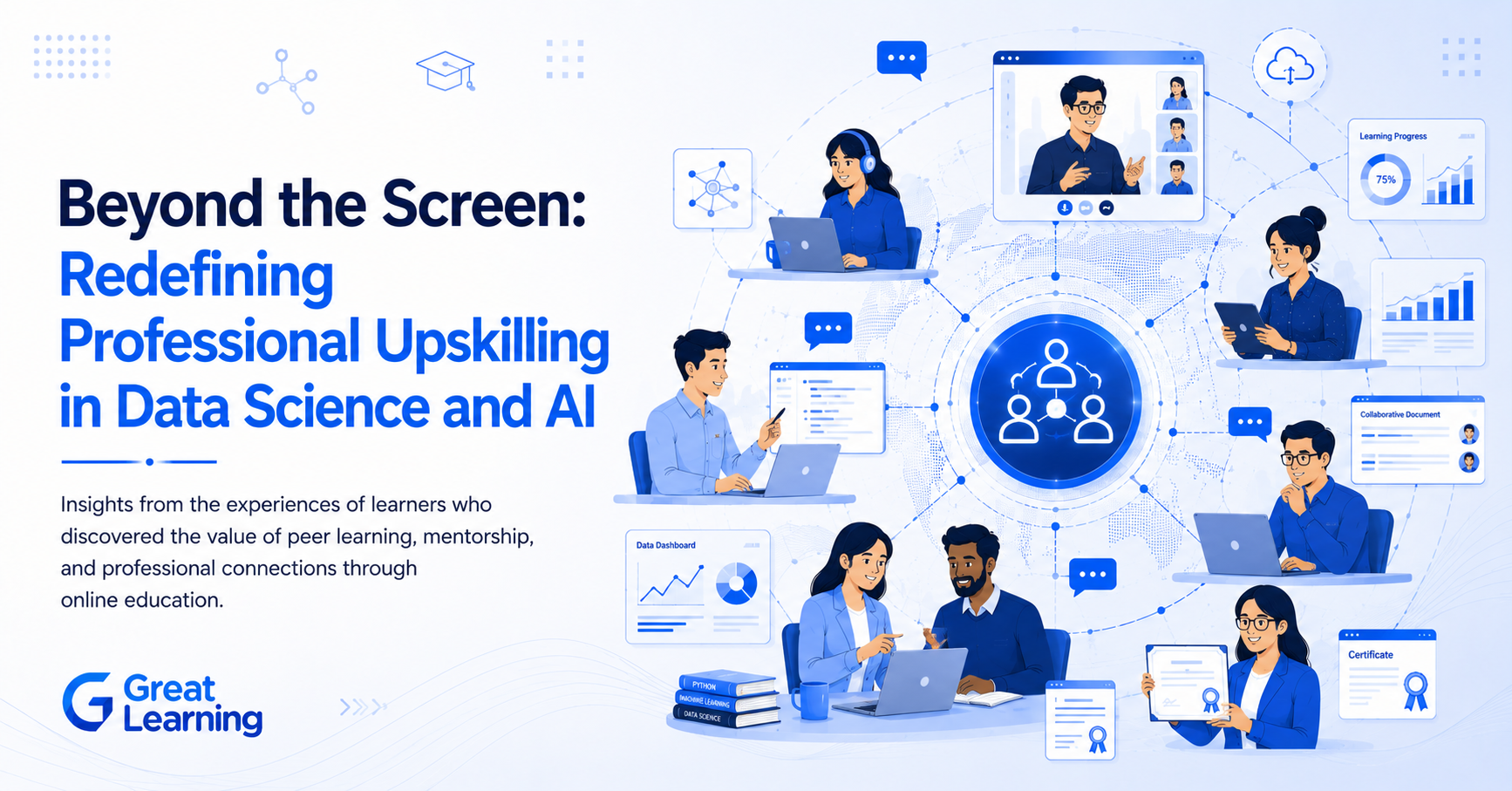
What often makes the difference between giving up and successfully completing a program isn't just a well-designed curriculum; it's the people you learn alongside. Today's online professional education is about more than building technical or business skills. It's also about forming meaningful connections with peers, mentors, and instructors who provide encouragement, share knowledge, and help learners stay motivated through challenges.
Through the experiences of two learners from programs offered in collaboration with Great Learning, this article explores how meaningful connections enrich the online learning journey.
Why Are Peer Friendships Essential in Online Education?
Peer support in online professional courses provides crucial emotional resilience, accountability, and practical help during unexpected personal or workplace disruptions, ensuring learners stay committed and complete their programs.
Life does not hit pause simply because you enroll in an intensive professional development program. Demanding full-time jobs, family responsibilities, and unexpected personal emergencies inevitably challenge a learner's capacity to maintain pace. This is where peer relationships transition from routine networking into vital safety nets.
Consider the experience of Yolanda Reed, who balanced her demanding role at the University of Texas at Austin Utilities & Energy Management with an intensive learning cohort. When she joined the Data Analytics Essentials program by Texas McCombs, she was pleasantly surprised to discover that her colleague, Ali, was also part of the cohort. Their shared experience of balancing work, family, and coursework gave them someone to rely on throughout the program.
"Balancing demanding work schedules and busy family lives, we supported each other whenever we could. Over time, that support grew into a bond we now describe as brother and sister."
— Yolanda Reed
When unexpected family health crises arose, requiring Yolanda to step back temporarily to care for her mother and, later, her niece, that peer bond became essential. Ali stepped in to help her keep pace with missed lessons, while Program Manager Ankita provided consistent encouragement and understanding. Their encouragement helped her stay committed to completing the program despite personal challenges.
How Do Study Partners Help Master Complex Technical Concepts?
Collaborative learning in technical programs helps demystify complex concepts by breaking down abstract logic into simple, relatable examples and connecting coding problems directly to real-world business scenarios.
Beyond emotional resilience, peer connections act as cognitive force multipliers when tackling technical concepts. Attempting to parse complex code logic, syntax errors, or data structures alone can quickly lead to cognitive overload. A study partner converts frustrating obstacles into structured, collaborative problem-solving.
This collaborative dynamic proved transformational for Davis Thomas Koilparambil, a Consultant at The Solution Consulting Fzco enrolled in the Post Graduate Program in Data Science with Generative AI: Applications to Business by Texas McCombs. Studying alongside his learning partner and peer Krish Menon, a Program Manager, completely changed how they approached intimidating coursework.
Post Graduate Program in Data Science with Generative AI: Applications to Business
Learn how to turn data into strategy in this UT Data Science and Business Analytics Course — now with a focus on Generative AI. Gain practical experience through 7 hands-on projects over a 7-month duration.
When confronted with challenging modules, such as Python coding logic, loops, functions, NumPy arrays, Pandas DataFrames, and data filtering, Davis and Krish tackled them systematically:
- Deconstruction: Whenever a concept felt dense, they discussed it collaboratively and broke it down into simple, manageable examples.
- Practical Application: They linked technical concepts directly to real business situations to build contextual clarity.
- Confidence Building: Active peer discussions eased the learning process, making Python coding and data manipulation far more practical and approachable.
"Whenever one of us found a concept difficult, we would discuss it together, break it down into simple examples, and try to understand how it could be used in real business situations... It made the overall learning journey more practical, collaborative, and enjoyable."
— Davis Thomas Koilparambil
What Role Do Mentors and Faculty Play in Student Retention and Success?
Approachable faculty and mentors help learners stay motivated, build confidence, and navigate difficult concepts.
Peer relationships often become an important part of learners' day-to-day study routines, but approachable faculty and mentors establish the overall learning culture. In rigorous upskilling programs, accessible instructors turn intimidating topics into achievable milestones.
Online learning can feel isolating without supportive instructional guidance. In Yolanda Reed's experience, mentors Jitendra and Rajendra played a key role in counteracting that isolation. Leveraging deep industry experience, their patience during live sessions, and accessibility outside scheduled class hours helped ground learners and build confidence whenever the coursework felt overwhelming.
How Does a Strong Peer Network Drive Real-World Career Growth?
Networking during professional online courses accelerates career transitions by providing cross-industry exposure, practical skill mastery, and immediate opportunities to apply new capabilities in the workplace.
The primary measure of professional upskilling is its practical impact on career trajectory. Strong peer networks can create professional opportunities and encourage learners to apply new skills at work.
| Learner | Industry / Background | Key Skill / Tool Mastered | Workplace & Career Outcome |
| Yolanda Reed | Utilities & Energy Management | Data Analytics & Power BI | Initiated new Data Analytics and Power BI projects at work, building momentum toward a transition onto the analytics team. |
| Davis Thomas Koilparambil | Solution Consulting | Python, GenAI, Data Science | Gained broader exposure to cross-industry applications of Data Science and Generative AI while expanding his professional network. |
Interacting with professionals across diverse backgrounds transforms peer networks into living case studies, demonstrating how modern analytics and Generative AI tools function across different market sectors.
Upskilling Was Never Meant to Be a Solo Journey
Upgrading your professional skillset in today's fast-moving economy demands dedication, time, and personal sacrifice. As Yolanda observed during her program, "This program is not for the faint of heart; you truly get out of it what you put into it."
However, maximum effort does not require isolated effort. The peer who helps unpack complex code late at night, the colleague who keeps you updated during a personal emergency, and the mentor who patiently explains a difficult framework are essential to long-term career growth.
No matter where you are in your learning journey, take a moment to appreciate the study partner, colleague, or mentor who supported you along the way. After all, meaningful connections often become the foundation of lasting professional growth.