

- What Should You Look for in an MBA That Combines Management and Technical Skills?
- Which MBA Specializations Are Best for Management and Technical Skills?
- How Do You Evaluate an MBA Curriculum for Technical Depth?
- Can an MBA Help You Build Both Technical and Leadership Skills?
- What Career Paths Can You Pursue With Management and Technical Skills?
- How Do You Choose the Right MBA for Your Career Goals?
- FAQs About Choosing an MBA for Management and Technical Skills
The skills expected from business professionals are changing as AI and digital technologies become part of everyday business operations. In India, 74%of CEOs say AI workforce readiness will significantly influence their organization’s prosperity over the next three years, while 26% say finding candidates with the right mix of technical proficiency and collaborative skills is a challenge. This shift raises an important question for MBA aspirants: How do you choose an MBA that builds both management expertise and technical skills?
The answer lies in looking beyond the MBA title. The right program should combine business fundamentals with skills such as data analytics, artificial intelligence, technology management, and digital transformation.
What Should You Look for in an MBA That Combines Management and Technical Skills?
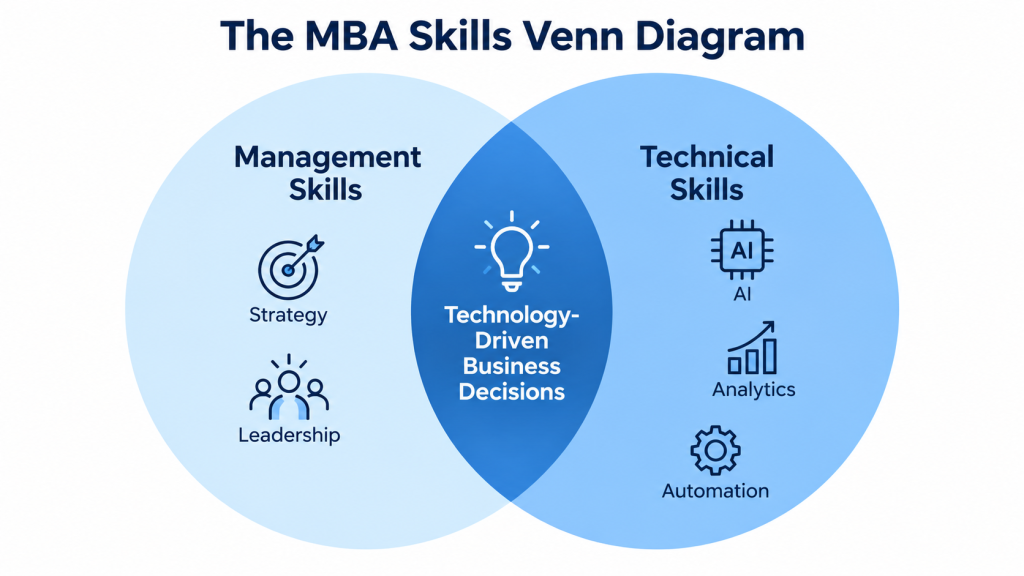
An MBA that balances management and technology should help you understand not only how businesses operate, but also how technology can improve business outcomes.
When comparing programs, look for:
- Core management subjects: Strategy, finance, marketing, operations, and leadership.
- Technical and analytical learning: Data analytics, AI, machine learning, automation, or technology management.
- Hands-on projects: Opportunities to apply technical concepts to real business problems.
- Industry-relevant tools: Exposure to analytics, AI, visualisation, or productivity tools used in organizations.
- Decision-making skills: The ability to interpret technical outputs and translate them into business decisions.
This combination can be particularly valuable if you want to work between business and technology teams rather than specialize exclusively in either area.
Which MBA Specializations Are Best for Management and Technical Skills?
The best MBA specialization depends on the type of role you want to pursue.
| MBA specialization | Technical focus | Management focus |
| Online MBA in Business Analytics | Data analysis, visualisation, business intelligence | Decision-making and strategy |
| Online MBA in AI & Data Science | AI, machine learning, data science | Business applications and leadership |
| Online MBA in IT Management | IT systems, digital technologies | Technology strategy and management |
| Online MBA in Finance | Financial modelling, analytics | Financial planning and management |
| Online MBA in Operations | Process analytics, automation | Operations and process management |
If you want to build a career that sits at the intersection of technology and business, an MBA incorporating AI, data analytics, and management may provide a more balanced skill set than a program focused only on traditional management subjects.
SRMIST Online MBA in Data Science & AI
Advance your career with SRMIST's UGC-entitled Online MBA in Data Science and Artificial Intelligence. Master machine learning, data visualization, and business analytics to drive data-centric decisions.
How Do You Evaluate an MBA Curriculum for Technical Depth?
Do not judge a program's technical component solely by the presence of words such as "AI" or "analytics" in its curriculum. Review the MBA syllabus to understand how management, analytics, technology, and other subjects are structured across a program. Look at what you will actually learn and apply.
Ask these questions before choosing an MBA:
- Does the curriculum include data and analytics?
- Does it cover AI or generative AI and their business applications?
- Will I work with relevant technology or analytics tools?
- Does the program include projects, case studies, or a capstone?
- Does it explain how technology supports business strategy and decision-making?
- Does it balance technical learning with leadership and communication?
This balance matters because technical knowledge alone does not necessarily prepare you to lead technology-driven initiatives. Deloitte and NASSCOM's research on India's AI skills landscape similarly highlights the need for a mix of technical and non-technical capabilities across different AI roles.
Can an MBA Help You Build Both Technical and Leadership Skills?
Yes, provided the program intentionally integrates the two.
Technical skills can help you analyze data, evaluate AI solutions, understand digital systems, and identify opportunities for automation. Management skills can help you lead teams, allocate resources, communicate with stakeholders, and connect technology initiatives to business goals.
This combination is increasingly relevant in India as AI adoption expands. According to a 2026 government backgrounder citing the NASSCOM AI Adoption Index, 87% of Indian enterprises are actively using AI solutions.
For MBA learners, this means understanding technology can be useful even when the end goal is not to become a software engineer or data scientist.
What Career Paths Can You Pursue With Management and Technical Skills?
An MBA combining management and technical skills can support careers across business, technology, analytics, and digital transformation.
Potential roles include:
- Business Analyst
- Product Manager
- Business Analytics Manager
- Technology Consultant
- Digital Transformation Manager
- Operations Manager
- AI or Technology Strategy Manager
- Product or Program Manager
The right career path will depend on your previous experience, specialization, technical depth, and the type of roles you target after the MBA.
How Do You Choose the Right MBA for Your Career Goals?
Use this five-step framework to compare programs:
1. Define your target role.
Decide whether you want a primarily managerial, technical, or hybrid career. Before shortlisting programs, also check the MBA eligibility criteria to make sure you meet the academic and other requirements.
2. Compare the curriculum.
Look for a combination of management fundamentals, analytics, AI, technology, and strategy.
3. Assess practical learning.
Prioritize programs that include projects, case studies, simulations, or capstone work.
4. Check the learning format.
If you are a working professional, consider whether the schedule, delivery format, and workload fit your career commitments.
5. Evaluate the overall value.
When evaluating an online MBA degree, look beyond the curriculum to consider the university, faculty, credentials, career support, industry exposure, and alumni network.
Advance your career with SRMIST's UGC-entitled Online MBA. Choose from 11 industry-focused specializations including Finance, Marketing, HR, AI & Data Science, Healthcare & Hospital Management and more.
Ultimately, the best MBA is not necessarily the one with the most technical subjects. It is the one that gives you enough technical understanding to work effectively with technology while developing the management skills to turn that technology into business value.
FAQs About Choosing an MBA for Management and Technical Skills
Which MBA is best for both management and technical skills?
An online MBA in Business Analytics and AI, Data Science, Technology Management, or a related specialization can combine technical and management learning. The right choice depends on your target role and the depth of technical skills you want to develop.
Can I learn technical skills through an MBA?
Yes. Many modern MBA programs include data analytics, AI, automation, business intelligence, and digital technologies alongside traditional management subjects. Look for programs that combine technical coursework with hands-on projects.
Which type of MBA program is best for me?
How to Choose Your MBA Specialization?
Is an MBA in Business Analytics better than a traditional MBA?
Neither is universally better. A traditional MBA may offer broader management exposure, while an MBA in Business Analytics can provide deeper analytical skills. Your choice should depend on whether your target career requires stronger technical and data-driven capabilities.
What technical skills should MBA students learn today?
MBA students can benefit from learning data analytics, AI literacy, data visualisation, automation, digital transformation, and the business applications of emerging technologies. The ideal combination depends on their industry and career goals.