
- What is a production-ready AI agent?
- What Components Are Required for Production AI Agents?
- How AI Agents Plan, Reason, and Execute Tasks
- Why Tool Use and Enterprise Integrations Matter
- How Memory and RAG Improve AI Agent Performance
- Why Monitoring and Observability Matter in Production
- How to Deploy AI Agents for Real World Use
- How to Evaluate Production AI Agents
- What a Production AI Agent Architecture Looks Like
- How the IIT Bombay Agentic AI Course Builds Production AI Skills
- Final Thoughts
- Frequently Asked Questions
Prompt engineering can help an AI agent follow instructions more effectively, but a production system requires much more than a well-written prompt.
Production AI agents need to plan tasks, use tools, access reliable context, handle failures, follow security controls, and operate consistently over time.
This gap between prototypes and production is becoming clearer as organizations deploy agents in real workflows.
A 2026 IBM Research study of 306 practitioners across 26 domains found that reliability remains the top development challenge for production AI agents, while 74% of practitioners primarily rely on human evaluation.
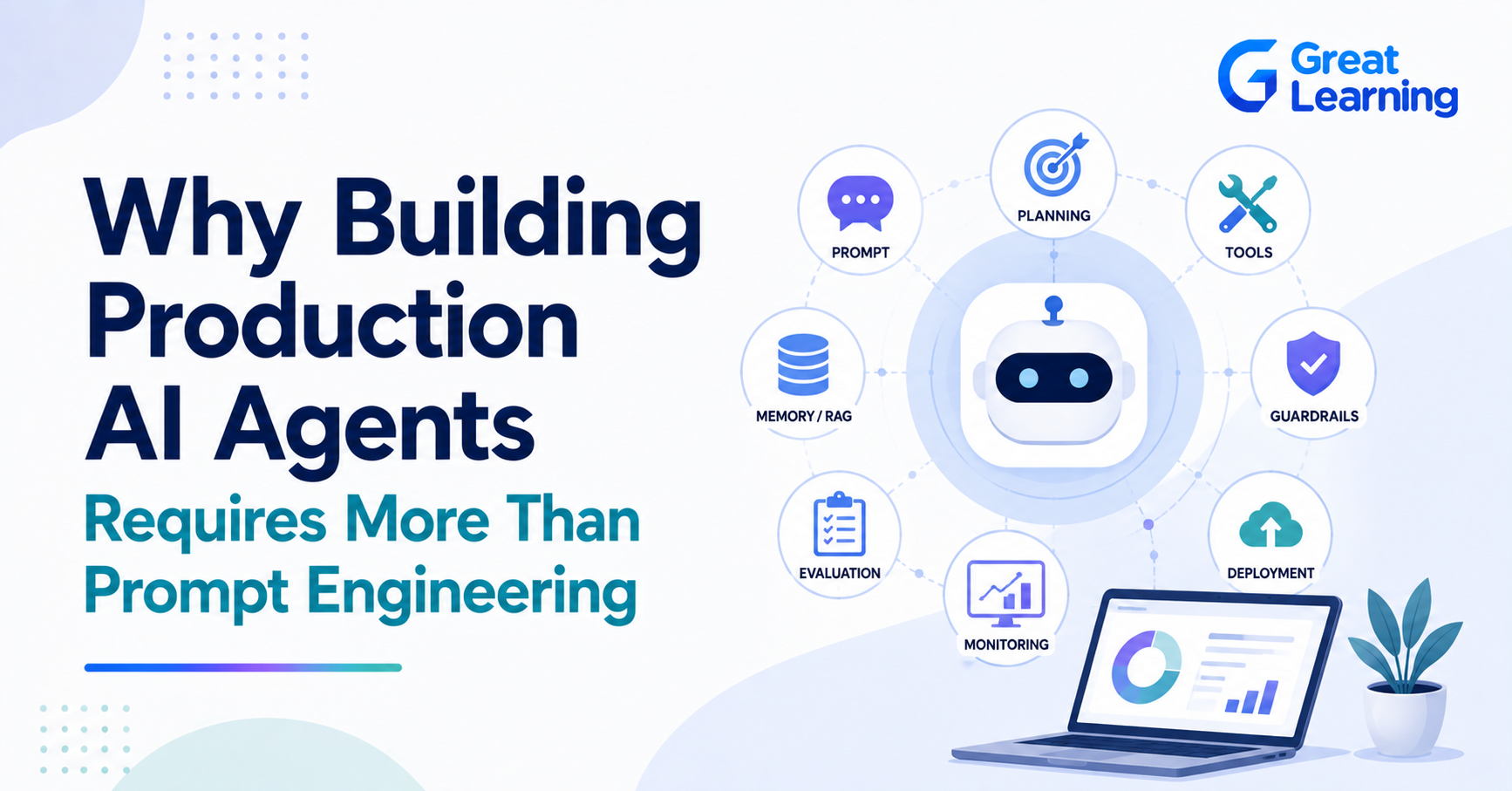
A production-ready agent therefore requires a broader engineering stack:
Prompt → Planning → Tools → Memory/RAG → Guardrails → Evaluation → Monitoring → Deployment
For AI professionals, understanding these layers is essential for moving from a successful demo to an agent that can operate reliably in real-world environments.
What is a production-ready AI agent?
A production-ready AI agent is an AI system designed to reliably perform real-world tasks beyond generating responses.
It can plan and execute multi-step workflows, use approved tools and data sources, maintain relevant context, handle errors, and operate within defined security and governance controls.
It should also be continuously evaluated and monitored, with human oversight available for sensitive or consequential actions.
What Components Are Required for Production AI Agents?
A production AI agent needs more than a strong prompt or an effective language model. It requires multiple components working together to manage context, execute tasks, handle failures, and maintain control.
A typical production stack includes:
LLM → Prompt → Planning → Tools → Memory/RAG → Guardrails → Evaluation → Monitoring → Deployment
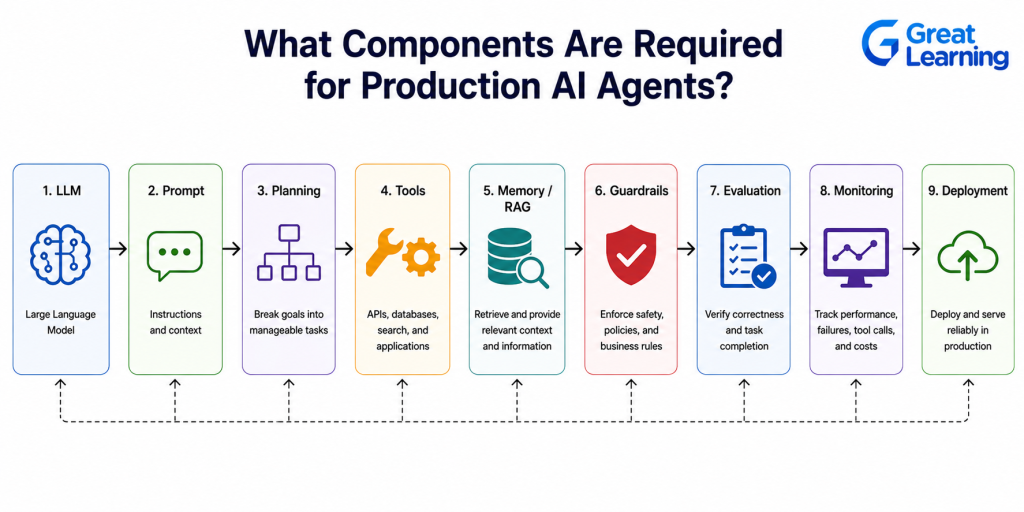
Each layer serves a different purpose:
- LLM and prompts: Interpret instructions and generate responses.
- Planning: Break complex goals into manageable tasks.
- Tools: Connect the agent to APIs, databases, search, and business applications.
- Memory and RAG: Provide relevant context and information.
- Guardrails: Restrict unsafe actions and enforce business rules.
- Evaluation: Test whether the agent completes tasks correctly.
- Monitoring: Track performance, failures, tool calls, and costs.
- Deployment: Make the agent available reliably within production environments.
This broader architecture is important because production agents can fail at different points, from selecting the wrong tool to retrieving incorrect information or taking an unauthorized action.
Recent IBM Research work on production agents similarly highlights reliability as the leading development challenge, reinforcing the need for systems-level engineering rather than prompt optimization alone.
How AI Agents Plan, Reason, and Execute Tasks
A production agent needs to do more than generate a response from a prompt. It must determine what needs to happen, which actions are required, and how to respond when an action does not produce the expected result.
A typical agent workflow can follow:
Goal → Plan → Act → Observe → Evaluate → Replan
For example, an enterprise research agent could receive a request to prepare a market analysis. It may break the task into research, data retrieval, analysis, and report generation; use approved tools for each step; evaluate the results; and revise the plan if information is missing.
Several approaches can support this behavior:
- ReAct: Combines reasoning with actions and observations.
- Plan-and-Solve: Creates a structured plan before executing tasks.
- Reflection: Reviews previous actions or outputs to identify potential improvements.
- Feedback loops: Use results from tools or the environment to determine the next action.
The important distinction is that production AI agents need these capabilities to work together reliably.
Planning without tool control, reasoning without evaluation, or action without safeguards can make an agent unpredictable in real-world workflows.
Why Tool Use and Enterprise Integrations Matter
A production AI agent needs to interact with the systems where business data and actions actually reside.
This means prompt engineering must be complemented by tool use, function calling, APIs, databases, and enterprise integrations.
For example, a customer service agent could:
- Retrieve a customer's account details from a CRM.
- Search an internal knowledge base for the relevant policy.
- Check order information through an API.
- Prepare a response based on the retrieved information.
- Escalate the case if the requested action requires human approval.
This turns an agent from a system that generates responses into one that can participate in real business workflows.
Modern agent architectures can also use MCP to connect AI applications with external tools and data sources through a standardized interface.
The IIT Bombay Agentic AI curriculum covers tool use and function calling, MCP, vector databases, and orchestration frameworks such as LangGraph and CrewAI.
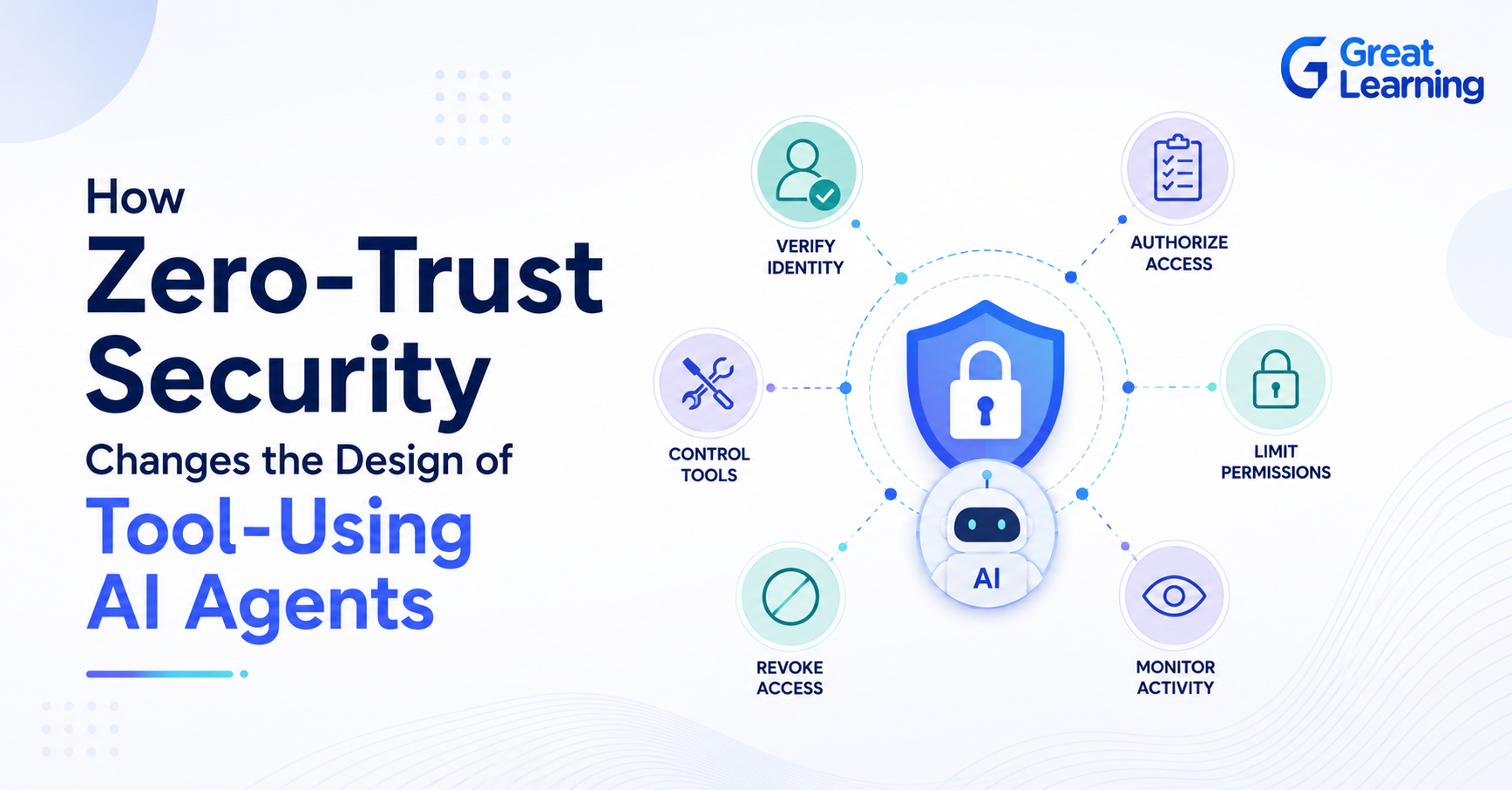
However, enterprises must control tool access. Agents should have clearly defined permissions and should not be allowed to perform sensitive or irreversible actions without appropriate validation or human approval.
How Memory and RAG Improve AI Agent Performance
Production AI agents often need more context than a single prompt can provide. Memory and retrieval augmented generation (RAG) allow agents to maintain relevant context and access information from external knowledge sources when completing complex tasks.
Memory helps an agent retain information from an ongoing workflow, while RAG lets it retrieve relevant information from documents, databases, or enterprise knowledge bases.
For example, an enterprise support agent could:
User Request → Retrieve Customer Context → Search Knowledge Base → Reason Over Information → Generate Response → Update Task Context
Key components can include:
- Short term memory: Maintains context during the current task.
- Long term memory: Stores relevant information for future interactions.
- RAG: Retrieves external information when the agent needs additional context.
- Vector databases: Support semantic retrieval from documents and knowledge bases.
- Context management: Decides what information to provide to the model at each step.
However, adding memory or RAG does not automatically make an agent more reliable. Retrieved information can be outdated or irrelevant, while poorly managed memory can introduce unnecessary context.
Production systems therefore need retrieval evaluation, access controls, data freshness checks, and clear memory policies.
The IIT Bombay Agentic AI curriculum includes memory systems using RAG, vector databases, and agent orchestration with LangGraph and CrewAI, providing practical foundations for building context-aware agentic systems.
Why Monitoring and Observability Matter in Production
An AI agent can perform well during testing and still behave differently after deployment. Changes in data, tool availability, user requests, model behavior, or workflow conditions can affect how the agent performs over time.
Monitoring and observability help teams understand what is happening inside an agent workflow and identify problems early.
Teams can monitor:
- Agent traces: Follow the sequence of decisions and actions.
- Tool calls: Track which tools the agent uses and whether calls succeed.
- Latency: Identify slow steps in the workflow.
- Token and infrastructure usage: Monitor operational costs.
- Errors: Detect failed tool calls, retrieval problems, or unexpected outputs.
- Task outcomes: Measure whether the agent actually completed its intended task.
- Behavior changes: Identify performance degradation after updates or environmental changes.
For example, if an agent suddenly starts making unnecessary tool calls, monitoring can help identify the change before it drives up costs or causes failed workflows.
This is why production AI agents need continuous observability rather than one-time testing.
How to Deploy AI Agents for Real World Use
Moving an AI agent from a prototype to production requires more than making the workflow work once.
The system needs a reliable deployment environment, controlled access to tools and data, and processes to test, monitor, and maintain agent behavior over time.
A production deployment should account for:
- API deployment: Expose the agent through secure application interfaces.
- Scalability: Handle changing workloads and concurrent users.
- Authentication: Verify users and services before allowing access.
- Logging: Record important agent and tool interactions.
- Version control: Track changes to prompts, models, tools, and workflows.
- Performance: Monitor latency, resource usage, and response quality.
- Failure handling: Define what happens when a model, tool, or external service fails.
For example, an enterprise agent deployed through FastAPI could connect to approved business tools while a monitoring layer tracks its performance.
If the agent encounters an unexpected failure, the workflow can stop or escalate to a human rather than continuing with an unreliable result.
The Agentic AI course by IIT Bombay includes deployment with FastAPI, Streamlit, and Docker, along with monitoring, evaluation, human-in-the-loop workflows, guardrails, and prompt security.
This provides exposure to the broader requirements for deploying and maintaining agentic systems in real-world environments.
How to Evaluate Production AI Agents
Testing an AI agent once is not enough to determine whether it is ready for production. Teams need to evaluate how consistently the agent completes tasks, uses tools, handles failures, and responds to changing inputs.
Key evaluation areas include:
| Evaluation Area | What to Measure |
| Task success | Whether the agent achieves its intended goal |
| Tool accuracy | Whether it selects and uses the right tools |
| Response quality | Whether outputs are correct, relevant, and grounded |
| Error recovery | How the agent responds to failed tools or missing information |
| Latency | How quickly the workflow completes |
| Cost | Tokens, API calls, and infrastructure used per task |
| Human escalation | Whether the agent correctly identifies cases requiring human review |
Evaluation should cover the entire agent trajectory, not just its final response. An agent might produce a convincing answer while using the wrong tool, taking unnecessary steps, or failing to follow an important business rule.
For production AI agents, continuous evaluation is therefore essential. It helps teams identify reliability problems, compare changes, and determine whether an agent is actually performing its intended task before expanding its autonomy.
What a Production AI Agent Architecture Looks Like
A production AI agent brings several components together rather than relying on a single model or prompt. The architecture needs to support planning, context retrieval, tool use, validation, monitoring, and human oversight throughout the workflow.
A typical architecture can follow:
User Request → Agent → Planner → Memory/RAG → Tool Layer → Guardrails → Execution → Evaluation → Monitoring
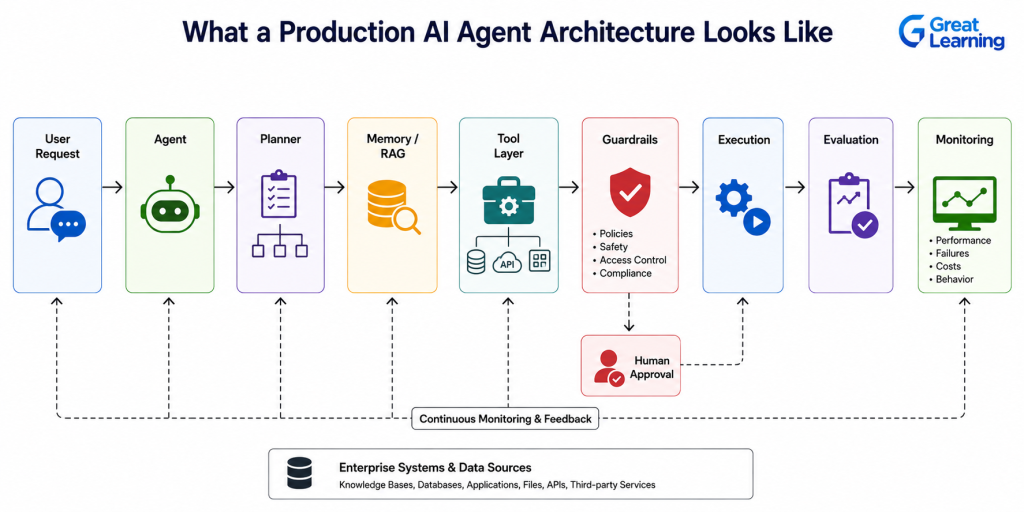
For example, an enterprise research agent could receive a request, create a task plan, retrieve information from approved knowledge sources, use external tools to gather additional data, validate the results, and then produce an output.
If the task involves a sensitive or irreversible action, the workflow can route it to a human for approval.
Each layer serves a specific purpose:
- Agent: Interprets the user's goal.
- Planner: Breaks the goal into actionable steps.
- Memory/RAG: Provides relevant context and knowledge.
- Tool layer: Connects the agent to APIs, databases, and business applications.
- Guardrails: Restrict unsafe or unauthorized actions.
- Evaluation: Checks whether the workflow performed as expected.
- Monitoring: Tracks performance, failures, costs, and agent behavior.
This layered approach is consistent with the IIT Bombay Agentic AI curriculum, which covers agent workflows and architecture, tool use, RAG, MCP, orchestration, guardrails, monitoring, evaluation, and deployment.
The key difference between a prototype and a production system is that every layer needs to work reliably together. A capable model alone cannot compensate for weak retrieval, uncontrolled tools, poor monitoring, or missing safeguards.
How the IIT Bombay Agentic AI Course Builds Production AI Skills
Building production AI agents requires a combination of architecture, orchestration, security, evaluation, and deployment skills. IIT Bombay's Agentic AI course covers this progression from agent foundations to real-world deployment.
IIT Bombay Certificate in Agentic AI
Master Agentic AI with IIT Bombay. Build dynamic, autonomous agentic systems and master multi-agent orchestration using LangGraph and CrewAI.
The curriculum includes RAG, MCP, LangGraph, CrewAI, planning and reasoning, multi-agent coordination, human-in-the-loop design, prompt injection defense, guardrails, monitoring, evaluation, and deployment with FastAPI, Streamlit, and Docker.
This makes the program relevant for professionals who want to move beyond prompt engineering and learn how to design, deploy, evaluate, and operate production-ready agentic systems. The program also includes practical projects designed around real-world AI agent applications.
Final Thoughts
Prompt engineering is an important starting point for working with AI agents, but production AI agents require a much broader engineering foundation.
Planning, tool integration, memory, evaluation, guardrails, monitoring, and deployment all determine whether an agent can operate reliably beyond a controlled demo.
The transition can be viewed as:
Prompt → Agent Workflow → Tool Use → Evaluation → Guardrails → Monitoring → Production
For professionals looking to build these capabilities, the Agentic AI course by IIT Bombay covers the broader production lifecycle, including agent architecture, RAG, MCP, planning and reasoning, multi-agent systems, human-in-the-loop design, guardrails, monitoring, evaluation, and deployment.
The key takeaway is simple: prompt engineering helps define how an agent responds, while production engineering determines whether that agent can be trusted to operate in the real world.
Want to see more from Great Learning in your searches? Mark us as a preferred source and our articles will show up more often in your Google results, Top Stories, and AI Overviews.

Frequently Asked Questions
1. Why is prompt engineering not enough for production AI agents?
Prompt engineering helps guide an AI agent's behavior, but production systems also require planning, tool integration, memory, evaluation, guardrails, monitoring, and deployment to operate reliably in real-world environments.
2. What makes an AI agent production-ready?
A production-ready AI agent should complete its intended tasks reliably, use approved tools correctly, handle failures, protect sensitive data, operate within defined permissions, and provide sufficient monitoring and evaluation.
3. How do you evaluate production AI agents?
You can evaluate AI agents using task completion, tool-call accuracy, response quality, error recovery, latency, cost, and appropriate human escalation. Evaluation should consider the full agent workflow, not just the final response.
4. How do guardrails make AI agents safer?
Guardrails limit what an agent can access or do. They can enforce tool permissions, data-access rules, action limits, output validation, and human approval requirements, reducing the risk of unauthorized or harmful actions.
5. Why do AI agents need monitoring and observability?
Monitoring helps teams track agent decisions, tool calls, errors, latency, costs, and task outcomes after deployment. Observability makes it easier to identify unexpected behavior and improve agent reliability over time.
6. What tools are used to build production AI agents?
Production AI agents can use technologies such as LangGraph, CrewAI, MCP, RAG, vector databases, APIs, FastAPI, Docker, and evaluation and monitoring tools. The appropriate technology depends on the agent's workflow and deployment requirements.
7. How can I learn to build production AI agents?
Professionals can develop these skills by learning agent architecture, planning and reasoning, tool use, RAG, MCP, multi-agent systems, guardrails, evaluation, monitoring, and deployment through practical projects. IIT Bombay's Agentic AI course covers these areas as part of its curriculum.