
- Why Single LLM Applications Are Not Enough for Enterprise AI
- What Are the Main Types of Enterprise AI Agent Architectures?
- How Should Enterprises Choose the Right AI Agent Architecture?
- How Do Tools, Data, RAG, and Memory Fit Into Enterprise AI Architecture?
- How Do Security, Evaluation, and Monitoring Shape Enterprise AI Architecture?
- How the IIT Bombay Agentic AI Course Builds Enterprise Architecture Skills
- Final Thoughts
- Frequently Asked Questions
Enterprise AI is moving beyond applications that simply send a prompt to an Large Language Models and generate a response.
Modern AI agents can reason through tasks, retrieve information, use tools, interact with enterprise systems, and complete multi-step workflows.
This makes enterprise AI agent architecture increasingly important. It determines how agents connect with models, tools, data, memory, other agents, security controls, and monitoring systems.
A single LLM application may work for simple tasks, but complex enterprise workflows require a more structured approach. The right architecture should match the task complexity, level of autonomy, risk, and business requirements.
As enterprises move toward more autonomous AI workflows, choosing the right architecture is essential for building reliable, secure, and scalable AI agent systems.
Why Single LLM Applications Are Not Enough for Enterprise AI
A single LLM application can work well when a user needs a straightforward response, such as summarizing a document, answering a question, or generating content.
However, enterprise workflows often require an AI system to perform several connected actions.
For example, an employee asking an AI agent to investigate a failed transaction may require the system to:
- Understand the request
- Retrieve relevant company information
- Access a database
- Call an internal API
- Analyze the results
- Decide what action to take
- Record the activity
- Escalate the case if necessary
A standalone LLM generally does not provide all these capabilities by itself. Enterprise AI agents need additional components for tool use, retrieval, memory, orchestration, permissions, and monitoring.
Another challenge is reliability. An LLM can generate a plausible response without actually verifying information or completing the required action. In enterprise environments, this can create operational, security, and compliance risks.
This is why organizations increasingly need architectures that connect models with controlled tools and enterprise data rather than treating the LLM as the entire application.
The distinction can be summarized simply:
Single LLM application → Generate a response
Enterprise AI agent → Reason, use tools, access information, take actions, and operate within defined controls
What Are the Main Types of Enterprise AI Agent Architectures?
Enterprise AI agents can follow different architectural patterns depending on the task, workflow complexity, and level of autonomy required. The goal is not to choose the most complex architecture, but the one that best fits the business need.
1. Single-Agent Architecture
A single agent manages the workflow using a defined set of tools and knowledge sources. This approach works well for focused tasks such as internal knowledge assistants, document analysis, and customer support.
2. Multi-Agent Architecture
Multiple specialized agents work together, with each handling a specific part of the workflow.
For example:
Research Agent → Analysis Agent → Verification Agent → Reporting Agent
This architecture is useful when a task requires different types of expertise or several specialized steps.
3. Orchestrator-Based Architecture
An orchestrator coordinates agents, tools, and workflow steps. It decides which capability should handle a task and manages how the results move through the workflow.
This approach is useful for complex enterprise processes that involve multiple systems, tools, or dependencies.
4. Human-in-the-Loop Architecture
A human is included at important decision points to provide approval, judgment, or oversight. This is particularly useful for high-risk activities such as financial transactions, security operations, compliance decisions, or irreversible actions.
The key principle is simple: use the simplest architecture that can reliably handle the task. A multi-agent system is not automatically better than a well-designed single-agent system.
Professionals looking to build these capabilities can Build GenAI skills with Great Learning courses and explore practical applications of Generative AI, LLMs, AI agents, and automation.
How Should Enterprises Choose the Right AI Agent Architecture?
Choosing an enterprise AI agent architecture should start with the business problem, not the AI model. The goal is to use enough architectural complexity to complete the task reliably without creating unnecessary coordination, cost, or maintenance overhead.
A single agent with a few controlled tools may be enough for a focused workflow. More complex processes may require multiple specialized agents, orchestration, or human approval.
Current enterprise architecture guidance similarly emphasizes choosing patterns based on task complexity, the need for specialized roles, and the risk associated with actions.
1. Consider Task Complexity
Simple, well-defined tasks can usually be handled by a single agent. If a workflow involves several independent steps, specialized expertise, or multiple systems, a more structured architecture may be appropriate.
2. Consider Tool and System Dependencies
An agent that only retrieves information has different architectural requirements from one that needs to interact with a CRM, ERP, database, payment system, or other enterprise application.
3. Consider the Required Level of Autonomy
Not every task should be fully autonomous. Low-risk activities can often be automated, while actions that are sensitive, costly, or difficult to reverse may require human approval.
4. Consider Data and Context Requirements
If an agent needs access to private enterprise information, architecture must account for retrieval, permissions, memory, and context management.
Retrieval-Augmented Generation (RAG) and controlled data access can help agents work with current enterprise information without relying only on the model's training data.
5. Consider Scalability, Cost, and Latency
Every additional agent or orchestration layer can introduce more model calls, coordination, monitoring requirements, and potential failure points. The architecture should therefore provide enough capability for the workflow without adding unnecessary complexity.
A Simple Decision Framework
- Focused, low-risk task → Single Agent
- Task requiring specialized roles → Multi-Agent
- Complex workflow across multiple systems → Orchestrator
- Sensitive or irreversible action → Human-in-the-Loop
The principle is straightforward: choose the simplest architecture that can reliably complete the required business workflow. Multi-agent systems should be introduced when specialization or coordination provides a clear benefit, not simply because they are more advanced.
Professionals who want to automate repetitive work can learn how to build AI agents and workflows without coding and apply them to tasks such as research, content creation, email management, competitive monitoring, and reporting.
How Do Tools, Data, RAG, and Memory Fit Into Enterprise AI Architecture?
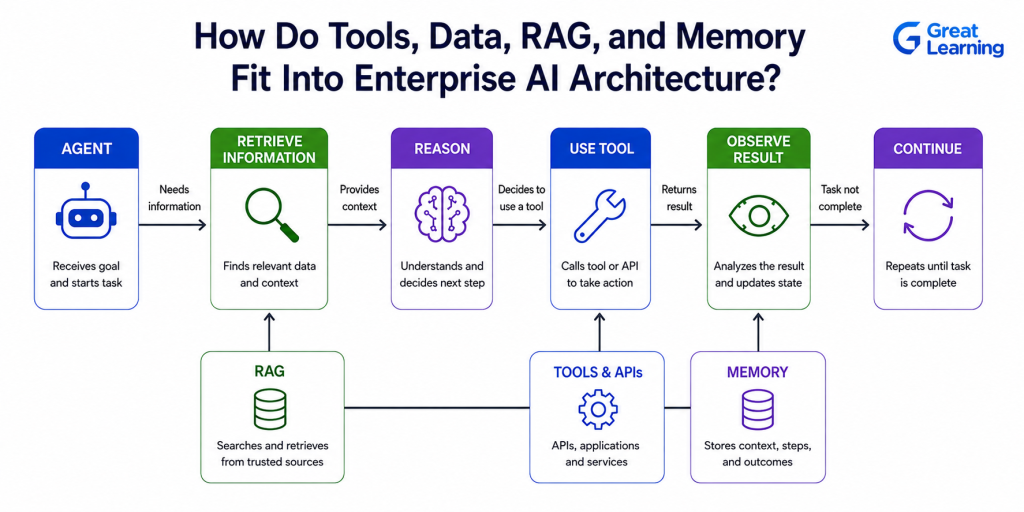
An AI agent becomes useful in an enterprise when it can do more than generate text. It needs controlled access to the data, tools, applications, and context required to complete its task.
Tools allow agents to interact with external systems. These might include enterprise APIs, databases, CRM platforms, ERP systems, search services, or internal applications.
RAG gives agents access to relevant enterprise information at runtime. Instead of relying entirely on information contained in the model, the agent can retrieve documents, policies, records, or other approved sources before generating a response or taking an action.
Memory can help an agent maintain context across a workflow.
For example, an agent handling a support case may need to remember what information it has already retrieved, which actions it has taken, and what remains to be completed.
A typical agent workflow can therefore look like:
Agent → Retrieve Information → Reason → Use Tool → Observe Result → Continue
Model Context Protocol (MCP) can also provide a standardized way for AI applications to connect with tools and data sources, helping enterprises manage how agents interact with external capabilities.
The important architectural principle is that access should be controlled. Agents should only receive the data and tool permissions required for their assigned tasks.
This becomes especially important as agents move from simply answering questions to taking actions across enterprise systems.
How Do Security, Evaluation, and Monitoring Shape Enterprise AI Architecture?
Enterprise AI agents need more than the ability to complete a task. They also need controls that determine what they can access, what actions they can take, and how their behavior is evaluated.
This makes security, evaluation, and monitoring core architectural components rather than optional additions.
1. Security and Governance
An enterprise agent should operate within clearly defined boundaries. These can include:
- Agent identity and authentication
- Role-based authorization
- Least-privilege tool access
- Data access controls
- Guardrails and policy enforcement
- Human approval for sensitive actions
- Audit trails
For example, an agent handling customer support may need permission to read customer records but should not automatically have permission to modify financial information. Separating these permissions limits the potential impact of an incorrect or unauthorized action.
Enterprise reference architectures increasingly treat security, observability, and governance as cross-layer concerns that operate across the agent, tools, data, and application layers.
2. Evaluation
Traditional AI evaluation often focuses on whether a model produces an accurate answer. Agentic systems require a broader view because the agent may need to complete several actions before reaching the final result.
Enterprises can evaluate:
- Task completion
- Tool-use accuracy
- Response quality
- Hallucination and factual errors
- Policy compliance
- Failure rates
- Cost and latency
- Human escalation rates
This means an agent can produce a technically correct final answer but still fail if it used the wrong tool, accessed unauthorized information, or took an unnecessary action along the way.
3. Monitoring and Observability
Once an agent is deployed, enterprises need visibility into its behavior. Monitoring can capture agent decisions, tool calls, retrieved information, errors, latency, costs, and escalation events.
This creates a feedback loop:
Agent Action → Observe → Evaluate → Identify Failure → Improve
Observability is particularly important for autonomous systems because failures can occur across multiple steps rather than in a single model response.
Current enterprise reference architectures therefore place monitoring and evaluation alongside orchestration, tools, memory, and guardrails as core production components.
The goal is to make enterprise agents bounded, measurable, and observable, not simply autonomous.
How the IIT Bombay Agentic AI Course Builds Enterprise Architecture Skills
Designing enterprise AI agents requires skills in agent architecture, tool use, RAG, orchestration, multi-agent systems, security, and evaluation.
The Agentic AI course by IIT Bombay covers these areas through topics such as agent workflows, tool calling, RAG, MCP, LangGraph, CrewAI, planning, reasoning, and multi-agent coordination.
IIT Bombay Certificate in Agentic AI
Master Agentic AI with IIT Bombay. Build dynamic, autonomous agentic systems and master multi-agent orchestration using LangGraph and CrewAI.
The program also covers human-in-the-loop systems, guardrails, access control, monitoring, observability, and evaluation, helping professionals understand how to design more reliable and controlled AI agent systems.
Practical projects provide opportunities to apply these concepts to single-agent, RAG-based, and multi-agent workflows.
Final Thoughts
Choosing the right architecture for enterprise AI agents is not about selecting the most advanced or complex design. It is about matching the architecture to the business problem, workflow complexity, level of autonomy, data requirements, and risk involved.
A focused task may work well with a single agent, while complex workflows can benefit from specialized agents and orchestration. For sensitive actions, human-in-the-loop controls can provide an additional layer of oversight.
Enterprise AI architecture also needs to account for tools, RAG, memory, security, evaluation, and monitoring. These components determine whether an agent can operate reliably beyond a simple LLM interaction.
The Agentic AI course by IIT Bombay can help professionals develop these capabilities through topics such as agent architectures, tool use, RAG, MCP, LangGraph, CrewAI, multi-agent systems, human-in-the-loop design, guardrails, evaluation, and deployment.
Ultimately, the goal is not to build the most complicated agent system. It is to build an architecture that is reliable, secure, observable, scalable, and appropriate for the enterprise workflow.
Frequently Asked Questions
1. What is an enterprise AI agent architecture?
Enterprise AI agent architecture is the structure that connects AI agents with models, tools, enterprise data, memory, orchestration, security controls, and monitoring so they can complete business tasks reliably.
2. How is an AI agent different from a single LLM application?
A single LLM application generally generates a response to a prompt. An AI agent can go further by planning tasks, using tools, retrieving information, taking actions, and evaluating results across multiple steps.
3. When should an enterprise use a single-agent architecture?
A single-agent architecture is suitable when one agent can reliably manage the required workflow using a relatively focused set of tools and knowledge sources. It is often simpler to operate and evaluate than a multi-agent system.
4. When should businesses use multi-agent AI?
Multi-agent AI can be useful when a workflow contains clearly different tasks or domains that benefit from specialized agents. For example, separate agents could handle research, analysis, verification, and reporting.
5. What is an orchestrator in an AI agent architecture?
An orchestrator coordinates agents, tools, and workflow steps. It can determine which capability should handle a task, manage the sequence of actions, and coordinate results across a complex workflow.
6. How do RAG and tools work with AI agents?
RAG allows agents to retrieve relevant information from approved knowledge sources, while tools allow them to interact with external systems such as databases, APIs, and enterprise applications. Together, they help agents move beyond generating responses toward completing useful tasks.
7. Why are security and evaluation important for enterprise AI agents?
Enterprise agents may access sensitive information or take actions in business systems. Security controls limit what an agent can access and do, while evaluation and monitoring help organizations identify errors, unsafe behavior, poor tool use, and workflow failures.
8. Which Agentic AI course can help professionals learn enterprise AI agent architecture?
The Agentic AI course by IIT Bombay covers agent workflows and architectures, tool use, RAG, MCP, orchestration with LangGraph and CrewAI, multi-agent communication, human-in-the-loop design, guardrails, monitoring, evaluation, and deployment.