
- What Is Vibe Coding and Why Has It Become Popular?
- What Is Agentic Engineering and How Does It Work?
- Vibe Coding vs Agentic Engineering: How the Engineering Workflow Changes
- Benefits of Moving From Vibe Coding to Agentic Engineering
- Risks of Moving Toward Autonomous Software Engineering
- How Developers Can Prepare for the Shift to Agentic Engineering
- What’s Next: The Future of Agentic Software Engineering
- Final Thoughts
- Frequently Asked Questions
AI is changing software development from a process where developers write and review code line by line into one where they increasingly direct AI systems to build, test, and improve software.
Vibe coding has accelerated this shift by making it possible to turn natural-language instructions into working code within minutes.
But generating code is only one part of software engineering. As AI systems become capable of planning tasks, using development tools, running tests, debugging problems, and iterating on their own, the focus is moving toward agentic engineering.
This shift raises an important question: Is agentic engineering simply the next stage of vibe coding, or does it represent a fundamentally different way of building software?
This article explores how the two approaches differ, the benefits and risks of moving toward more autonomous engineering workflows, and what developers need to prepare for the next phase of AI-powered software development.
What Is Vibe Coding and Why Has It Become Popular?
Vibe coding has become popular because it lowers the barrier between an idea and a working prototype. Developers can describe a feature in natural language, generate an initial implementation, and then refine it through AI-assisted iteration.
AI-assisted development is becoming increasingly common among professional developers. JetBrains' 2026 Developer Ecosystem Survey found that 90% of professional developers were using AI coding agents at work at least weekly, with 68% using them daily.
This growing adoption helps explain why development is moving beyond simple AI-assisted code generation toward workflows where AI can handle larger, connected engineering tasks.
However, generating code is only one part of software engineering. AI-generated code can still contain bugs, security weaknesses, or inefficient implementations.
As development tasks become more complex, simply generating code from prompts is not enough. This creates the need for a more structured approach: agentic engineering.
What Is Agentic Engineering and How Does It Work?
Agentic engineering takes AI-assisted development a step further. Instead of using AI mainly to generate or modify individual pieces of code, developers can use AI agents to manage multiple steps of an engineering task.
An agent can take a requirement, break it into smaller tasks, work with a codebase, write code, run tests, identify errors, make changes, and repeat the process until the task reaches a defined outcome.
Those interested in applying agents to practical workflows can explore Building Agentic Workflows with Microsoft Copilot Course by Great Learning Academy Pro.
Microsoft Copilot Course for Agentic Workflows
Master agentic workflows with this Microsoft Copilot Course. Learn to build AI-powered automation, streamline business tasks, and create intelligent workflows for real-world productivity.
How Agentic Engineering Goes Beyond AI-Assisted Code Generation
Traditional AI coding assistance is generally request-driven. A developer asks the AI to create a function, explain an error, or modify a file.
Agentic engineering is more goal-driven. The developer provides an objective, context, constraints, and tools, while the agent determines and executes a sequence of actions.
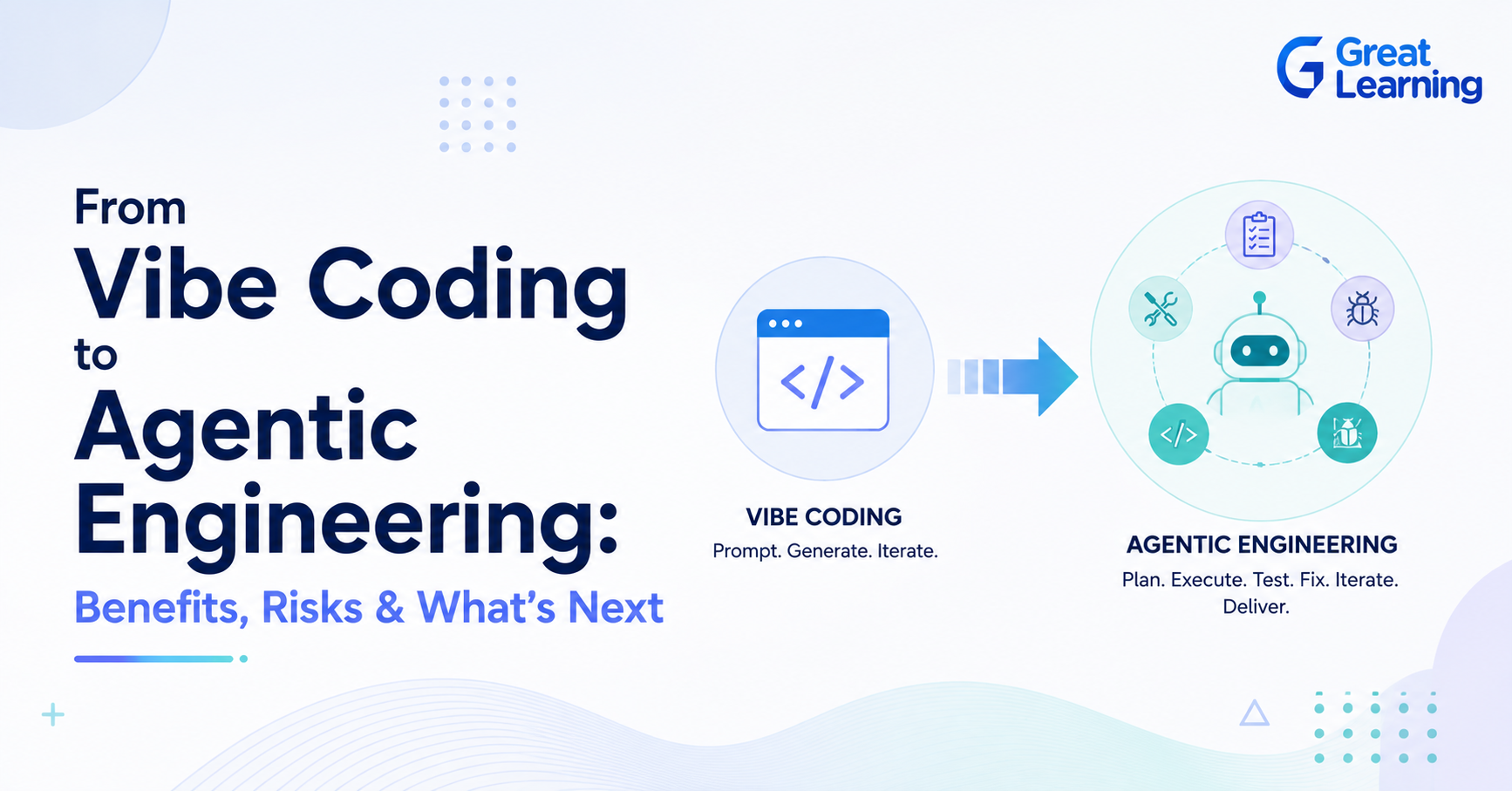
A typical agentic engineering workflow looks like:
Requirement → Planning → Code → Testing → Debugging → Iteration → Review
This allows AI to participate in a much larger portion of the development lifecycle.

How AI Agents Execute Engineering Workflows
Agentic systems can interact with development tools such as code repositories, terminals, testing frameworks, APIs, and documentation. This enables them to move beyond producing code and actually perform engineering tasks across multiple steps.
For example, instead of asking an AI assistant to fix one failing test, a developer could give an agent the broader task of investigating the failure, identifying the cause, updating the implementation, running the relevant tests, and reporting the changes.
The Evolving Role of Developers
This does not remove developers from the process. Instead, their role shifts toward defining requirements, designing systems, setting constraints, reviewing results, managing risks, and overseeing AI-driven workflows.
The key difference is therefore not simply that agents can write more code. It is that AI can increasingly participate in the engineering process itself, which sets agentic engineering apart from conventional AI-assisted coding.
Vibe Coding vs Agentic Engineering: How the Engineering Workflow Changes
Vibe coding and agentic engineering both use AI to accelerate software development, but they differ in how much responsibility AI takes within the engineering workflow.
Vibe coding generally focuses on generating and refining code from developer instructions, while agentic engineering gives AI a broader objective and allows it to execute multiple connected tasks.
| Aspect | Vibe Coding | Agentic Engineering |
| Primary focus | Code generation | End-to-end engineering tasks |
| Developer input | Prompts and instructions | Goals, requirements, constraints |
| AI autonomy | Relatively limited | Higher |
| Planning | Usually developer-led | Agent can plan task steps |
| Tool usage | Mainly coding assistance | Codebases, terminals, testing tools, APIs, and more |
| Testing | Often prompted or manually initiated | Can be part of the agent workflow |
| Debugging | Developer and AI collaborate | Agent can investigate and iterate |
| Task scope | Individual or smaller tasks | Multi-step and complex workflows |
| Human role | Prompting and reviewing | Designing, supervising, validating, and governing |
As these responsibilities expand, free AI courses for freshers can help beginners build the foundational AI skills needed to understand and work with evolving development workflows.
From Code Generation to Task Execution
The biggest difference is the unit of work. In vibe coding, the developer might ask AI to create a feature and then guide it through successive changes.
In agentic engineering, the developer can define the desired outcome and allow an agent to determine several steps required to reach it.
A Different Level of Autonomy
Agentic engineering also introduces greater autonomy. An agent may decide which files to inspect, which tools to use, what tests to run, and what changes to make based on the task and available context.
That creates greater potential for productivity, but it also increases the need for clear constraints, testing, monitoring, and human oversight.
As AI takes responsibility for more steps, an error in one part of the workflow can influence everything that follows.
Benefits of Moving From Vibe Coding to Agentic Engineering
The move from vibe coding to agentic engineering is not simply about making AI generate more code. The bigger benefit is the ability to automate connected engineering tasks as a workflow.
Instead of repeatedly prompting an AI assistant, developers can give an agent a broader objective and let it handle multiple execution steps.
1. Automating Multi-Step Development Workflows
Agentic systems can connect activities such as code generation, testing, debugging, and iteration. This reduces the need for developers to manually coordinate every step, particularly for repetitive development tasks.
2. Faster Testing and Debugging
An agent can run tests, inspect failures, identify potential causes, modify the implementation, and run the tests again.
This creates a faster feedback loop and can reduce the time spent moving between coding and debugging tools.
3. Handling More Complex Engineering Tasks
Vibe coding is particularly effective for quick experiments and smaller development tasks.
Agentic engineering can extend AI assistance to larger, multi-step workflows, such as implementing a feature across multiple files, updating tests, and validating the resulting changes.
4. Improving Developer Productivity
By taking care of repetitive execution work, agents can allow developers to spend more time on higher-value activities such as architecture, technical decisions, code review, and product requirements.
This productivity effect is also reflected in developer surveys. GitKraken's 2026 State of AI report found that 84% of developers feel more productive when using AI, while 43% feel much more productive.
This illustrates how AI is moving beyond code generation toward broader engineering activities such as review, validation, and workflow execution.
5. Scaling AI-Assisted Development
Agentic engineering also creates the possibility of running multiple development workflows with less manual coordination.
As agents become more capable, teams can potentially use them as engineering collaborators rather than treating AI as a tool that only responds to individual coding requests.
The key advantage, therefore, is the shift from AI-assisted coding to AI-assisted engineering execution.
Risks of Moving Toward Autonomous Software Engineering
Greater AI autonomy can improve development speed, but it also introduces risks that are less visible when AI is used only for individual coding tasks.
When an agent can make decisions across multiple steps, a small mistake can potentially affect a much larger part of the engineering workflow.
1. Incorrect Code at Scale
An AI agent may produce code that appears functional but contains logical errors, inefficient implementations, or unexpected dependencies.
When the agent can modify multiple files or components, these problems can spread across the system before they are detected.
2. Security and Permission Risks
Agents may need access to repositories, terminals, databases, APIs, or other development tools.
Poorly defined permissions can create security risks, particularly if an agent executes an unintended command or accesses information beyond what is required for its task.
3. Hidden Technical Debt
Fast AI-generated development can make it easier to accumulate technical debt.
Code may work in the short term while introducing unnecessary complexity, inconsistent patterns, or maintenance problems that become expensive later.
4. Flawed Decisions Across Multi-Step Workflows
Agentic systems can make incorrect decisions about which files to modify, which approach to use, or how to respond to a failed test.
Because each step can influence the next, one incorrect assumption can create a chain of downstream errors.
5. Testing, Evaluation, and Human Oversight
Traditional testing remains important, but agentic workflows also require continuous evaluation and monitoring.
Developers need ways to verify what agents changed, why they made those changes, and whether the final result meets the required standards.
The central challenge is finding the right balance: more autonomy can increase productivity, but more autonomy also requires stronger controls, testing, permissions, and human oversight.
How Developers Can Prepare for the Shift to Agentic Engineering
The shift toward agentic engineering does not replace traditional software development. Developers need to combine strong engineering fundamentals with the ability to design, manage, and evaluate AI-driven workflows.
Developers looking to strengthen their foundation can explore AI for Everyone Pro course from Great Learning Academy Pro and build a broader understanding of modern AI systems.
AI for Everyone: Learn AI Essentials
Learn how AI for Everyone makes artificial intelligence accessible to all. Learn how AI can enhance your life, work, and creativity, regardless of technical skills.
- Move from prompting to specification: Define clear objectives, requirements, constraints, expected outputs, and acceptance criteria instead of relying only on iterative prompts.
- Strengthen software engineering fundamentals: Build expertise in architecture, testing, databases, APIs, security, and system design to evaluate AI-generated solutions effectively.
- Learn agent and tool orchestration: Understand how agents work with APIs, code repositories, testing environments, and other tools, and where human intervention is needed.
- Build reliable testing and evaluation: Use automated testing, code reviews, evaluation, logging, and monitoring to validate both agent outputs and workflows.
- Develop skills beyond code generation: Focus on architecture, security, technical decision-making, AI governance, and system oversight as AI takes on more implementation work.
- Build AI engineering expertise: Structured learning can help developers understand how AI systems and agentic workflows are designed and applied in real-world engineering environments.
The Artificial Intelligence Engineering course by JHU can help professionals develop skills relevant to AI engineering, agentic workflows, and the evolving role of AI in software development.
JHU Certificate Program in AI and Agentic AI Engineering
Designed for software developers, data and AI professionals seeking hands-on technical expertise in building, deploying, and scaling AI and Agentic AI systems using MLOps, LLMOps, and cloud platforms.
What’s Next: The Future of Agentic Software Engineering
Agentic engineering could represent a broader shift in how software is designed, built, tested, and maintained.
As AI agents become better at reasoning across tasks and working with development tools, software teams may move from using AI for isolated coding tasks toward AI-driven engineering workflows.
1. From AI-Assisted Coding to AI-Driven Engineering
The next stage is likely to involve agents handling larger portions of the development lifecycle.
Instead of generating a function or fixing a single bug, agents could manage feature implementation, testing, documentation, code maintenance, and parts of deployment within defined boundaries.
2. Human + Agent Engineering Teams
Developers are unlikely to disappear from these workflows. Their role may increasingly involve setting technical direction, defining requirements, reviewing agent output, managing risk, and making architectural decisions.
This could create engineering teams where humans handle high-level decisions while AI agents execute well-defined technical tasks.
3. Increasing Autonomy Requires Better Controls
Greater autonomy will also increase the importance of permissions, testing, observability, evaluation, and governance.
The more responsibility given to an agent, the more important it becomes to know what the agent did, why it did it, and whether the result is reliable.
4. How Developer Roles May Evolve
Developers may spend less time on repetitive implementation and more time on system architecture, problem definition, AI-agent orchestration, security, evaluation, and technical oversight.
Ultimately, the transition from vibe coding to agentic engineering is not simply about AI writing more code.
It is about AI taking on more of the engineering process while developers increasingly become the people who design, direct, validate, and govern that process.
Final Thoughts
The shift from vibe coding to agentic engineering is changing how developers approach software development. Instead of using AI only for individual coding tasks, developers can increasingly work with AI agents that plan, execute, test, and refine multiple engineering tasks.
This shift makes skills such as software engineering, system design, AI orchestration, evaluation, security, and technical oversight increasingly important.
Developers will need to understand how to define objectives, set boundaries, review agent outputs, and ensure that AI-driven workflows remain reliable.
The Certificate Program in Artificial Intelligence and Agentic AI Engineering by JHU can help professionals build relevant AI engineering skills and understand how AI can be integrated into modern software development workflows.
Ultimately, the transition is not about replacing developers with AI. It is about enabling developers to direct, evaluate, and manage increasingly capable AI-driven engineering systems.
Frequently Asked Questions
1. What is vibe coding?
Vibe coding is an AI-assisted development approach where developers use natural-language prompts to generate, modify, debug, or refine code. It allows them to focus more on describing the desired outcome rather than manually writing every line.
2. What is agentic engineering?
Agentic engineering is an approach where AI agents can handle multiple stages of software development, such as planning, coding, testing, debugging, and iteration. Developers provide objectives and constraints while agents execute connected engineering tasks.
3. How is agentic engineering different from vibe coding?
Vibe coding primarily uses AI to generate or modify code based on developer instructions. Agentic engineering gives AI a broader objective and allows agents to plan and execute multiple connected tasks using development tools.
4. Is agentic engineering the next step after vibe coding?
Agentic engineering can be viewed as a broader evolution of AI-assisted development. Vibe coding focuses mainly on generating and modifying code, while agentic engineering extends AI involvement across larger parts of the software development lifecycle.
5. What are the risks of agentic engineering?
Key risks include incorrect code, security issues, excessive permissions, flawed decisions, hidden technical debt, and insufficient testing. As agents gain more autonomy, monitoring, evaluation, constraints, and human oversight become increasingly important.
6. Will agentic engineering replace software developers?
Agentic engineering is more likely to change how developers work than eliminate their role. Developers may spend more time on architecture, requirements, system design, security, evaluation, and AI-agent oversight, while agents handle more repetitive implementation tasks.
7. Which AI Engineering Course Can Help Developers Prepare for Agentic Engineering?
The Certificate Program in Artificial Intelligence and Agentic AI Engineering by JHU can help professionals develop AI engineering capabilities relevant to modern AI-driven development and agentic workflows. It can help learners understand how AI can be integrated into software engineering processes as these workflows evolve.