
Many beginners entering the artificial intelligence field often feel confused about where to start, whether with programming, machine learning concepts, or modern AI tools, and the answer to all these questions is:
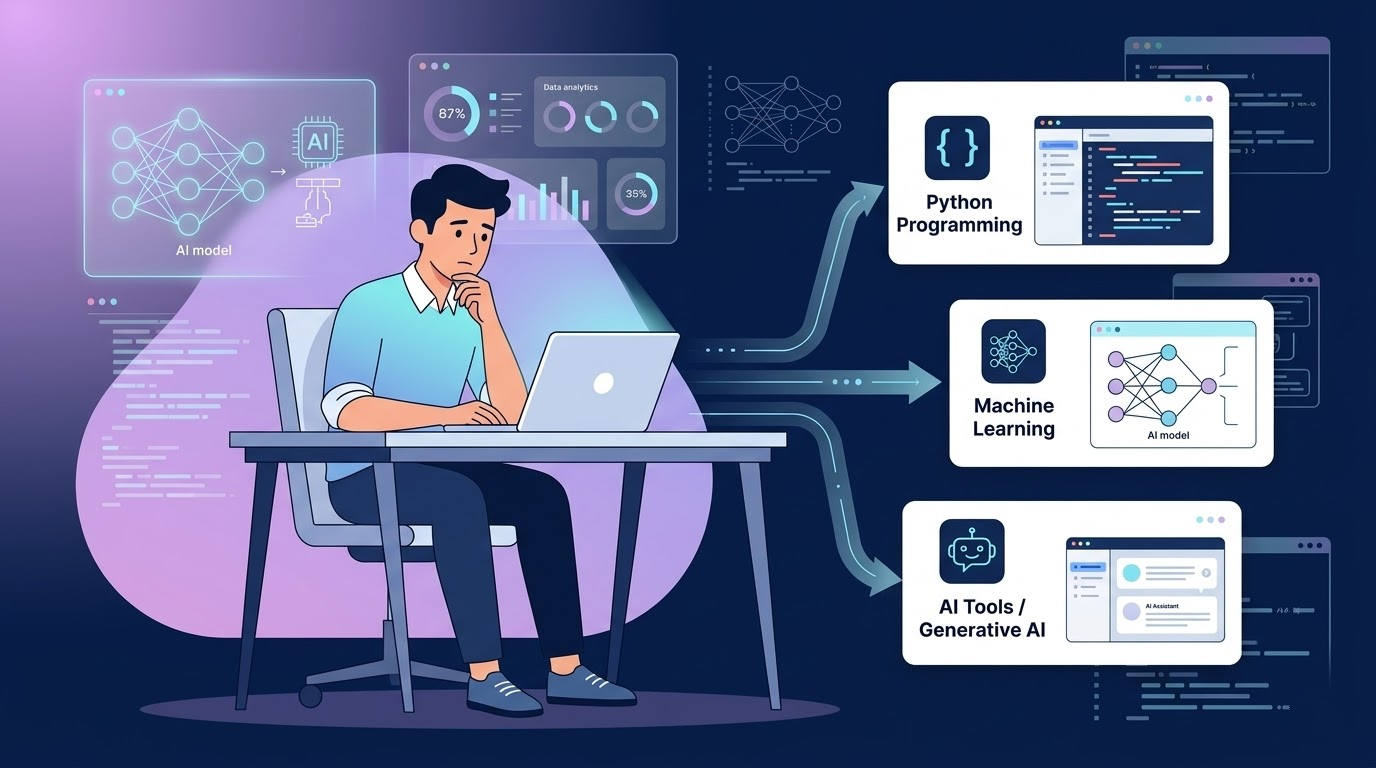
The most effective path is to start with learning Python, move to machine learning, and then learn AI tools.
This structured approach helps you build the right technical foundation before applying advanced AI systems. Let’s explore why this progression is the most logical and effective way to begin a career in AI.
The Ideal Learning Sequence for Starting the Journey
Step 1: Learn Python First to Build the Technical Foundation
Starting with Learning Python is essential and should be your first step, as it is the primary language used to build modern artificial intelligence systems.
It is universally recognized as the data industry's undisputed language due to its simplicity and a massive ecosystem of libraries.
While older versions of the language existed, knowing the difference between Python 2 VS Python 3 ensures you use the most modern, secure, and fully supported syntax available today.
It provides the necessary syntax and logic required to manipulate large datasets and instruct computers on how to perform automated tasks.
This step helps you build custom solutions from scratch, ensuring you are a creator of technology rather than just a user. Here is what you must get started with learning
1. Master Syntax Fundamentals
You must begin by thoroughly understanding core programming elements such as:
- Variables
- Fundamental Data Types, Including Lists, Dictionaries, And Tuples
- Loops
- Conditionals
- Functions
This step is completely essential because it gives you the ability to write logical instructions that a computer can follow. Mastering these basics directly helps you solve complex analytical problems and write clean, reusable code.
2. Learn Object-Oriented Programming
You need to study classes, objects, inheritance, and methods to write highly organized and modular code.
This approach is highly in demand among employers because it enables large teams to work on the same software securely. Understanding these concepts helps you build scalable applications and learn about the many real-world uses of Python, with examples.
3. Practice File Handling, Error Management, And Basic Libraries
You must learn how to read and write files, manage unexpected system errors, and use libraries like requests for handling external APIs.
This skill is critical for pulling raw information from the internet and saving it securely on local servers. It heavily helps you avoid system crashes and ensures your data collection processes run smoothly for model building.
4. Learning Numpy For Arrays & Matrix Operations
You need to master the Numpy library to perform highly complex mathematical calculations at incredibly fast speeds.
This is essential because artificial intelligence heavily relies on processing massive matrices of numbers. Learning this helps you optimize your code to run efficiently on large corporate servers.
5. Master Pandas For Data Manipulation
You must learn how to use Pandas to load large datasets, clean messy data, carefully handle missing values, and perform deep exploratory data analysis.
This step is vital because real-world data is always unorganized and full of errors. Mastering this helps you prepare high-quality information, ensuring your future predictive models produce highly accurate business insights.
6. Visualize Data With Matplotlib And Seaborn
You need to learn Matplotlib and Seaborn to create insightful plots, detailed histograms, and clear scatter plots to visually understand hidden data patterns.
This is extremely important for communicating your technical findings to non-technical business leaders. This data visualization with Python capability directly helps you prove the absolute value of your work and secure stakeholder approval for complex engineering projects.
To strengthen your concepts, watching this highly informative video on Python for Machine Learning provides an excellent visual breakdown of these exact foundational concepts.
However, to truly master these programming skills, this Learn Python with Generative AI program from Johns Hopkins University, delivered in collaboration with Great Learning, is a 10-hour asynchronous course designed to provide an accelerated pathway to Python proficiency through an AI-driven approach.
Learn Python with Generative AI
Learn Python programming fundamentals and apply Generative AI to write, debug, and refine code, progressing from foundational concepts to applied programming.
The curriculum focuses on using Generative AI tools like ChatGPT to write, debug, and refine code, covering everything from basic syntax and professional IDE setup to intermediate data analysis with NumPy and advanced file handling.
Targeted at graduates, working professionals, and tech practitioners, the program emphasizes hands-on learning through over 10 coding assignments and real-world projects, ultimately awarding a Certificate of Completion and 1 Continuing Education Unit (CEU) from JHU.
After completing, you can also actively test your growing skills by trying out a practical Python exercise or running your code in a reliable Python compiler tool.
Step 2: Learn Machine Learning to Understand How AI Models Actually Work
Once you know how to write code, you must understand the Machine Learning Algorithms and models principles that allow you to create ML models for streamlining your day-to-day tasks.
Learning these core concepts in machine learning helps you understand exactly how predictions are made, allowing you to fix errors and improve system accuracy.
This deep knowledge is essential for building reliable models, optimizing performance, and eventually working with advanced AI systems such as deep learning, computer vision pipelines, and large language models.
1. Master Core Machine Learning Algorithms
Learn supervised models like linear regression, logistic regression, decision trees, random forests, and k-nearest neighbors, along with unsupervised techniques such as k-means clustering and PCA, using libraries like scikit-learn.
These algorithms form the foundation of real-world ML systems used for tasks like sales forecasting, fraud detection, customer segmentation, and behavior prediction.
2. Learn Data Preprocessing
You need to master feature scaling, encoding categorical data, train-test splits, and handling dataset duplicates.
This is an essential step because raw data will instantly break analytical models if not formatted correctly. This skill helps you feed clean, highly structured data into your algorithms, guaranteeing much higher reliability.
3. Evaluating Models Using Advanced Metrics
You must learn how to calculate accuracy, precision, recall, F1-score, and confusion matrices while using cross-validation to avoid severe overfitting.
This is vital because a model that performs well on training data might completely fail in the real world. Mastering these evaluation techniques helps you prove your system's worth and prevents costly corporate mistakes.
4. Build Complete Pipelines
You must learn how to design automated workflows from initial data loading to final prediction and model tuning using GridSearchCV.
This is extremely important for keeping your code organized and ready for live production environments. This process helps you save countless hours by automating the tedious model-tuning process.
After learning all the concepts, you need to apply your knowledge to different project ideas, such as predicting house prices or identifying customer churn using large public datasets.
Completing these tasks helps you build a strong portfolio full of impressive work that showcases your true capabilities to your employers.
To get started with introductory material, the Basics of Machine Learning free course helps you grasp foundational concepts. However, to deeply understand these analytical concepts, the Machine Learning Essentials with Python program provides an incredibly thorough technical education.
Learn Machine Learning with Python
Learn machine learning with Python! Master the basics, build models, and unlock the power of data to solve real-world challenges.
This structured program helps you master data processing, predictive modeling, and system evaluation through rigorous hands-on practice.
Step 3: Learn AI Tools to Apply and Scale Your Skills Faster
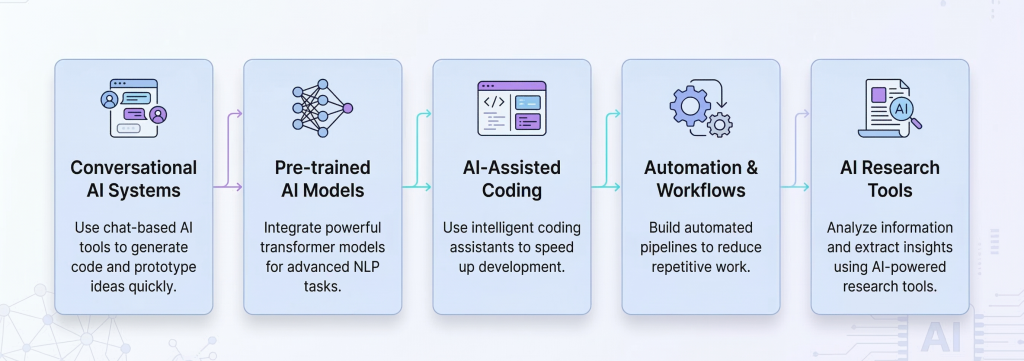
Finally, learn AI tools to apply everything practically without starting from scratch each time.
After building a strong technical foundation, learning how to use modern interfaces and pre-trained models becomes highly beneficial.
Learning to work with AI tools and the differences between generative AI and predictive AI helps you choose the right tool for your specific business problem, saving massive amounts of time by automating repetitive coding tasks.
This final step helps you increase your daily productivity while giving you the underlying knowledge to verify that the automated outputs are actually correct and secure:
1. Start With Conversational Chat Systems
You should begin experimenting with ChatGPT, Perplexity AI, or Claude for instant code generation, error explanations, and rapid prototyping of new software ideas.
This is highly useful for overcoming temporary coding blocks and understanding complex documentation quickly. Using these interfaces helps you drastically speed up your daily development workflow.
2. Use Hugging Face Transformers
You must learn Hugging Face and securely integrate massive pre-trained language models into your private software for advanced natural language processing tasks.
This is incredibly important because training your own massive models from scratch is mainly expensive for most companies. This skill helps you add strong intelligence to your local applications at a fraction of the cost.
3. Experiment With Advanced AI-Assisted Coding
You should try no-code options like Bubble for quick app building, and then transition to powerful developer tools like Cursor or Tabnine for AI-assisted coding in your Python projects.
This is essential for staying competitive in a rapidly moving job market. Mastering these developer tools helps you write highly secure code faster while letting the system handle basic syntax generation.
4. Leverage AI for Automation and Workflow Management
Platforms such as Zapier AI, Make (Integromat), and Notion AI allow you to automate repetitive tasks like data syncing, report generation, email summarization, and document processing.
Learning how to combine these tools with APIs helps professionals build AI-powered workflows that save time and increase productivity in real-world business environments.
5. Use AI for Research and Knowledge Discovery
Tools like Elicit and Consensus help you quickly find reliable information, summarize research papers, and extract key insights from large documents.
These tools are extremely useful for technical research, learning new concepts faster, and validating ideas while building AI projects.
While navigating Python, Machine Learning, and AI tools on your own is possible, combining these crucial steps into a single, cohesive, mentor-led path can significantly fast-track your career, and programs like the Post Graduate Program in Artificial Intelligence and Machine Learning are known to be an ideal solution.
PG Program in AI & Machine Learning
Master AI with hands-on projects, expert mentorship, and a prestigious certificate from UT Austin and Great Lakes Executive Learning.
Designed in collaboration with top industry experts and leading academicians from The University of Texas at Austin and Great Lakes Executive Learning, this program blends academic depth with hands-on application.
The 12-month program equips professionals with the knowledge, tools, and real-world skills to thrive in an AI-driven era. Here is how this comprehensive program bridges the gap between learning and career success:
- Master the Complete AI Stack: You will become adept at the latest AI technologies, including Deep Learning, Computer Vision, NLP, Reinforcement Learning, MLOps, Generative AI, and Agentic AI.
- Achieve Tangible Learning Outcomes: After completing this program, you will be able to successfully build and deploy end-to-end AI solutions. You will also be equipped to use deep learning for complex problem-solving , manage AI workflows with MLOps , and apply Generative AI models, like ChatGPT, in business contexts for automation and content generation.
- Learn High-Demand Tools: The curriculum covers 29+ languages and tools. You will gain practical experience with essential technologies from Python, SQL, and Docker to cutting-edge frameworks like TensorFlow, Transformers, LangChain, and ChatGPT.
- Build a Verifiable Portfolio: You will go beyond theoretical learning by completing 11 hands-on projects and 1 Capstone Project. You will make project submissions on GitHub, an online repository that stores all your assignments in a single place to boost your visibility and prove your technical expertise to potential recruiters.
- Receive Expert Mentorship: The program features a structured learning path with live mentorship and dedicated support. These industry practitioners will help you build a solid foundation and clarify doubts during weekend sessions.
- Advance Your Career: You will receive dedicated career support, including resume reviews, interview preparation, and access to a job board with opportunities shared by 4000+ organizations. Upon successful completion, you will also earn recognized dual certificates from the prestigious University of Texas at Austin and Great Lakes Executive Learning.
As you plan your next professional steps, you can also review this extensive career and roadmap guide to understand exactly where your newly acquired skills fit into the global market.
Conclusion
The journey to securing a high-paying role in the technology sector does not start with typing instructions into an automated chatbot.
You must logically progress by learning Python first to gain full control over data, mastering machine learning to deeply understand how predictive algorithms actually work, and finally using AI tools to heavily accelerate your established workflows.
By diligently following this structured path, you actively protect your professional career from rapid market shifts and establish yourself as a highly capable, irreplaceable technical engineer.