
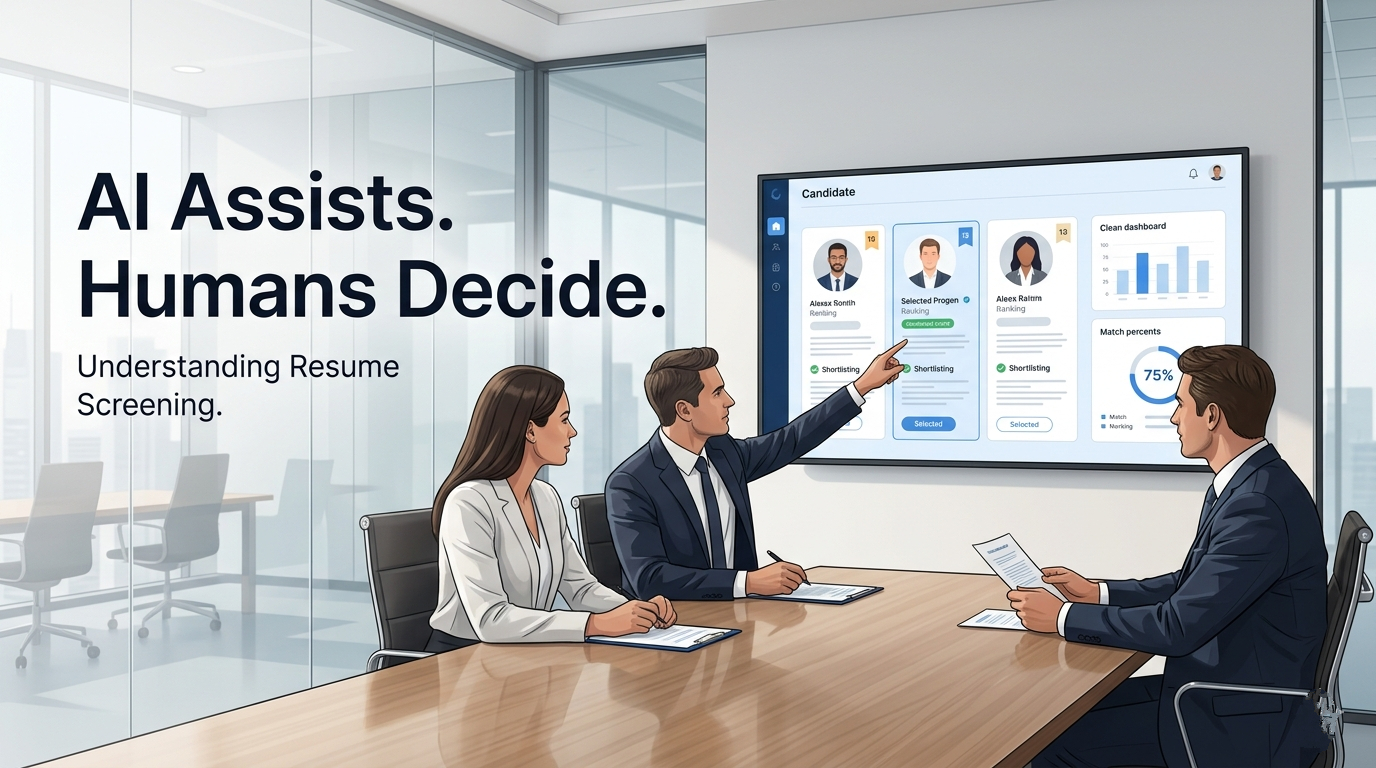
Yes, in most large companies today, AI filters screen your resume before any human ever sees it. Applicant Tracking Systems (ATS) and AI-powered screening tools have become standard infrastructure in modern recruitment pipelines.
With organizations like Google receiving over 3 million applications annually for a single internship cycle, manually reviewing every resume is no longer operationally feasible.
More than 90% of employers now use some form of automated system to filter or rank applications and rely on AI-driven resume-screening tools. If your resume does not meet the algorithmic criteria, it is often eliminated before a recruiter opens a single file.
What Are AI Resume Filters?
AI resume filters are automated software systems that parse, analyze, and rank job applications based on predefined criteria aligned with job descriptions.
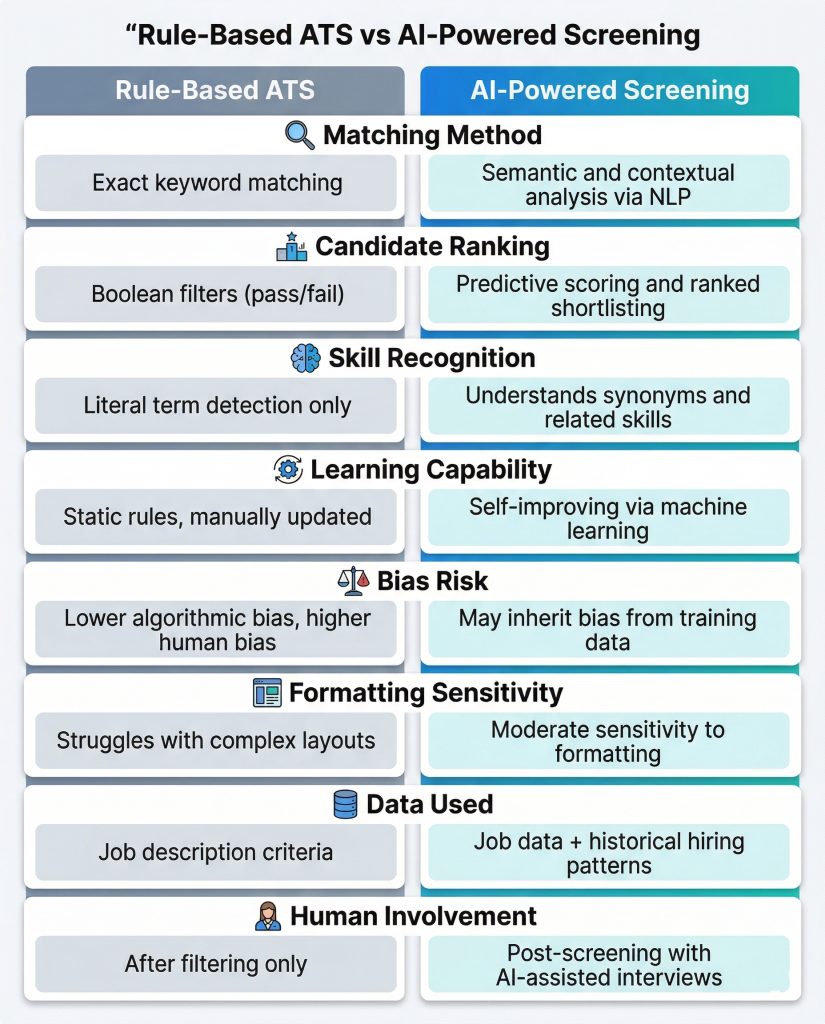
AI-powered screeners use Natural Language Processing (NLP), machine learning models, and semantic analysis to evaluate candidate fit.
These tools extract structured data from unstructured resume text, including work history, skills, qualifications, and formatting signals, and assign each applicant a relevance score.
Applications that fall below a set threshold are automatically disqualified and never reach a human recruiter's queue.
Rule-Based ATS vs. AI-Powered Screening: What's the Difference?
How AI Filters Screen Resumes?
1. Keyword Matching and Parsing
The first layer of any AI screening pipeline is resume parsing, the extraction of structured information from raw resume text. The system identifies key fields such as
- Job Titles
- Dates Of Employment
- Educational Qualifications
- Skills
Standard section headers such as "Work Experience," "Skills," and "Education" are reliably recognized. Unconventional headers such as "My Journey" or "What I Bring" can confuse parsing algorithms, leading to critical information being misclassified or skipped entirely.
2. Ranking Candidates Based on Job Fit
Once parsed, each resume receives a relevance score based on alignment with the job description. Sections like Skills and Work Experience carry the highest weight in scoring algorithms, while Education is assigned moderate priority.
A bullet point such as "Increased customer retention by 35% using Salesforce CRM" scores higher than a bare listing of "Salesforce" in a skills section, because the AI recognizes both the tool and the quantifiable outcome.
Candidates are then ranked, and only those above a set score threshold advance to the recruiter's review queue.
3. Skills, Experience, and Semantic Analysis
Modern AI screeners go beyond literal keyword detection. Using semantic analysis, they identify conceptual relationships between terms.
For example, a resume listing "predictive modeling" may still match a job description calling for "machine learning," provided the model has been trained to associate these competencies.
However, this capability is uneven across platforms, and relying on paraphrasing over precise terminology remains a risk. Always include both the full term and its acronym, for instance, "Search Engine Optimization (SEO)" to maximize match probability.
4. Elimination Criteria
AI filters automatically disqualify resumes based on:
- Formatting violations- Multi-column layouts, tables, embedded graphics, and text boxes disrupt parsing algorithms and can render a resume unreadable to the system.
- Missing keywords- If role-critical terms from the job description are absent, the relevance score drops below the acceptance threshold regardless of actual candidate quality.
- Irrelevant background signals- Mismatched industry experience, unrelated job titles, or unexplained career gaps can trigger negative weighting in predictive scoring models.
- File format incompatibility- Scanned PDF images and files with embedded graphics are frequently flagged as "unparseable" by legacy ATS platforms such as Taleo or iCIMS.
If your resume is being rejected before it reaches a recruiter, the issue is almost always structural or terminological, not a reflection of your actual capabilities. Start by building an ATS-friendly resume to ensure your application passes these automated screening processes.
Why Employers Use AI Filters?
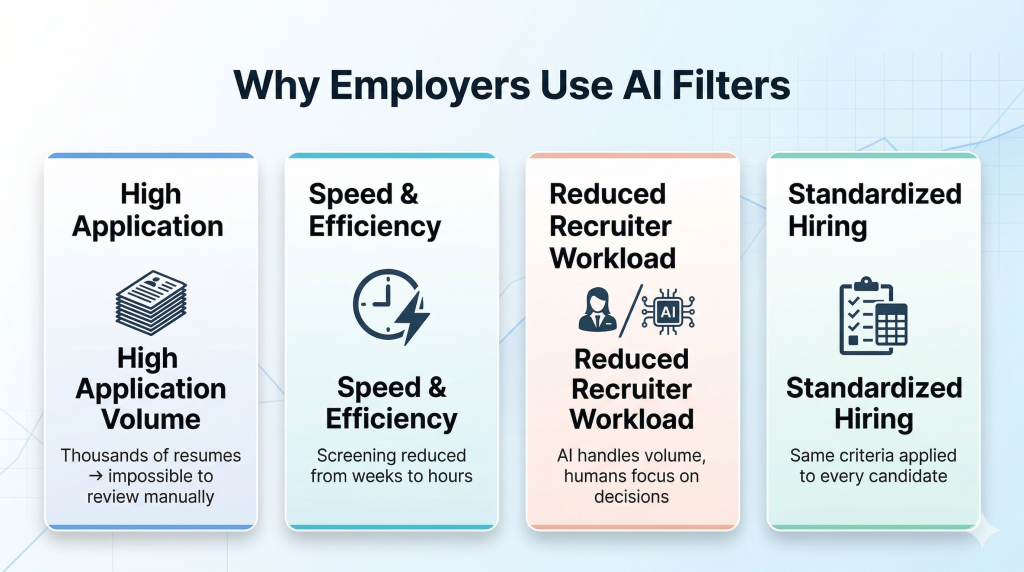
1. High Volume of Applications
The mathematics of modern hiring make human-first review impossible at scale. When a single job posting at a major technology company attracts thousands of applications within 72 hours, even a team of ten recruiters cannot manually assess each one meaningfully. AI filters create an operationally viable first layer.
2. Speed and Efficiency
AI-assisted hiring processes have demonstrated up to a 87.64% reduction in financial costs compared to fully manual methods, primarily by automating initial screenings and reducing the manual workload for HR teams. Screening cycles that previously spanned weeks are compressed to hours.
3. Reducing Recruiter Workload
The explicit goal is to redirect recruiter bandwidth from volume processing to value-added activities such as conducting interviews, assessing cultural alignment, and making final hiring decisions. Human oversight remains concentrated in areas like communication style, team dynamics, and behavioral evaluation, where algorithmic assessment is inherently limited.
4. Standardization in Hiring
AI screening tools apply identical evaluation criteria to every applicant, eliminating inconsistencies introduced by recruiter fatigue, schedule pressure, or individual cognitive bias. This standardization is particularly valuable in high-compliance industries and organizations with structured diversity, equity, and inclusion (DEI) mandates.
Professionals looking to understand the backend metrics used by HR teams to evaluate these tools should explore the HR Analytics Course. This free resource introduces the fundamentals of HR data analysis, showing you how organizations use data metrics to streamline recruitment, measure candidate success, and optimize human resource operations.
Do Human Recruiters Still Read Resumes?
The answer is: Yes
Despite the prevalence of automation, the human element remains the final and most critical arbiter in the hiring process.
AI serves as a powerful digital assistant, not an autonomous hiring manager. When applicants follow universal tips to write a resume that employers really want, their goal is to please the algorithm so that they can reach the human. Here is how human recruiters interact with filtered resumes:
- Shortlisted candidates are presented to human recruiters as ranked profiles, often through a dashboard that highlights match scores, flagged keywords, and missing criteria.
- Recruiters skim, not read industry data consistently shows that recruiters spend an average of six to eight seconds on an initial resume review, even for applications that have passed AI screening.
- Cultural and soft skill evaluation remains a distinctly human function; AI tools assess hard skill alignment but cannot reliably evaluate interpersonal dynamics, leadership presence, or contextual career judgment.
- Edge cases and senior roles often see greater human involvement, particularly for executive positions or roles where domain expertise is rare and difficult to quantify algorithmically.
The key insight is: AI does not replace the human recruiter; it controls which candidates the human recruiter ever encounters. If your resume does not survive the algorithmic filter, the question of whether a human would have valued your experience becomes moot. Understanding what employers genuinely look for beyond basic formatting is as important as passing the automated screen.
For comprehensive, step-by-step guidance on constructing a document that beats the bots, enroll in the Resume Building free course. This module provides actionable techniques on formatting, content structuring, and optimization strategies to help you craft a professional profile that effectively showcases your strengths.
How to Bypass the Filters?
To ensure your application transitions from the algorithmic database to a human recruiter's desk, you must engineer your document specifically for automated parsing. This is where strategic formatting and keyword integration become paramount.
To guarantee your document is parsed accurately, utilize the Great Learning Resume Builder. This powerful tool is engineered specifically to generate professional, ATS-compliant formats that algorithms can easily read, ensuring your skills and experiences are perfectly structured to bypass automated filters and reach hiring managers.
Create ATS-Friendly Resumes in Minutes
Use our free resume builder to craft a professional, ATS-friendly resume quickly. Choose from customizable templates, tailor layout and design, and download in PDF. Start building your career-ready resume today.
1. Use Relevant Keywords from Job Descriptions
Treat each job description as a vocabulary guide. Identify the most frequently repeated technical skills, tools, certifications, and role-specific terminology.
Mirror this language directly in your resume, particularly in the Skills and Work Experience sections, which carry the highest algorithmic weight. Do not rely on synonyms where precise terms have been specified.
2. Simple, ATS-Friendly Formatting
To build an ATS-friendly resume, abandon complex dual-column layouts. Stick to standard, single-column, left-aligned text. You can explore safe layouts by looking at free resume templates to download that are pre-vetted for parser compatibility.
Stick to single-column layouts with standard fonts such as Arial, Calibri, or Times New Roman. Use text-based PDFs or .docx files. Avoid headers and footers for contact information, as legacy systems frequently fail to parse these zones.
3. Avoid Graphics, Tables, and Complex Designs
Algorithms cannot read images or data nested inside complex tables. Keep the text clean. If you want to make your CV stand out from the crowd, do it through impactful metrics and data-driven achievements, not through graphic design elements.
Skill bars, icons, photos, infographics, and multi-column tables look polished to the human eye but are invisible or disruptive to parsing algorithms. A visually simple resume that parses cleanly will outperform a design-heavy resume every time in an automated screen.
For candidates at the beginning of their careers, the challenge of balancing keyword optimization with communicating limited experience is real. Resources on career objectives for freshers offer targeted guidance on framing early-career profiles for algorithmic and human evaluation alike.
4. Use Clear Headings and Standard Sections
Use universally recognized section headers: Professional Summary, Work Experience, Education, Skills, Certifications. Avoid creative or unconventional labels.
Consistency in date formatting, for example, "Jan 2022 – Mar 2024" throughout, prevents calculation errors in experience-duration scoring. To double check your resume tou want to watch how to build a good resume to ensure each section structure aligns with what ATS platforms expect.
5. Add Soft Skills
Equally important is ensuring your soft skills are communicated through concrete achievements rather than generic claims. Incorporating strong soft skills framed in terms of measurable outcomes signals competence to both the algorithm and the recruiter who eventually reviews your shortlisted profile.
Even after ensuring all the above rules are met, a single generic resume is structurally incompatible with AI screening at scale.
Each application requires a version of your resume calibrated to the specific job description, adjusting terminology, reordering skills sections, and aligning your professional summary with the role's stated requirements.
Additionally, learners can greatly benefit from video tutorials on Effective Resume Building, Resume Writing Tips & Tricks to accelerate role specific tailoring process, generating ATS-optimized resume drafts that reduce manual effort without sacrificing precision.
Upskill to Stand Out Even After Passing the Filter?
Passing the AI filter gets you into the recruiter's queue. What converts that opportunity into an interview is the quality and relevance of your skills.
As AI reshapes hiring standards, employers increasingly expect candidates to demonstrate working familiarity with AI tools and concepts, not just in technology roles, but across business functions.
If you are looking to make AI literacy a genuine career differentiator, Great Learning's PG Program in Artificial Intelligence and Machine Learning: Business Applications, offered in collaboration with UT Austin's McCombs School of Business, provides structured, industry-aligned training in applied AI. The program covers machine learning, NLP, computer vision, and business applications, equipping professionals with skills that are directly relevant to AI screeners and recruiters alike.
PG Program in AI & Machine Learning
Master AI with hands-on projects, expert mentorship, and a prestigious certificate from UT Austin and Great Lakes Executive Learning.
Whether you are pivoting to a new domain or advancing in your current role, understanding how an AI can accelerate a career pivot has never been more relevant.
Conclusion
AI operates as a sorting mechanism, not the final decision-maker. By understanding how these natural language processing algorithms parse, score, and rank data, professionals can strategically engineer their applications to survive the initial automated cull. Remember, you format for the machine, but you write for the human.
Once you master the technical requirements to bypass the digital gatekeepers, you can focus on broader career development strategies by exploring an extensive career and roadmap guide, and prepare for the next step of the hiring phase by reviewing common interview questions.
The integration of AI in recruitment simply changes the rules of the first round; human connection, quantifiable achievements, and genuine expertise still win the final offer.