
- What Is Gemini Omni?
- How Does Gemini Omni Work?
- How to use Gemini Omni?
- What Are the Key Features of Gemini Omni?
- How Does Gemini Omni Generate Text, Images, Audio, and Video Together?
- Gemini Omni vs GPT-4o vs Other Multimodal AI Models
- What Is Pricing and API Access for Gemini Omni?
- What Governance and AI Safety Measures Are in Place in Gemini Omni?
- What Are the Real-World Use Cases of Gemini Omni?
- What Should Enterprises Know Before Adopting Gemini Omni?
- Conclusion
- Frequently Asked Questions
At Google I/O 2026, Google DeepMind officially introduced Gemini Omni, a foundation model that natively processes and generates text, images, audio, and video through a unified architecture. For enterprises and developers burdened by fragmented AI tools, this launch represents a major architectural leap that eliminates complex multi-model pipelines. Let’s dive deeper into understanding this model and its real-world impact.
What Is Gemini Omni?
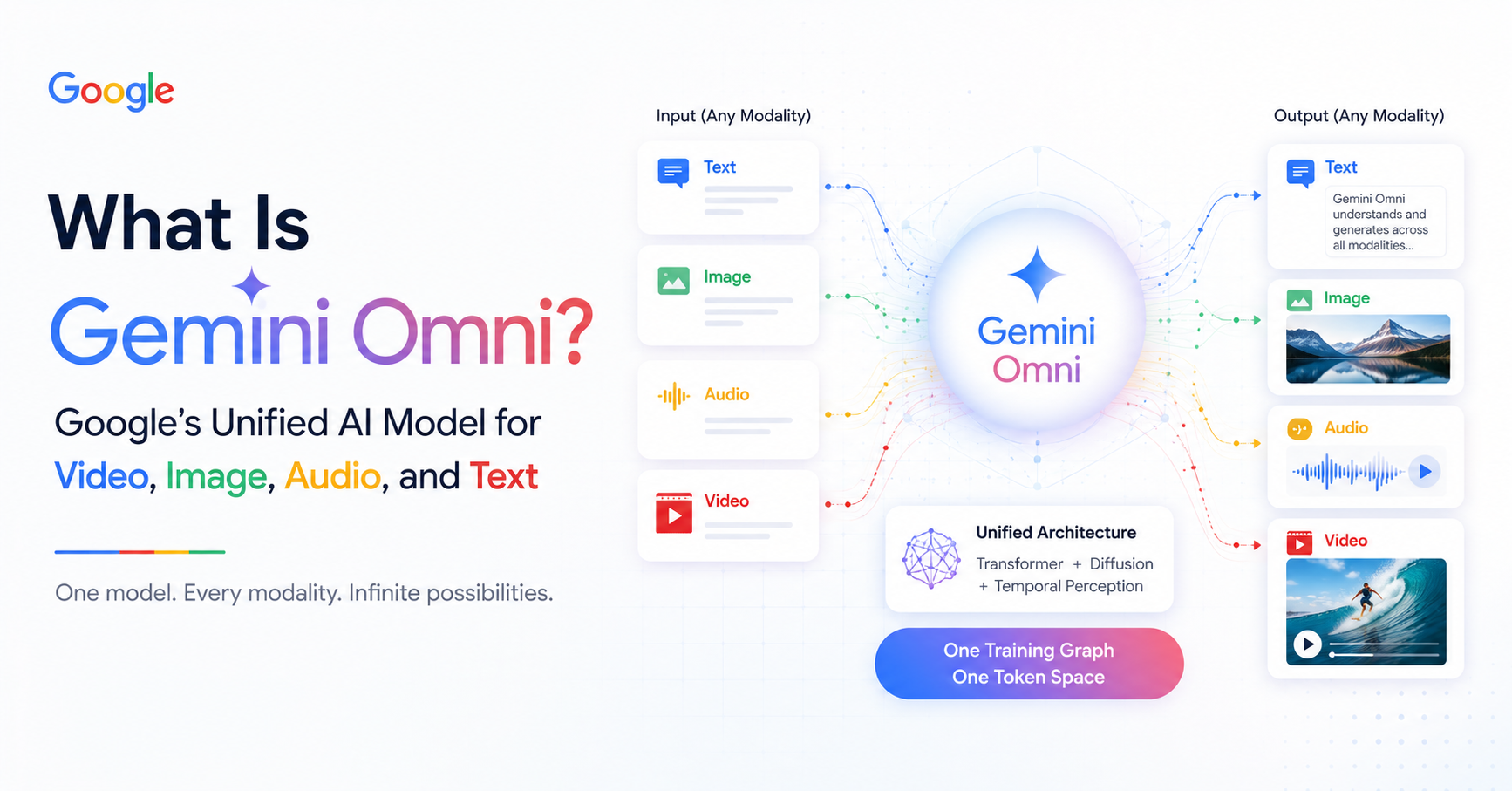
Gemini Omni is Google DeepMind’s native multimodal artificial intelligence model designed to process and generate text, images, audio, and video through a unified architecture.
Introduced at Google I/O 2026, the model integrates separate AI workflows into a single system capable of any-to-any generation. It can interpret multiple forms of media input simultaneously and generate contextually aligned text, visual, audio, or video outputs through advanced cross-modal reasoning within a single inference process.
How Does Gemini Omni Work?
Gemini Omni operates on a unified architecture combining Transformer, diffusion, and temporal perception modules within a single training graph, processing text, images, audio, and video in the same token space.
Unlike traditional AI systems that rely on separate pipelines for different media formats, Gemini Omni handles multimodal inputs and outputs within a single inference process, enabling cross-modal reasoning and any-to-any content generation.
Core Technologies Behind Gemini Omni
1. Cross-Modal Generation
Gemini Omni can interpret and combine multiple input formats simultaneously, including:
- Text prompts
- Images
- Video clips
- Audio inputs
- Voice instructions
The model can then generate cohesive outputs across different modalities, such as producing video from text and image references or generating synchronized audio and visual content from a single prompt.
2. Conversational AI Editing
The model supports multi-turn conversational editing, allowing users to iteratively refine generated outputs using natural language or voice commands. Users can:
- Replace characters or objects
- Modify backgrounds and environments
- Add cinematic effects and camera movements
- Adjust lighting, pacing, and scene composition
- Enhance visual continuity across frames
This enables a more agentic and interactive AI content creation workflow.
3. Real-World Physics and Scene Understanding
Gemini Omni incorporates advanced spatial and temporal reasoning capabilities to improve realism in generated content. The model can:
- Simulate lighting and shadow behavior
- Maintain object consistency across frames
- Understand motion trajectories and physics
- Preserve scene depth and environmental coherence
These capabilities significantly improve the quality of AI-generated video and synthetic media outputs.
4. SynthID Watermarking and AI Governance
To support responsible AI deployment, Gemini Omni integrates SynthID watermarking technology that embeds imperceptible identifiers into AI-generated outputs. This helps improve:
- AI content traceability
- Synthetic media identification
- Digital authenticity verification
- Enterprise governance and compliance frameworks
How to use Gemini Omni?
Gemini Omni is available through the Gemini ecosystem for eligible users aged 18 and above. Access is currently offered through select Google AI subscription tiers and integrated creative workflows.
Step 1: Upload Your Input Media

Start by uploading one or more reference assets, such as:
- An image
- A short video clip
- A voice recording
- A product demo recording
- A text-based concept prompt
Gemini Omni can process multiple input formats simultaneously within the same workflow.
Step 2: Provide a Natural Language Prompt

Describe the scene, transformation, or output you want the model to generate.
Example prompts:
- “Transform this biking clip into a futuristic neon city environment.”
- “Add cinematic rain effects and realistic reflections.”
- “Generate a professional product advertisement from this phone recording.”
The model interprets both the uploaded media and the textual instruction together using cross-modal reasoning.
Step 3: Refine the Output Conversationally

Gemini Omni supports multi-turn conversational editing. Users can iteratively improve outputs through additional prompts, such as:
- “Replace the background with a sunset landscape.”
- “Stabilize the camera movement.”
- “Add slow-motion effects during the final scene.”
- “Improve facial lighting and audio clarity.”
This creates a more interactive and agentic AI editing workflow.
Step 4: Generate Multimodal Outputs
The model can produce:
- AI-generated videos (10-second clips)
- Synchronized audio and visual content
- Edited visual sequences with unified audio
- Video with natural language narration
All outputs are generated within a unified multimodal inference pipeline.
Step 5: Export and Deploy Content
Once finalized, the generated content can be used across:
- Marketing campaigns
- Enterprise presentations
- AI-assisted media production
- Product demonstrations
- Social media workflows
- Creative content creation
Gemini Omni also embeds SynthID watermarking technology to help identify AI-generated media and support responsible AI governance
Understanding this architecture, especially how unified tokenization and cross-modal attention interact, is foundational for developers and product teams building on top of Gemini Omni.
To deepen your understanding of prompting these systems effectively, watch Mastering Prompt Engineering & LLMs: Skills You Need, which covers the reasoning structures and prompt design patterns most relevant to working with multimodal foundation models.
What Are the Key Features of Gemini Omni?
- Any-to-any input processing: Accepts prompts combining text, static images, audio tracks, video clips, and motion references in a single request.
- Conversational video editing: Users modify video over multiple natural language turns while the model retains structural context from previous instructions.
- World physics simulation: Motion, gravity, fluid dynamics, and kinetic interactions are modeled to behave more naturally in generated footage.
- Character and object consistency: Maintains identity, appearance, and motion of visual elements across scenes, environments, and stylistic transformations.
- Low-latency generation: Omni Flash is optimized for fast 10-second clip generation, targeting real-time creative workflows.
- Synchronized multimodal output: Video output is coherent with all input modalities, meaning audio, motion, and visual cues are unified rather than merged in post-processing.
How Does Gemini Omni Generate Text, Images, Audio, and Video Together?
1. Cross-Modal Reasoning in Practice
Traditional reasoning pipelines in multimodal AI systems were sequential: understand the image, generate a caption, and pass the caption to a video model.
In contrast, Gemini Omni multimodal transformer architecture allows it to reason about the semantic relationship between a character image, a background scene prompt, and an audio track before any generation begins.
This produces three practical outcomes:
- Higher coherence: Visual elements respond meaningfully to audio and text context because they're processed together, not after one another
- Fewer pipeline artifacts: There's no "translation loss" between stages, the model doesn't need to convert a video into a text description to reason about it; it reasons about the video directly
- Faster iteration: Creators can refine output conversationally without re-entering inputs from scratch
2. Synthetic Media and World Modeling
Gemini Omni incorporates a physics-aware generation layer, which Google describes as a world model or world physics understanding.
This layer governs how synthetic media elements behave in the generated output:
- How fabric moves
- How light reflects
- how objects interact with surfaces
The result is that generated footage maintains internal physical plausibility even across complex motion sequences, which has been a persistent limitation in earlier video generation models.
Gemini Omni vs GPT-4o vs Other Multimodal AI Models
| Feature | Gemini Omni | GPT-4o | Claude Opus 4.7 | Qwen3.5-Omni |
|---|---|---|---|---|
| Architecture | Native multimodal unified architecture | Native multimodal model for text, image, and audio | Advanced reasoning model with high-resolution image and long-context support | Hybrid Attention MoE architecture with Thinker and Talker modules |
| Native Video Generation | Yes, integrated core capability | No – requires separate video model integration | No | No – focused primarily on multimodal understanding |
| Input Modalities | Text, image, audio, and video | Text, image, and audio | Text and image | Text, image, audio, and video inputs |
| Output Modalities | Video clips with synchronized audio and edited visual sequences | Text, image, and audio | Text and image | Text, audio, and image outputs |
| Conversational Editing | Yes – supports multi-turn video editing workflows | Limited conversational text/image editing | No | Partial audio-visual interaction workflows |
| Physics & Scene Simulation | Supports world modeling, lighting, and spatial reasoning | Limited | No | Limited audio-visual grounding capabilities |
| Context Window | Extended multimodal conversational memory | Approx. 128K tokens | Up to 1 million tokens | Approx. 256K tokens |
| Enterprise API Availability | Available through Vertex AI rollout | OpenAI API and Azure OpenAI ecosystem | Anthropic API and AWS Bedrock integration | DashScope International APIs |
| Consumer Availability | AI Plus, AI Pro, and AI Ultra tiers | ChatGPT Plus subscription | Claude Pro subscription | Primarily API-first access |
| Primary Strength | Unified multimodal video generation and editing | Strong reasoning and ecosystem integration | Long-context document and code reasoning | Audio-visual understanding and speech generation |
The critical architectural distinction:
GPT-4o processes text, images, and audio natively, but does not generate video natively; that capability is handled by Sora, a separate model.
Gemini Omni is, as of its launch, the first top-tier foundation model to include native video output in the same unified architecture as language and audio reasoning.
What Is Pricing and API Access for Gemini Omni?
1. Consumer Subscription Pricing
Gemini Omni Flash is accessible through Google's updated Google AI subscription plans:
- AI Plus ($7.99/month): Entry-level paid access providing 2x higher usage than the free tier, access to Gemini Omni, and 200 Google Flow credits per month.
- AI Pro ($19.99/month): Mid-tier access providing 4x higher usage limits, expanded access to Gemini 3.1 Pro, and 1,000 Google Flow credits per month.
- AI Ultra (Starting at $99.99/month): Aimed at developers and advanced creators, this tier provides the highest usage limits, priority access to experimental features, and bundled access to Google Antigravity. It includes massive Google Flow credit allocations (10,000 credits for the $99.99 plan, scaling up to 25,000 credits for the $199.99 tier).
2. Usage Caps and Google Flow Credits
Google has moved paid plans away from fixed daily prompt caps to compute-based usage limits. Utilizing Gemini Omni, especially for video generation, relies heavily on Google Flow credits.
A simple text prompt consumes significantly less capacity compared to video generation, which burns credits based on output length and quality. This compute-based structure provides more predictable cost management for power users.
3. Developer and Enterprise API Access
Recent announcements, the Vertex AI API for Gemini Omni is rolling out to developers "in the coming weeks." Until the API is generally available, Omni functions primarily as a consumer and prosumer tool.
- Production Deployment: Official API pricing per million tokens or per second of generated video has not been publicly confirmed. Projections based on Veo 3.1 and Gemini 3.5 Flash suggest input pricing may land in the $1.50–$2.50 range per million tokens.
- Sandbox Testing: Google AI Studio remains the free developer environment for experimenting with Gemini models ahead of production deployment on Vertex AI.
What Governance and AI Safety Measures Are in Place in Gemini Omni?
1. Content Credentials and Watermarking
Gemini Omni-generated content is subject to Google's AI alignment and safety frameworks, which include:
- Synthetic media watermarking using Google's SynthID technology, which embeds imperceptible cryptographic markers in generated video to enable provenance verification
- Content credentials attached to generated outputs, aligned with C2PA (Coalition for Content Provenance and Authenticity) standards
- Red teaming and adversarial testing protocols were applied during model development
2. Responsible Use and Deployment Policy
Google's AI governance framework for Gemini Omni includes usage policies that govern permissible inputs, output types, and deployment contexts. Key elements include:
- Restrictions on generating content that depicts real, identifiable individuals without consent.
- Rate limiting and usage quota systems to prevent large-scale synthetic media abuse.
- Data handling protocols that differ between consumer tiers and the enterprise Vertex AI environment are an important distinction for organizations with regulatory obligations around data residency and privacy
3. Enterprise Data Security
For enterprise deployments via Vertex AI, Google provides additional governance infrastructure:
- Private networking to isolate inference workloads from the public internet
- Regional data residency controls for GDPR and sector-specific compliance requirements
- Audit logging for API calls, enabling organizations to maintain records of AI-generated content within their compliance frameworks
Understanding systems like Gemini Omni is just the beginning. To truly capitalize on this technology in the workplace, professionals need to integrate these models into automated systems. The AI-Native Professional: Workflows and Agents for Productivity program by Great Learning is built exactly for this purpose.
This 6-week, online, expert-led program empowers professionals to build AI workflows and deploy their own AI agents with zero coding required.
By learning to chain together the latest AI tools (including OpenAI, Claude, Gemini, NotebookLM, Perplexity, Activepieces, Gamma, Vids, and Lovable) using intuitive drag-and-drop, you will build highly functional systems such as a One-Click Content Factory and an Email Triage Assistant.
Ultimately, you will automate recurring tasks, make your work run itself, and reclaim hours of valuable time every week.
What Are the Real-World Use Cases of Gemini Omni?
1. Creative and Media Production
Gemini Omni is already deployed in Google Flow and YouTube Shorts, where it enables creators to:
- Generate short-form video from text prompts and reference imagery in a single step
- Edit existing video clips through natural language instructions without re-uploading or re-prompting
- Synchronize voiceovers, music references, and character appearances in one generative pass
2. Enterprise Content Workflows
For enterprise content operations, Omni's any-to-any architecture reduces the tool stack required for multimodal content production:
- Marketing teams can produce campaign-ready video assets from brand style guides and product images in one workflow
- Training departments can generate instructional videos from documentation and audio narration without dedicated video production resources
- Product teams can prototype UI walkthroughs from wireframes, screen recordings, and voiceover scripts simultaneously
3. Developer and API Ecosystem
For developers building AI-native applications, the upcoming Vertex AI API for Gemini Omni will provide a programmatic interface with enterprise-grade SLAs, data residency controls, and private networking options. The API ecosystem around Gemini Omni is expected to align with Google Cloud's existing enterprise developer infrastructure.
If you're building in this space and want to deepen your practical knowledge of Google's AI tooling, Great Learning's Google AI Essentials course offers a free, structured introduction to working directly with Gemini models in Google's developer environment, covering API access patterns, prompt workflows, and real-time model testing without requiring a financial commitment.
What Should Enterprises Know Before Adopting Gemini Omni?
1. Current State vs. Roadmap
Gemini Omni Flash is available and generating results, but Vertex AI API availability for production deployment is still pending general availability. This matters because:
- Production-grade generative video at scale requires a programmatic interface, not just consumer app access
- Enterprise SLAs, data handling commitments, and compliance frameworks only apply to the Vertex AI path, not the consumer subscription tiers
- Seat-based experimentation through AI Ultra ($100/month) is viable for evaluation and pilot purposes
2. Stack Rationalization Opportunity
For enterprises currently operating separate vendor contracts for text-to-image, image-to-video, lip-sync, and voice generation, Gemini Omni's unified architecture represents a genuine stack consolidation opportunity.
Organizations that have assembled multimodal workflows from multiple specialist tools should assess whether a unified model offers better coherence, lower operational overhead, and a cleaner API surface, even if the per-unit costs are comparable.
3. Evaluation Criteria for Decision-Makers
Before building production workflows around Gemini Omni, technical decision-makers should confirm:
- Vertex AI API general availability timeline for their region
- Data residency requirements and whether Omni's enterprise infrastructure satisfies them
- Context window and inference latency specifications for their specific use case
- Compatibility with existing LLM orchestration and agent workflow infrastructure
- Content governance requirements, particularly around watermarking and synthetic media disclosure obligations
For practitioners who want to develop Gemini-specific skills in a more focused format, Great Learning also offers Google Gemini: Practical AI for Working Professionals, a premium course that covers working with Gemini models, understanding their capabilities, and applying them within real-world professional workflows.
Conclusion
Gemini Omni represents a structural shift in the architecture of multimodal AI. By unifying text, image, audio, and video processing into a single foundation model rather than chaining specialist tools, Google DeepMind has introduced an approach that reduces pipeline complexity, improves cross-modal coherence, and opens new possibilities for agentic AI systems that must reason across diverse data types.