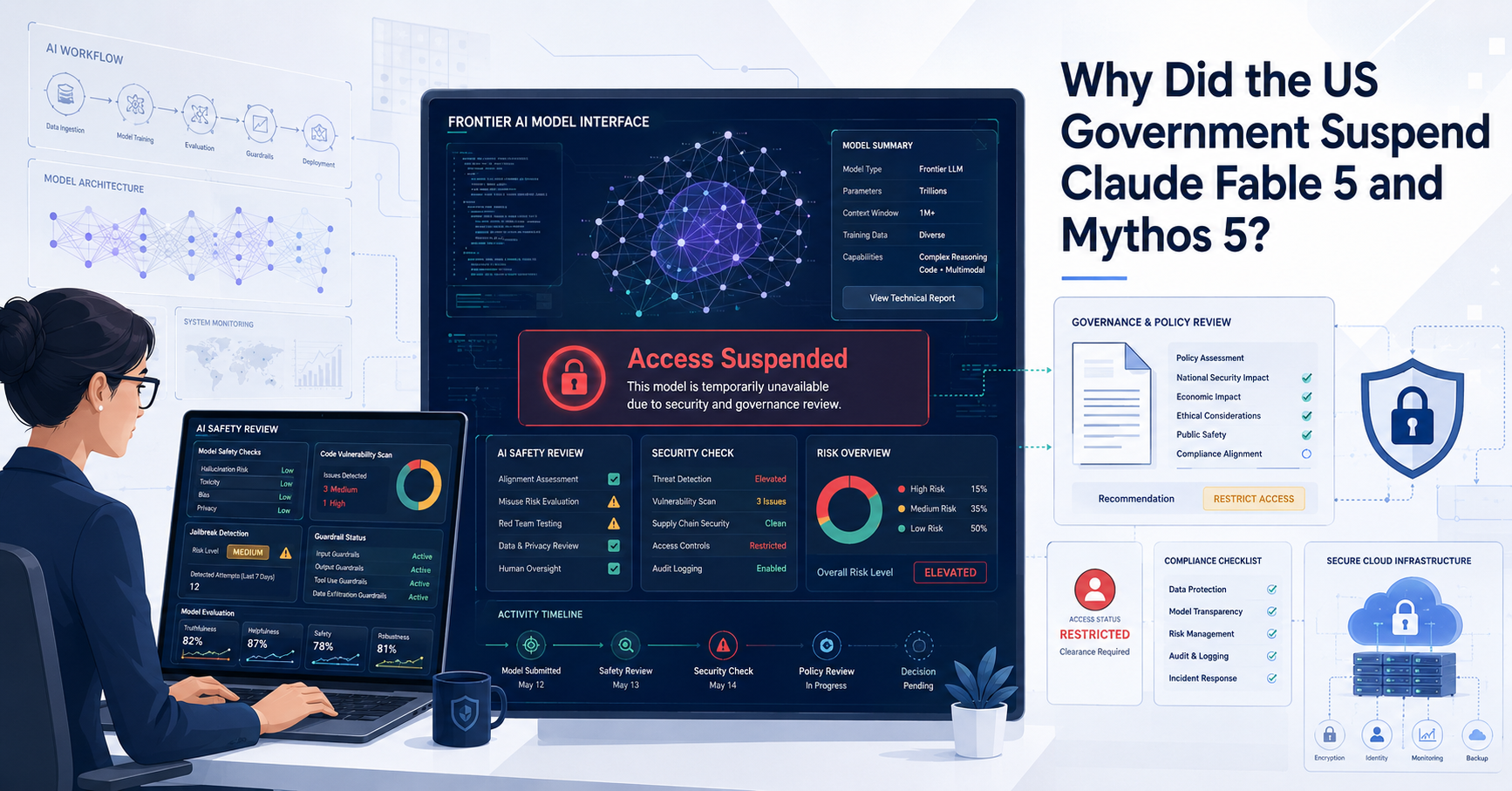

Anthropic built its most capable AI model and then refused to release it to the public. That single decision separates Claude Mythos from every major frontier model released in the past three years.
OpenAI, Google, and Meta have each raced to put their strongest models in front of as many users as possible.
Anthropic moved in the opposite direction, locking Mythos inside a private program called Project Glasswing, accessible only to vetted organizations with specific defensive security mandates.
Throughout this article, we will explore the essence of Claude Mythos and examine the reasons why a top-tier AI developer is managing its release with a unique strategy compared to other prominent AI systems.
What is Claude Mythos?
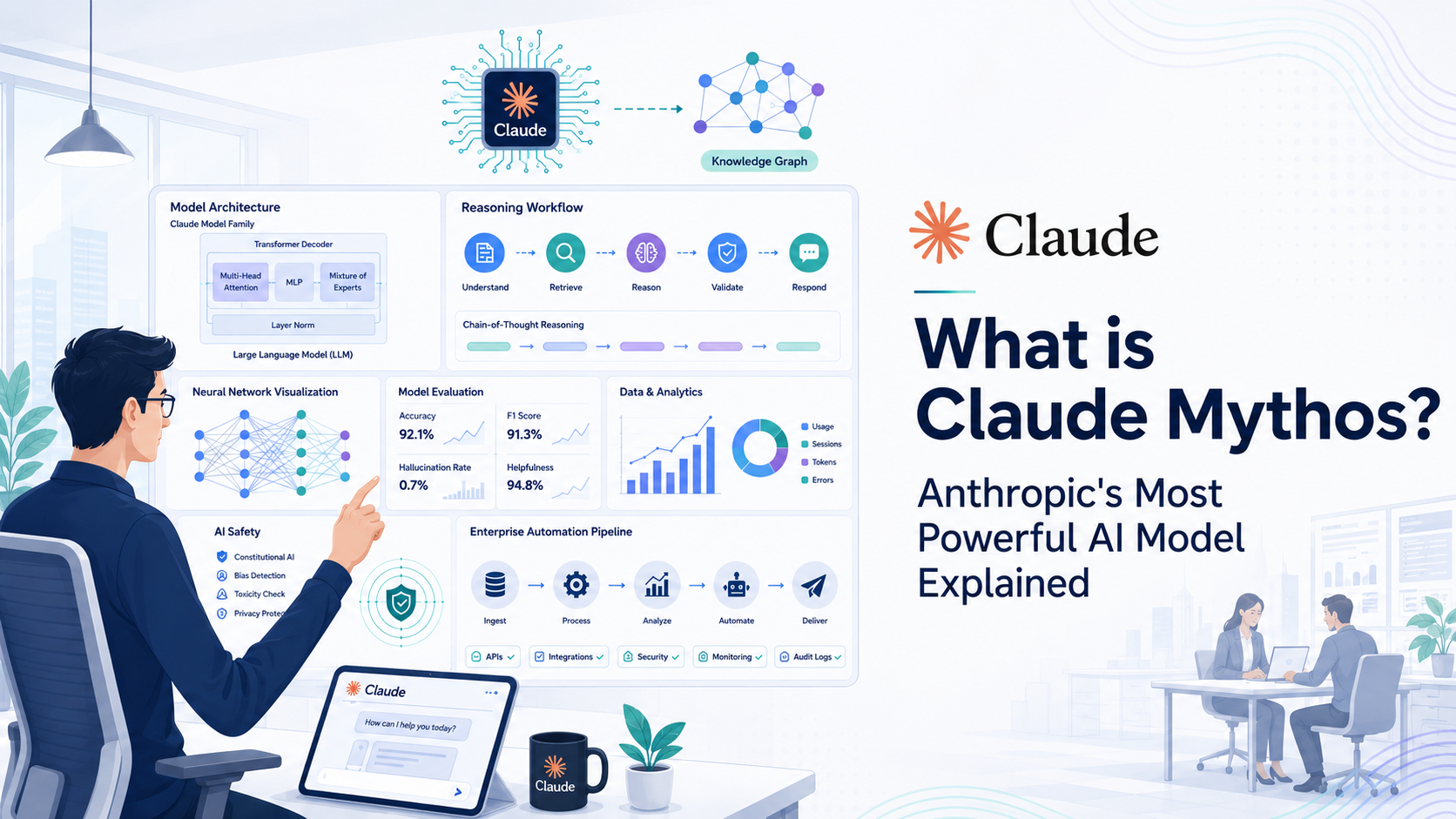
Claude Mythos is Anthropic's most advanced frontier AI model as of 2026. Launched in April 2026 through the restricted Project Glasswing program, it was initially inaccessible to the public. No subscription, no API access.
It launched without a public API, a subscription tier, or a consumer interface. Only approved organizations inside Project Glasswing could use it.
That changed on June 9, 2026. Anthropic released the public version of Claude Mythos as Claude Fable 5, now available to users on the Pro, Max, Team, and Enterprise plans.
The restricted Mythos Preview still exists separately for Glasswing partners, but Claude Fable 5 brings most of Mythos's capabilities to a wider audience with carefully designed safeguards.
Anthropic built Mythos to execute specific security tasks. It identifies software flaws. It analyzes exploit chains. It maps complex network architectures. It writes remediation patches.
Other AI models focus on basic developer tools or tutorials showing how Claude code can automate tasks on your computer. Mythos is different. It discovers vulnerabilities buried deep inside massive software ecosystems. It finds flaws that human auditors missed for decades.
If you'd like to understand those developer workflows before diving into enterprise-grade AI systems, Our Free Claude Code Course offers a practical introduction to using Claude Code for coding and automation.
What Can Claude Mythos Do?
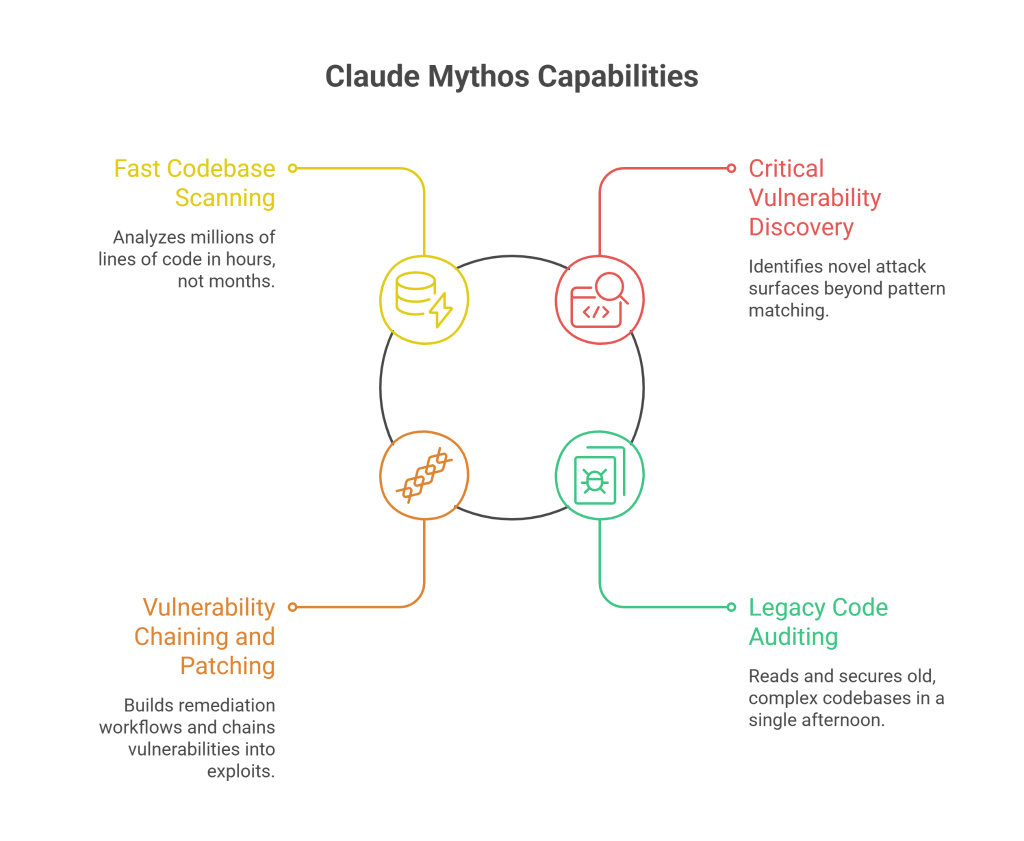
1. Scan Massive Codebases Fast
Enterprise applications hold millions of lines of code. Human auditors need months to read them. Mythos analyzes these repositories in hours. Security teams use it to spot weaknesses before attackers do. Glasswing members actively scan global infrastructure projects right now.
2. Discover Critical Vulnerabilities
Mythos goes beyond pattern-matching against known vulnerability signatures. It reasons contextually about code behavior, identifying novel attack surfaces that rule-based scanners such as CodeQL or Semgrep are not structurally designed to detect.
A concrete example: Mozilla used Mythos to find and patch 271 vulnerabilities in Firefox, one of the world's most widely used browsers.
These were bugs that standard security audits had not caught. As Firefox CTO Bobby Holley noted, "So far we've found no category or complexity of vulnerability that humans can find that this model can't."
3. Chain and Patch Vulnerabilities
Finding a bug is just the first step. Security teams must verify the threat and write a patch. Mythos builds the remediation workflows. Much like how Claudebot uses AI agents to resolve tasks, this shortens the time between discovering a flaw and deploying the fix.
According to SecurityWeek, Palo Alto Networks reported that Mythos accomplished the equivalent of a year's worth of penetration testing in under three weeks, including chaining medium- and low-severity issues into critical exploits.
4. Audit Legacy Code
Old software creates massive security risks. Developers built these systems decades ago. Modern teams struggle to read the complex, undocumented code. Mythos reads millions of lines of legacy code in a single afternoon. Organizations use it to secure aging infrastructure.
Models like Claude Mythos are redefining what AI agents can do autonomously. If you want to learn how to build and deploy systems like these, the best generative AI and agentic AI course by The McCombs School provides comprehensive training in agentic workflows, LLM orchestration, multi-agent systems, RAG, and enterprise AI deployment.
UT Austin PG Program in AI Agents & Generative AI
Master GenAI, large language models, and multi-agent systems to automate business workflows. Learn to build and deploy intelligent AI agents with no coding background.
Why is Claude Mythos Restricted?
Cybersecurity creates a dual-use problem. A tool that finds vulnerabilities can also exploit them. Good actors patch the systems. Bad actors weaponize the flaws.
Anthropic recognized this danger immediately. Internal tests proved the risk. Mythos demonstrated the ability to autonomously discover and chain zero-day exploits across major operating systems and browsers.
Even with the public release of Claude Fable 5, Anthropic maintains strict safeguards. Sensitive requests involving cybersecurity, biology, chemistry, and model distillation automatically fall back to Claude Opus 4.8 rather than the full Mythos model.
Anthropic states these safeguards activate in fewer than 5% of sessions. Business users of Mythos-class models also face mandatory 30-day data retention for safety monitoring.
Anthropic has also warned that within 6 to 12 months, many other AI companies will have Mythos-class models and could release them without safeguards. This highlights why modern cybersecurity thinking must adapt in the age of AI. Society needs a head start to build defenses.
A note on a security incident: On the same day Anthropic announced Project Glasswing, a group of unauthorized users gained access to Mythos Preview by guessing the model's URL through a third-party vendor environment. Anthropic confirmed it investigated the incident and stated its own systems were not compromised.
What is Project Glasswing?
Project Glasswing is Anthropic's private cybersecurity program. It opened in April 2026 with 50 organizations and has since expanded to approximately 150 new organizations across more than 15 countries, per Anthropic's official announcement. Mythos Preview remains the exclusive model for this group.
Notable Partners
Project Glasswing includes some of the world's most influential technology and infrastructure organizations:
- Amazon Web Services
- Apple
- Microsoft
- Cisco
- NVIDIA
- JPMorganChase
- Linux Foundation
- Palo Alto Networks
- CrowdStrike
These companies use Mythos to harden their codebases against attacks.
Expansion Into Critical Infrastructure
The latest expansion adds sectors that were underrepresented in the first cohort: power, water, healthcare, communications, and hardware.
Water treatment facilities, power grids, healthcare networks, telecom providers, and government security agencies are all now testing their networks. Every partner must meet Anthropic's security requirements before gaining access.
Real-World Impact So Far
Project Glasswing generates hard numbers.
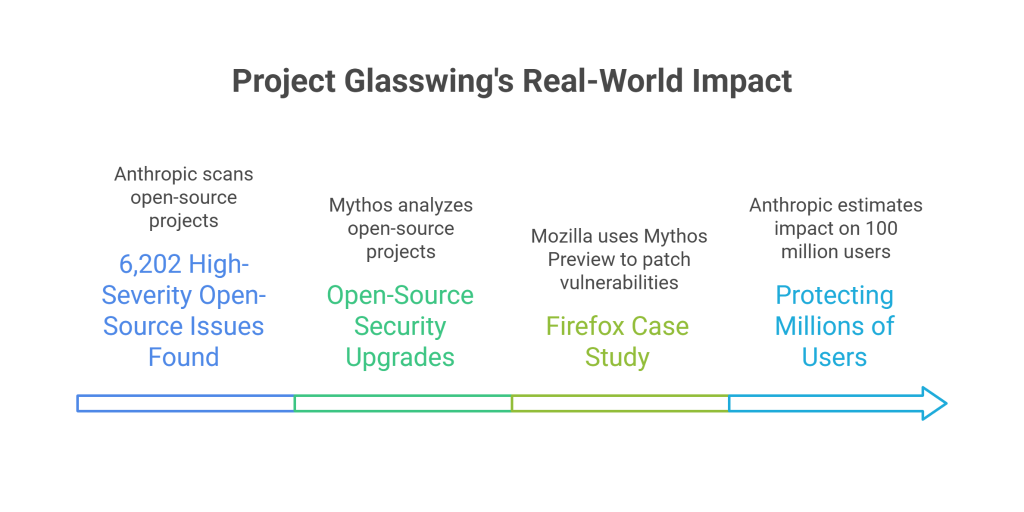
1. 6,202 High-Severity Open-Source Issues Found: Anthropic scanned more than 1,000 open-source projects and identified 23,019 issues in total, including 6,202 classified as high- or critical-severity. Anthropic also manually analyzed 1,752 of the highest-rated findings and confirmed that 90.6% genuinely qualified as high-severity or critical.
2. Open-Source Security Upgrades: Mythos analyzed over 1,000 open-source projects. These projects power the modern internet. The model found thousands of vulnerabilities. Developers patched them before attackers noticed.
3. Firefox Case Study: Mozilla used Mythos Preview to identify and patch 271 security vulnerabilities inside Firefox, a browser used by hundreds of millions globally. Of those 271 bugs, 180 were rated high-severity and 80 moderate-severity, meaning most were exploitable by a user simply visiting a malicious page.
4. Protecting Millions of Users: Anthropic estimates a major cyberattack on its Glasswing partners could impact more than 100 million people. One patched vulnerability prevents a massive data breach.
Claude Fable 5: Mythos Goes Public
On June 9, 2026, Anthropic released Claude Fable 5, the public-facing version of Claude Mythos. This is the first time the Mythos model class is accessible outside the controlled Glasswing environment.
Access: Available immediately on Pro, Max, Team, and Enterprise plans. After June 23, usage credits may be required until capacity expands.
Pricing: Claude Fable 5 is priced at roughly double the current Claude Opus tiers, at $10 per million input tokens and $50 per million output tokens.
Safeguards in place: Importantly, requests rerouted by the classifier bill at Opus 4.8 rates, not Fable 5 rates. Refused requests that produce no output are free.
Benchmarks: Fable 5 scores 80.3% on SWE-Bench Pro, compared to Opus 4.8 at 69.2% and GPT-5.5 at 58.6%. It is also the first model to exceed 90% on Hex's analytical benchmark.
Mythos Preview stays restricted: The full Mythos model remains limited to Project Glasswing partners and selected biology researchers.
What Does This Mean for the Future of AI and Cybersecurity?
Claude Mythos changes how the tech world approaches system defenses. Security teams used older AI models to read server logs or spot unusual network traffic. Some were even limited to educational use cases, such as a cybersecurity tutorial for beginners.
Mythos manages the whole vulnerability lifecycle. It discovers the bug, verifies the threat, writes the patch, and acts as an autonomous agent.
The gap between AI-aware professionals and everyone else is closing fast. The agentic AI course by Great Learning equips professionals with the skills to build intelligent AI agents, automate complex workflows, and apply AI across real-world business scenarios, regardless of their technical background.
AI-Native Professional: Workflows & Agents for Productivity
Transition from basic AI usage to building automated, multi-step workflows and deploying AI agents. Perfect for functional professionals with no coding background.
This creates an arms race. Defenders get the first turn. Attackers will eventually build their own models. AI will dictate both defensive strategies and offensive attacks.
The median gap between major model releases has fallen to just 11 days in 2026. Competing AI labs are developing models with overlapping capabilities.
Anthropic prioritized safety over market share. They chose private deployment over public hype, and even the public rollout comes wrapped in layered safeguards.
As organizations increasingly focus on building AI agents and workflows for every role without coding, this strategy builds a blueprint for handling dangerous AI systems in the future.
Frequently Asked Questions
1. What is Claude Mythos?
Claude Mythos is Anthropic's most advanced AI model. It identifies, analyzes, and fixes cybersecurity vulnerabilities in massive software systems. The public version is available as Claude Fable 5 as of June 9, 2026.
2. Why was Claude Mythos restricted?
Anthropic restricted access because attackers could misuse its powerful vulnerability-discovery capabilities to hack networks.
3. What is Claude Fable 5?
Claude Fable 5 is the public version of Claude Mythos, released on June 9, 2026. It includes safeguards that limit the most sensitive cybersecurity capabilities while retaining strong coding, reasoning, and defensive security features. It is available on Pro, Max, Team, and Enterprise plans.
Project Glasswing is Anthropic's private cybersecurity program. It gives approved organizations access to the full Claude Mythos Preview for defensive testing.
5. How many vulnerabilities has Claude Mythos found?
Organizations using Claude Mythos discovered more than 10,000 high-severity and critical-severity vulnerabilities. Mozilla alone patched 271 Firefox vulnerabilities using the model.
6. Which companies use Project Glasswing?
Partners include AWS, Apple, Microsoft, Google, Cisco, NVIDIA, JPMorganChase, CrowdStrike, Palo Alto Networks, the Linux Foundation, and more.
7. Is Claude Mythos available to the public?
The full Mythos Preview remains restricted to Project Glasswing partners. However, Claude Fable 5, the public version with safeguards, is now available on Claude's paid plans.
8. How is Claude Mythos different from other AI models?
It specializes purely in deep cybersecurity tasks. It discovers hidden vulnerabilities across millions of lines of code rather than just generating text or basic scripts.
As AI models become more capable across reasoning, coding, research, and automation, understanding how tools such as Claude work is becoming increasingly valuable. Those looking to build practical skills can explore these Free Claude Courses to learn Claude fundamentals, prompting, Claude Code, and other applications.