
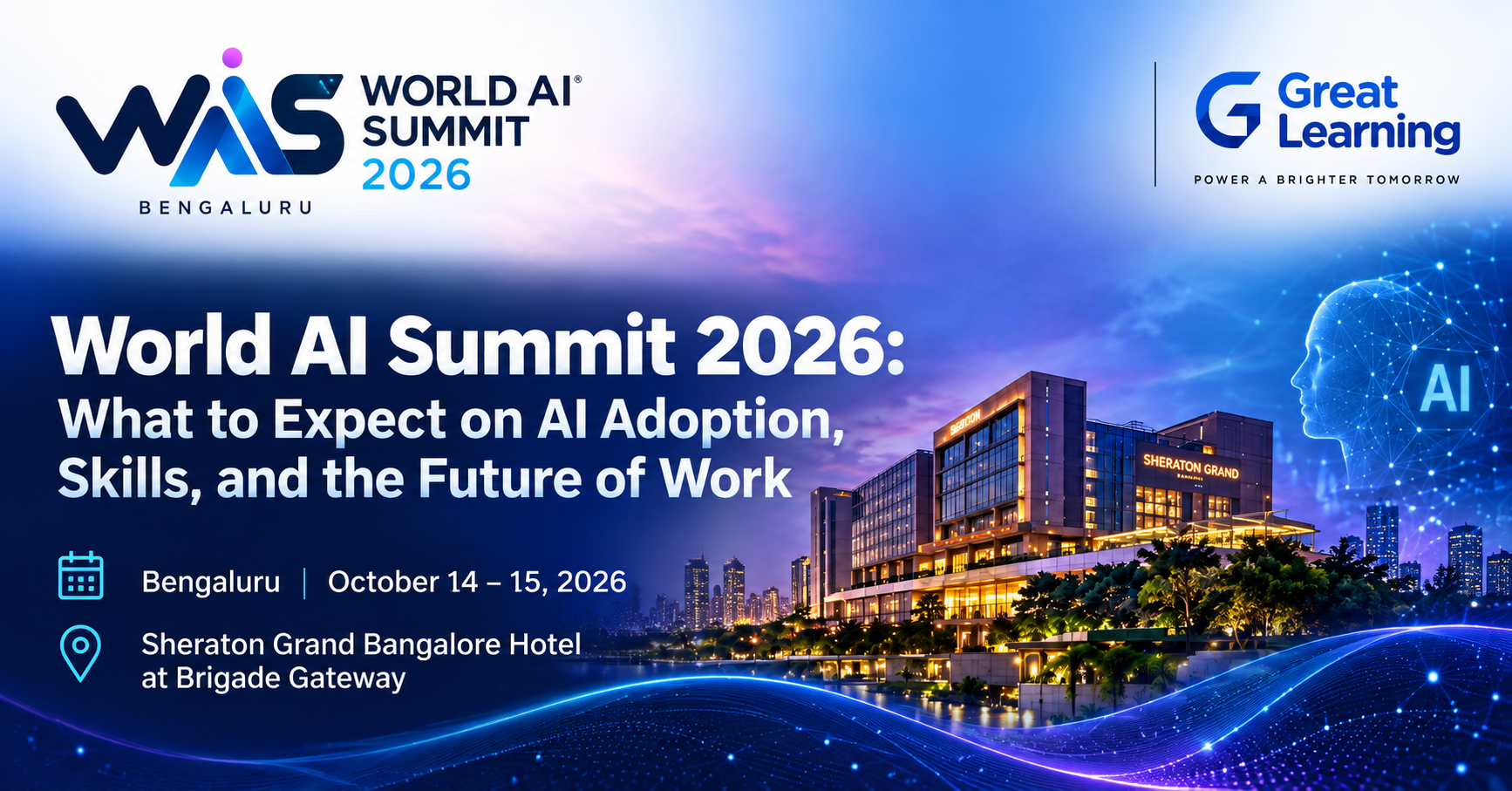
World AI Summit 2026 returns to Bengaluru on October 14–15 at the Sheraton Grand Bangalore Hotel at Brigade Gateway. The third edition brings together government, industry, research, and education to discuss AI development, responsible adoption, and practical applications.
Among the announced speakers is Dr. Pavankumar Gurazada, Associate Director, Academics, at Great Learning. His participation brings a learning and workforce perspective to an event covering enterprise AI, agents, infrastructure, and governance. For professionals following the summit, a central question is how to prepare for work involving greater collaboration with AI.
Updated October 12, 2026 | Pre-Event Coverage
What to Expect at World AI Summit 2026
World AI Summit 2026 will bring together AI leaders, policymakers, technology professionals, researchers, and startups to discuss AI adoption and its implications for businesses and society. The organizer advertises more than 100 speakers, over 1,000 delegates, and more than 50 startups across seven tracks.
The summit’s announced theme focuses on inclusive, responsible AI and India’s readiness for wider adoption. The summit spans advanced models and computing, national AI capabilities, enterprise deployment, global capability centers, agents and robotics, public-service applications, and startup investment.
This range brings related decisions into the same conversation. Choosing an AI system involves questions about cost and infrastructure. Introducing the system into a business requires decisions about workflows, employee preparation, data access, and accountability.
The announced lineup includes Sandeep Varaganti of JioMart, Sanjeev Gupta of the Karnataka Digital Economy Mission, and Tulshekar Gangireddy of JPMorgan Chase & Co. Their inclusion places business implementation and public-sector perspectives alongside the technology discussions. Readers should check the official speaker directory for lineup updates.
For attendees evaluating the summit's relevance, the key areas to watch are practical enterprise AI deployments, approaches to responsible AI governance, and examples of how organizations are preparing employees for AI-enabled workflows. Confirmed session titles, timings, and speaker details should be checked against the organizer's latest agenda.
Dr. Pavankumar Gurazada’s Focus on Learning and Workforce Preparation
The organizer’s speaker announcement connects Dr. Gurazada’s participation with AI-driven learning, emerging technology skills, workforce transformation, and preparing professionals for changing work requirements. These broad discussion areas place education within the practical challenge of AI adoption.
Pavankumar Gurazada's official speaker profile confirms his participation. As of October 12, the organizer has yet to publish a final session title, time, or hall.
Dr. Gurazada’s academic work includes designing and teaching programs in generative AI for business, agentic workflows, machine learning, and business analytics. He has teaching appointments at Northwestern University’s School of Professional Studies and the University of Arizona.
This background makes his participation relevant to professionals assessing what to learn and how to apply those skills. A person using AI to prepare a report still needs to check the evidence. A manager introducing an automated workflow needs to establish review points and ownership.
The learning question therefore extends beyond operating a tool. Professionals need practice defining tasks, evaluating results, recognizing limitations, and deciding when to intervene. His announced discussion areas provide a relevant setting for examining those needs.
For working professionals, this means developing more than prompt-writing skills. AI literacy also involves assessing the quality of generated content, checking evidence, understanding limitations, and knowing when human judgment is necessary. These capabilities can help employees apply AI more effectively within their existing roles.
Why AI Skills Are a Timely Workforce Issue
Recent research shows job requirements are changing alongside broader AI use. PwC’s 2026 Global AI Jobs Barometer, published in June, reports skill requirements in the most AI-exposed jobs are changing more than twice as fast as those in the least exposed jobs. The research analyzes more than one billion job advertisements across six continents.
The implication for professional learning is practical: training needs to connect with changing responsibilities. An employee learning to generate an answer also needs to learn how to judge the answer’s quality and determine whether the result supports a business decision.
For professionals seeking practice with workplace applications, Great Learning’s AI Agents Development course covers prompting, research, no-code automation, and agent workflows.
AI-Native Professional: Workflows & Agents for Productivity
Transition from basic AI usage to building automated, multi-step workflows and deploying AI agents. Perfect for functional professionals with no coding background.
Microsoft’s 2026 Work Trend Index surveyed 20,000 workers using AI across 10 countries. Among respondents, 50% identified quality control of AI output as a human skill growing in importance, while 46% identified critical thinking. These findings concern surveyed AI users, rather than the entire workforce.
The same report found 65% feared falling behind without adapting through AI, while 45% felt safer pursuing existing goals than redesigning their work with AI. The findings suggest a tension between pressure to change and the support employees need to experiment.
Taken together, these findings point to three practical priorities for workforce preparation: understanding where AI fits into a task, evaluating whether its output is reliable, and applying domain knowledge before acting on its recommendations. Employers can support these priorities through role-specific training, supervised experimentation, and clear policies for AI use.
From Learning AI Concepts to Operating Reliable Systems
Agentic AI adds another dimension to workforce readiness. In a June 2025 forecast, Gartner predicted more than 40% of agentic AI projects would be canceled by the end of 2027 because of rising costs, uncertain business value, or insufficient risk controls. The figure is a projection, rather than a measured failure rate.
The forecast adds context to the summit’s enterprise and workforce discussions. Building an agent is one stage of implementation. Teams also need to evaluate outputs, control permissions, monitor spending, and establish when human approval is necessary.
These responsibilities involve several roles. Engineers assess system behavior. Business teams define acceptable outcomes. Managers decide who approves consequential actions and who investigates failures. Learning needs to reflect those different responsibilities.
How These Questions Relate to Everyday Work
Consider a marketing professional using AI to summarize customer feedback. A useful review would check whether the summary reflects the source material, separates recurring concerns from isolated comments, and protects customer information.
An analyst using AI to explain a performance change faces a different test. A plausible explanation needs supporting data. The analyst must distinguish an observed relationship from an unsupported claim about its cause.
For an operations team, an agent processing invoices introduces questions about exceptions and approvals. Extracting information from a document differs from authorizing a payment. The workflow needs clear boundaries between those actions.
These examples show why technology, learning, and governance belong in the same discussion. They also provide a practical basis for evaluating summit presentations: look for a defined task, supporting evidence, acknowledged limitations, and lessons relevant to other teams.
What to Watch When the Summit Begins
For enterprise sessions, the most useful details will explain the original problem, the implementation process, and how results were assessed. For workforce discussions, watch for specific skills, learning methods, and examples of changing responsibilities.
Dr. Gurazada’s announced focus on AI-driven learning and workforce transformation is particularly relevant here. The interest lies in how professional learning prepares people to make sound decisions as AI becomes part of their work. Confirmed session details and insights will follow once available.
This page will carry verified updates through October 14–15, followed by the key takeaways for professionals and learning teams.