
- Grok 4.6 at a Glance
- What Is Grok 4.6 and What Makes It Different?
- Grok 4.6 Features for Long-Running AI Agents
- How Grok 4.6 Improves AI Coding and Software Development
- Grok 4.6 Benchmarks: How Does It Perform?
- Grok 4.6 vs Claude vs ChatGPT
- Which AI Model Is Best for Coding and AI Agents?
- What Grok 4.6 Means for Enterprise AI
- Challenges of Long-Running AI Agents
- How Professionals Can Prepare for the Agentic AI Shift
- Conclusion
- Frequently Asked Questions
The latest generation of AI models is increasingly designed to research information, write and test code, use tools, work across large projects, and complete multi-step tasks.
xAI's latest model, Grok 4.6, follows this shift with a particular focus on long-running agents, coding, knowledge work, and interactive applications.
xAI says the model can stay engaged across complex tasks such as researching a topic, analyzing information, working across a codebase, and turning an idea into a functional application or work artifact.
This makes the release particularly relevant to developers and businesses exploring AI agents. But Grok 4.6 is entering a highly competitive market that already includes advanced models from Anthropic and OpenAI.
So how does it compare with Claude and ChatGPT, and what does its release mean for the future of AI-powered software development?
Grok 4.6 at a Glance
| Specification | Official value |
| Release date | August 12, 2026 |
| API model ID | grok-4.6 |
| Context window | 500,000 tokens |
| Knowledge cutoff | February 1, 2026 |
| Input and output | Text and image input; text output |
| Reasoning levels | Low, medium, high by default, and xhigh |
| API interfaces | Responses and Chat Completions |
| Built-in tools | Function calling, web search, X search, and code execution |
| Base API price | $2 input, $0.50 cached input, and $6 output per million tokens |
Source: https://docs.x.ai/developers/grok-4-6
What Is Grok 4.6 and What Makes It Different?
Grok 4.6 is xAI's latest AI model, released on August 12, 2026, as an upgrade to Grok 4.5.
Rather than focusing only on conversational improvements, xAI has emphasized the model's ability to sustain work across many steps and handle more ambitious interactive and visual tasks.
The model is designed for tasks such as:
- Researching unfamiliar topics
- Analyzing complex information
- Working across software codebases
- Building applications from broad ideas
- Performing knowledge-work tasks
- Using agentic workflows
- Creating interactive and visual projects
- Testing and refining its own work
This reflects an important change in how frontier AI models are being developed. The goal is increasingly to create systems that can take a high-level objective and work toward a completed outcome rather than simply generate a response.
Grok 4.6 Features for Long-Running AI Agents
One of the most important aspects of the release is its focus on long-running AI agents.
A conventional chatbot typically follows a simple interaction:
Prompt → Response
An AI agent follows a more complicated workflow:
Goal → Planning → Tool Use → Execution → Evaluation → Correction → Completion
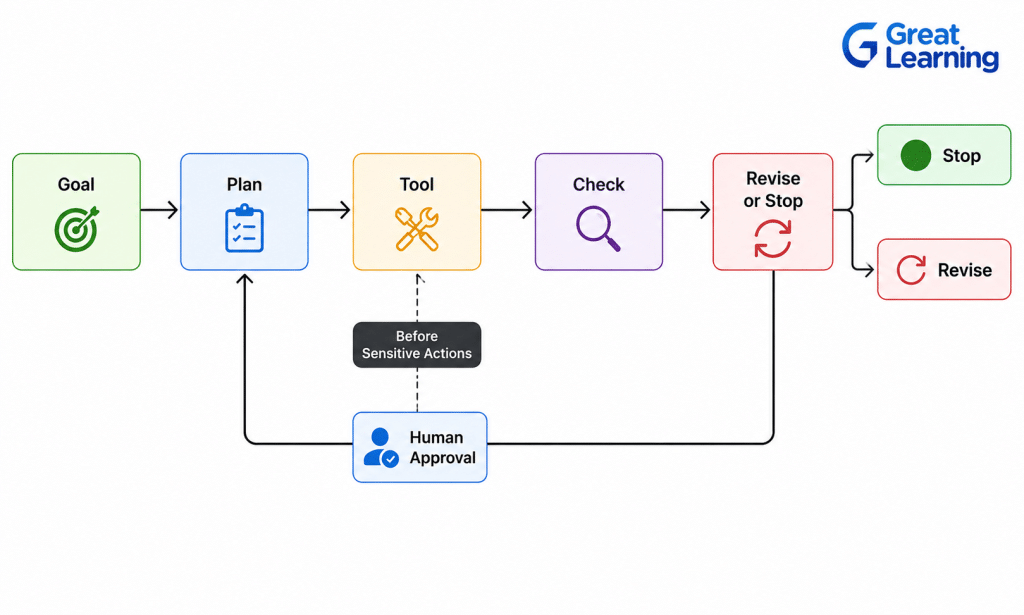
For example, a developer could ask an AI agent to build a web application. Instead of generating a code snippet and stopping, the system could research the requirements, structure the application, implement features, test the result, identify problems, and make additional changes.
xAI says Grok 4.6 was trained on a wide range of agentic reinforcement-learning tasks covering knowledge work, general coding, kernel optimization, web development, computer-aided design, and other domain-specific environments.
The company also reports that on longer trajectories, Grok 4.6 increasingly demonstrates self-testing and verification, allowing it to check its work before continuing.
This capability matters because reliability becomes harder as the number of steps in an AI workflow increases.
How Grok 4.6 Improves AI Coding and Software Development
AI coding has evolved from autocomplete tools to conversational programming assistants and, increasingly, autonomous coding agents.
Grok 4.6 is designed for this latest stage.
xAI says the model is particularly strong at turning broad product ideas into working first versions. It can research an unfamiliar domain, structure an application, implement core interactions, and refine the result through multiple rounds of feedback.
As AI moves from coding assistants to autonomous agents, understanding how to build, deploy, and manage AI systems is becoming increasingly valuable.
Explore this Artificial Intelligence Engineering course by JHU to develop practical skills in AI agents, Generative AI, MLOps, LLMOps, and production AI systems.
JHU Certificate Program in AI and Agentic AI Engineering
Designed for software developers, data and AI professionals seeking hands-on technical expertise in building, deploying, and scaling AI and Agentic AI systems using MLOps, LLMOps, and cloud platforms.
This approach changes the developer's role.
Instead of manually writing every component, developers can increasingly focus on:
- Defining requirements
- Reviewing architecture
- Setting constraints
- Evaluating generated code
- Testing outputs
- Managing security and reliability
- Making higher-level engineering decisions
The model is already available through Cursor and Grok Build, as well as the xAI API and platforms including OpenRouter, Vercel, and Cloudflare.
Explore the Agentic AI course by IIT Bombay to develop practical knowledge of agentic AI and prepare for the growing demand for professionals who can work with AI-driven systems.
IIT Bombay Certificate in Agentic AI
Master Agentic AI with IIT Bombay. Build dynamic, autonomous agentic systems and master multi-agent orchestration using LangGraph and CrewAI.
For organizations building AI-assisted development workflows, this ecosystem integration may be as important as the underlying model benchmarks.
Grok 4.6 Benchmarks: How Does It Perform?
Benchmark performance provides one way to evaluate a frontier model, although it should not be treated as a complete measure of real-world usefulness.
xAI reports that Grok 4.6 reaches frontier-level performance across several agentic coding and knowledge-work evaluations.
It also reports a score of 61 on the Artificial Analysis Intelligence Index, matching GPT-5.6 Sol in the company's published comparison.
The published results include:
| Benchmark | Grok 4.6 High | GPT-5.6 Sol Max | Claude Fable 5 Max |
| Artificial Analysis Intelligence Index | 61 | 61 | 62 |
| GDPVal-AA v2 | 1,753 | 1,728 | 1,741 |
| CursorBench v3.2 | 69.9% | 67.2% | 70.5% |
| DeepSWE v1.1 | 65.9% | 73% | 70% |
| FrontierCode v1.1 | 61.3% | 60.6% | 63.6% |
| APEX-Agents | 57.5% | 56.7% | 59.2% |
| Terminal-Bench v3.0 | 26% | 34.6% | 34.1% |
xAI notes that competitor figures are drawn from the respective developers' published system cards or benchmark leaderboards, while the table reports the best available results for each evaluation.
The results show why the current AI race cannot be reduced to a single winner. Grok 4.6 leads some evaluations, while GPT-5.6 Sol and Claude models lead others.
The more meaningful development is that multiple frontier models are now achieving strong performance on agentic coding and long-running workflows.
Grok 4.6 vs Claude vs ChatGPT
Grok 4.6 competes directly with Claude and ChatGPT across coding, reasoning, research, AI agents, and professional workflows.
Each model has different strengths, so the best choice depends on the task.
- Claude Opus 4.6: Focuses on agentic coding, large codebases, debugging, code review, research, and long-context tasks. It also supports features such as context compaction and agent teams in Claude Code.
- GPT-5.6: Takes a broader approach, covering coding, knowledge work, research, cybersecurity, science, computer use, and long-running professional workflows. Its multi-agent capabilities can coordinate multiple agents across complex tasks.
- Grok 4.6: Emphasizes long-running agents, coding, knowledge work, and building interactive applications from broad ideas.
Grok 4.6 vs Claude
Both models focus heavily on AI-assisted software development and agentic workflows.
- Claude: Particularly strong for large codebases, code review, debugging, and long-context reasoning.
- Grok 4.6: Particularly focused on autonomous task execution, coding, and turning ideas into functional applications.
The key difference is not simply which model generates better code, but how effectively it can handle an entire software-development workflow.
Grok 4.6 vs ChatGPT
Grok 4.6 and GPT-5.6 both target complex, multi-step tasks, but they're positioned differently.
- ChatGPT: Broader focus across coding, research, computer use, science, cybersecurity, and professional knowledge work.
- Grok 4.6: More strongly positioned around long-running agents, agentic coding, knowledge work, and interactive applications.
Ultimately, Grok 4.6, Claude, and ChatGPT are moving beyond simple chatbots toward AI systems that can plan, use tools, execute tasks, and evaluate their own work.
This makes the comparison more nuanced:
| Capability | Grok 4.6 | Claude | ChatGPT |
| Long-running agents | Strong focus | Strong | Strong |
| Agentic coding | Strong | Strong | Strong |
| Large codebases | Strong | Major strength | Strong |
| Long-context work | Strong | Major strength | Strong |
| Research | Strong | Strong | Strong |
| Computer use | Developing focus | Strong | Major focus |
| Application building | Major focus | Strong | Major focus |
| Knowledge work | Strong | Strong | Major focus |
| Multi-agent workflows | Agentic focus | Agent teams | Parallel multi-agent workflows |
| Visual/interactive work | Major focus | Strong | Major focus |
| API access | Yes | Yes | Yes |
The result is a three-way competition, with each platform having overlapping strengths rather than one universally dominant capability.
Which AI Model Is Best for Coding and AI Agents?
No single model is objectively best for every workload.
- For AI coding, Claude, ChatGPT, and Grok 4.6 are all targeting increasingly autonomous software-development workflows.
- For long-context reasoning, Claude remains highly competitive, particularly with its 1-million-token context capability in beta for Opus 4.6.
- For general professional knowledge work, GPT-5.6 Sol has a broad capability set covering research, coding, computer use, documents, presentations, spreadsheets, science, and design.
- For long-running agentic workflows and idea-to-application development, Grok 4.6 has made this a central part of its product positioning.
The practical choice should therefore depend on the task, not a single leaderboard.
What Grok 4.6 Means for Enterprise AI
The emergence of stronger agentic models has important implications for enterprise AI.
Businesses have traditionally used AI for relatively contained tasks such as:
- Text generation
- Summarization
- Classification
- Search
- Customer support
- Data extraction
- Basic analysis
Agentic AI expands the scope of automation.
An enterprise agent could potentially research a customer issue, retrieve information from internal systems, analyze relevant data, draft a response, update a business application, and escalate the task when human intervention is required.
The model is only one part of this architecture.
Enterprise AI agents also require:
- Secure tool access
- API integrations
- Data governance
- Identity and permissions
- Monitoring
- Evaluation
- Human oversight
- Error handling
- Cost controls
Better models make these systems more capable, but they do not remove the engineering and governance requirements needed to deploy them safely.
Challenges of Long-Running AI Agents
Long-running AI agents introduce several challenges that are less prominent in simple chatbot interactions:
- Reliability: Every additional step creates another opportunity for an agent to make a mistake. An incorrect early decision can affect everything that follows.
- Evaluation: A single-response benchmark cannot fully measure whether an agent completed a long workflow successfully. Organizations need task-level evaluations that measure both intermediate decisions and the quality of the final outcome.
- Security: Agents with access to APIs, repositories, databases, or business systems can take actions with real consequences. Strong permissions, access controls, and safeguards are therefore essential.
- Human Oversight: Not every task should be fully autonomous. High-impact business decisions may still require human review and approval.
- Cost and Latency: Long-running workflows can consume more computing resources than simple question-answer interactions. Model efficiency, caching, context management, and intelligent tool use are therefore increasingly important.
- Data and Privacy: Check retention, training use, regional processing, and gateway terms before sending proprietary code or business data.
How Professionals Can Prepare for the Agentic AI Shift
As AI models become more capable, professionals need to understand more than individual AI tools.
The emerging skill set includes:
- Generative AI fundamentals
- Large language models
- Prompt and context engineering
- AI agent architecture
- Tool and API integration
- Workflow automation
- Model evaluation
- AI application development
- Responsible AI
- Data and software engineering
Understanding these areas helps professionals move from simply using AI assistants to designing systems that can incorporate AI into real business and technical workflows.
Professionals interested in building these capabilities can explore Great Learning's artificial intelligence courses, which covers machine learning, generative AI, AI applications, and practical implementation.
Conclusion
Grok 4.6 marks another step toward AI systems that can handle extended, multi-step tasks. Its focus on AI agents, coding, knowledge work, and self-testing puts it in direct competition with Claude and ChatGPT.
While Grok 4.6, Claude, and GPT-5.6 have different strengths, all three are moving toward a common goal: AI systems that can plan, use tools, execute tasks, evaluate results, and deliver outcomes.
For developers and business professionals, understanding how these AI agents work may matter more than simply knowing which model ranks highest on a benchmark.
Frequently Asked Questions
1. What is Grok 4.6?
Grok 4.6 is xAI's latest AI model, released in August 2026 with a focus on long-running agents, coding, knowledge work, and interactive and visual applications.
2. What are the key Grok 4.6 features?
Key capabilities include long-running agentic workflows, coding, knowledge work, self-testing and verification, application development, and interactive and visual tasks.
3. What are Grok 4.6's main limitations?
Benchmarks do not represent every repository, tool setup, or workflow. Long agent runs still need tests, limited permissions, logs, cost controls, and human approval for high-impact actions.
4. How does Grok 4.6 compare with Claude?
Grok 4.6 and Claude are both designed for advanced coding and agentic workflows. Grok emphasizes long-running agents and idea-to-application development, while Claude has particularly strong capabilities in coding, large codebases, long-context reasoning, and extended agentic tasks.
5. How does Grok 4.6 compare with ChatGPT?
Grok 4.6 and GPT-5.6 both target complex, multi-step workflows. Grok emphasizes agentic coding and long-running tasks, while GPT-5.6 has a broader focus spanning coding, research, computer use, knowledge work, science, cybersecurity, and design.
6. Is Grok 4.6 better than ChatGPT or Claude?
There is no universal winner. Performance varies by task and benchmark. Grok 4.6, Claude, and GPT-5.6 each have strong capabilities in coding, reasoning, research, and agentic workflows, so the best choice depends on the specific workload.
7. Where can developers use Grok 4.6?
Grok 4.6 is available through Cursor, Grok Build, the xAI API, and partner platforms including OpenRouter, Vercel, and Cloudflare. xAI lists API pricing starting at $2 per million input tokens and $6 per million output tokens.
8. Why are AI agents becoming important?
AI agents can execute multi-step workflows instead of simply responding to individual prompts. This makes them potentially useful for software development, research, data analysis, business automation, and other tasks that require multiple connected actions to complete an objective.