phone iconSpeak with our expert +1 947 245 0986

Trusted by millions of learners

Learn more about the course

Get details on syllabus, projects, tools, and more

Program Not Found

Sorry, this content is currently not available
in your region

Continue to check out similar courses available to you

EXPLORE COURSES
Name
Email
Mobile Number

By submitting this form, you consent to our Terms of Use & Privacy Policy and consent to be contacted via email, phone (including by AI-generated/pre-recorded voice calls), SMS, or WhatsApp.

DBA in General Management

DBA in General Management

Application closes 25th Aug 2026

Program Outcomes

Elevate executive leadership and influence

On successfully completing this program, you will:

  • Drive innovation through long-term strategies aligned with organisational goals in global markets.

  • Use advanced research and AI to solve complex business challenges and guide decisions.

  • Lead organisational change, manage resistance, and engage teams to drive continuous improvement.

  • Navigate global markets and lead culturally diverse teams to achieve international business growth.

  • Turn ideas into viable business models, create business plans, and understand global entrepreneurship.

Global Rankings

  • Ranked #1 among Top 10 Online DBA Degrees of 2024

    Ranked #1 among Top 10 Online DBA Degrees of 2024

    Forbes

  • Top Tier 1 ranking for DBA

    Top Tier 1 ranking for DBA

    Global DBA Ranking by CEO Magazine

  • Accredited by the HLC

    Accredited by the HLC

    Accreditation agency recognized by US Dept. Edu.

Key program highlights

Why choose the DBA in General Management

  • List icon

    Top ranked DBA by Forbes

    Ranked #1 in Forbes’ list of the best online DBA degrees of 2024

  • List icon

    Hands-on projects followed by thesis

    Work on numerous real world projects followed by capstone projects and a final dissertation with dedicated guidance from top faculty and industry experts.

  • List icon

    WES recognized and HLC accredited

    Ensures global acceptance and enhances career and academic opportunities.

  • List icon

    Alumni status from Walsh College

    Earn alumni status from Walsh College upon program completion.

  • List icon

    Expert mentorship and support

    Learn from top faculty and leading industry practitioners

  • List icon

    Powerful Global Network

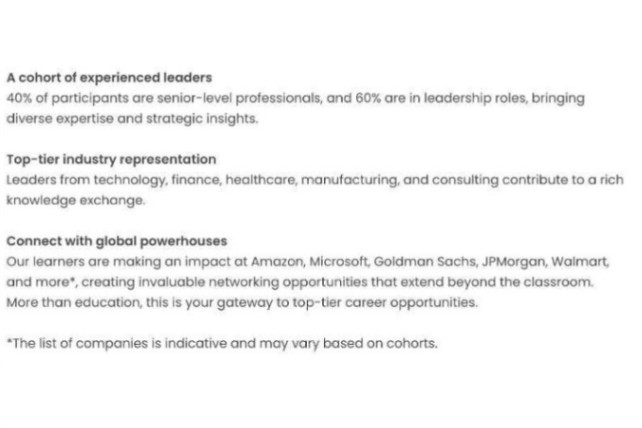
    Network with professionals from leading firms like Amazon, Microsoft, and JPMorgan, and unlock career opportunities beyond the classrooms.

Skills you will learn

Business Analytics

Information Systems Management

Organizational Leadership

Change Management

Crisis Management and Resilience

Strategic Decision-Making

Entrepreneurship

Effective Communication

Advanced Research Methods

Machine Learning

Business Finance

Managerial Economics

Operations and Marketing

Cybersecurity

Business Analytics

Information Systems Management

Organizational Leadership

Change Management

Crisis Management and Resilience

Strategic Decision-Making

Entrepreneurship

Effective Communication

Advanced Research Methods

Machine Learning

Business Finance

Managerial Economics

Operations and Marketing

Cybersecurity

view more

  • Overview
  • Learning Journey
  • Curriculum
  • Certificate
  • Faculty
  • Career Support
  • Fees
  • FAQ

This program is ideal for

DBA in General Management (STEM MBA + DBA) empowers leaders to drive innovation and create research-led impact

View Batch Profile

  • Experienced professionals

    Ideal for executives, managers and entrepreneurs seeking to enhance their expertise in business strategy, leadership and management.

  • Career advancement seekers

    Suited for individuals aiming to advance into higher leadership roles or transition into new career opportunities.

  • Aspiring leaders and academics

    Designed for professionals aiming to advance in people management, organisational leadership, and data-driven decision-making roles.

  • CTOs and tech leaders

    Designed for future technology leaders to master business strategies and innovate to drive global digital transformation.

Learn with self-paced videos

Our pedagogy is designed to ensure career growth and transformation

  • banner-image

    Learn with self-paced videos

    Learn critical concepts from video lectures by faculty

  • banner-image

    Engage with your mentors

    Clarify your doubts and gain practical skills during the weekend mentorship sessions

  • banner-image

    Work on hands-on projects

    Work on projects to apply the concepts & tools learnt in the module

  • banner-image

    Get personalized assistance

    Our dedicated program managers will support you whenever you need

Year 1

EFFECTIVE COMMUNICATION

The effective communication course seeks to equip learners with public speaking and presentation skills. It focuses on helping learners refine their communication skills to express their thoughts and ideas with clarity and impact. They will sharpen their interpersonal skills in both oral and written communication to think critically, develop structured content and present effectively. The course also tries to further strengthen skills in creating effective documents that may be read in absentia, such as reports and proposals.

MARKETING MANAGEMENT

As an introductory course, marketing management will highlight the role of marketing in today’s organizations. It demonstrates how marketing is leveraged to achieve corporate objectives by analyzing market environments, consumer behavior and segmentation, targeting, and positioning strategies. This course embarks on the task of building value propositions around the marketing mix elements of product, price, place, and promotion. The focus is on how these elements converge in the evolution and design of marketing strategies aimed at creating a competitive advantage for the marketer, including an examination of digital and service marketing strategies.

DATA ANALYSIS FOR DECISION-MAKING

Problems in business contain significant quantitative elements in the form of facts and figures. Managers must conduct data analysis and interpretation for effective decision-making. In this context, preparing quantitative arguments to justify decisions is crucial. This course focuses on statistical methods to accomplish this. Learners learn to collect, analyze, and interpret data accurately. Through datasets and case studies, the process of deriving meaningful insights from data and presenting it visually to others is demonstrated. The course introduces concepts and methods of statistics, including variability, randomness, and distributions.

ORGANIZATIONAL BEHAVIOR AND HR

This social science course provides the student with the tools to understand and evaluate individual, group, and organizational processes. The learners will also gain an appreciation of the relevance of the study of organizational behavior to the practice of human resource management. This course will help them develop an understanding of how and why people behave in an organization, and emphasize the manager’s role in nurturing and maintaining positive and successful organizational behavior within their department, division, or organization.

MANAGEMENT AND FINANCIAL ACCOUNTING

This course fosters a robust conceptual grasp of financial statements and diverse cost management approaches, enabling learners to enhance business decisions. Topics covered include accounting basics, financial statement types and applications, consolidated financial statements, various financial analysis techniques, ratio analysis for performance evaluation, real-life standardized financial statement analysis, and industry-specific examples. Learners delve into cost components, their significance, informed costing and managerial decisions, budgeting components, operational control tools, and strategic cost management. Through a comprehensive curriculum, learners acquire a profound understanding of financial aspects and cost management strategies, empowering them to make informed and effective business choices.

STRATEGIC MANAGEMENT

This course focuses on cultivating a robust conceptual grasp of strategy management for adept business decision-making. It covers the strategic management process, adapting to changing business environments, fundamental principles, and tools. Learners analyze real-world strategy creation and implementation experiences, competition using internal and external analyses, case comprehension and presentation, strategic company analysis, and defending organizational strategic positions. Upon completion, learners gain comprehensive insights into strategic management’s intricacies, equipping them to navigate complex business landscapes effectively and make informed strategic decisions.

MANAGERIAL ECONOMICS

This course equips learners with a robust grasp of economic theory and decision science tools to tackle intricate business choices within functional domains like marketing, finance, and human resources. Learners will delve into factors shaping demand and supply, comprehend consumer behavior’s utility maximization, optimize production within input limitations, assess cost dynamics over time, and discern firm pricing and production decisions amid competition. The curriculum covers key economic indicators, the money flow cycle, and GDP drivers: private consumption, investments, and government spending. Additionally, learners will grasp the utilization of fiscal and monetary instruments to stimulate economies and the factors steering a nation’s external transactions.

OPERATIONS AND SUPPLY CHAIN MANAGEMENT

This course focuses on cultivating a robust grasp of operations and supply chain management for adept business decision-making. It covers India’s GDP impact, operations management’s relevance, operational strategies, capacity planning, layout, and scheduling. Additionally, it delves into supply chain management essentials, evolution, demand forecasting techniques, procurement, sourcing, inventory management, logistics management’s significance, supply chain drivers, performance measurement, and recent trends. Learners will comprehend these aspects to navigate complex business challenges effectively. Through this comprehensive curriculum, learners will emerge equipped with a thorough understanding of operations and supply chain management and its pivotal role in modern business landscapes.

BUSINESS FINANCE

This course provides a comprehensive understanding of business finance, focusing on effective decision-making. It covers financial tools, capital budgeting, NPV, IRR, cash flow estimation, working capital, expected returns, security markets, capital structure, dividends, project financing, and company valuation. Learners acquire skills to evaluate finance options, make astute capital decisions, calculate present value, and analyze investment returns. They explore securities sales, debentures, institutional roles, and capital structure determinants. The curriculum delves into dividend policies, project financing techniques, and methods for valuing companies. Upon completion, learners will have a robust knowledge of financial aspects crucial for strategic business choices.

ENTREPRENEURSHIP AND INNOVATION

This course caters to individuals aiming to cultivate entrepreneurial skills and business acumen. It teaches problem framing, solution crafting, and idea transformation into a viable business foundation. Learners gain tools for successful business initiation and growth, learning via case study immersion. Fostering an entrepreneurial mindset, the curriculum emphasizes entrepreneurship’s global economic impact. Specific objectives include grasping business setup, creating a comprehensive business plan from the model canvas, understanding value dynamics in the modern economy, and mastering startup launch processes, from ideation to market entry, potential exit, or IPO. Upon completion, learners will have a robust entrepreneurial toolkit and operational knowledge.

DATA VISUALIZATION

This course is designed to cultivate a strong proficiency in data visualization, focusing on several key objectives. Learners will gain an in-depth understanding of how the brain perceives data and derives insights from it. They will learn to identify meaningful visual characteristics within datasets and make informed choices about appropriate display mechanisms to effectively communicate data. Moreover, the course will empower learners to transform raw data into actionable information that can guide decision-making. Practical application of Tableau software will be a central component, allowing learners to solve real-world business problems using their newly-learnt skills. This comprehensive curriculum aims to enhance learners’ ability to interpret data perceptively, communicate effectively through visualization, and harness data for practical decision-making across diverse industries.

BUSINESS ANALYTICS

Learners perform basic operations related to data analysis, learn how to read, explore and visualize data and work with data frames and different Pandas Libraries. They will be able to recognize why time series data requires special techniques for analysis. They will describe the components of a time series, identify and estimate these components, and learn to apply simple methods for time series forecasting.

MACHINE LEARNING

This course empowers learners to navigate the intricacies of machine learning through a comprehensive and application-driven approach. Experience a practical, hands-on course centered around applying machine learning using KNIME. Gain proficiency in constructing and interpreting diverse machine learning models. Explore key concepts, build models within KNIME, tackle regression and classification challenges, grasp both parametric and non-parametric algorithms, delve into clustering and association rules, text mining intricacies, and master model validation techniques.

CAPSTONE PROJECT

Learners will be exposed to end-to-end problem solving using a combination of tools and techniques in analytics and learn the practical implementation of various analytical techniques, while choosing the one which gives the most appropriate results for decision-making in business. They will understand the trade-offs that need to be made when solving a problem in real life. Additionally, they will develop better presentation and report writing skills.

Year 2

LEGAL ESSENTIALS FOR BUSINESS SUCCESS

This course is a comprehensive overview of the legal environment of business. Learners understand the basics of American and International law. Topics include constitutional and administrative law, contracts, commercial transactions, employment law and other governmental regulations, environmental protection and property. Learners will also discuss the formation of business organizations for conducting both domestic and international business.

PART I: ORGANIZATIONAL RESILIENCE FRAMEWORK

Successful firms prepare for adversity by being proactive and flexible in the face of a crisis. This course introduces scholars to the importance of building resiliency, methodology, and business readiness into today’s modern organizations. Emphasis is placed on the need to anticipate, prepare for, react to, and adapt to both sudden and incremental changes. Leaders must be equipped to resist failure while simultaneously positioning their organization to respond strategically and methodically to disruptions or disasters.

SPECIALIZATIONS : BUSINESS ANALYTICS

PART II: ORGANIZATIONAL RESILIENCE FRAMEWORK Organizational resilience prepares the enterprise to endure difficult or challenging times. Leadership is integral in ensuring a company’s resilience because ultimately, responsibility falls squarely on the shoulders of the leader. Flexibility, integrity, problem solving, crisis management, and identifying opportunities fall squarely on the humans within the organization and the individual(s) who lead them. PRINCIPLES OF DATA ANALYTICS This course provides an overview of the knowledge that learners after successfully completing the MSDA degree curriculum. Each weekly session’s materials focus on one aspect of data analytics. The course acts as a roadmap with respect to an overview of the data analytic skill sets that learners need to earn an MBA degree. PRESCRIPTIVE ANALYTICS This course exposes the student to prescriptive analytics. It is used as a method in identifying competitive advantages in the enterprise by identifying the optimal solution. The learners will learn how prescriptive analytics is used in Business Analytics and decision-making. They will explore optimal decision-making models to identify optimal solutions. Topics such as simulation modeling and multi-criteria decision-making are introduced. They will also work on transforming findings into actionable next steps in effective decision-making using prescriptive analytic techniques.

SPECIALIZATIONS : INFORMATION SYSTEMS MANAGEMENT

PART II: ORGANIZATIONAL RESILIENCE FRAMEWORK Organizational resilience prepares the enterprise to endure difficult or challenging times. Leadership is integral in ensuring a company’s resilience because ultimately, responsibility falls squarely on the shoulders of the leader. Flexibility, integrity, problem solving, crisis management, and identifying opportunities fall squarely on the humans within the organization and the individual(s) who lead them.   FUNDAMENTALS OF CYBERSECURITY An exploration of the components of a comprehensive information systems security infrastructure. These include critical areas such as planning and administration of security, the security program, access control and network security measures, Internet and e-commerce security issues, physical protection of computing facilities, and the legal and regulatory aspects of information security. Learners will learn how to protect an organization from computer crime and potentially malicious behavior, and to ensure confidentiality, availability and data integrity through several hands-on case studies. Learners will review the eight domains of ISC2 CISSP.   GOVERNANCE, RISK AND COMPLIANCE This course examines the triad of Governance, Risk and Compliance (GRC) as an essential framework for the management of information technology with business. Governance describes the overall management approach through which senior executives direct and control the entire organization. IT governance is part of overall governance and focused on the best use of technology to support business goals. Risk management comprises a set of processes, tools and techniques to assist the organization in identifying and prioritizing its key assets, identifying risks, qualitatively and quantitatively assessing those risks, and determining mitigation strategies. Compliance refers to the responsibility of organizations and their technology departments to comply with internal and external requirements.

Year 3

RESEARCH AND METHODS COURSES

• Research Methods: Introduction and Scope • Qualitative and Exploratory Research Methods • Quantitative Research Methods I: Data Management and Non-experimental • Quantitative Research Methods II: Experimental and Statistical

RESIDENCY COURSES

• Doctoral Residency I • Doctoral Residency II • Doctoral Residency III

DISSERTATION COURSES

• Dissertation I - Chapter 1 • Dissertation II – Chapter 2 • Dissertation III – Chapter 3 • Dissertation IV- Chapter 4 • Dissertation V – Chapter 5

Note: The curriculum listed above are indicative and subject to updates as technology evolves.

Get certificates from the world's leading institutions

Earn Doctoral and Master's Degrees from the World's Leading Institution

  • thumbs-up

    Earn a World-Class Doctorate

    Benefit from HLC accreditation and WES recognition, enhancing the credibility and international acceptance of your qualification.

  • thumbs-up

    Prestigious Credentials

    Earn Doctoral and Master's Degrees from the World's Leading Institution.

  • thumbs-up

    Lifetime Alumni Status

    Gain full alumni status from Walsh College and join an elite network of AI consultants, C-suite leaders and entrepreneurs.

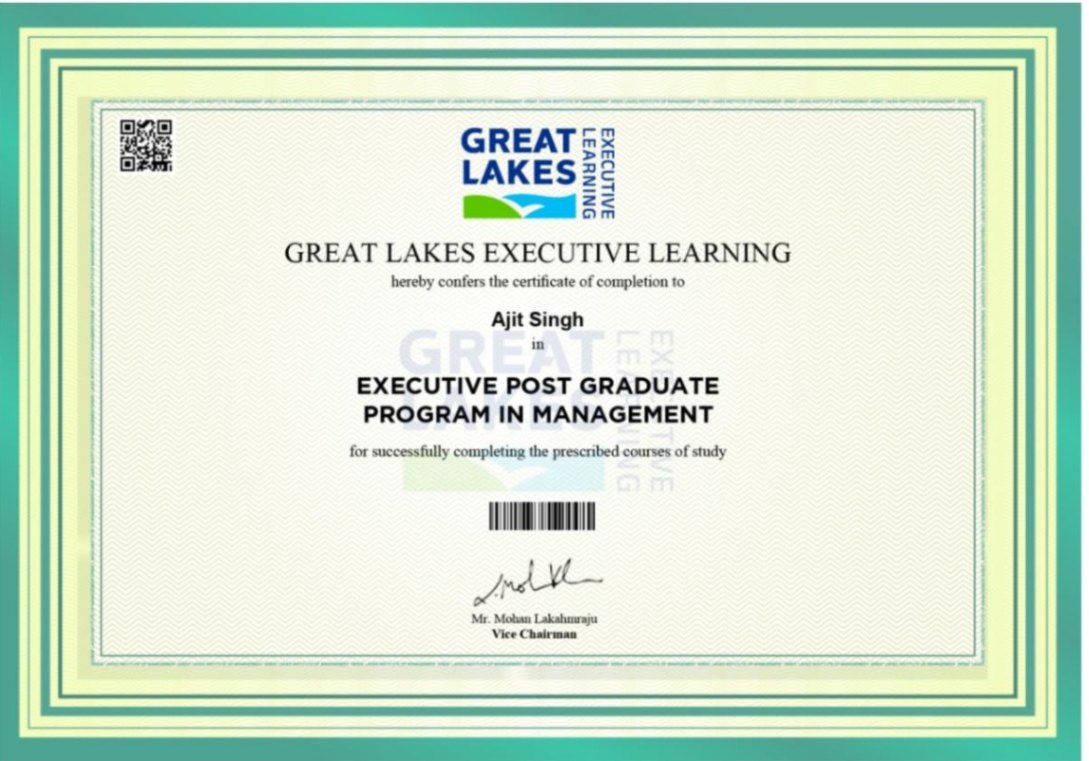
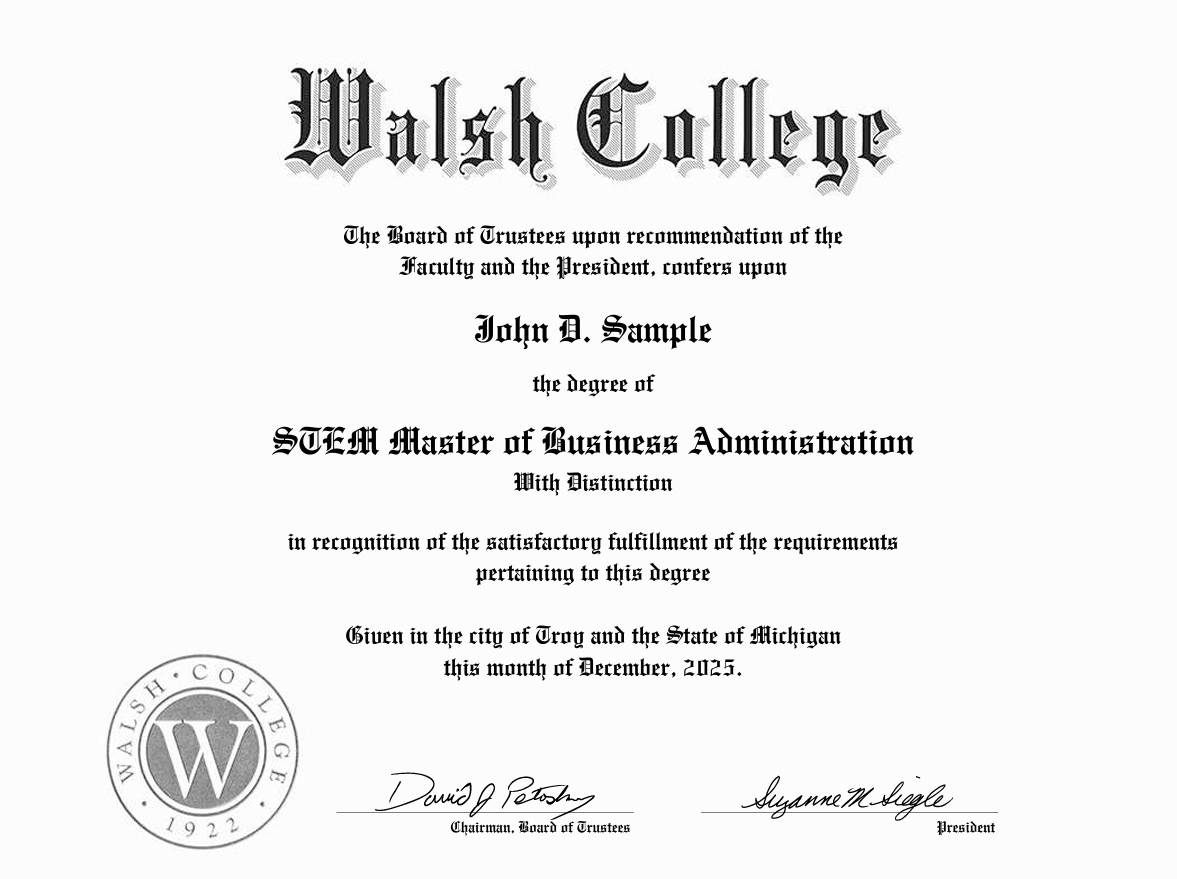
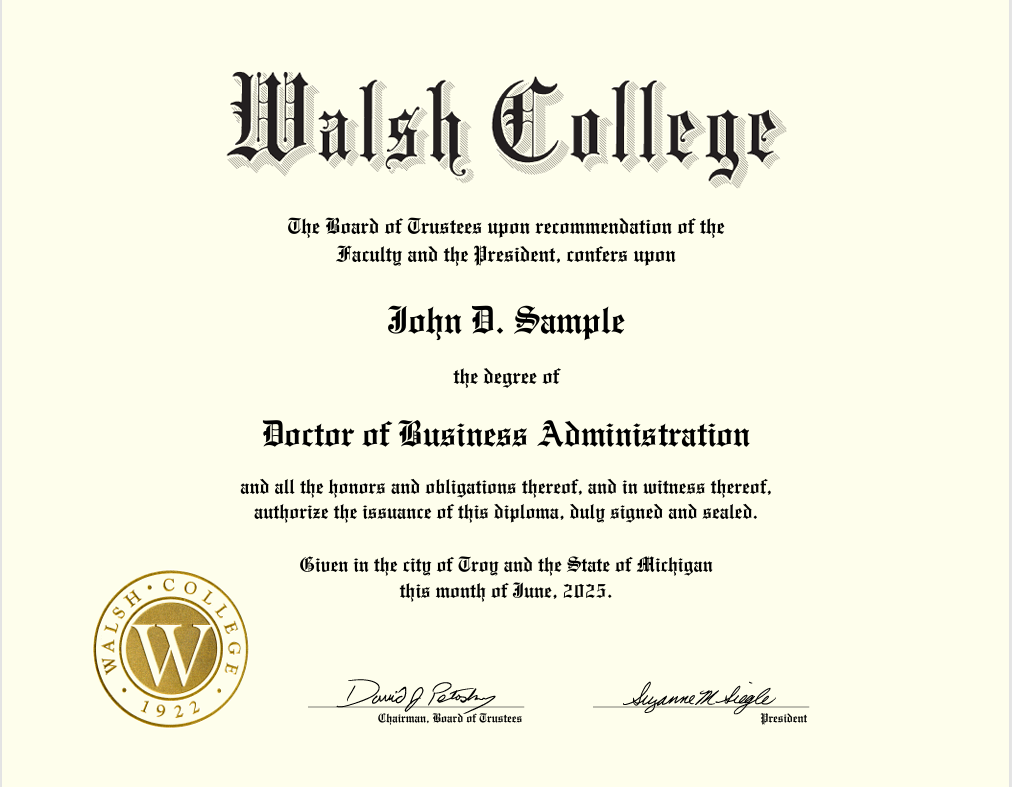
  • certificate image 0
  • certificate image 1
  • certificate image 2

* Image for illustration only. Certificate subject to change.

  • Terri Richards

    Terri Richards

    PhD, Faculty Chair of Marketing and Management Programs
    Doctoral Program Director

    Know More
    Company Logo
  • Dr. D. Stuart MCCubbrey

    Dr. D. Stuart MCCubbrey

    Director - IT Data Privacy & Regulatory Compliance at General Motors

    Know More
    Company Logo
  • Javad Katibai

    Javad Katibai

    Chassis System Architect - General Motors

    Know More
    Company Logo
  • Steven Harms

    Steven Harms

    Adjunct Professor - Business Law Department

    Know More
    Company Logo
  • James Gerrity

    James Gerrity

    PhD, Adjunct Associate Professor

    Know More
    Company Logo

Get industry ready with dedicated career support

  • banner-image

    1:1 mentorship from industry experts

    Get 1:1 career mentorship from our industry experts to prepare for jobs in AI and ML

  • banner-image

    Interview prep with experts

    Participate in mock interviews and access our tips & hacks on the latest interview questions of top companies

  • banner-image

    Resume & profile review

    Get your resume/cv and LinkedIn profile reviewed by our experts to highlight your AI & ML skills & projects

  • banner-image

    Access to Great Learning Job Board

    Apply directly to top opportunities from leading companies with Great Learning Job Board

Course Fees

The course fee is USD 12,000

Invest in your career

  • benifits-icon

    Earn a ‘Dr.’ title & get recognized as a specialist in your field

  • benifits-icon

    Gain alumni status from Walsh College upon program completion

  • benifits-icon

    Master business strategy (with STEM MBA + DBA) to solve complex, data-driven business problems

  • benifits-icon

    Benefit from HLC accreditation and WES recognition

Take the next step

timer
00 : 00 : 00

Apply to the program now or schedule a call with a program advisor

Unlock exclusive course sneak peek

Application Closes: 25th Aug 2026

Application Closes: 25th Aug 2026

Talk to our advisor for offers & course details

Application process

Our admissions close once the requisite number of participants enroll for the upcoming batch . Apply early to secure your seats.

  • steps icon

    1. Fill the application form

    Apply by filling a simple online application form.

  • steps icon

    2. Interview Process

    Go through a screening call with the Admission Director’s office.

  • steps icon

    3. Join program

    An offer letter will be rolled out to the select few candidates. Secure your seat by paying the admission fee.

Eligibility

  • Applicants must hold a 3 or 4-year bachelor’s degree or equivalent in any discipline with a minimum of 60% marks from a UGC-recognized university or institution. The medium of instruction must be in English.
  • No GRE/GMAT or any English proficiency test scores are required.

Got more questions? Talk to us

Connect with our advisors and get your queries resolved

Speak with our expert +1 947 245 0986 or email to walsh-mbadba@mygreatlearning.com

career guidance

Frequently asked questions

Program Details
Program Details

What is the duration of the DBA in General Management program?

The program is designed to be completed in 3 years with a 100% online learning format, offering flexibility for working professionals.

Do I need GRE, GMAT, or TOEFL scores to apply?

No, the application process is simple and does not require GRE, GMAT, or TOEFL scores.

What will I earn upon completing the program?

Graduates receive a DBA and MBA dual degrees from Walsh College and Great Lakes. Get an alumni status from Walsh College.

What are the key highlights of this program?

  • Ranked #1 in Forbes' Best Online DBA Degrees (2024)

  • Top-tier Global DBA by CEO Magazine

  • Hands-on projects and case studies

  • Live sessions with top faculty and industry experts

What are the eligibility criteria for the program?

Applicants must have:

  • A bachelor’s degree (3 or 4 years) with a minimum of 60% marks from a UGC-recognized institution

  • English as the medium of instruction

  • No GRE/GMAT or English proficiency test requirements

What are the available specializations?

After Year 1, you can specialize in:

  • Business Analytics: Focus on prescriptive analytics, decision-making models, and data-driven insights.

  • Information Systems Management: Emphasis on cybersecurity, governance, risk, and compliance.


What is the structure of the curriculum?

The program is divided into three years:

  • Year 1: Core courses in communication, marketing, finance, strategy, and operations

  • Year 2: Advanced courses on legal frameworks and organizational resilience with specialization options

  • Year 3: Research methods, residency courses, and dissertation work


What type of projects will I work on?

You will complete capstone projects at the end of Year 1 and Year 2, applying practical tools and techniques to solve real-world business challenges.

How can I apply for the program?

The application process is simple:

  • Fill out the online application form.

  • Interview with the Admissions Director.

  • Secure your seat by paying the admission fee after receiving an offer letter.