
Self-Paced, Flexible Online Course
Cybersecurity Fundamentals


 Speak with our expert
+14107844881
Speak with our expert
+14107844881





Learn more about the course
Get details on syllabus, projects, tools, and more

Cybersecurity Fundamentals

LEARNING OUTCOMES
Understand How Adversaries Think
Fast-track your programming journey with a case-based learning experience
-

Explain hacker ideologies, motivations, psychological drivers, and the evolution of tactics across generations
-
Apply ethical hacking and penetration testing methodologies, evaluate cryptographic systems, including PKI
-
Communicate cybersecurity findings through penetration test reports and executive summaries
-
Recognize real-world reconnaissance, exploitation, information gathering, and social engineering techniques
Earn a certificate of completion from Johns Hopkins University
-

#6 National University Rankings
U.S. News & World Report, 2025
-
#13 Best Global University
U.S. News & World Report, 2024
-
#1 Computer Information Technology
U.S. News & World Report, 2025
-
#1 Biomedical Engineering Program
US News and World Report

KEY COURSE HIGHLIGHTS
Why Choose Cybersecurity Fundamentals Course?
-
Flexible format
Benefit from an asynchronous, self-paced learning journey, featuring engaging video walkthroughs and recorded sessions by Johns Hopkins University faculty
-
Case-based learning
Learn the motives, behaviors, and ethics behind responsible hacking through live real-world use cases, projects, and industry relevant techniques.
-
Earn Continuing Education Units
Earn two Continuing Education Units upon completion of this course, allowing you to demonstrate your commitment to continuous learning and skill advancement.
-
Globally recognized credential
Upon completion, earn a Certificate of Completion from Johns Hopkins University, along with 2 Continuing Education Unit (CEU)


Skills you will learn
Hacker Motivation
Exploitation Recognition
Social Engineering
Penetration Testing
Cryptography and PKI
Information Gathering
Security Reporting
Risk Communication
Hacker Motivation
Exploitation Recognition
Social Engineering
Penetration Testing
Cryptography and PKI
Information Gathering
Security Reporting
Risk Communication
view more
- Overview
- Learning Journey
- Curriculum
- Projects
- Certificate
- Faculty
- Fees

This Course Is Ideal For
Professionals seeking to build skills to identify vulnerabilities, assess risks, and communicate findings.
-
Network Administrators
Looking to build skills in real-world adversarial thinking, ethical responsibility, and industry-aligned cybersecurity practices.
-
IT Security Specialists
Including Infrastructure Professionals looking to enhance system defense skills.
-
Compliance and Risk Professionals
Compliance officers, auditors, and security consultants aiming to understand regulatory requirements and manage risk.
-
Aspiring Cybersecurity Practitioners
Individuals transitioning into cybersecurity roles who want hands-on experience and practical knowledge to enter the field.
Experience a unique learning journey
Our pedagogy is designed to ensure a holistic learning experience
-
Flexible learning journey
Learn at your own pace with a flexible, asynchronous format built for working professionals
-
Engaging material
Stay up-to-date with relevant content and video walkthroughs on today's cybersecurity landscape
-
Application-focused approach
Gain actionable insights through projects and real-world use cases
-
Globally recognized credentials
Earn a Johns Hopkins Certificate of Completion and 2 Continuing Education Units upon completion




Curriculum
The curriculum for this course is designed by the faculty of Johns Hopkins University and leading industry practitioners, focusing on cybersecurity basics, combining hacker psychology, penetration testing methodology, cryptographic foundations, and information-gathering techniques.
Module 1 | Ideology, Motives & Behaviors of Hackers
Concepts Covered: - Types and Generations of Hackers - Hacker Psychology and Motivation
Module 2 | PenTest Reports & Executive Summaries
Concepts Covered: - Penetration Testing Methodologies - Applying Ethical Hacking Frameworks - Structuring and Interpreting Executive-Level Security Reports
Module 3 | Cryptography & Public Key Infrastructure
Concepts Covered: - Secret-Key and Public-Key Encryption - How PKI Enables Authentication and Secure Communication - Identifying Cryptographic Weaknesses Exploited by Attackers
Module 4 | Information Gathering & Social Engineering
Concepts Covered: - Conducting Technical and Open-Source Information Gathering - Understanding Social Engineering Methods and Attack Patterns - Using Reconnaissance Tools to Identify Vulnerabilities
Work on Hands-On Assignments
Engage in comprehensive assignments using emerging tools and technologies across sectors
-
Real-World
Use Cases
-
Hands-On
Coding assignments
-
Industry-Ready
Tools and technologies

The Foundation
Hacker Mindset Analysis
Description
Study real-world attacker motivations and behavioral patterns.
Skills you will learn
- Threat Analysis
- Attacker Psychology
- Adversarial Thinking

Professional Protocol
Penetration Test Reporting
Description
Work with pentest reports, security findings and executive summaries.
Skills you will learn
- Security Reporting
- Risk Communication
- Executive Summaries

Technical Depth
Cryptography in Practice
Description
Analyze how encryption and PKI protect—or expose—systems.
Skills you will learn
- Encryption Concepts
- Public Key Infrastructure (PKI)
- Cryptographic Risk Analysis

Tactical Edge
Reconnaissance & Social Engineering
Description
Examine how attackers use reconnaissance and social engineering techniques to exploit vulnerabilities.
Skills you will learn
- Reconnaissance Techniques
- Social Engineering
- Vulnerability Analysis
Earn a Professional Certificate
Earn a certificate of completion from Johns Hopkins University to showcase to your professional network.
-
#1 Ranked Online Grad Program
Computer Information Technology by U.S. News & World Report

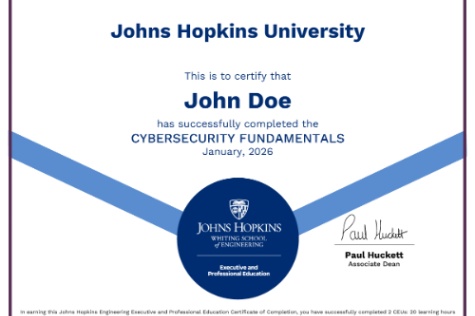
* Image for illustration only. Certificate subject to change.
Meet Your Faculty
Learn from world-renowned JHU faculty
-
Jason Crossland
Senior Cybersecurity Engineer, JHU Applied Physics Laboratory
23+ years in cybersecurity and systems engineering
Instructor at JHU Whiting School of Engineering for 11 years
Know More


 LinkedIn Profile
 University Link
Course Fees
The course fee is USD 500
Advance Your Career
-
Explain hacker ideologies, motivations, psychological drivers, and the evolution of tactics across generations
-
Apply ethical hacking and penetration testing methodologies, evaluate cryptographic systems, including PKI
-
Communicate cybersecurity findings through professional penetration test reports and executive summaries
-
Real-world reconnaissance, scanning, exploitation, information gathering, and social engineering techniques


Enrollment process
Get started instantly with our self-enrollment process and begin your learning journey today
-
1. Enter your details
Provide your information to begin the enrollment process
-
2. Make payment
Complete the payment to receive your enrollment confirmation via email


Prerequisites
- Learners must achieve a score of 85 percent or higher to successfully complete the course and earn a certificate of completion from Johns Hopkins University
Delivered in Collaboration with:

Johns Hopkins University is collaborating with online education provider Great Learning to offer the Learn Python with Generative AI course. Great Learning is a professional learning company with a global footprint in 14+ countries. Its mission is to make professionals around the globe proficient and future-ready. This course leverages JHU's leadership in innovation, science, engineering, and technical disciplines developed over years of research, teaching, and practice. Great Learning collaborates with institutions to manage enrollments (including all payment services and invoicing), technology, and participant support.

Similar free courses for you
-

 Beginner
 0.5 Hrs
Introduction to Cryptography
-

 Beginner
 1.0 Hrs
Encryption Basics
-

 Beginner
 1.5 Hrs
Cyber Security Threats
-

 Beginner
 1.0 Hrs
Introduction to Firewall
-

 Beginner
 2.0 Hrs
Introduction to Cloud Security
-

 Beginner
 1.0 Hrs
Cyber Forensics
-

 Intermediate
 1.0 Hrs
Cyber Security For Leadership
-

 Beginner
 1.5 Hrs
Advanced Cyber Security - Threats and Governance
-

 Beginner
 1.0 Hrs
Network Security
-

 Beginner
 0.5 Hrs
Types of Cyber Security


.jpg "Encryption Basics")



.jpg "Cyber Forensics")


Explore latest trends & topics
-
How to Start a Cyber Security Career in 2024
2025-06-11 10:24:56 UTC
-
Cyber Security Career: Programming Languagues
2024-06-21 10:11:38 UTC
-
How To Start A Career In Ethical Hacking-2024
2024-06-21 10:10:13 UTC
-
Types of Cybersecurity attacks
2024-06-21 10:08:49 UTC
-
Cybersecurity Threats - Indian Banking sector
2024-06-21 10:06:48 UTC
-
Top 56 Cybersecurity Blogs to Follow in 2024
2024-06-21 10:04:48 UTC
-
Benefits of Cybersecurity - Different domains
2024-06-21 10:02:19 UTC
-
What is Human Firewall? All you need to know!
2024-06-21 09:58:56 UTC
-
Benefits & Use Cases of Cybersecurity Across Different Domains
2020-09-17 08:25:07 UTC
-
What is Information Security Definition, Roles and Salary
2020-09-17 08:24:50 UTC








Hey there! Welcome back.


Forgot your password? No problem.

You are already registered. Please login instead.
Login
Forgot Password?
Enter your registered email and we'll send you a link to change your password.