
Free R Programming Course with Certificate
Introduction to R
 4.56
Beginner level
1.5 learning hrs
4.56
Beginner level
1.5 learning hrs
Learn the basics of R programming, including installation, data types, and variables. Join our free R course to explore operators, vectors, lists, matrices, arrays, dataframes, and flow control statements with practical examples.
Instructor:
Mr. Bharani Akella


What you'll learn


About this course
This free Introduction to R course is perfect for beginners looking to get started with R programming. You will begin by learning how to install R and declare variables, covering the basics needed to work with the language. We will introduce you to key data types, such as numeric, character, and logical, providing plenty of practical examples to help you understand them. You will also learn how to use different operators, such as assignment, arithmetic, relational, and logical, to perform calculations and data manipulations.
The course also covers R’s core data structures, including vectors, lists, matrices, and arrays, and shows you how to store and organize data the right way. You will learn about factors and dataframes, which are essential for working with structured data. We will also teach you built-in functions and flow control statements, enabling you to write more efficient code. With hands-on exercises throughout, this course will give you the experience you need in data analysis, manipulation, and visualization, making it a great starting point for anyone interested in data science or statistical computing.
Are you seeking more advanced data handling skills and getting valuable insights? The Great Learning’s Best Data Science Programs are for you. Enroll in the paid programs to gain career transitioning skills and course completion certificates
Course outline
Installing R and Variables in R
Installation is the very first step of using the software. This module provides information to all the learners from where we have to install R and how to declare and initialize variables in R.
Data Types in R
Just like any other programing language R also has a variety of Data Types like numeric Data Type, Character Data Type, etc. In this module, we have a detailed discussion of Data Types in R with examples.
Operators in R
In this module, you will understand the types of Operators in R. you will learn about assignment operators, arithmetic operators, relational operators, and logical operators with suitable code examples.
Vector in R
This module equips you with the vector details in R, and you will also have a hands-on session on creating vector with appropriate code examples.
List in R
In R, a list is a generic object that represents an ordered collection of things. You will go through a detailed explanation on lists with code examples.
Matrix in R
A matrix is a rectangular array of numbers arranged in columns and rows. This module explains matrix- two dimensional data structure better with code examples.
Arrays in R
Arrays are important data storage structures with a specific number of dimensions. Through this module, you will learn about multidimensional homogeneous data structure- array in R with relevant code examples.
Factor and Dataframe in R
This module begins with explaining what a factor is and will help you understand it through an example. The second part of this section talks about what dataframes are and why they are essential. You will then work with sample codes to understand dataframes better.
Inbuilt Functions and Flow Control Statements in R
This module contains a hands-on session in R where you will thoroughly learn about inbuilt functions and flow control statements in R through informative code examples.
Get access to the complete curriculum once you enroll in the course
This course is ideal for
- Beginners wanting to learn R programming basics.
- Students and job seekers exploring data science careers.
- Working professionals who want to learn statistical computing.
- Learners who need certified proof of R skills.
 4.56
4.56
Level up with advanced skills & become job ready with Pro+
Subscribe to Pro+ today to build skills with 50+ Pro courses and prep for jobs with advanced AI tools.
 PRO
PRO


Practice exercises
Guided Projects
AI Resume Builder
AI mock interviews









What our learners enjoyed the most
Skill & tools
60% of learners found all the desired skills & tools
Our course instructor

Mr. Bharani Akella
Data Scientist
IT & Software Expert


Frequently Asked Questions
Will I receive a certificate upon completing this free course?
Is this course free?
Is the Introduction to R course a certification course?
What are the prerequisites required to learn this Introduction to R course?
There are no particular prerequisites for this beginner’s course, but knowing programming can help learners understand R more effectively. You can get started with R programming basics through this free course to get a better hold of its essential concepts.
How long does it take to complete this free Introduction to R course?
This free Introduction to R course contains 1 hour of video content, which helps you thoroughly understand R programming basics.
Will I have lifetime access to the free course?
Once you enroll in the free course of your choice, you can learn it at your pace and revisit it anytime to brush up on your knowledge.
Is it worth learning Introduction to R?
Yes, it is worth learning Introduction to R because it is a tool that can be used for data analysis and data visualization. R is a statistical programming language used for statistical computing and modeling.
What is R used for?
R is a programming language that creates a free software environment for statistical computing and graphics endowed by the R Foundation for Statistical Computing. The R language is widely used among data miners and statisticians to develop statistical software and data analysis.
Why is R programming language so popular?
There are many reasons for R's popularity. It is a complimentary open-source programming language with rich statistical and graphical tools. It is also easily extensible so that new functionality can be added easily. Finally, R has a large and active user community, which means a wealth of online resources and support is available.
What jobs demand that you learn Introduction to R?
There are many jobs that demand that you learn R programming like Data Scientist, Data Analyst, Data Visualization Analyst, Business Analyst, R Developer, and Quantitative Analyst.
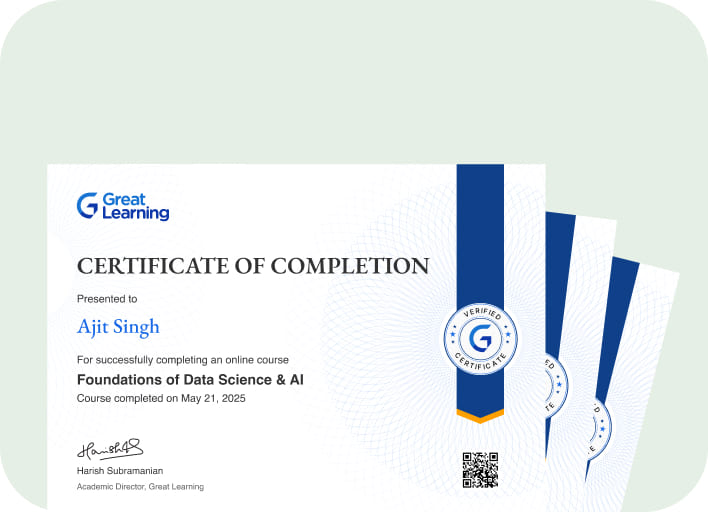
Will I get a certificate after completing this Introduction to R course?
After enrolling in this free Introduction to R course, you must successfully complete all of the specified modules as well as a quiz to receive a free online certificate of course completion.
What knowledge and skills will I gain upon completing this Introduction to R course?
Through this Introduction to R course, you will understand R commands and packages. You will also get familiar with R functions, data types, operators, and Rstudio.
How much does this Introduction to R course cost?
The course from Great Learning Academy, Introduction to R, is free for anyone interested in learning new skills. Professionals who want to upskill by studying R programming can start this course.
Is there a limit on how many times I can take this Introduction to R course?
The free courses proffered by Great Learning Academy, including this Introduction to R course, are available to any passionate learner. They can access them as many times as they want to obtain helpful knowledge.
Can I sign up for multiple courses from Great Learning Academy at the same time?
You can simultaneously enroll in as many free Great Learning Academy courses as you want and gain your preferred knowledge at your own pace.
Why choose Great Learning for this Introduction to R course?
This free Introduction to R course offered by Great Learning Academy is for beginners who want to learn the R programming language. This course helps you understand the R language basics, which will further help you understand its advanced topics better.
Who is eligible to take this Introduction to R course?
Any eager learner, from student to professional, can get started with R language through this introductory course.
What are the steps to enroll in this course?
Visit the Great Learning Academy website:
- Search for your intended course
- Click on the enroll button prominently visible on the course page for a successful registration.

Recommended Free Data Science courses
-
FREE

-
FREE
-
FREE
-
FREE
-
FREE
-
FREE
-
FREE
-
FREE
 FREE
FREE

.jpg "Course thumbnail image")


Similar courses you might like
-
FREE
-
FREE
-
FREE
-
FREE


Related IT & Software Courses

-
12 weeks · Online
Know More
-
MIT Professional Education
Applied AI and Data Science Program15 Weeks · Live Online · Weekdays & Weekend
Know More
-
Deakin University
Master of Data Science (Global) Program24 Months · Online
Top 1% UniversityKnow More






Relevant Career Paths >

Other IT & Software tutorials for you
Introduction to R
Developed by Ross Ihaka and Robert Gentleman, the R programming language has a broad statistical and graphical techniques index. It incorporates AI algorithms, linear regression, time series, and statistical inference to give quote examples. C, C++, and Fortran are used for heavy computational purposes, although more vital program parts of R libraries are written in R.
Data Analysis in R is performed in a sequence of actions: Programming, Transforming, Discovering, Modeling, and Communicating the results.
- Programming: R is statistical programming that also produces clear and accessible code Transforming: R is comprised of an assortment of libraries planned explicitly for data science
- Discovering: Investigate the information, refine your theory, and examine them
- Modeling: A wide array of tools is available in R to capture the right model for your data
- Communicate: Integrate codes, graphs, and yields into a report with R Markdown or create flashy applications to share.
What is R utilized for?
- Statistical Inference
- Machine Learning Algorithm
- Data Analysis
R is the world's most popular programming language. It is the most preferred choice of data scientists and is supported by an expert and gifted network of professionals. R is educated in universities and conveyed in strategic business applications.
R fundamental - Syntax
R Programming is a broadly used programming language popular amongst data scientists and statisticians and is utilized in data analysis. The manner by which we characterize its code is very basic. The "Welcome World!" is the fundamental program for all the dialects, and now we will understand the language structure of R programming with the program that can display "Welcome world". Programmers can program code in the order prompt or utilize an R script document.
R data types
While coding in any programming language, you must utilize various variables to store data. Variables are the reserved memory areas to store information; wherever you create a variable, you allocate some memory space for it. This implies that when you create a variable, you reserve some space in memory for it.
Unlike other programming languages such as C, Python, and Java, the variables are not declared as any particular data type in R. The variables are allocated with R-Objects, and the R-object's data type turns into the variable's data type. There are numerous sorts of R-objects. The frequently utilized ones are −
- Vectors
- Lists
- Matrices
- Arrays
- Factors
- Data Frames
Matrices
- A matrix is a two-dimensional rectangular dataset. It is created utilizing a vector input to the matrix function.
Arrays
- While matrices are limited to two dimensions, arrays can be of quite a few dimensions. The array function takes a faint attribute that creates the required number of dimensions.
Dataframes
- Data frames are data objects in tabular form. Not at all like a matrix in a data frame, every section can contain different data methods. The first column can take numeric values, the subsequent column can be characters and the third column can be logical. It is a rundown of vectors of equivalent length.
R Variables
- A variable allocates a titled memory location that programs can control. In R, atomic vectors, a bunch of atomic vectors, or a combination of numerous R objects are the variables that can be stored. A legitimate variable name comprises letters, numbers, and the dot or underlined characters.
R – Pros
- R offers a clear perception of data with effective visualization, making the data productively planned and understood. Instances of its visualization packages are ggvis, ggplot2, rChart, and googleVis.
- R has a broad ecosystem of a dynamic network and desirable packages. The packages are accessible at Github, BioConductor, and CRAN.
- It was created, for analysts, by analysts. Thus, they can impart ideas and thoughts through R packages and code.
Conclusion
The free Introduction to R Programming course offered by Great Learning Academy is a great head start to your career in R programming for a career in Data Science and Statistical Analysis. With good hands-on experience in the field, you will fit in the best of the corporate world's opportunities. Enroll in the course and be proficient in R programming.
The introduction to R programming course has a comprehensive curriculum that includes how to install R, variables in R, data types, vectors, operators, lists, matrices, arrays, factors and data frames, inbuilt functions, flow control statements, and more.
The course is delivered in the form of video content of a 1-hour duration, along with a quiz and project for you to measure your learning. This self-learning course will provide you with the knowledge of R basics and enable beginner-level proficiency with the programming language.
You will gain a certificate after completion of the Introduction to R course from Great Learning. You can share this certificate on your LinkedIn profile, on resumes, CVs, and other professional and educational documents. This course is especially suitable for freshers, programmers, and developers who want to learn a new programming language, professionals seeking career enhancement by learning R, and those who want to refresh their understanding of the R programming language. If you are one of those in this group, then sign up for this course now and for free.