
- How AI Adoption Differs Across Business Functions
- AI Adoption in Product and Product Development
- AI Adoption in Marketing and Sales
- AI Adoption in Finance
- AI Adoption in Operations
- What Business Leaders Need to Know About AI Adoption
- From AI Experiments to Scaled Business Impact
- How an Artificial Intelligence Course Can Help Business Leaders Build AI Skills
- Final Thoughts
- Frequently Asked Questions
AI adoption is moving beyond isolated experiments and becoming part of how businesses develop products, engage customers, manage finances, and run operations. However, the way organizations use AI varies significantly by business function.
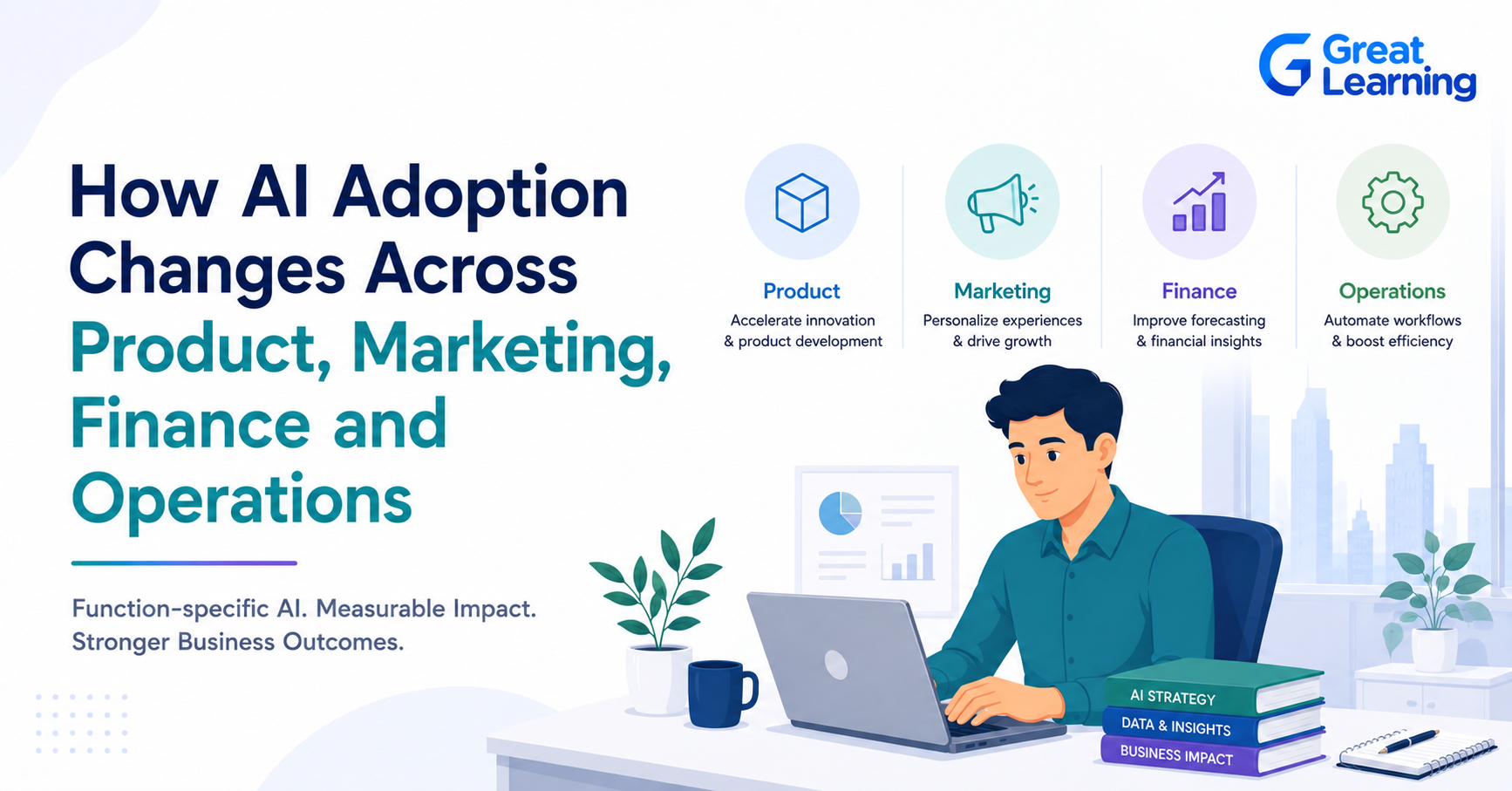
For product teams, AI can accelerate research and product development. Marketing teams use it for personalization and campaign optimization, while finance teams apply it to forecasting and analysis. Operations teams are increasingly focused on automation and workflow optimization.
McKinsey's November 2025 State of AI report found that more than two-thirds of organizations now use AI in more than one business function, and half report using it in three or more, with generative AI use particularly common in areas such as marketing and sales, product and service development, service operations, and software engineering.
The result is a shift from asking “Where can we use AI?” to “Where can AI create the most measurable business value?”
How AI Adoption Differs Across Business Functions
AI adoption does not follow a single model across an organization. Each function typically prioritizes AI use cases based on its objectives, data, workflows, and performance metrics.
| Business Function | Primary AI Focus | Common Use Cases |
| AI in Product | Innovation and customer insights | Product research, feedback analysis, personalization |
| AI in Marketing | Growth and customer engagement | Content generation, segmentation, campaign optimization |
| AI in Finance | Analysis and forecasting | Reporting, forecasting, anomaly detection |
| AI in Operations | Efficiency and automation | Process automation, service operations, workflow optimization |
This functional approach is important for business leaders because the most valuable AI use case for one team may not be appropriate for another.
A marketing team may prioritize customer personalization, while an operations team may gain more value from automating repetitive workflows.
Effective AI adoption therefore starts with the business function and its specific challenges—not with the AI tool itself.
AI Adoption in Product and Product Development
Product teams are using AI to move faster from customer insight to product improvement.
Common applications include analyzing user feedback, identifying feature opportunities, generating product concepts, personalizing experiences, and accelerating product development.
Generative AI is already widely used in product and service development, making it one of the leading areas of enterprise adoption. Product and service development is among the functions where organizations most commonly report revenue benefits from AI.
A typical product workflow could look like:
Customer Feedback → AI Analysis → Opportunity Identification → Prototype → Human Review → Product Improvement
For business leaders, the key is to use AI to shorten product cycles and improve customer understanding, rather than simply adding AI features to a product.
AI Adoption in Marketing and Sales
Marketing teams are among the most active users of AI because their workflows involve customer data, content, segmentation, and campaign optimization.
AI can support content creation, customer segmentation, personalization, campaign analysis, lead prioritization, and conversational engagement.
For example, an AI-powered marketing workflow can analyze customer behavior, identify audience segments, generate campaign variations, and recommend which messages to test. Marketers can then review the recommendations and make the final decisions.
Current industry data also shows how quickly this is moving from experimentation to practical use. Salesforce's 2026 State of Marketing research found that 81% of marketers in India have adopted AI, while fragmented customer data remains a major barrier to scaling AI-powered personalization.
The key for business leaders is therefore not simply to increase AI usage. It is to connect AI with customer data, marketing objectives, and measurable outcomes such as engagement, conversion, campaign efficiency, and revenue.
AI Adoption in Finance
Finance is moving from basic automation toward AI-assisted forecasting, analysis, controls, and decision-making. Common applications include knowledge management, accounts payable automation, anomaly detection, reporting, and financial analysis.
Common applications include:
- Financial forecasting: Analyze trends and support planning.
- Reporting: Generate summaries and management commentary.
- Anomaly detection: Identify unusual transactions, expenses, or financial patterns.
- Accounts payable: Automate invoice processing and approvals.
- Knowledge management: Retrieve information from financial documents and policies.
- Scenario analysis: Support faster evaluation of business decisions.
AI adoption is also expanding across multiple finance workflows. McKinsey found that 44% of surveyed CFOs were using generative AI across more than five use cases in 2025, compared with 7% the previous year.
However, finance requires a higher level of accuracy, data quality, security, and human oversight. Gartner's 2026 research also highlights a growing gap between AI deployment and realized business value, reinforcing the need for finance leaders to evaluate AI based on outcomes rather than adoption alone.
For finance leaders, effective AI adoption means using AI to improve financial decisions and processes while maintaining strong controls and accountability.
AI Adoption in Operations
Operations teams are using AI where repetitive, data-intensive processes can be improved through automation, prediction, and faster decision-making. Common applications include process automation, customer service, supply chain optimization, quality control, predictive maintenance, and workflow management.
Applications such as fleet route optimization, warehouse robotics, and AI-enabled store operations show how AI is moving beyond digital assistants into operational processes.
A typical operations workflow could look like:
Monitor → Detect → Analyze → Recommend → Approve → Execute
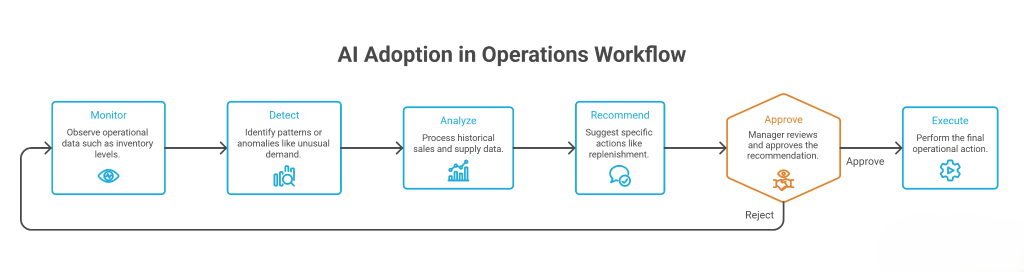
For example, an AI system could monitor inventory levels, detect an unusual demand pattern, analyze historical sales and supply data, recommend a replenishment action, and route the recommendation to a manager before an order is placed.
The growing interest in Agentic AI is also changing how operations can be automated. AI agents can coordinate multiple steps across connected systems rather than simply completing a single task.
For operations leaders, effective AI adoption means identifying high-volume, measurable processes where automation can improve cost, speed, quality, or capacity while maintaining appropriate human oversight.
What Business Leaders Need to Know About AI Adoption
AI adoption across functions is increasing, but adoption alone does not guarantee business value.
Deloitte’s 2026 State of AI in the Enterprise report found that nearly three-quarters of companies plan to deploy agentic AI within two years, yet only 21% report having a mature governance model for it, highlighting the gap between AI adoption and the capabilities needed to scale it responsibly.
Business leaders therefore need to evaluate AI initiatives across four areas:
- Value: Does the use case solve a meaningful business problem?
- Data: Is the required data available, reliable, and secure?
- Workflow: How will AI change the way employees work?
- Governance: What controls and human oversight are required?
This is particularly important as organizations move from standalone AI tools toward AI agents, automated workflows, and function-specific applications.
Deloitte's research shows that organizations are increasingly focused on embedding AI into business processes rather than treating it as a separate technology initiative.
For business leaders, effective AI adoption therefore means choosing the right use cases, redesigning workflows where necessary, building AI literacy across teams, and measuring outcomes before scaling.
From AI Experiments to Scaled Business Impact
The next challenge is moving from isolated AI pilots to repeatable, measurable business applications.
Business leaders should evaluate each use case based on business value, feasibility, data readiness, workflow impact, and risk rather than simply adopting the latest AI technology.
A practical adoption cycle is:
Identify → Prioritize → Pilot → Measure → Integrate → Scale
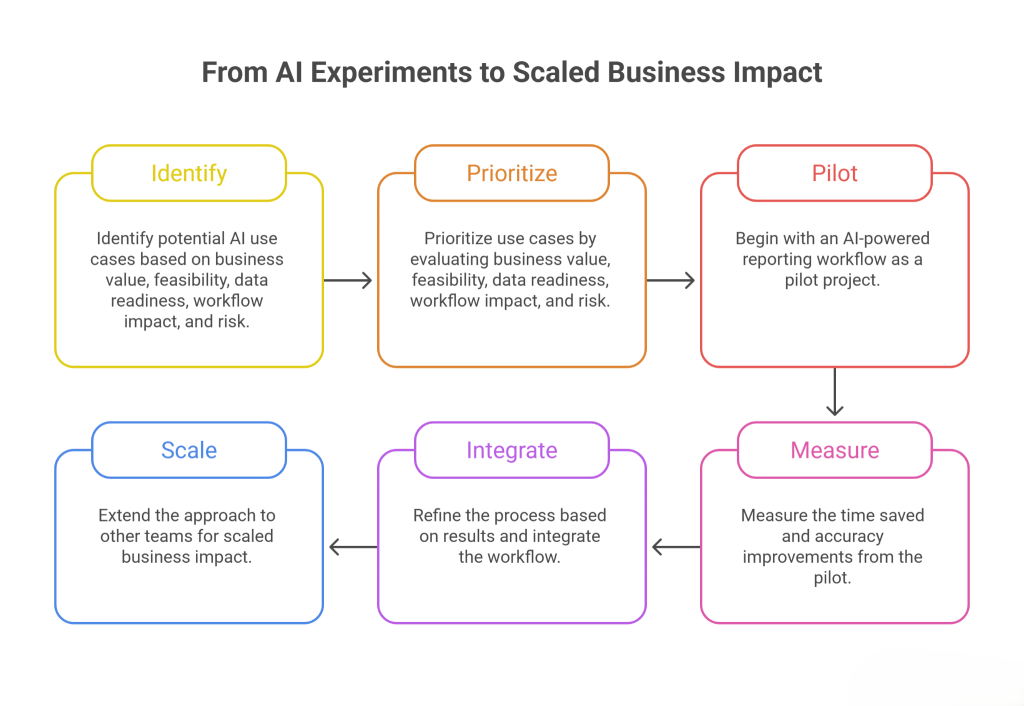
For example, a company could begin with an AI-powered reporting workflow, measure the time saved and accuracy improvements, refine the process based on results, and then extend the approach to other teams.
This approach also helps organizations distinguish between AI adoption and meaningful AI transformation.
A July 2026 MIT FutureTech and Carnegie Mellon University study of S&P 500 firms found that only 11% had AI deeply integrated into core business processes by 2025, highlighting the gap between experimenting with AI and embedding it into how businesses operate.
For business leaders, the objective is not to deploy AI everywhere. It is to identify where AI can create measurable value and build the capabilities needed to scale those use cases responsibly.
Building AI Literacy Across Business Functions
AI adoption is becoming a cross-functional capability rather than a responsibility limited to IT or data teams. Product, marketing, finance, and operations leaders each need enough AI literacy to identify relevant use cases, assess feasibility, and understand how AI can change existing workflows.
A practical approach is to build AI literacy around four capabilities:
| Capability | What Leaders Should Understand |
| Identify | Where AI can solve a meaningful business problem |
| Evaluate | Data requirements, feasibility, risks, and expected value |
| Implement | How AI fits into workflows and employee roles |
| Measure | Productivity, cost, revenue, quality, and other business outcomes |
This cross-functional understanding helps leaders make better decisions about where AI should be applied, how it should be implemented, and what outcomes it should deliver.
The goal is not for every business leader to become an AI engineer. It is to develop enough AI literacy to identify valuable opportunities, collaborate with technical teams, evaluate AI solutions, and guide responsible adoption within their function.
How an Artificial Intelligence Course Can Help Business Leaders Build AI Skills
Business professionals can develop AI literacy through structured learning that combines AI fundamentals, practical applications, business use cases, and responsible AI. The focus should be on understanding how AI technologies can be applied to real organizational challenges rather than simply learning individual tools.
The Texas McCombs's Artificial Intelligence Course covers machine learning, Generative AI, Agentic AI, AI strategy, and practical business applications. Its hands-on approach helps professionals connect AI capabilities with real-world business problems.
Post Graduate Program in AI & Machine Learning: Business Applications
Master in-demand AI and machine learning skills with this executive-level AI course—designed to transform professionals into strategic tech leaders.
For business leaders, the value lies in developing the ability to identify high-impact use cases, evaluate AI solutions, collaborate with technical teams, and make informed decisions about AI adoption.
Final Thoughts
AI adoption looks different across product, marketing, finance, and operations, but the underlying challenge is the same: turning AI capabilities into measurable business value.
Business leaders need more than familiarity with AI tools. They need the AI literacy to identify valuable use cases, understand how AI can fit into workflows, evaluate outcomes, and guide responsible implementation.
For professionals looking to build these capabilities, the Artificial Intelligence course by Texas McCombs provides a structured pathway to develop practical AI knowledge and apply it to real-world business challenges.
Frequently Asked Questions
1. What is AI adoption in business?
AI adoption in business refers to integrating artificial intelligence into business processes, workflows, and decision-making to improve outcomes such as productivity, efficiency, customer experience, and revenue.
2. How is AI adoption changing marketing and sales?
AI is helping marketing and sales teams automate content creation, analyze customer behavior, personalize campaigns, prioritize leads, and improve forecasting. The focus is shifting from individual AI-generated tasks to AI-assisted customer and sales workflows.
3. How are finance teams using AI?
Finance teams use AI for forecasting, financial reporting, anomaly detection, invoice processing, document analysis, and scenario planning. Human oversight remains important for financial accuracy, security, and compliance.
4. How is AI changing product development?
AI can help product teams analyze customer feedback, identify product opportunities, generate concepts, personalize experiences, and accelerate development. It allows teams to move faster from customer insights to product improvements.
5. How is AI being used in operations?
Operations teams use AI to automate repetitive processes, optimize workflows, monitor performance, improve supply chains, and support predictive maintenance. AI agents can also coordinate multi-step operational tasks across connected systems.
6. What challenges do businesses face when adopting AI?
Common challenges include poor data quality, unclear business objectives, integration with existing systems, AI accuracy, privacy and security risks, employee adoption, and difficulty measuring ROI. Successful AI adoption requires addressing these challenges alongside the technology itself.
7. How can business leaders build AI adoption skills?
Business leaders can build AI adoption skills by learning AI fundamentals, Generative AI, AI workflows, Agentic AI, responsible AI, and AI strategy. Hands-on projects and real-world business use cases can also help leaders understand how to identify, evaluate, and implement valuable AI solutions.