
- Why Business Leaders Need AI Skills Beyond AI Tools
- What Should Business Leaders Learn About AI?
- How AI Is Creating Opportunities Across Business Functions
- Why Business Leaders Need to Understand Generative AI and Agentic AI
- What Makes an AI Course Suitable for Business Leaders and Functional Heads?
- How an AI Course Can Help Business Leaders Apply AI in Their Organizations
- What Makes an AI Course Suitable for Business Leaders and Functional Heads?
- Final Thoughts
- Frequently Asked Questions
Business leaders and functional heads are increasingly expected to make decisions about AI investments, adoption, and implementation without becoming technical AI specialists themselves.
To do this effectively, they need to understand what AI can do, where it can create business value, and how to evaluate its risks and limitations.
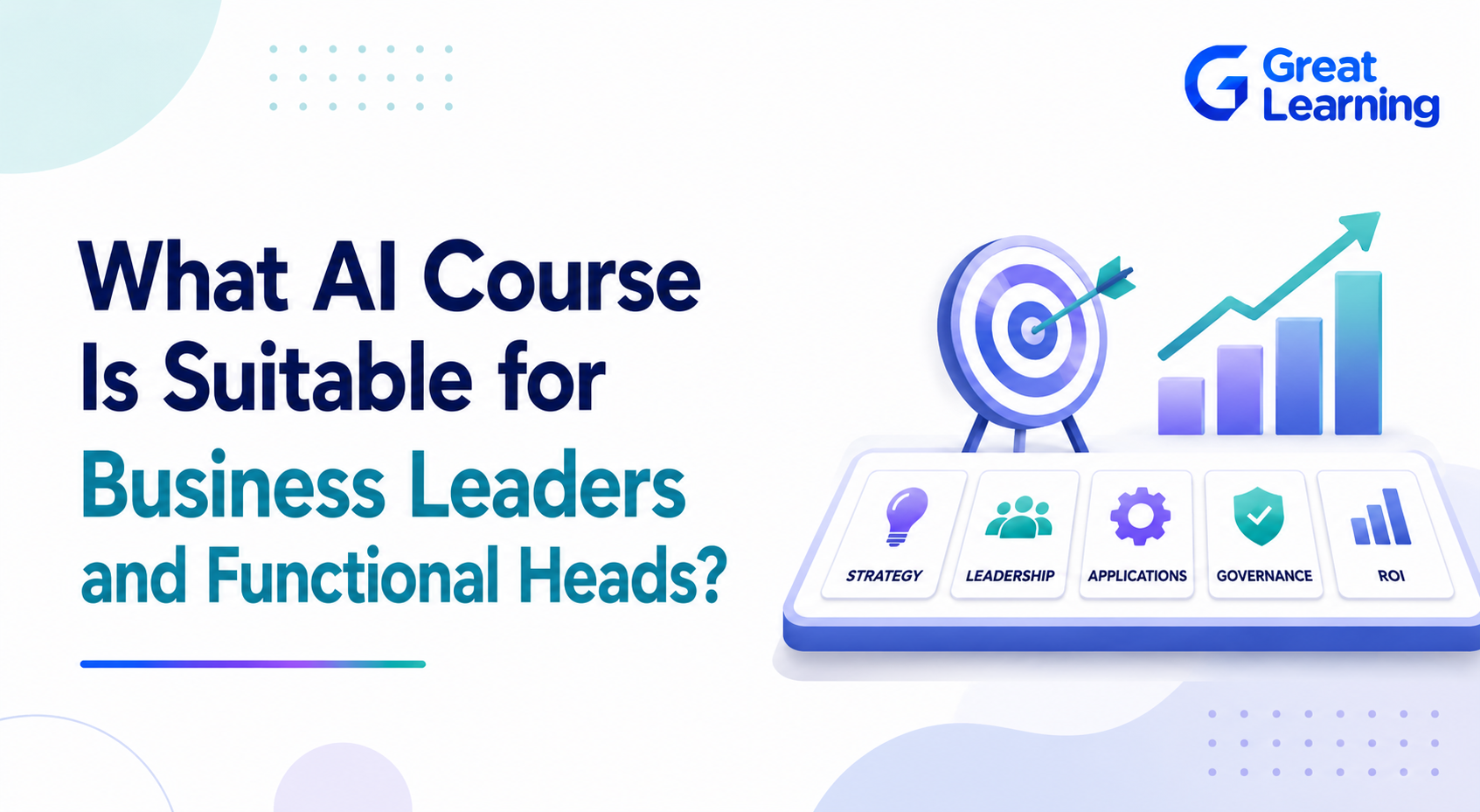
Choosing the right AI course for business leaders therefore requires more than learning popular AI tools. Leaders need practical exposure to AI strategy, Generative AI, Agentic AI, business use cases, ROI, governance, and implementation.
The right course should help leaders connect AI capabilities with their business priorities, identify meaningful opportunities, and make informed decisions about where and how AI can create measurable business impact.
Why Business Leaders Need AI Skills Beyond AI Tools
Business leaders do not need to become AI engineers, but they do need enough AI literacy for business leaders to understand how the technology can affect their functions, teams, and business decisions.
Simply knowing how to use ChatGPT or another AI tool is not enough to evaluate whether an AI initiative is valuable, feasible, or ready to scale.
This distinction is becoming more important as AI moves into core business operations. BCG's 2026 research found that nearly three-quarters of CEOs say they are the key decision-maker on AI, reflecting the growing role of leadership in shaping AI strategy and investment.
For business leaders and functional heads, AI literacy means understanding where AI can create value, how Generative AI and AI agents can change workflows, what data and technology are required, and where human judgment remains necessary.
It also means being able to work effectively with technical teams. Leaders who understand the capabilities and limitations of AI can ask better questions, assess proposed solutions more critically, and make more informed decisions about AI investments.
The goal is therefore not to turn every business leader into a technical specialist. It is to develop enough AI fluency to connect technology with business priorities and lead its practical adoption.
What Should Business Leaders Learn About AI?
An effective AI course for business leaders should go beyond explaining how AI tools work.
Business leaders and functional heads need practical knowledge that helps them understand AI capabilities, evaluate business applications, and make informed decisions about adoption.
Developing AI skills for working professionals can help them build the capabilities needed to apply AI effectively in their roles.
Key areas should include:
- AI fundamentals: Understand machine learning, Generative AI, and how modern AI systems work.
- Business applications: Identify how AI can improve productivity, customer experience, decision-making, and operations.
- Generative AI: Understand the capabilities and limitations of tools such as LLMs and enterprise GenAI applications.
- Agentic AI: Learn how AI agents can plan tasks, use tools, and automate multi-step workflows.
- AI strategy: Understand where AI fits into business priorities and how initiatives can move from experimentation to implementation.
- AI governance: Recognize risks related to privacy, security, bias, compliance, and human oversight.
- AI ROI: Evaluate whether an AI initiative can deliver measurable business value.
- Data readiness and integration: Assess whether the required data, systems, access controls, and integration work are in place.
- Operating model and change management: Plan team roles, workflow changes, human oversight, and adoption.
This broader understanding is increasingly important because executive AI literacy is becoming a distinct leadership capability.
Gartner's June 2026 research identifies executive AI literacy as a core leadership competency, while MIT Sloan Executive Education similarly emphasizes that executive AI literacy involves understanding how AI works, its limitations, and its broader strategic implications.
For functional heads, the goal is not to master every AI technology. It is to understand enough to evaluate opportunities, challenge assumptions, work effectively with technical teams, and make responsible decisions about AI adoption.
How AI Is Creating Opportunities Across Business Functions
AI is no longer limited to technology teams. Business and functional leaders are increasingly exploring AI for business professionals and how it can improve marketing, finance, operations, sales, customer experience, product development, and human resources.
The use cases vary by function. Marketing teams can use AI for customer segmentation and content personalization, finance teams can apply it to forecasting and analysis, while operations teams can use AI to automate workflows and improve planning.
Sales teams can use AI for lead analysis and customer insights, while HR teams can apply it to employee support and talent analytics.
Recent Deloitte research shows this shift across organizations. In its 2026 State of AI in the Enterprise research, 34% of surveyed organizations said they are using AI to deeply transform products, services, core processes, or business models, while another 30% are redesigning key processes around AI.
For functional heads, this means AI knowledge needs to extend beyond knowing which tools are available.
They need to understand how AI can fit into their specific function, which business problems it can address, and how it can complement existing teams and processes.
Why Business Leaders Need to Understand Generative AI and Agentic AI
Understanding AI today means looking beyond basic productivity tools. Generative AI can help business teams create content, analyze information, summarize documents, and support knowledge work, while Agentic AI can go further by planning tasks, using tools, and executing parts of a workflow.
This distinction matters for business leaders because the value of AI increasingly depends on how it is integrated into business processes, not simply how many AI tools employees use.
Business leaders should therefore understand where Generative AI can improve employee productivity and where Agentic AI could support more complex workflows.
They should also recognize the limitations of these technologies, including unreliable outputs, data requirements, security risks, and the need for human oversight.
For functional heads, this knowledge helps connect emerging AI capabilities with actual business needs. Rather than adopting AI because a tool is popular, leaders can assess whether Generative AI or Agentic AI can meaningfully improve a specific process, customer experience, or business outcome.
What Makes an AI Course Suitable for Business Leaders and Functional Heads?
For business leaders and functional heads, an effective AI course for business leaders should focus on understanding AI capabilities, identifying business use cases, evaluating ROI, and managing implementation and governance.
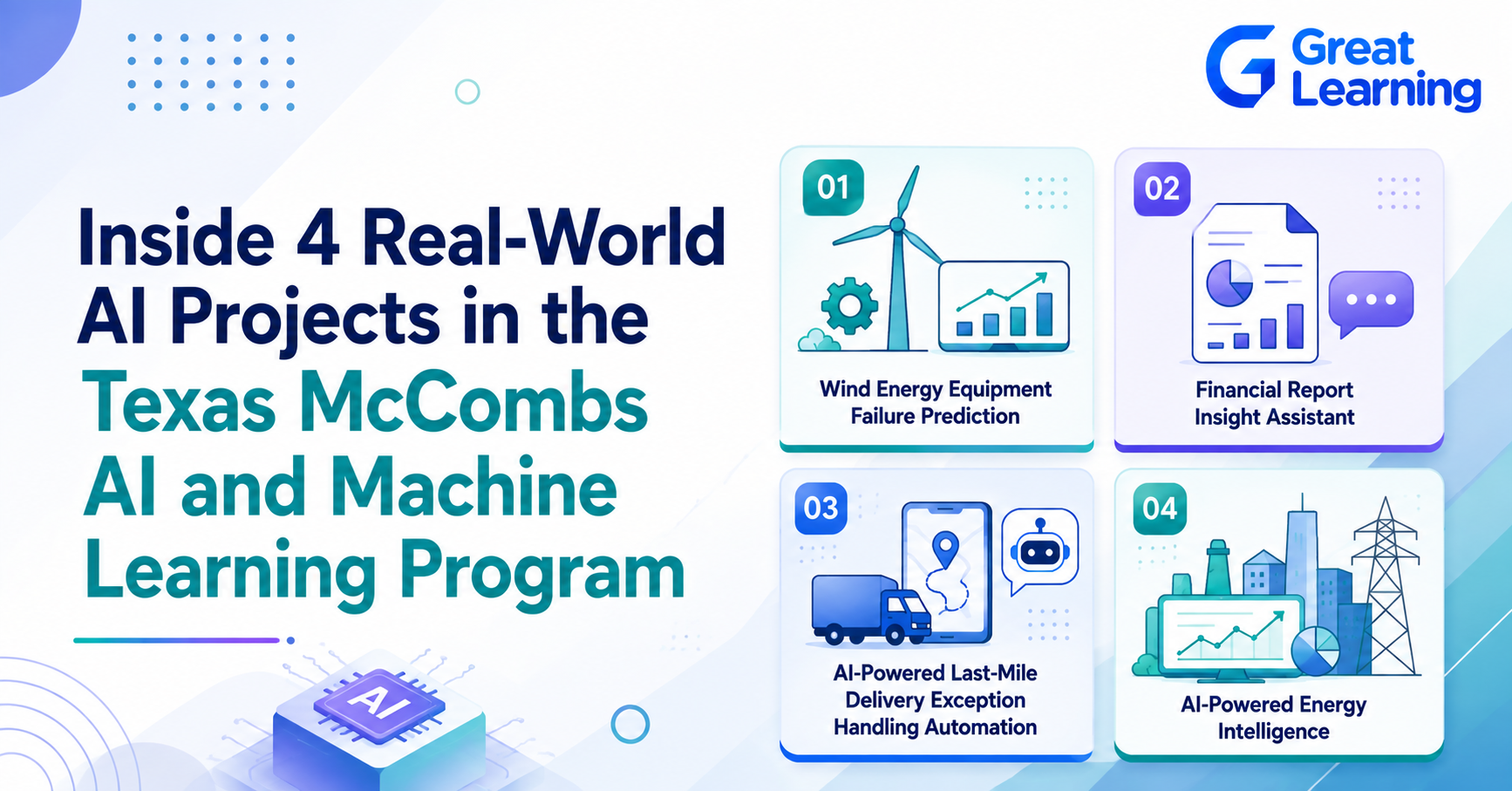
The Artificial Intelligence course by Texas McCombs and Great Lakes Executive Learning follows this business-focused approach, covering AI strategy, Generative AI, Agentic AI, ROI assessment, AI governance, and practical business applications through projects and a capstone.
This makes it relevant for professionals who want to lead AI initiatives, evaluate opportunities, and work effectively with technical teams without becoming AI engineers.
How an AI Course Can Help Business Leaders Apply AI in Their Organizations
For business leaders, the value of an AI course comes from being able to connect AI concepts with real organizational challenges.
Learning through business cases and practical projects can help leaders understand how AI can be applied to areas such as customer experience, operations, marketing, finance, and decision-making.
The Artificial Intelligence course by Texas McCombs and Great Lakes Executive Learning takes a business-first, no-code approach, with curriculum covering AI project development, business impact, AI use cases, Generative AI, Agentic AI, AI strategy, ROI assessment, governance, and AI-driven decision-making.
It also includes hands-on projects and a capstone designed to connect AI capabilities with business outcomes.
This approach is particularly relevant for functional heads who need to work across business and technical teams.
Rather than focusing primarily on coding models, the emphasis is on helping leaders evaluate AI opportunities, make informed investment decisions, lead implementation, and align AI initiatives with organizational goals.
What Makes an AI Course Suitable for Business Leaders and Functional Heads?
For business leaders and functional heads, an effective AI course for business leaders should connect AI capabilities with business strategy, decision-making, and practical implementation.
Rather than focusing primarily on coding, it should help leaders understand how AI can be evaluated, applied, governed, and scaled across their organizations.
A business-focused AI course should cover AI fundamentals, Generative AI, Agentic AI, business use cases, AI strategy, ROI, governance, and collaboration with technical teams.
Practical projects and real-world case studies are equally important because they bridge AI concepts with business challenges.
The Artificial Intelligence course by Texas McCombs and Great Lakes Executive Learning follows this business-first approach through a no-code curriculum covering AI strategy, ROI assessment, Generative AI, Agentic AI, AI governance, and AI-driven decision-making, supported by projects and a capstone.
PG Program in AI & Machine Learning
Master AI with hands-on projects, expert mentorship, and a prestigious certificate from UT Austin and Great Lakes Executive Learning.
This makes the program well suited for business leaders and functional heads who want to evaluate AI opportunities, lead adoption, and collaborate confidently with technical teams without becoming AI engineers.
Final Thoughts
The right AI course for business leaders should help professionals move beyond simply using AI tools and develop the judgment needed to apply AI effectively within their organizations.
Business leaders and functional heads need to understand AI capabilities, identify meaningful use cases, evaluate business value, manage risks, and lead implementation.
The Artificial Intelligence course by Texas McCombs and Great Learning Executive Learning combines these business-focused capabilities with practical exposure to Generative AI, Agentic AI, AI strategy, ROI assessment, governance, and real-world projects.
For leaders, the objective is not to become AI engineers. It is to develop the AI fluency required to make better decisions, lead AI initiatives, and turn emerging AI capabilities into measurable business impact.
Frequently Asked Questions
1. What is the best AI course for business leaders?
The best AI course for business leaders should combine AI fundamentals with business applications, Generative AI, Agentic AI, AI strategy, ROI, governance, and practical projects. The right choice depends on the leader's role, objectives, and level of technical experience.
2. Do business leaders need coding skills to learn AI?
Not necessarily. Business leaders need enough technical understanding to evaluate AI capabilities and work effectively with technical teams, but they do not need to become AI engineers or programmers to lead AI adoption.
3. What should an AI course for functional heads cover?
It should cover AI fundamentals, Generative AI, Agentic AI, business use cases, AI strategy, ROI assessment, governance, and practical implementation. Functional examples can also help leaders understand how AI applies to their specific business areas.
4. How can business leaders identify valuable AI use cases?
Leaders should look for business problems where AI can improve productivity, reduce repetitive work, enhance customer experiences, improve decision-making, or create new products and services. The potential value should be considered alongside feasibility, data availability, cost, and risk.
5. How can business leaders measure the ROI of AI?
AI ROI can be assessed by comparing the expected business benefits, such as cost savings, productivity improvements, revenue growth, or customer experience gains, with implementation and ongoing operating costs.
6. Should business leaders learn Generative AI and Agentic AI?
Yes. Understanding both helps leaders distinguish between AI that primarily generates content or insights and AI agents that can plan tasks, use tools, and execute parts of business workflows. This can help leaders make more informed decisions about where each technology is appropriate.
7. Is an AI course worth it for senior managers and executives?
An AI course can be valuable for senior professionals who need to lead AI adoption, evaluate investments, identify use cases, or work with technical teams. A business-focused program such as the Artificial Intelligence course by Texas McCombs and Great Learning Executive Learning can be particularly relevant when the goal is to develop AI fluency alongside strategic and business skills.