
- Why Are Working Professionals Combining AI Skills With an MBA?
- Standalone AI Course vs. MBA With AI Skills: What's the Difference?
- What Does an MBA Add That a Standalone AI Course May Not?
- How Can AI Skills Make an MBA More Relevant?
- Which Working Professionals Can Benefit From Combining an MBA With AI Skills?
- What AI Skills Should Working Professionals Learn Alongside an MBA?
- Is an MBA With AI Skills Better Than a Standalone AI Course?
- How Should Working Professionals Choose Between an AI Course and an MBA?
- FAQs About Combining AI Skills With an MBA
The skills expected from business professionals are changing. As organizations integrate AI into marketing, finance, operations, product development, and decision-making, professionals increasingly need more than functional expertise. They also need to understand where AI can create value, how to evaluate its impact, and how to apply it within a broader business strategy.
This shift is already reshaping roles across India: 86% of employers say AI has impacted job roles and responsibilities, while 35% report significant role redefinition, according to NASSCOM’s India’s AI Talent Inflection Point report.
This is changing the way working professionals approach upskilling. Rather than learning AI in isolation, many are looking to combine AI capabilities with business, strategic, and leadership skills that can support their progression into broader roles.
Why Are Working Professionals Combining AI Skills With an MBA?
Working professionals are combining AI skills with an online MBA because they need to understand both how AI works and how to apply it to business challenges. An online MBA develops skills in strategy, finance, marketing, operations, and leadership, while AI skills help professionals identify use cases, evaluate emerging technologies, and support AI-driven decision-making. This combination is particularly relevant as AI adoption expands across business functions, with applications extending beyond software development and Data Science into areas such as marketing, finance, operations, and product management.
Standalone AI Course vs. MBA With AI Skills: What's the Difference?
A standalone AI course and an MBA with AI skills serve different purposes.
| Factor | Standalone AI Course | MBA + AI Skills |
| Primary focus | AI concepts and applications | Business + AI application |
| Business strategy | Depends on the course | Core MBA component |
| Leadership | Depends on the course | Core management focus |
| AI application | Technical or functional | Strategic and business-oriented |
| Best suited for | Focused AI upskilling | Broader management + AI development |
A standalone AI course can be a strong option for someone seeking specialized technical knowledge. However, professionals targeting broader management responsibilities may benefit from combining AI capabilities with formal business education.
What Does an MBA Add That a Standalone AI Course May Not?
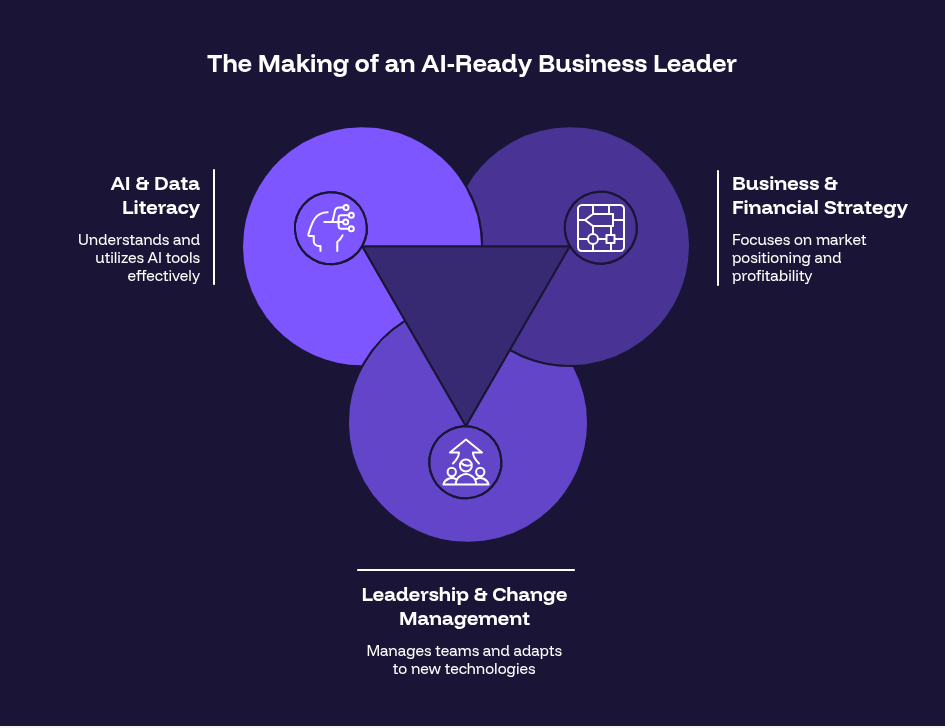
Beyond AI knowledge, professionals also need to understand the organizational factors that determine whether an AI initiative succeeds.
Business Strategy and Decision-Making
Professionals learn how to evaluate markets, resources, risks, and business opportunities. Adding AI literacy can help them assess where emerging technologies fit within these decisions.
Leadership and People Management
AI adoption often involves organizational change. Managers need to communicate new initiatives, coordinate teams, and manage resistance, not simply select an AI tool.
Financial and Business Acumen
AI initiatives require investment. Understanding costs, business models, financial performance, and ROI can help professionals evaluate whether an AI implementation makes commercial sense.
Cross-Functional Collaboration
AI projects often bring together business, technology, data, and operations teams. Professionals with both business expertise and AI fluency can potentially serve as a bridge between these groups.
SRM University, Sikkim Online MBA
Advance your career with SRM University, Sikkim's UGC-entitled online MBA. Choose from 7 in-demand specializations in Finance, Marketing, HR, Analytics, Operations, Healthcare & Hospitality.
How Can AI Skills Make an MBA More Relevant?
AI can add a technology dimension to traditional management knowledge.
For example, a marketing professional can combine marketing strategy with AI-powered customer analytics. An operations manager can explore intelligent automation. A product manager can evaluate AI-enabled product features. A finance professional can use AI and analytics to support business forecasting and decision-making.
For professionals specifically looking to combine management knowledge with AI and analytics capabilities, an online MBA in Business Analytics and AI can provide a more focused pathway. The specialization includes areas such as Artificial Intelligence and Deep Learning, Generative AI, Data Visualization, and Business Analytics alongside the broader MBA curriculum.
Which Working Professionals Can Benefit From Combining an MBA With AI Skills?
Combining an MBA with AI skills is particularly relevant for professionals who want to apply AI within their existing functions rather than transition into technical AI roles. AI skills for business professionals can include understanding AI applications, identifying relevant use cases, and using AI to improve everyday business processes.
Product Managers and Product Leaders
They can use AI knowledge to evaluate AI-enabled products, identify use cases, and work more effectively with technical teams.
Marketing and Sales Professionals
AI skills can complement knowledge of customer behavior, digital marketing, personalization, and analytics.
Finance Professionals
AI and analytics can support forecasting, financial analysis, risk assessment, and business decision-making.
Operations Managers
AI can be applied to process optimization, automation, forecasting, and supply chain management.
Entrepreneurs and Business Leaders
Business leaders can use AI knowledge to evaluate new opportunities and determine where automation or intelligent systems could create value.
SRM University, Sikkim Online MBA in Business Analytics & AI
A 2-year online MBA in Business Analytics and Artificial Intelligence built for working professionals and graduates. Gain skills in AI, predictive analytics, and Generative AI.
What AI Skills Should Working Professionals Learn Alongside an MBA?
Professionals do not necessarily need to learn every technical aspect of AI. The right skills depend on their role and career goals.
Useful areas can include:
- Generative AI and prompt engineering
- AI-assisted data analysis
- Machine learning fundamentals
- AI agents and workflow automation
- Business intelligence
- AI strategy and implementation
- AI ethics and governance
- Data literacy
The goal is not to become an AI engineer but to build enough fluency to evaluate tools, identify relevant use cases, and apply AI effectively within a professional function. For professionals who want to identify specific areas for AI upskilling, exploring skills by domain, role, and career goal can be a useful starting point. Explore skills for AI and other career paths.
Is an MBA With AI Skills Better Than a Standalone AI Course?
Neither option is universally better. The right choice depends on the professional's career objective.
A standalone AI course may be more appropriate for someone who already has strong business knowledge and wants specialized AI capabilities.
An MBA combined with AI skills may be more relevant for someone who wants to develop management expertise while understanding how AI can influence business strategy, operations, products, and decision-making.
How Should Working Professionals Choose Between an AI Course and an MBA?
Consider these questions before choosing:
- What role do you want next? Technical AI roles may require deeper specialized training, while management roles may benefit from broader business education.
- What skills do you already have? An AI course can fill a technology gap, while an MBA can add management and strategic capabilities.
- Are you aiming for leadership? If your goal involves managing teams, functions, or transformation initiatives, business knowledge becomes increasingly important.
- Do you want specialization or breadth? A standalone course offers focused upskilling; an MBA can provide broader business knowledge alongside an AI specialization.
FAQs About Combining AI Skills With an MBA
Is an MBA with AI skills better than a standalone AI course?
It depends on your career goals. A standalone AI course can suit professionals seeking specialized AI knowledge, while an MBA with AI skills can be useful for professionals who want to combine technology awareness with management, strategy, and leadership capabilities.
Why should MBA professionals learn AI?
MBA professionals should learn AI because AI is increasingly influencing how organizations structure teams, make decisions, and operate across business functions. NASSCOM’s India’s AI Talent Inflection Point report found that nearly all Indian organizations expect their 2026 workforce strategy to focus on AI-related roles, with 40% anticipating major workforce restructuring. For MBA professionals, AI literacy can therefore help them evaluate AI use cases, make data-informed decisions, manage AI-driven transformation, and connect emerging technologies with broader business strategy.
Do you need coding skills to learn AI for business?
Not necessarily. Professionals working with AI for strategy, management, marketing, operations, or decision-making may benefit more from understanding AI applications, limitations, tools, and business implications than from becoming AI developers.
Which AI skills are useful for managers?
Generative AI, data literacy, AI strategy, business intelligence, workflow automation, AI governance, and an understanding of machine learning fundamentals can be useful for managers.