
- What Does Data Engineering for AI Involve?
- How Data Pipelines Support AI Systems
- Why Data Quality Is Critical for AI
- Data Engineering for Generative AI and RAG
- How Data Engineering Supports Agentic AI
- Data Engineering, MLOps, and AI Engineering: What’s the Difference?
- Essential Data Engineering Skills for AI Professionals
- How to Build Data Engineering Skills for an AI Career
- How Data Engineering Supports Reliable AI in Production
- How an AI and Data Science Course Can Build Data Engineering Skills
- Final Thoughts
- Frequently Asked Questions
AI professionals often focus on models, applications, and increasingly powerful AI tools. But behind every reliable AI system is a data foundation that determines what information the system can access, how accurately it can use that information, and how consistently it performs.
The challenge is significant. Gartner found that 63% of organizations either do not have or are unsure whether they have the right data management practices for AI, highlighting how strongly AI outcomes depend on data readiness.
This makes data engineering for AI an important skill for modern AI professionals. Data pipelines support machine learning models, while Generative AI, RAG, and Agentic AI increasingly depend on reliable access to structured and unstructured data.
The relationship can be summarized as:
Data → Data Engineering → AI Models → AI Applications → Business Outcomes
Understanding this connection helps AI professionals move beyond building models in isolation and develop reliable, scalable AI solutions for real-world use.
What Does Data Engineering for AI Involve?
Data engineering for AI involves building the systems and pipelines that collect, transform, validate, store, and deliver data for machine learning and AI applications.
The core capabilities include:
| Data Engineering Skill | Role in AI |
| Data ingestion | Collect data from databases, APIs, applications, and other sources using tools like Fivetran, Airbyte, or custom API pipelines |
| ETL/ELT pipelines | Transform raw data into usable datasets commonly built with dbt, Apache Airflow, or Dagster |
| Data storage | Organize structured and unstructured data for AI workloads using warehouses like Snowflake or BigQuery, and lakes like Databricks Delta Lake |
| Data quality | Detect missing, inconsistent, duplicate, or unreliable data |
| Data orchestration | Schedule and manage complex data workflows |
| Cloud infrastructure | Scale data processing and storage as AI workloads grow |
| Data governance | Manage access, security, lineage, and responsible data use |
These capabilities become even more important when building modern AI applications.
For example, a RAG system needs a reliable pipeline to ingest documents, clean and structure them, create embeddings, update the knowledge base, and make relevant information available for retrieval.
For AI professionals, understanding these fundamentals makes it easier to build AI systems that work reliably with real-world data rather than only with clean datasets used during experimentation.
How Data Pipelines Support AI Systems
AI applications depend on a reliable flow of data from its source to the system that uses it. A data pipeline manages this movement by collecting, transforming, validating, and delivering data in a usable form.
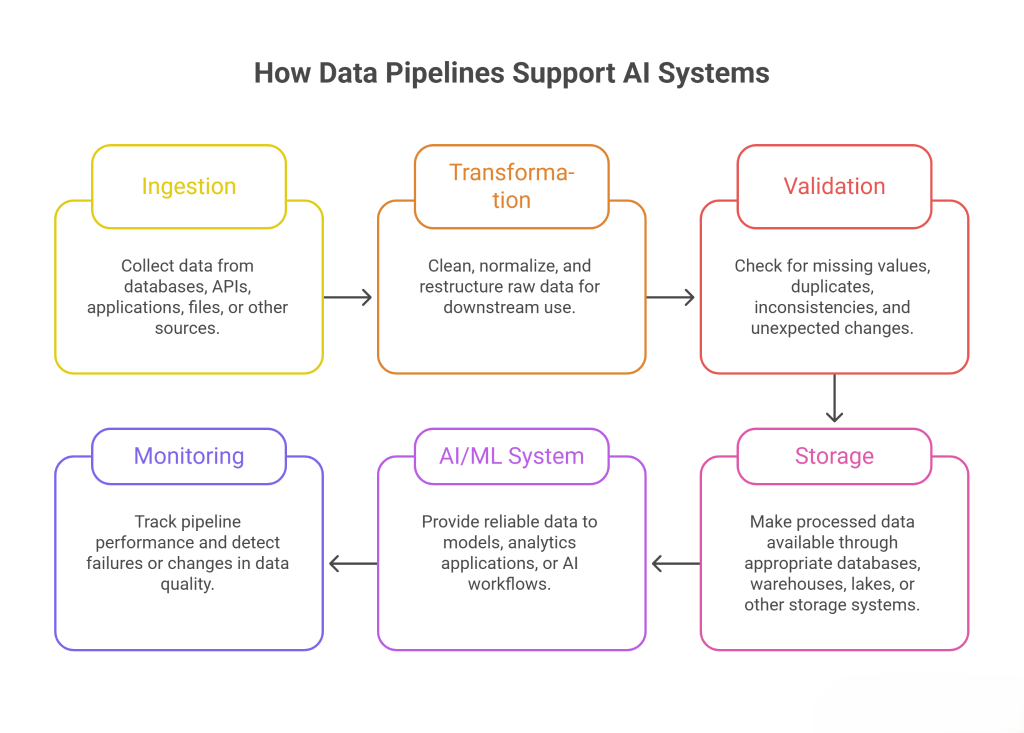
A typical AI data pipeline can follow this flow:
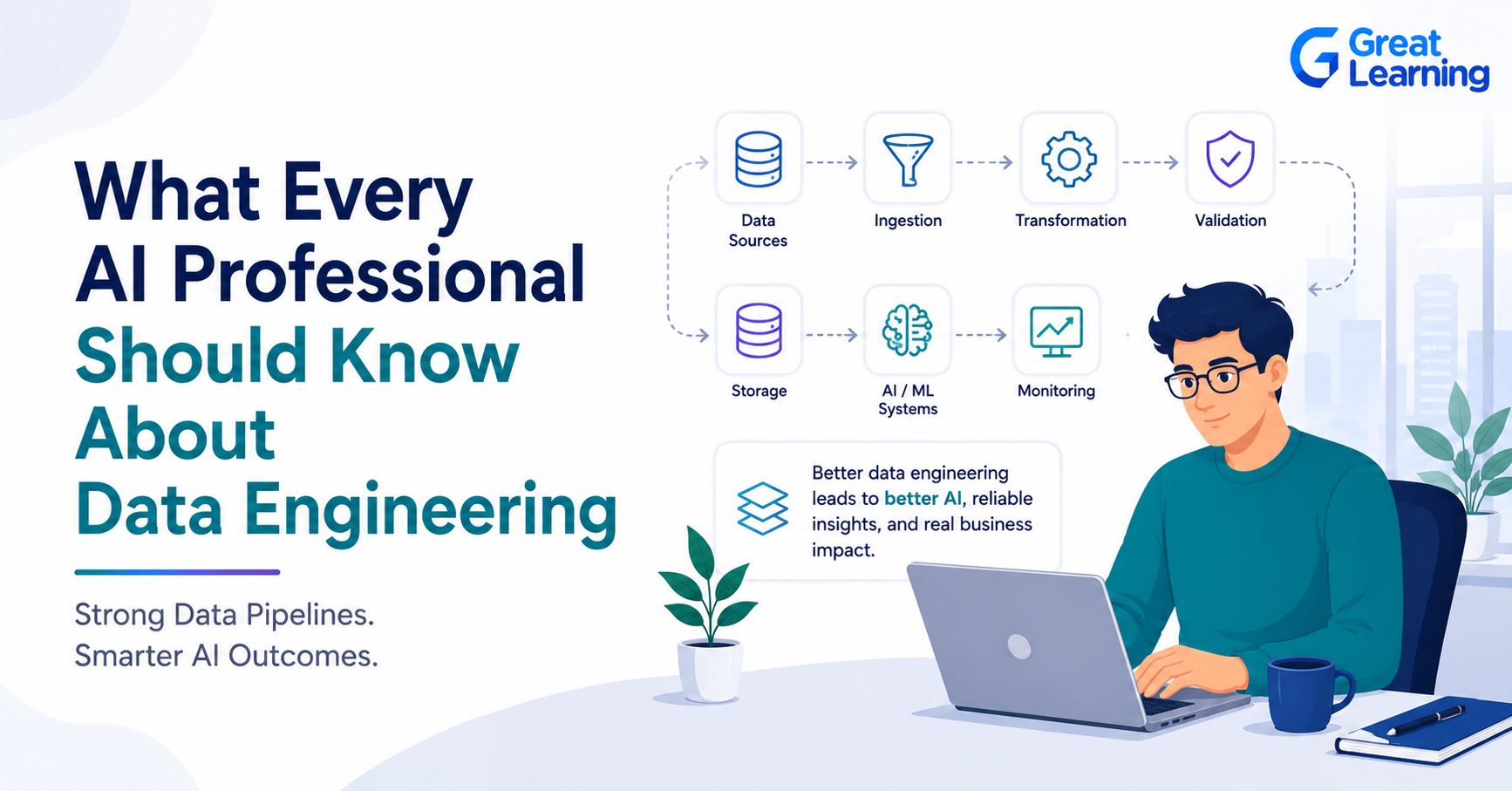
Data Sources → Ingestion → Transformation → Validation → Storage → AI/ML System → Monitoring
Each stage has a specific role:
- Ingestion: Collect data from databases, APIs, applications, files, or other sources.
- Transformation: Clean, normalize, and restructure raw data for downstream use.
- Validation: Check for missing values, duplicates, inconsistencies, and unexpected changes.
- Storage: Make processed data available through appropriate databases, warehouses, lakes, or other storage systems.
- AI/ML system: Provide reliable data to models, analytics applications, or AI workflows.
- Monitoring: Track pipeline performance and detect failures or changes in data quality.
For modern AI applications, the pipeline may also need to handle unstructured data such as documents, images, and text. This becomes particularly important for RAG systems, where data must be prepared before it can be retrieved and supplied as context to an AI model.
The key takeaway is simple: AI models can only work with the data made available to them, making reliable data pipelines a foundational part of production AI.
Why Data Quality Is Critical for AI
Reliable data is essential for building AI systems that produce dependable results. Missing values, duplicates, outdated records, inconsistent formats, and incorrect labels can affect everything from machine learning models to RAG applications.
For AI professionals, data quality should be treated as an ongoing process rather than a one-time cleaning task. A practical quality workflow includes:
Profile → Clean → Validate → Monitor → Update
This becomes even more important for Generative AI and RAG. A RAG system can only retrieve useful context if the underlying documents are properly extracted, structured, indexed, and maintained.
As per Recent research, quality issues in RAG systems tend to show up at four points: extraction (missing or garbled text from source documents), chunking (context split in the wrong place), retrieval (the wrong chunk surfaced), and generation (the model answering from a stale or incomplete chunk).
Data engineering therefore plays a critical role in making AI systems reliable. Strong pipelines should include validation rules, data lineage, monitoring, access controls, and processes for updating stale information.
The principle is simple: better models cannot compensate for unreliable data. AI professionals need to understand how data quality is maintained throughout the AI lifecycle, not just how data is prepared before model development.
Data Engineering for Generative AI and RAG
Generative AI introduces new data engineering requirements because AI applications often need to work with large collections of documents, knowledge bases, and other unstructured data.
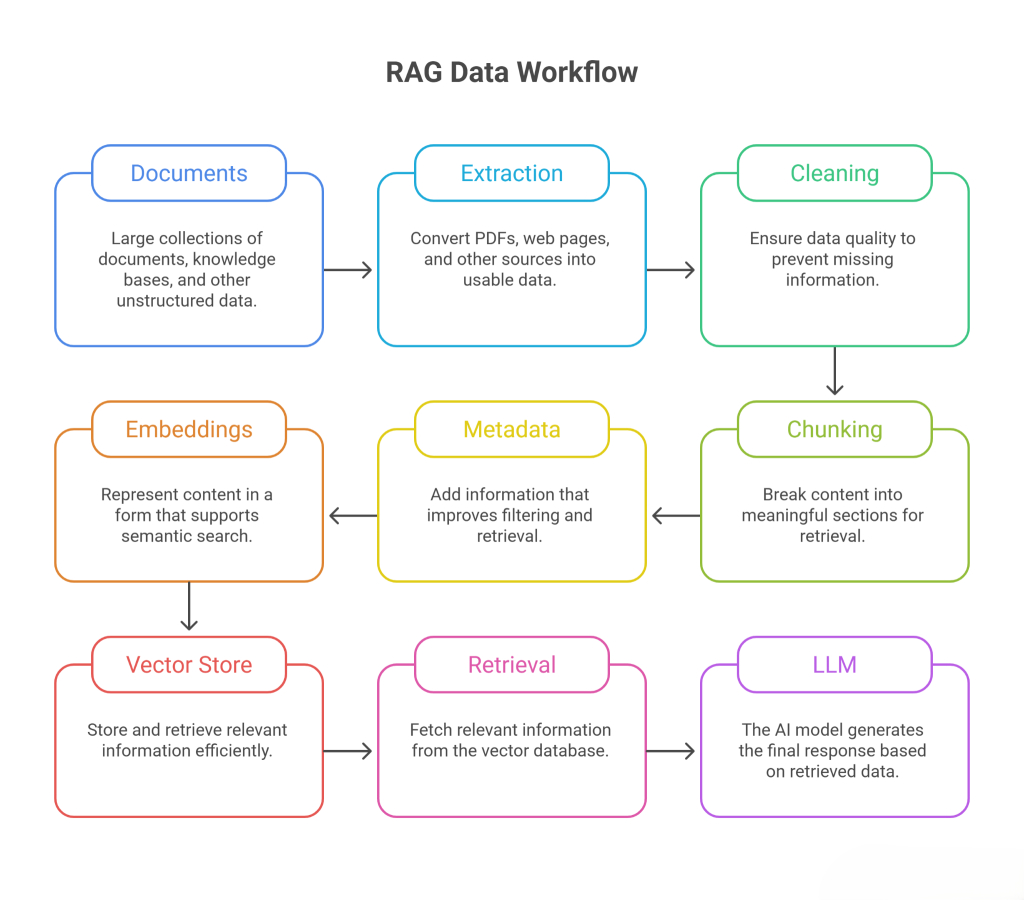
A typical RAG data workflow looks like:
Documents → Extraction → Cleaning → Chunking → Metadata → Embeddings → Vector Store → Retrieval → LLM
Each step affects the quality of the final AI response. Poor document extraction can introduce missing information, weak chunking can reduce retrieval relevance, and outdated source data can lead to stale responses.
Data engineers and AI professionals therefore need to understand areas such as:
- Document processing: Convert PDFs, web pages, and other sources into usable data.
- Chunking: Break content into meaningful sections for retrieval.
- Metadata: Add information that improves filtering and retrieval.
- Embeddings: Represent content in a form that supports semantic search.
- Vector databases: Store and retrieve relevant information efficiently.
- Knowledge-base updates: Keep indexed information up to date.
- Access controls: Ensure AI systems retrieve only authorized information.
This makes RAG partly a data engineering problem. The AI model may generate the final response, but the data pipeline determines what information the model can access and use.
How Data Engineering Supports Agentic AI
Agentic AI systems need more than an LLM and a set of instructions. Agents often need to access business data, retrieve information, call external tools, and use updated context while completing multi-step tasks. That makes the underlying data infrastructure an important part of agentic AI.
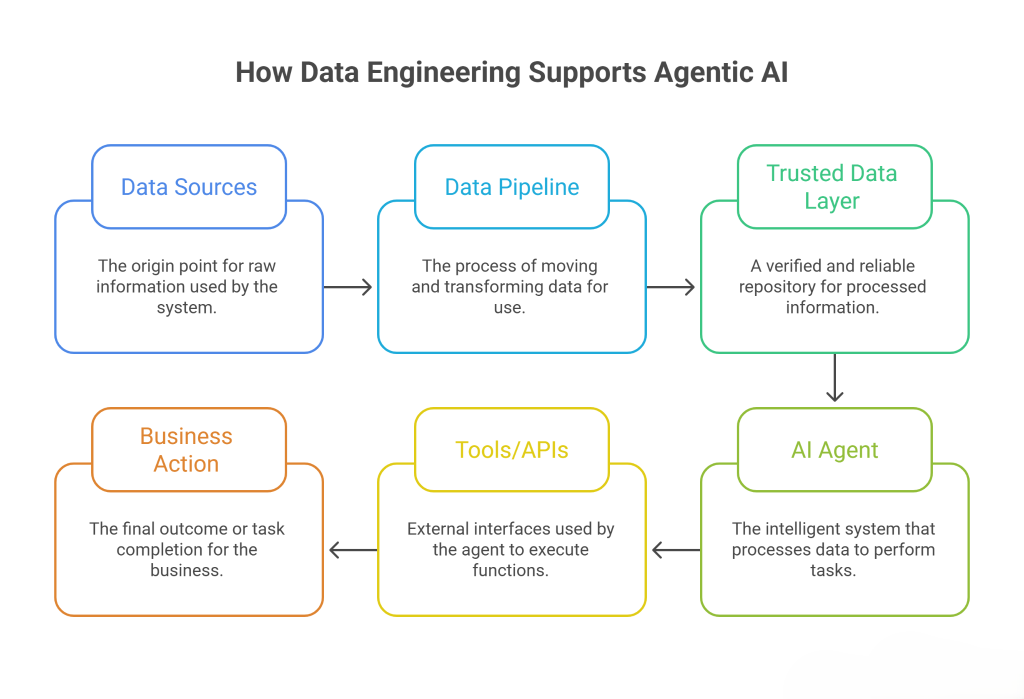
A typical flow might look like:
Data Sources → Data Pipeline → Trusted Data Layer → AI Agent → Tools/APIs → Business Action
For example, an AI agent supporting customer operations could retrieve customer records, access product information, analyze past interactions, and use approved business systems to complete tasks. Each step depends on reliable and appropriately accessible data.
Data engineering supports this by providing:
- Reliable data access for AI agents and applications
- Structured and unstructured data pipelines
- APIs and integrations for connecting systems
- Data freshness for workflows that depend on current information
- Access controls for sensitive business data
- Monitoring and lineage to understand where information comes from
This is why AI professionals increasingly need to understand the connection between data infrastructure, AI models, and AI applications.
MIT Professional Education's AI and Data Science course covers Agentic AI alongside data science, machine learning, and practical business applications, reinforcing this end-to-end perspective.
Data Engineering, MLOps, and AI Engineering: What’s the Difference?
As AI systems move into production, data engineering overlaps with MLOps and AI engineering, but the three disciplines serve different purposes.
| Area | Primary Focus |
| Data Engineering | Build reliable pipelines, data platforms, and infrastructure |
| ML Engineering | Train, deploy, and maintain machine learning models |
| MLOps | Manage the operational lifecycle of ML models and workflows |
| AI Engineering | Build applications and systems powered by AI models |
For example, a data engineer may build the pipeline that prepares customer data, an ML engineer may use that data to train and deploy a prediction model, and an AI engineer may integrate an LLM or RAG system into a customer-facing application.
MLOps provides the practices and infrastructure needed to operate these systems reliably in production.
There is some overlap, particularly in smaller teams. An AI engineer building a RAG application may also create document ingestion and embedding pipelines, while data engineers increasingly work with AI-specific data requirements.
Understanding these boundaries helps AI professionals see where data engineering fits into the broader AI lifecycle—from preparing reliable data to deploying and maintaining production AI systems.
Explore the AI Engineer course by JHU and take the next step toward a career in AI engineering.
Essential Data Engineering Skills for AI Professionals
AI professionals do not need to become specialized data engineers, but they should understand the data systems that support modern AI applications.
The most useful skills span data foundations, pipeline development, AI-specific data preparation, and production practices.
| Skill Area | What to Learn |
| Data Foundations | SQL, Python, databases, data formats |
| Data Pipelines | ETL/ELT, ingestion, transformation, orchestration |
| Data Infrastructure | Warehouses, data lakes, cloud storage, APIs |
| AI Data | Embeddings, vector databases (Pinecone, Weaviate, or pgvector), document processing, RAG |
| Data Quality | Validation, monitoring, lineage, freshness |
| Production | Security, access control, observability, governance |
For professionals working with modern AI, the AI data layer deserves particular attention.
Understanding how documents become searchable knowledge, how data reaches AI agents, and how information is validated can be just as important as understanding the model itself.
The goal is to develop enough data engineering knowledge to build, evaluate, and collaborate on reliable AI systems from data preparation through deployment.
How to Build Data Engineering Skills for an AI Career
AI professionals can build their data engineering knowledge progressively rather than trying to master the entire data stack at once.
A practical progression is:
SQL & Python → Data Systems → Pipelines → Cloud → AI Data Infrastructure → Production AI
Start with SQL, Python, databases, and data formats to understand how data is stored and accessed. Next, learn how ingestion, transformation, orchestration, and validation work together in production pipelines.
Once those foundations are in place, move into cloud data infrastructure, APIs, distributed data processing, and AI-specific data workflows such as document processing, embeddings, vector databases, and RAG.
The final step is understanding how these systems operate in production, including monitoring, security, data governance, and reliability.
For AI professionals, the objective is not to become a data engineer overnight. It is to develop enough data engineering knowledge to understand, build, and improve the data foundations that modern AI systems depend on.
How Data Engineering Supports Reliable AI in Production
Building an AI prototype is only the beginning. Once an AI system is deployed, its underlying data must remain accurate, available, secure, and up to date as business conditions change.
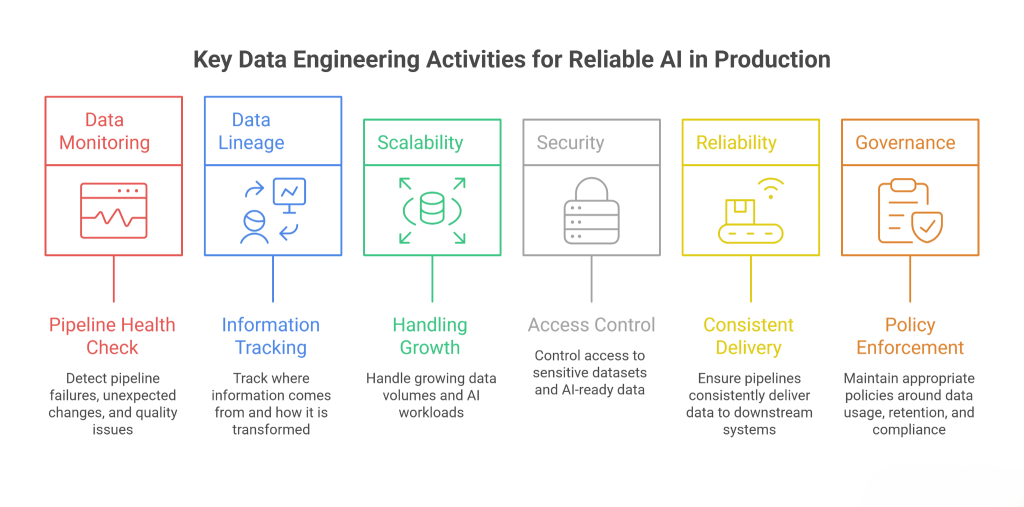
Production-ready data engineering therefore needs to support:
- Data monitoring: Detect pipeline failures, unexpected changes, and quality issues.
- Data lineage: Track where information comes from and how it is transformed.
- Scalability: Handle growing data volumes and AI workloads.
- Security: Control access to sensitive datasets and AI-ready data.
- Reliability: Ensure pipelines consistently deliver data to downstream systems.
- Governance: Maintain appropriate policies around data usage, retention, and compliance.
For example, a RAG application connected to an outdated knowledge base may continue producing responses based on information that is no longer accurate.
A well-designed data pipeline can detect changes, update the underlying knowledge base, and maintain a more reliable source for retrieval.
This is why data engineering for AI extends beyond preparing datasets for model training. It involves maintaining the data infrastructure that keeps AI systems useful and dependable after deployment.
How an AI and Data Science Course Can Build Data Engineering Skills
AI professionals can strengthen their data engineering knowledge through a program that connects data science, machine learning, and modern AI applications rather than treating these areas separately.
The AI and Data Science course by MIT Professional Education covers data science foundations, machine learning, deep learning, Generative AI, RAG, and Agentic AI through practical, hands-on projects. This broader perspective helps professionals understand how data moves from preparation and analysis into AI models and real-world applications.
MIT Professional Education's Data Science Course
Gain the expertise top companies seek and open doors to Data Science jobs.
For professionals building AI careers, the value is in developing an end-to-end understanding of data, models, and AI applications—and how these components work together to create reliable solutions.
Final Thoughts
Data engineering is becoming an essential part of modern AI development. From preparing training data to powering RAG pipelines and Agentic AI workflows, reliable data infrastructure determines how effectively AI systems can perform in real-world environments.
AI professionals do not need to become specialized data engineers, but they should understand how data is collected, transformed, validated, stored, and delivered to AI systems.
This knowledge helps them build more reliable solutions and collaborate effectively across data and engineering teams.
The AI and Data Science course by MIT Professional Education provides a broader foundation across data science, machine learning, Generative AI, RAG, and Agentic AI, supported by hands-on projects and practical business applications.
Frequently Asked Questions
1. Why is data engineering important for AI?
Data engineering provides the pipelines and infrastructure needed to collect, transform, validate, store, and deliver reliable data to AI systems. Without dependable data, even well-designed AI models can produce unreliable results.
2. What data engineering skills do AI professionals need?
AI professionals should understand SQL, Python, databases, ETL/ELT pipelines, data quality, cloud infrastructure, APIs, data governance, and AI-specific data workflows such as embeddings, vector databases, and RAG.
3. How do data pipelines support AI systems?
Data pipelines move information from source systems through ingestion, transformation, validation, and storage before making it available to AI models or applications. They also support monitoring and ongoing data updates.
4. Why is data quality important for AI?
AI systems depend on the quality of their input data. Missing, outdated, duplicated, or inconsistent data can affect model predictions, analytics, RAG retrieval, and AI-generated outputs.
5. What is the difference between data engineering and AI engineering?
Data engineering focuses on building reliable data infrastructure and pipelines, while AI engineering focuses on developing applications and systems powered by AI models. The two roles often overlap when building production AI systems.
6. What data engineering skills are needed for Generative AI and RAG?
Professionals working with Generative AI and RAG should understand document processing, chunking, metadata, embeddings, vector databases, retrieval pipelines, data updates, and access controls. These skills help ensure AI systems can retrieve relevant and reliable information.
7. Can I learn data engineering and AI together?
Yes. A structured program can help professionals build foundational knowledge in data science and machine learning before progressing to Generative AI, RAG, and Agentic AI. The AI and Data Science course by MIT Professional Education follows this broader progression and includes hands-on projects and a capstone project.
8. How long does it take to learn data engineering for AI?
Most professionals move from SQL and Python basics to production-ready AI data skills in 4–6 months of consistent, structured learning, faster with a guided program, and slower when learning alone from scattered resources.
9. Do AI engineers need to know SQL?
Yes. SQL remains the primary way to query, filter, and validate the structured data that feeds most AI and ML pipelines, even in a role focused on models rather than infrastructure.
10. What is the difference between a data lake and a vector database?
A data lake stores raw and processed data in its original form for broad use. A vector database stores numerical embeddings of that data, built specifically for the similarity search that powers RAG retrieval.