
- Why Should MBA Students Learn AI and Data Science?
- 5 AI and Data Science Skills Future Managers Should Learn
- How Can Managers Apply AI and Data Science Skills?
- Do MBA Students Need to Learn Coding for AI and Data Science?
- What Should an MBA Curriculum Include for AI and Data Science?
- How Can AI and Data Science Skills Help Future Managers?
- FAQs About AI and Data Science for MBA Students
AI is changing not only how businesses operate but also the skills employers expect from future managers. In India, AI and data skills are attracting a 20–25% hiring premium, while analytical thinking and problem-solving skills command a 10–15% premium, according to Deloitte India’s 2026 Campus Workforce Trends study of 257 organizations and 505 campuses. The study also found that AI is creating new roles and skill requirements for early-career talent.
For MBA students, this shift means that traditional management skills increasingly need to be complemented by AI literacy, data analysis, and technology-driven decision-making. But future managers do not necessarily need to become data scientists or AI engineers. They need to understand how these technologies work, where they can create business value, and how to use them responsibly.
So, what should future managers learn about AI and data science during an MBA?
Why Should MBA Students Learn AI and Data Science?
AI and data science help managers turn business data into actionable insights, automate routine processes, identify patterns, and make evidence-based decisions.
For future managers, learning these technologies is less about writing complex code and more about understanding how they can be applied to business problems. This includes evaluating AI use cases, interpreting analytical outputs, working with technical teams, and understanding the risks associated with data and AI.
An MBA in AI and Data Science can help learners build this blend of business and technology skills. As AI becomes embedded across functions such as strategy, operations, marketing, and supply chain, managers will increasingly need to connect technology with business objectives.
SRMIST Online MBA in Data Science & AI
Advance your career with SRMIST's UGC-entitled Online MBA in Data Science and Artificial Intelligence. Master machine learning, data visualization, and business analytics to drive data-centric decisions.
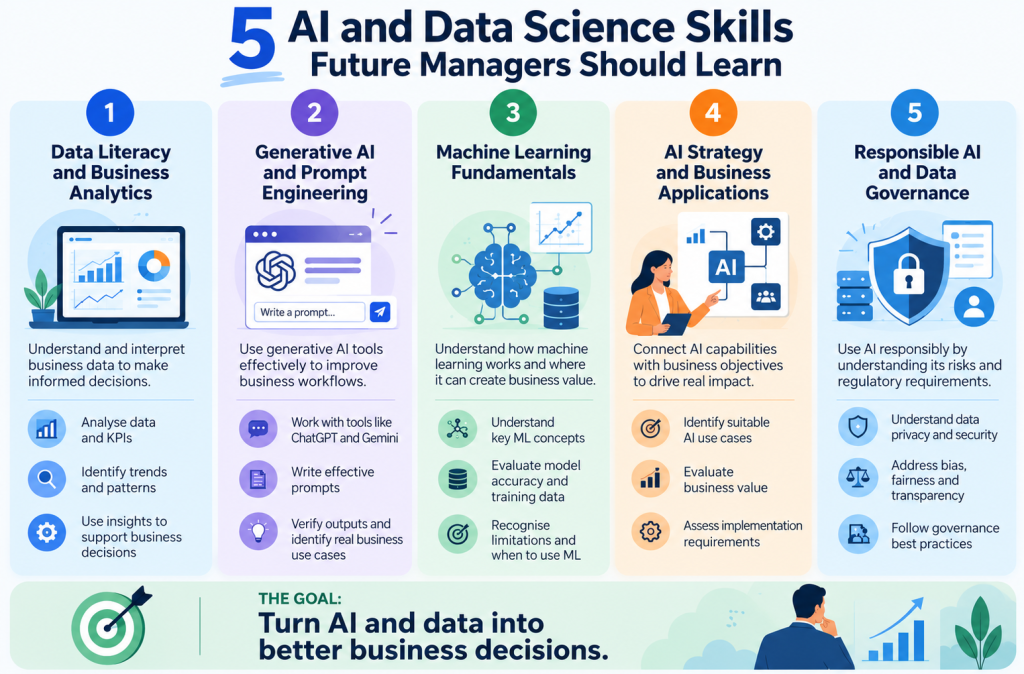
5 AI and Data Science Skills Future Managers Should Learn
1. Data Literacy and Business Analytics
Data literacy is one of the most important skills for managers in data-driven organizations. MBA students should learn how to interpret business data, identify trends, understand key performance indicators (KPIs), and evaluate analytical findings.
They should also develop a basic understanding of descriptive and predictive analytics. This allows managers to ask better questions, assess evidence, and use data to support business decisions rather than relying entirely on intuition.
2. Generative AI and Prompt Engineering
Generative AI is becoming part of everyday business workflows, from research and content creation to customer service and internal knowledge management.
Future managers should understand how tools such as ChatGPT and Gemini can support business tasks. They should also learn how to write effective prompts, verify AI-generated information, identify hallucinations, and protect sensitive business data.
More importantly, managers should be able to identify opportunities to incorporate AI into repeatable workflows instead of treating generative AI as simply a content-generation tool.
3. Machine Learning Fundamentals
Managers do not need to build complex Machine Learning models, but understanding the fundamentals can help them evaluate AI-driven products and projects.
An MBA syllabus can introduce concepts such as supervised and unsupervised learning, predictive modelling, training data, model accuracy, and algorithmic limitations.
This knowledge enables managers to have more informed conversations with data science teams and assess whether Machine Learning is appropriate for a particular business problem.
4. AI Strategy and Business Applications
Technical knowledge becomes more valuable when managers can connect it to business objectives.
Future managers should learn how to identify suitable AI use cases, evaluate potential business value, assess implementation requirements, and measure the outcomes of AI initiatives.
For example, a manager could evaluate whether AI can improve demand forecasting, customer segmentation, fraud detection, employee analytics, or process automation.
This strategic perspective is particularly relevant in India, where Deloitte found that at-scale AI deployment is strongest in areas such as product development, strategy and operations, marketing and sales, and supply chain.
5. Responsible AI and Data Governance
As organisations use AI to support increasingly important decisions, managers also need to understand its risks.
MBA students should learn the fundamentals of data privacy, security, bias, fairness, transparency, AI governance, and human oversight. These considerations are particularly important when AI systems process customer, employee, financial, or other sensitive business data.
Responsible AI knowledge helps managers balance innovation with ethical, regulatory, and operational requirements.
How Can Managers Apply AI and Data Science Skills?
AI and Data Science skills can be applied across almost every business function:
- Marketing: Customer segmentation, campaign analysis, and personalization
- Finance: Forecasting, anomaly detection, and financial analysis
- Human Resources: Workforce analytics and AI-assisted resume screening
- Operations: Demand forecasting, process optimization, and automation
- Sales: Lead scoring, customer insights, and sales forecasting
The objective is not simply to use more AI tools. Managers need to identify where AI or analytics can solve a genuine business problem and produce measurable outcomes.
Do MBA Students Need to Learn Coding for AI and Data Science?
No, advanced programming skills are not essential for most future managers.
Managers primarily need to understand AI concepts, interpret data, evaluate analytical outputs, and connect technology to business objectives. However, basic knowledge of SQL, Python, Excel, Power BI, or Tableau can be valuable, particularly for managers working closely with analytics or technology teams.
The depth of technical learning should depend on the individual's role and career goals. A broader management program such as an online MBA degree can help learners build the business and managerial foundation needed to apply technology skills effectively. A future product manager, for example, may benefit from a different level of technical knowledge than a manager leading a data science team.
Advance your career with SRMIST's UGC-entitled Online MBA. Choose from 11 industry-focused specializations including Finance, Marketing, HR, AI & Data Science, Healthcare & Hospital Management and more.
What Should an MBA Curriculum Include for AI and Data Science?
An MBA curriculum designed for an AI-driven workplace should combine management knowledge with practical technology skills. Key areas can include:
- Business analytics and data literacy
- AI and Machine Learning fundamentals
- Generative AI and AI-assisted workflows
- Data visualisation and storytelling
- Predictive analytics
- AI strategy and implementation
- Responsible AI and data governance
- Hands-on projects based on real business problems
Practical projects are particularly valuable because they help MBA students move from understanding AI concepts to applying them to real business situations.
How Can AI and Data Science Skills Help Future Managers?
AI and data science skills can help future managers make evidence-based decisions, identify business opportunities, improve operational efficiency, evaluate technology investments, and lead AI adoption within their organizations.
The goal is not for every manager to become a technical specialist. Instead, future managers need enough AI and data fluency to understand opportunities, ask the right questions, collaborate with technical teams, and make responsible business decisions.
FAQs About AI and Data Science for MBA Students
What AI skills should MBA students learn?
MBA students should learn generative AI, AI and Machine Learning fundamentals, prompt engineering, data analytics, AI strategy, and responsible AI. The focus should be on applying these skills to business problems rather than developing highly technical AI models.
Is Data Science useful for MBA students?
Yes. Data science and analytics help MBA students understand business data, identify patterns, evaluate forecasts, and make evidence-based decisions across functions such as marketing, finance, operations, and HR.
Do I need Python to learn AI during an MBA?
Not necessarily. Most future managers do not need advanced Python skills. However, basic programming or SQL knowledge can be useful for professionals who want to work more closely with data science and technology teams.
How can AI help future managers make better decisions?
AI can help managers analyse large datasets, identify patterns, generate forecasts, automate repetitive tasks, and provide decision-support insights. Managers still need to validate AI outputs and apply business judgment before making important decisions.