
- Why AI Skills Differ Across Roles
- What Skills Do AI Engineers Need?
- What Skills Do Data Scientists and Machine Learning Engineers Need?
- What AI Skills Do Data and Business Analysts Need?
- What AI Skills Do Product Managers Need?
- What AI Skills Do Business Leaders Need?
- What AI Skills Do Marketing Professionals Need?
- How the Texas McCombs PG Program in AI & ML Builds These Skills
- Final Thoughts
- Frequently Asked Questions
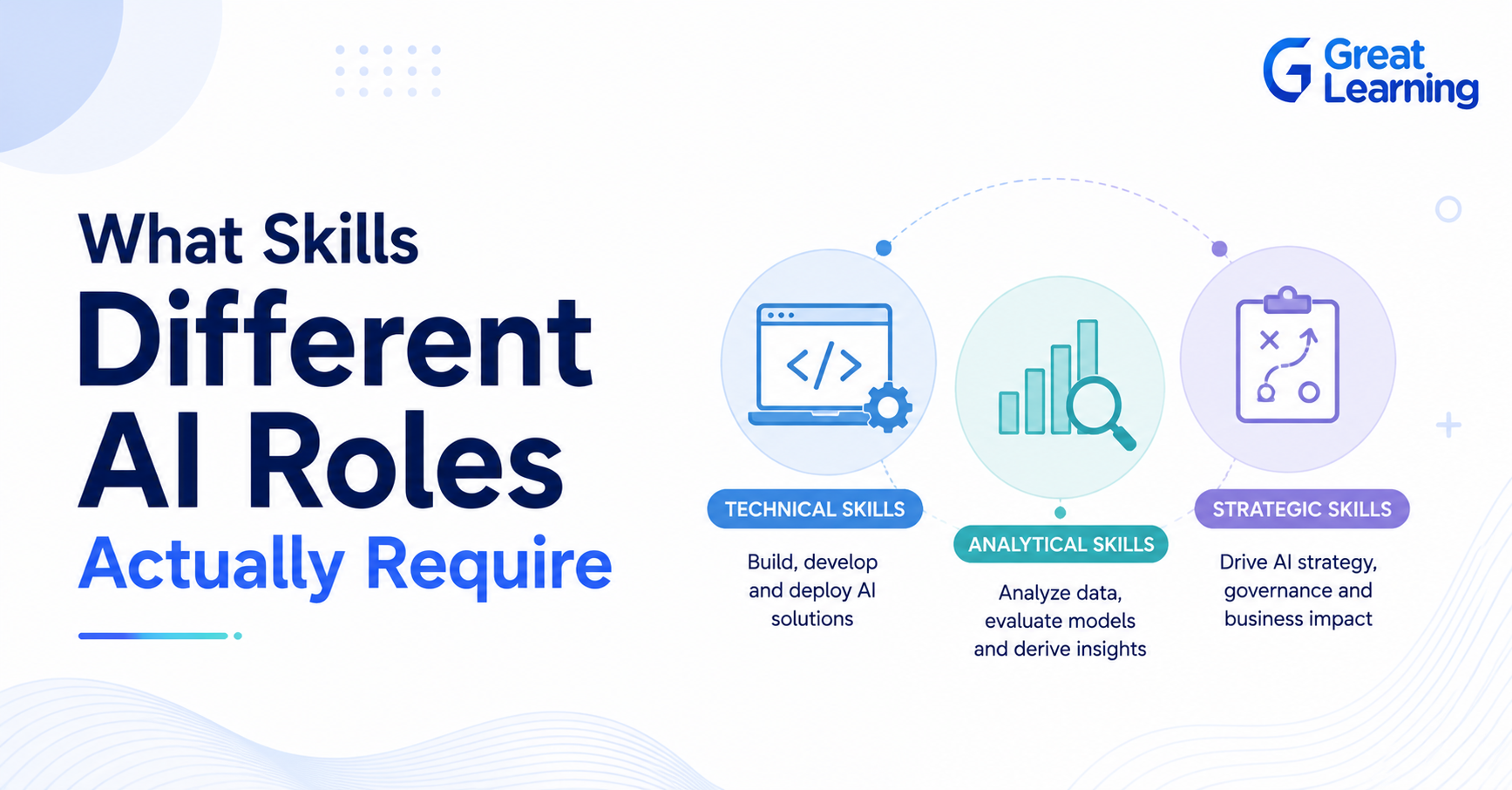
AI skills fall into three broad categories: technical (programming, model building, deployment), analytical (data interpretation, evaluation), and strategic (adoption, governance, business decision-making).
Which category matters most to you depends entirely on your role, this guide breaks down the specific skills for engineers, analysts, product managers, marketers, and business leaders.
An AI engineer may need programming, machine learning, and model deployment skills, while a business leader may need to understand AI strategy, governance, and business impact.
Similarly, analysts and marketing professionals may benefit more from AI-assisted analytics, Generative AI, and automation.
This makes it important to understand which AI skills matter for each role, rather than trying to learn every available AI technology.
The right approach, therefore, is to connect AI skills with actual job responsibilities and build the technical, analytical, or strategic capabilities needed to apply AI effectively.
Why AI Skills Differ Across Roles
AI is no longer limited to professionals who build machine learning models. Organizations are using it across software development, data analysis, customer research, marketing, product development, operations, and strategic decision-making.
As a result, AI skills for different roles vary depending on what professionals are expected to accomplish. An engineer may need to build and deploy an AI system, while a product manager may need to evaluate whether that system solves a genuine customer problem.
The 2026 PwC Global AI Jobs Barometer, which analyzed more than one billion job postings across six continents, found that the skills required for the most AI-exposed jobs are changing more than twice as fast as those required for the least AI-exposed roles.
This shows why AI learning needs to be role-specific. Professionals need to develop the technical, analytical, or strategic AI skills that match how they actually use AI in their work.
AI skills can broadly fall into three categories:
- Technical AI skills: Programming, machine learning, deep learning, model development, and deployment.
- Analytical AI skills: Data analysis, statistics, interpretation, evaluation, and problem-solving.
- Strategic AI skills: AI adoption, product strategy, governance, risk management, and business decision-making.
Understanding these differences helps professionals focus their learning on the skills that are most relevant to their careers.
What Skills Do AI Engineers Need?
AI engineers need a strong combination of software engineering and AI expertise because their work typically involves turning AI capabilities into usable applications and systems.
The role can include building AI-powered applications, integrating models with APIs and tools, evaluating outputs, and supporting deployment.
Key skills include:
- Python and software development
- Machine learning and deep learning fundamentals
- Generative AI and large language models
- RAG and Agentic AI
- APIs and AI frameworks
- Model evaluation and testing
- Deployment and MLOps
- Responsible AI and security
The emphasis is on being able to build, integrate, evaluate, and deploy AI systems, rather than simply understanding how AI models work.
Current 2026 role analyses also distinguish AI engineering from data science by placing greater emphasis on production systems, LLM integration, and system-level implementation.
What Skills Do Data Scientists and Machine Learning Engineers Need?
Data scientists and machine learning engineers often work with similar technologies, but their responsibilities are different.
Data scientists generally focus more on understanding data, finding patterns, building models, and translating results into business insights, while machine learning engineers focus more on turning models into reliable production systems.
Data Scientists
Data scientists typically need:
- Statistics and probability
- Python and SQL
- Data analysis and Data visualization
- Exploratory data analysis
- Feature engineering
- Machine learning
- Predictive modeling
- Model evaluation
- Business and communication skills
Their role is often to translate a business problem into an analytical or modeling problem and determine what the data can reveal.
Machine Learning Engineers
Machine learning engineers typically need:
- Machine learning algorithms
- Deep learning
- Python and software engineering
- Model optimization
- Deployment
- MLOps
- Cloud and infrastructure
- Model monitoring
The distinction can be summarized simply:
Data Scientist → Data, analysis, modeling, and insights
ML Engineer → Productionizing, deploying, and scaling ML systems
This difference matters when choosing which AI skills to develop. A professional interested in statistical analysis and business problem-solving may need a different learning path from someone who wants to build and maintain production ML systems.
What AI Skills Do Data and Business Analysts Need?
Data and business analysts do not necessarily need to build complex AI models. Their focus is more often on using data, AI tools, and analytical methods to answer business questions and support better decisions.
Important skills include:
- Data analysis and visualization
- SQL and Python fundamentals
- Statistical reasoning
- Generative AI and prompting
- AI-assisted analytics
- Predictive analytics
- Interpreting AI-generated insights
- Identifying useful AI applications
- Communicating findings to stakeholders
- Understanding AI limitations and potential errors
For example, an analyst could use Generative AI to explore a dataset, identify potential trends, or speed up reporting, but still needs the analytical judgment to verify whether the result is accurate and meaningful.
InterviewStack’s recent 2026 job-posting analysis also shows this shift. An analysis of 3,891 data analyst postings found that 18.7% mentioned some form of AI, while 6.9% explicitly required newer AI skills such as Generative AI, LLMs, or AI agents.
The key skill is therefore not simply knowing how to use an AI tool. Analysts need to understand how to combine AI with data, validate its outputs, and translate the results into actionable business insights.
What AI Skills Do Product Managers Need?
Product managers need enough AI knowledge to determine where AI can create value, what is technically feasible, and how an AI-powered product should be evaluated.
They do not necessarily need to build models themselves, but they need enough technical understanding to work effectively with engineering and data teams.
Important skills include:
- AI and machine learning fundamentals
- Identifying practical AI use cases
- AI product strategy
- Understanding model capabilities and limitations
- Evaluating AI outputs and user experience
- Working with data and AI teams
- Responsible AI and governance
- Measuring product and business impact
For example, a product manager developing an AI-powered customer-support feature needs to understand not only how the system works, but also whether its responses are accurate, useful, safe, and aligned with customer needs.
This is becoming an important shift in the product role. Productboard's 2026 research found that 96% of product teams use AI consistently, while 53% of product professionals identified systems-level thinking as an essential skill in the AI era.
The goal is therefore not to turn every product manager into an AI engineer. It is to develop enough AI product knowledge, technical judgment, and evaluation skills to make informed decisions throughout the product lifecycle.
What AI Skills Do Business Leaders Need?
Business leaders need a different combination of AI skills from technical specialists. Their focus is less on building models and more on understanding AI opportunities, evaluating risks, guiding adoption, and connecting AI investments with business outcomes.
Key skills include:
- AI fundamentals and literacy
- Identifying high-value AI use cases
- AI strategy and adoption
- Understanding AI capabilities and limitations
- AI governance and risk management
- Evaluating AI investments and ROI
- Change management
- Responsible AI
- Strategic decision-making
For example, a business leader evaluating an AI customer-service system needs to determine whether it can improve service quality, what risks it introduces, how it should be governed, and whether the expected business value justifies the investment.
This need for leadership-level AI capability is becoming more important as organizations move from experimentation toward broader deployment.
KPMG's 2026 Global AI Pulse, based on more than 2,100 senior leaders across 20 countries, highlights accountability, governance, AI economics, and visibility into AI costs and outcomes as increasingly important as organizations scale AI.
The goal is therefore not to turn every business leader into a data scientist. It is to develop enough AI literacy, strategic judgment, and governance knowledge to make informed decisions about where AI should be used and how it should be managed.
What AI Skills Do Marketing Professionals Need?
Marketing professionals increasingly need a combination of AI fluency, data skills, and strategic judgment.
Rather than becoming AI engineers, they need to understand how AI can improve research, content creation, personalization, campaign analysis, and customer engagement.
Key skills include:
- Generative AI and prompting
- AI-assisted customer and market research
- Content and workflow automation
- Marketing analytics and data interpretation
- Personalization
- AI use-case identification
- Quality control and evaluation
- Responsible AI and data privacy
- Strategic thinking and communication
The shift is already visible in the marketing workforce. The American Marketing Association's 2026 State of Marketing Careers Report found that AI ranked as the most important skill marketers expect to need over the next five years, while also highlighting adaptability, strategic thinking, decision-making, and AI fluency as important capabilities.
For marketing professionals, the goal is therefore not simply to learn more AI tools. It is to combine AI fluency with marketing expertise and human judgment to improve business outcomes.
How the Texas McCombs PG Program in AI & ML Builds These Skills
Professionals looking to build a broader AI skill set can benefit from a structured program that combines technical foundations with practical business applications.
The Artificial Intelligence course by Texas McCombs covers Python, machine learning, deep learning, NLP, computer vision, Generative AI, Agentic AI, model evaluation, and AI deployment.
Post Graduate Program in AI & Machine Learning: Business Applications
Master in-demand AI and machine learning skills with this executive-level AI course—designed to transform professionals into strategic tech leaders.
The program also emphasizes hands-on learning through projects, case studies, and 30+ AI tools, helping learners apply AI and ML techniques to practical business problems.
This breadth can be useful for professionals at different stages of their AI journey.
Technical professionals can build deeper expertise in AI and ML, while product, technology, and business professionals can develop the technical understanding needed to evaluate and apply AI solutions.
The program specifically lists product and tech enablement professionals and business leaders among its target learners.
The focus is therefore not just on learning individual AI tools. It is on developing practical AI capability, technical understanding, and strategic judgment that professionals can apply to real-world problems.
Final Thoughts
AI skills are no longer limited to professionals who build machine learning models. The right skills depend on the role, responsibilities, and level of AI involvement.
AI engineers need technical depth, data scientists need strong analytical and modeling skills, while analysts, product managers, marketing professionals, and business leaders need skills that help them apply, evaluate, and manage AI effectively.
The key is to focus on role-relevant capabilities rather than trying to master every AI technology.
The Artificial Intelligence course by Texas McCombs can help professionals build a broader foundation across AI, machine learning, Generative AI, Agentic AI, evaluation, and deployment while applying these concepts to practical business problems.
Ultimately, the most valuable AI skill set is one that connects technical knowledge with practical application and sound professional judgment.
Frequently Asked Questions
1. What AI skills are most important for professionals?
The most important AI skills depend on the role. Technical professionals may need programming, machine learning, and model deployment, while business professionals may benefit more from AI literacy, analytics, Generative AI, evaluation, and strategic decision-making.
2. What skills do AI engineers need?
AI engineers typically need Python, machine learning, deep learning, Generative AI, LLMs, RAG, Agentic AI, APIs, model evaluation, deployment, and MLOps skills.
3. What skills do data scientists need?
Data scientists generally need statistics, Python, data analysis, exploratory data analysis, feature engineering, machine learning, predictive modeling, model evaluation, and business communication skills.
4. What AI skills should business analysts learn?
Business analysts can benefit from data analysis, statistical reasoning, AI-assisted analytics, Generative AI, prompting, data visualization, and the ability to evaluate and communicate AI-generated insights.
5. What AI skills do business leaders need?
Business leaders need AI literacy, AI strategy, use-case identification, governance, risk management, responsible AI, change management, and the ability to evaluate AI investments and business impact.
6. What AI skills do marketing professionals need?
Marketing professionals can benefit from Generative AI, prompting, AI-assisted research, content workflows, personalization, marketing analytics, automation, and responsible AI practices.
7. Can non-technical professionals build AI skills?
Yes. Non-technical professionals do not necessarily need advanced programming or machine learning expertise. They can focus on understanding AI fundamentals, using relevant AI tools, evaluating outputs, identifying useful applications, and connecting AI capabilities with their professional responsibilities.
8. How can professionals build the right AI skill set?
Start by identifying your target role and current skill gaps. Then build the AI fundamentals relevant to that role, practice through real-world projects, and develop the ability to evaluate and apply AI effectively.
9. Which AI course can help professionals build role-relevant AI skills?
The Artificial Intelligence course by Texas McCombs covers AI and machine learning foundations along with Generative AI, Agentic AI, model evaluation, deployment, and other practical applications. It can help professionals develop a broader understanding of AI and apply these capabilities to real-world business problems.