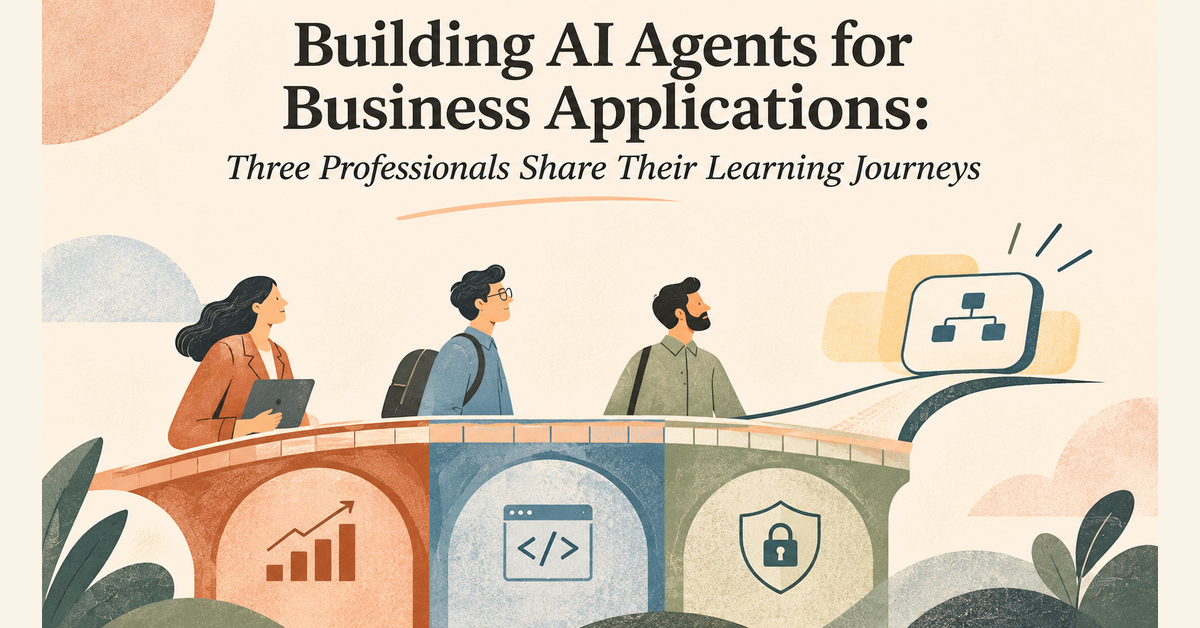
Businesses are moving beyond using Generative AI to answer questions towards building AI agents that can reason, use tools, and execute multi-step tasks. Yet making these systems work reliably at an enterprise scale remains a challenge. Capgemini's World Cloud Report for Financial Services 2027, published in November 2026, found that 59% of financial institutions were piloting or deploying multi-agent AI, but only 10% had achieved enterprise-wide orchestration. The disparity highlights a growing need for professionals who can bridge the gap between AI development and its practical application within organizations.
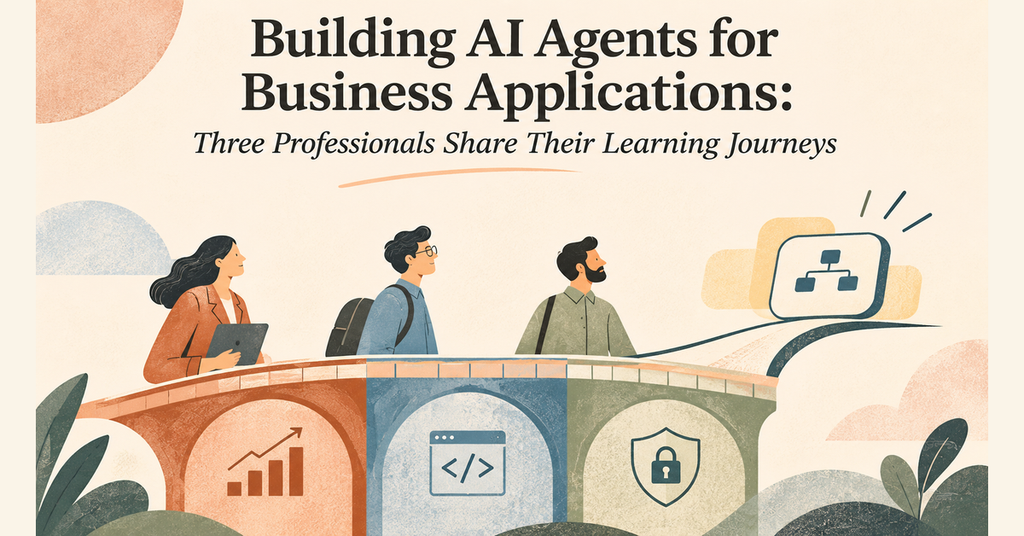
The Post Graduate Program in AI Agents for Business Applications by McCombs School of Business at The University of Texas at Austin addresses this evolving need through practical learning in AI agent development and business applications. The experiences of three learners illustrate how professionals from different backgrounds are building capabilities in this field, from applying domain knowledge to designing agentic workflows and addressing the security considerations of autonomous systems.
PG Program in AI Agents for Business Applications
This program focuses on applying Agentic AI to solve business problems, improve operational efficiency, and drive innovation. Learn to build AI agents using Generative AI, Large Language Models, and other advanced tools.
1. Can You Build AI Agents Without Prior Coding Knowledge?
For Ngang Vadex Ngang, a General Manager in Cameroon's finance, insurance, and banking services sector, learning to build AI agents meant stepping into an unfamiliar technical field. Coming from a non-IT background with no prior coding knowledge, he joined the program to understand how AI applications are developed and put into practice.
Through the program, he explored large language models (LLMs), retrieval-augmented generation (RAG), and AI agents, progressing towards building functional applications through practical projects.
Reflecting on this shift, Ngang said:
"From having zero coding knowledge to building functional AI agents, this journey has been a complete career pivot."
He further described his progress:
"In just 12 weeks, I transformed from a novice into a practical technical practitioner."
Professionals with deep domain knowledge understand the challenges, workflows, and decisions within their industries. This expertise puts them in a strong position to identify where AI agents can address real business problems and develop solutions that are relevant to their fields. By building technical skills alongside their existing knowledge, they can translate industry-specific challenges into practical AI applications.
2. What Does It Take to Design AI Agents for Complex Business Workflows?
Designing AI agents for complex business workflows requires an understanding of how different components work together to help agents plan tasks, retain context, interact with tools, and execute actions. For enterprise applications, these capabilities also influence how reliably and efficiently an agent can handle multi-step processes.
For Somil Rastogi, a Principal Solutions Architect at SAS Institute, one of the key takeaways from the program was understanding the transition from Generative AI to agentic workflows. He gained hands-on experience with orchestration frameworks such as ReAct (Reasoning and Acting) and Plan-and-Execute.
Reflecting on this learning, he highlighted the importance of understanding how to:
"manage the 'brain' of an AI agent—through memory management, tool integration, and LLM orchestration"
These concepts helped him understand the mechanisms behind building "reliable, scalable, and self-correcting AI systems."
His learning covered several technical areas:
- ReAct and Plan-and-Execute frameworks: Approaches to structuring agent reasoning and task execution.
- Memory management: Managing context within agent workflows.
- Tool integration: Enabling agents to interact with external tools and systems.
- LLM orchestration: Coordinating the components that power an agent's workflow.
Together, these capabilities help determine how an AI agent manages complex tasks and responds to changing requirements, making orchestration an important consideration when designing AI systems for business applications.
3. How Can Organizations Keep Autonomous AI Agents Under Control?
As AI agents gain the ability to access information, use tools, and execute tasks autonomously, organizations need safeguards to ensure their actions remain within defined boundaries. This involves establishing governance frameworks, managing agent identities and access permissions, setting guardrails, and retaining human oversight for critical decisions.
Reid Wisa, a Chief Information Security Officer who completed the program, explored this challenge from a cybersecurity perspective. He described the shift from static automation to autonomous systems as:
"a pivotal moment in enterprise architecture."
He highlighted the potential of specialized agents within an Autonomous Security Operations Center (SOC), where they could:
- Detect and correlate potential security threats.
- Investigate suspicious activity.
- Support threat containment.
However, enabling these capabilities requires careful security design. Reid emphasized the importance of governance frameworks, identity controls, and guardrail architectures when deploying AI agents in complex enterprise environments.
His perspective highlights that greater autonomy must be accompanied by stronger safeguards. Organizations need to define what agents can access, which actions they can perform independently, and where human intervention is necessary.
From a Working Agent to a Dependable Business System
Building an AI agent is only the first step. The real challenge lies in making it useful and dependable in an enterprise environment. An agent must address a genuine business need, perform tasks reliably, and operate within clearly defined boundaries.
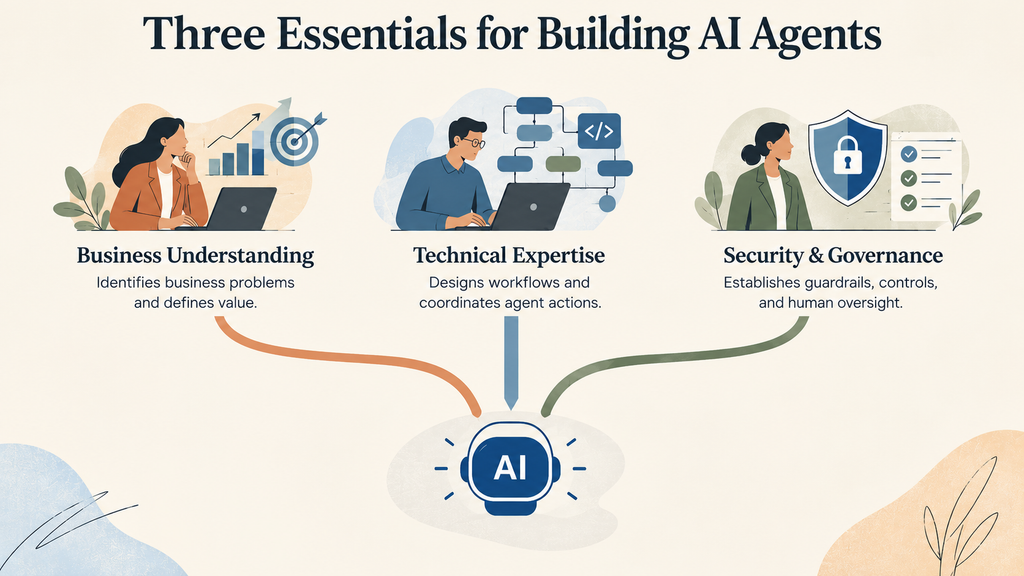
The experiences of these three professionals highlight why moving from experimentation to enterprise adoption requires a broader understanding of AI. Technical knowledge alone is not enough; professionals must also consider the business context in which an agent operates and the implications of giving AI systems greater autonomy.
Ultimately, the goal is not simply to build agents that can perform tasks, but to develop systems that organizations can use with confidence.